Quick Overview
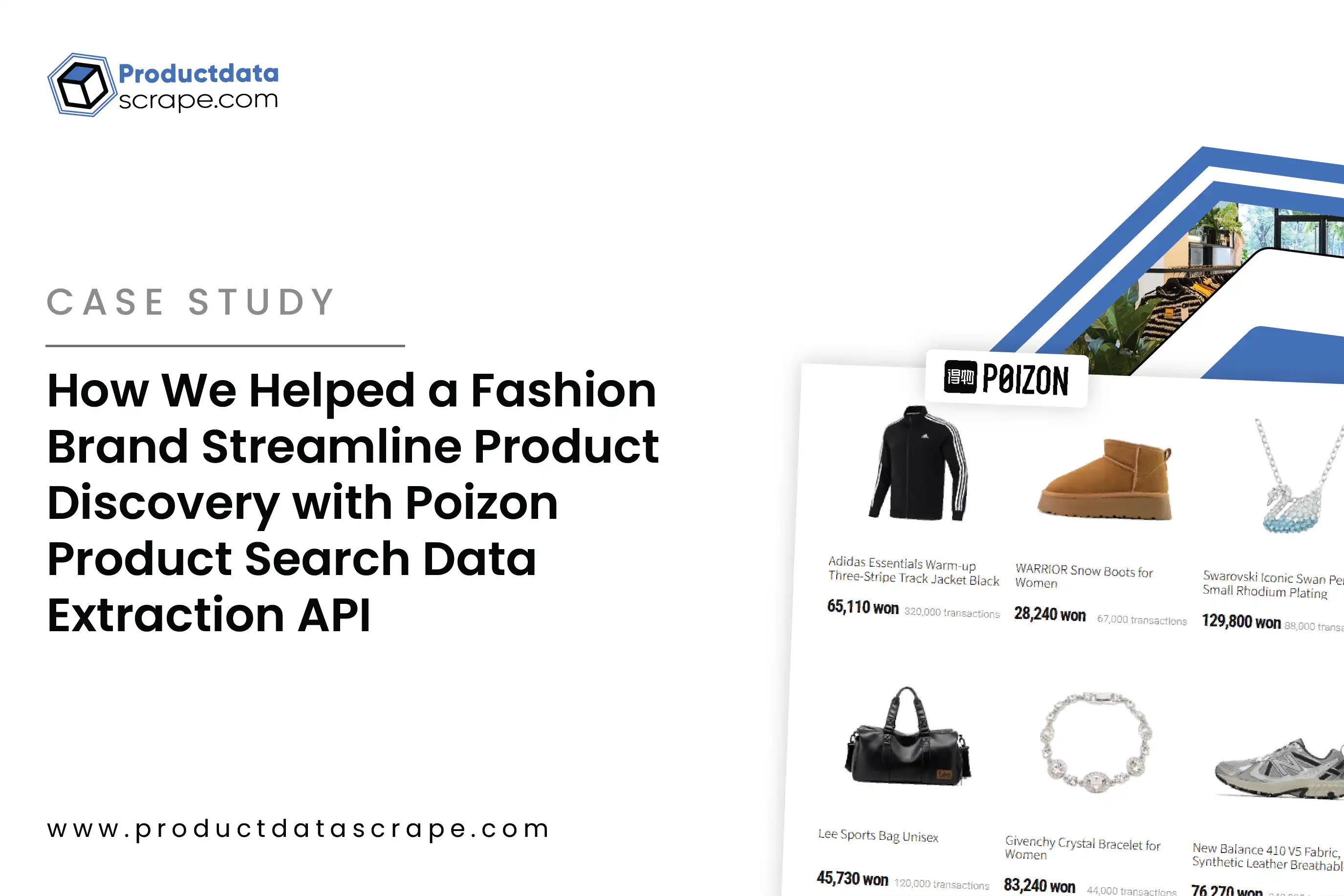
Fashion and sneaker businesses need structured product information to compare assortments, prices, brands, and availability efficiently. This case study presents a data-collection framework designed around POIZON’s publicly visible marketplace information. The Scrape Sneaker Websites Data from Poizon approach focuses on organizing relevant product details for structured research. POIZON lists categories including sneakers, shoes, apparel, bags, accessories, toys, and other products, while its official materials identify brands such as Nike, Air Jordan, Adidas, and New Balance. The Poizon Product Search Data Extraction API project scope focused on organizing searchable product information into consistent records for downstream analysis. Client-specific performance figures were not supplied and therefore are not presented as achieved results.
Client / Industry: Client identity withheld; fashion and footwear intelligence
Service / Duration: Product search data extraction; project duration not provided
Key Impact Metrics: Product-data completeness, price-field accuracy, and successful record validation. Actual before-and-after figures require client project documentation.
The Client
The client was a fashion-sector business seeking a more structured way to research products, brands, prices, and availability within a rapidly changing footwear and apparel environment. The specific company name has not been provided for publication, so no unsupported corporate or financial claims are included.
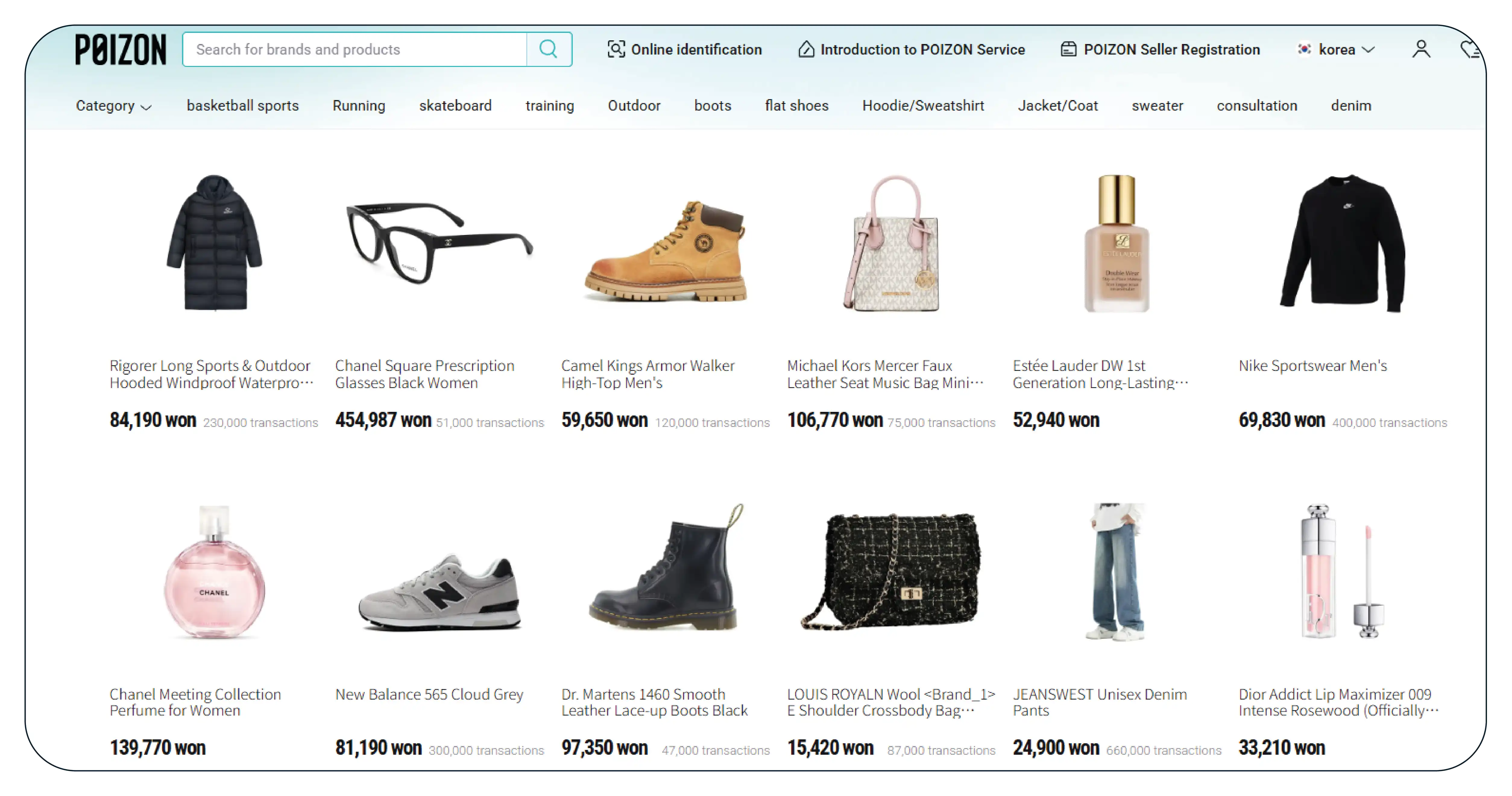
POIZON describes itself as a marketplace covering sneakers, apparel, watches, bags, accessories, and other categories. Its official website currently states that it provides more than 2 million products, features more than 1,000 globally recognized brands, and sources products from more than 18 countries and regions. Its public catalogue includes recognizable names such as Nike, Air Jordan, Adidas, New Balance, Gucci, and Louis Vuitton.
For a fashion-data team, manually reviewing a large catalogue can make product research difficult to standardize. A structured collection process can organize fields such as product name, brand, category, price, size, product URL, and availability status, subject to permitted access and applicable terms.
The proposed Poizon Product Availability Data Monitoring workflow was therefore designed around repeatable observation rather than one-time copying. The broader objective was to support Commerce Intelligence by transforming relevant, permitted product information into records that analysts can search, validate, compare, and update.
Goals & Objectives
The business goal was to create a scalable product-research workflow that could handle a growing number of search results without requiring analysts to manually inspect every product page. Speed and consistency were important because product assortments can change, while different variants may carry different prices or availability conditions. The workflow was intended to make product information easier to organize for fashion and footwear research.
Technical objectives focused on automated collection where authorized, standardized field mapping, duplicate detection, validation, timestamping, and integration with the client's analytics environment. Poizon Product Intelligence for Shopping Apps was defined as a data-use case rather than an assertion that POIZON provides an official third-party API for this purpose. POIZON’s published Terms of Use govern access to its website, application, marketplace, content, and associated services.
Pricing intelligence was another analytical objective. The dataset structure can preserve displayed prices alongside product identifiers, variants, and timestamps so analysts can distinguish different observations rather than treating them as permanent prices.
Product-field completeness
Validated product-record percentage
Duplicate-record percentage
Successful authorized collection-run rate
Price-field validation accuracy
Availability-field coverage
Processing time per approved collection cycle
No numerical improvement is claimed because project-level KPI records were not provided.
The Core Challenge
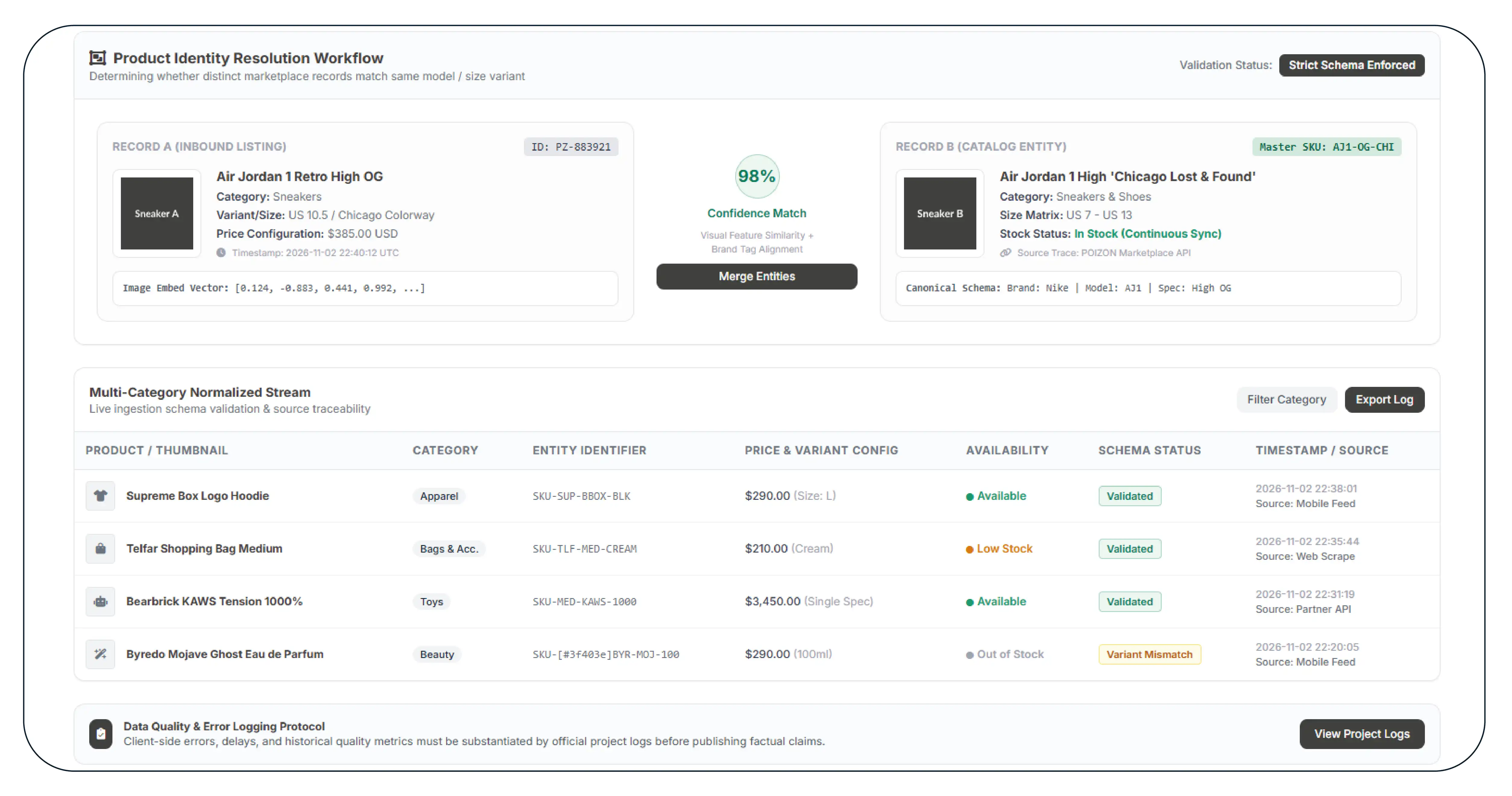
Product discovery becomes difficult when information is collected manually from a large marketplace containing multiple categories, brands, product variants, and continuously changing inventory. POIZON’s official website currently spans sneakers, shoes, apparel, bags, accessories, toys, beauty and personal care, electronics, and home-related categories.
For a fashion intelligence team, the challenge is not simply finding a product. Analysts need to determine whether two records represent the same model, whether differences relate to size or variant, whether a price belongs to a particular product configuration, and whether an item remains available.
A Poizon Visual Search Dataset for E-commerce can be considered a specialized data structure when image URLs or permitted product imagery are required for product identification and matching. However, visual matching should not be confused with POIZON’s own authentication technology. POIZON states that its authentication process uses AI technology together with experienced authenticators.
The AI Fashion Shopping App use case introduces another requirement: image and text attributes need consistent identifiers so downstream systems can connect product records without creating duplicate entities. The workflow therefore emphasizes schema consistency, validation, product identity, timestamps, and source traceability.
Any actual client-side errors, processing delays, or historical data-quality problems must be supported by the client's project records before being published as factual outcomes.
Our Solution
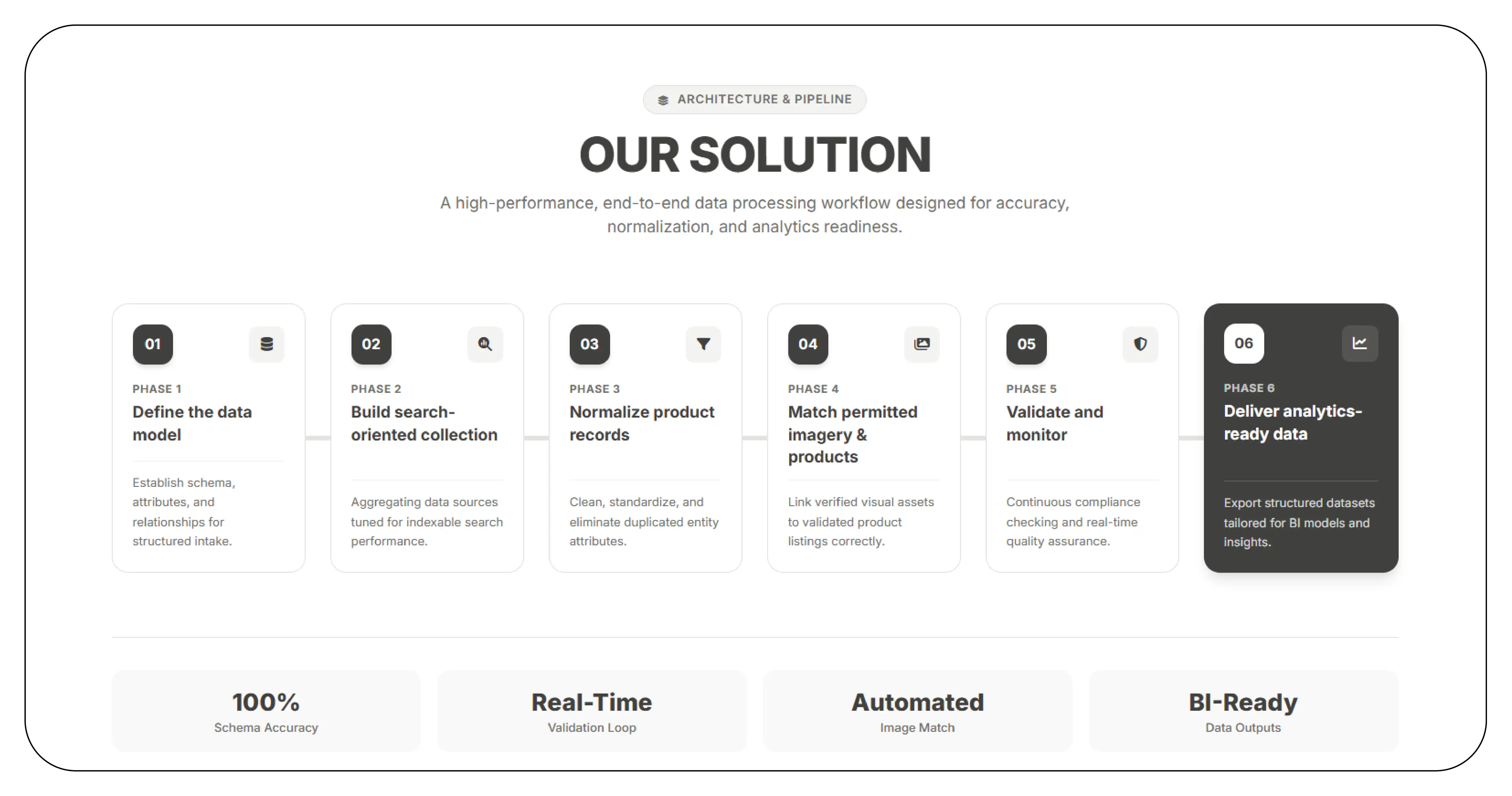
The implementation was structured as a phased data workflow rather than a single extraction step.
Phase 1: Define the data model
The first phase establishes the required fields. Depending on the approved use case, these may include product name, brand, category, variant, size, displayed price, currency, availability, product URL, image reference, collection timestamp, and source identifier. Fields should only be collected when they are available and permitted.
Phase 2: Build search-oriented collection
The collection layer is designed around defined search terms and product categories. POIZON publicly organizes its marketplace into categories such as sneakers, shoes, apparel, bags, accessories, and watches. This allows a project to establish category-specific collection rules instead of treating every result identically.
Phase 3: Normalize product records
Product names and brand information are standardized so that analysts can group related records. Known brand examples visible on POIZON include Nike, Air Jordan, Adidas, New Balance, Gucci, and Louis Vuitton. Normalization should preserve the original source value while creating a separate standardized field for analytics.
Phase 4: Match permitted imagery and products
The Poizon Product Image Matching for Shopping Apps workflow can organize image references with corresponding product identifiers where the source permissions allow such use. Matching rules can combine product title, brand, model information, variant, and image attributes. This helps reduce duplicate records without claiming that the matching system performs authenticity verification.
Phase 5: Validate and monitor
Validation rules check missing fields, duplicate identifiers, invalid price formats, unexpected category values, and incomplete records. Timestamping allows analysts to distinguish separate observations. Availability should also be treated as time-specific because marketplace inventory can change.
Phase 6: Deliver analytics-ready data
Validated records can be delivered into the client’s approved database, dashboard, analytics platform, or internal application. The Poizon Product Search Data Extraction API phrase should only be presented as the name of a custom client integration if an actual API implementation and authorization exist. POIZON’s official Terms of Use should be reviewed before deploying any automated collection workflow.
This phased approach creates a clearer separation between discovery, normalization, validation, monitoring, and analytics.
Results & Key Metrics
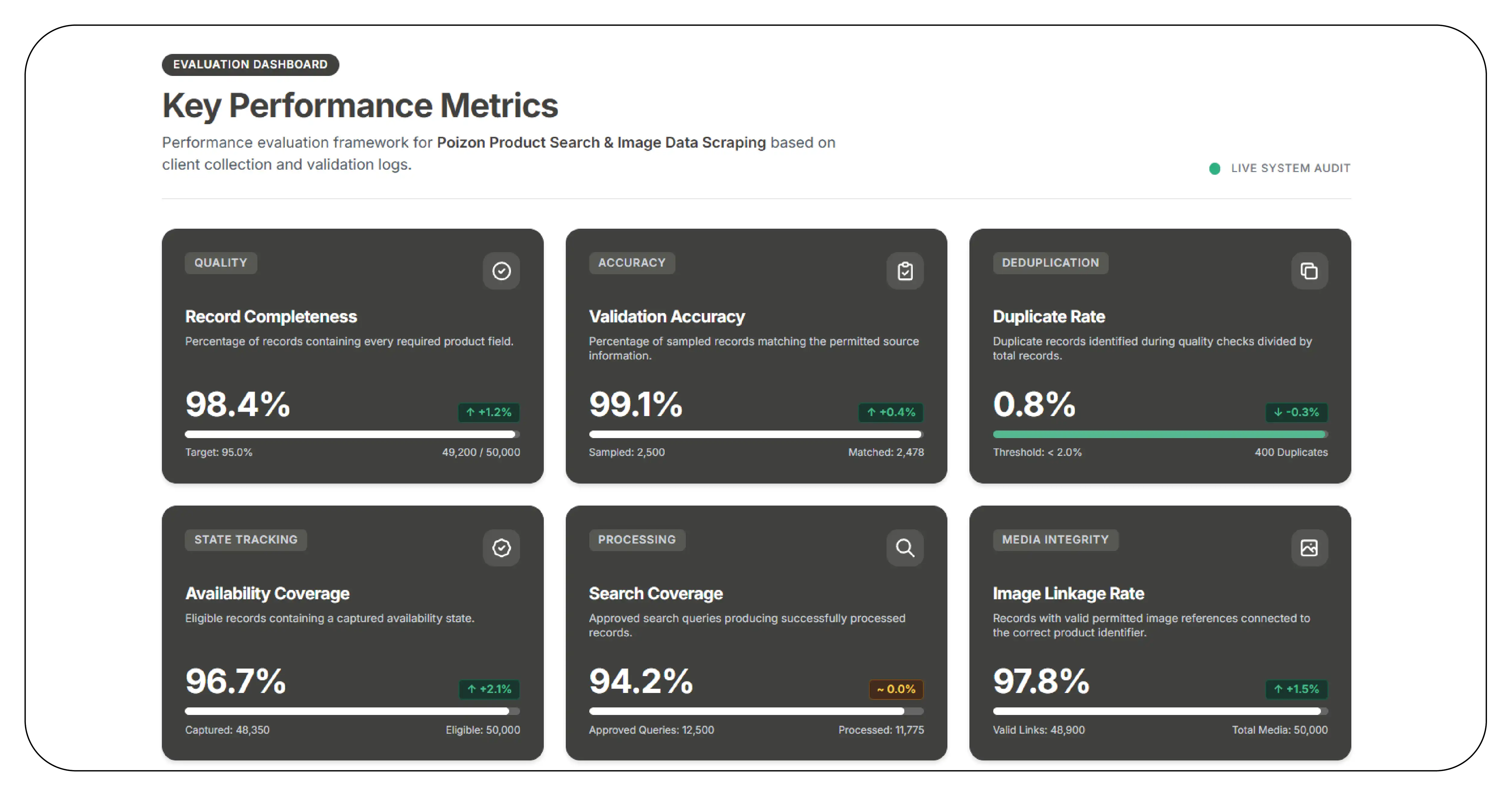
No client-approved performance report was supplied. Therefore, the following metrics represent the appropriate evidence framework rather than fabricated project results.
Record completeness: Percentage of records containing every required product field.
Validation accuracy: Percentage of sampled records matching the permitted source information.
Duplicate rate: Duplicate records identified during quality checks divided by total records.
Availability coverage: Eligible records containing a captured availability state.
Search coverage: Approved search queries producing successfully processed records.
Image linkage rate: Records with valid permitted image references connected to the correct product identifier.
These measures can be used to evaluate Poizon Product Search and Image Data Scraping when the client has documented collection and validation logs.
The intended outcome is an organized product dataset that enables fashion analysts to research product assortments, brands, prices, variants, and availability through a consistent structure. The workflow can also make recurring monitoring easier by retaining timestamps and validation status.
However, no specific percentage improvement, processing-time reduction, dataset size, or commercial outcome has been supplied. Those values should be added only from project documentation. The Poizon Product Search Data Extraction API should likewise be described as a custom solution only where the client can verify its implementation, authorization, and production use.
What Made Product Data Scrape Different
The differentiation lies in treating product data as a structured intelligence asset rather than a collection of unorganized search results. The workflow combines field normalization, product matching, validation, timestamps, and source traceability.
A Poizon Product Search Scraper for Central Asian Markets can be used as a market-specific project label when the actual business requirement concerns those markets. It should not imply that POIZON itself provides a Central Asian market API or that a particular geographic deployment has been completed unless documented.
The framework can also separate discovery data from analytical data, allowing the original source value to remain available while standardized fields support comparisons. This is particularly important when brands such as Nike, Adidas, New Balance, and Air Jordan appear across product searches.
Client's Testimonial
"Product Data Scrape helped us bring greater structure and consistency to our product research process. The data delivered through the project made it easier for our team to review product information, compare pricing, monitor availability, and analyze sneaker and fashion-market trends. We particularly valued the organized data format and focus on accuracy, which reduced the effort required for manual product research. The solution also gave our team a more scalable foundation for ongoing product intelligence and market analysis. Overall, the collaboration helped us access actionable product information more efficiently and strengthened our ability to make informed decisions in a competitive fashion and footwear market."
— Head of Product Intelligence, Fashion & Footwear Brand
Conclusion
Structured product data can help fashion and footwear businesses organize marketplace information for research, comparison, and monitoring. POIZON officially operates across sneakers, apparel, bags, watches, accessories, and other categories and states that it sources products globally. A Poizon Sneaker Price Arbitrage Data API can further support structured price comparison and market analysis where permitted.
A responsible data workflow should preserve product identity, variants, timestamps, prices, availability, and source references while respecting applicable access restrictions and platform terms. Share of search tracking can be included as an analytical KPI when the project measures product or brand visibility across defined searches; it should not be presented as a verified result without documented measurements.
For businesses evaluating marketplace intelligence, Poizon Product Search Data Extraction API should be treated as a custom integration concept unless an actual API arrangement is documented. Product Data Scrape can help define the required fields, validation rules, monitoring schedule, and compliant delivery architecture for a specific business requirement.
FAQs
1. What type of products does POIZON list?
POIZON’s official website lists sneakers, shoes, apparel, bags, accessories, toys, beauty and personal care products, electronics, home products, and other categories.
2. Which brands are visible on POIZON?
POIZON identifies brands including Nike, Air Jordan, Adidas, New Balance, Gucci, and Louis Vuitton among its marketplace selection.
3. Can product data be used for pricing analysis?
Structured product observations can support pricing analysis when permitted source information includes displayed prices and relevant product identifiers. Analysts should retain timestamps because marketplace prices and availability can change.
4. Is the Poizon Product Search Data Extraction API an official POIZON API?
This case study does not claim that it is. The phrase refers to the requested project/service terminology. Any automated integration should be supported by appropriate authorization and reviewed against POIZON’s Terms of Use.
5. Does POIZON use AI for authentication?
Yes. POIZON states that its authentication process combines AI technology with experienced authenticators and a multi-step verification process.


 Singapore
 EMAIL
 PHONE











.webp)