Introduction
Retailers can automate product identification by matching UPC codes against Amazon catalog records through authorized data access methods. This helps transform large barcode lists into structured product information for catalog management, comparison, and pricing research.
Amazon product data lookup from a UPC list Scraping enables businesses to organize product identification workflows around standardized product codes. Instead of manually searching for individual products, retailers can process UPC lists and match available records with product titles, brands, categories, descriptions, and other relevant attributes. Amazon's Selling Partner API Catalog Items operations support catalog searches using product identifiers, including UPCs, subject to API access and usage requirements.
For e-commerce businesses, this process supports Catalog Enrichment by helping identify missing product attributes, inconsistent records, and potential catalog matches. A reliable workflow must also validate matches, account for product variations, and respect Amazon's data usage policies. This guide explains how retailers can structure UPC-based research, evaluate pricing information, monitor catalog changes, and create more useful product datasets.
How can UPC codes simplify product identification?
Universal Product Codes provide a standardized way to identify products. A UPC is commonly represented as a 12-digit barcode number, allowing retailers and catalog managers to use product identifiers rather than relying exclusively on product names or descriptions.
Amazon's official listing guidance identifies UPC, EAN, ISBN, and other GTIN formats as product identifiers used for catalog matching and listing creation. Amazon's Selling Partner API also supports searching catalog items using identifiers, including UPC. These capabilities make identifier-based research a practical approach for businesses managing extensive product catalogs.
Amazon Product Data Extraction by UPC helps retailers organize product lookup around consistent inputs. A typical workflow begins with a spreadsheet containing UPC values. The identifiers are checked for formatting errors, duplicates, and missing digits before being submitted through an authorized catalog search method. Matching results can then be mapped to internal product records.
The process is especially useful for retailers managing products from multiple suppliers. Supplier descriptions may differ even when they refer to the same product. UPC-based matching can help identify candidate catalog records without depending entirely on text similarity.
E-commerce data scraping is another term used for collecting structured product information from online sources. However, retailers should distinguish between authorized API access and automated extraction from website pages. Amazon's API terms and licensing requirements govern how catalog content can be accessed and reused.
Practical steps include:
- Validate UPC length and numeric format.
- Preserve leading zeros in spreadsheet and database fields.
- Remove duplicate identifiers before lookup.
- Store the original UPC alongside the matched Amazon identifier.
- Record marketplace and lookup date.
- Flag missing or ambiguous matches for manual review.
Amazon's Selling Partner API Catalog Items documentation explains the supported catalog search functionality.
What should retailers monitor when matching UPCs to catalog records?
Matching a UPC to an Amazon listing is only the first step. Retailers also need to understand whether the returned record accurately represents the intended product. Differences in pack size, color, model, product configuration, and regional packaging can create misleading matches if catalog results are accepted without validation.
UPC-Based Amazon Product Data Monitoring provides a structured way to review identifier matches and associated catalog attributes over time. Businesses can compare returned product identifiers with their internal product master records and flag inconsistencies.
Important attributes to examine include:
- Product title and brand.
- Manufacturer or model information, where available.
- Product category and product type.
- UPC and other associated identifiers.
- Product variations and pack quantities.
- Product images and descriptions, subject to applicable access and usage rules.
- Marketplace-specific product availability.
Retailers can organize these attributes into E-Commerce Datasets for catalog management and research. A consistent dataset should preserve both the original source information and normalized internal fields. This helps users distinguish source values from their own corrections or classifications.
Amazon's Catalog Items API documentation describes fields such as identifiers, summaries, product types, images, sales ranks, and variations that may be requested through supported operations. The exact response depends on the operation, marketplace, permissions, and requested data elements.
Documented product identifier and API milestones
The following table highlights verified documentation points rather than claiming unsupported annual growth in UPC searches or Amazon product listings.
| Year | Verified documentation point | Relevance to retailers |
|---|
| 2020 | Amazon published a Catalog Items API version using the 2020-12-01 endpoint | Programmatic catalog lookup was documented |
| 2021 | No comparable official annual UPC lookup-volume statistic is provided in the cited API documentation | Avoid inventing market-volume estimates |
| 2022 | Catalog Items API model 2022-04-01 documents identifier types including UPC, EAN, GTIN, and ISBN | Supports structured identifier-based research |
| 2023 | No comparable official annual UPC matching-accuracy statistic is provided in the cited documentation | Measure internal matching quality |
| 2024 | Amazon's listing guide explains product identifiers and UPC barcode usage | Helps retailers standardize product inputs |
| 2025 | Amazon's current API documentation continues to describe catalog search capabilities | Check the current API version and requirements |
| 2026 | Current API references document catalog searches and requested response datasets | Build workflows against current documentation |
Sources: Amazon Catalog Items API model, Amazon listing guide, and Catalog Items API reference.
A useful internal KPI framework includes match rate, unmatched UPC count, duplicate rate, product attribute completeness, and the percentage of matches requiring manual review. These are operational measurements retailers can calculate from their own lookup results. They should not be confused with published Amazon-wide performance statistics.
How can retailers use product information for brand and catalog protection?
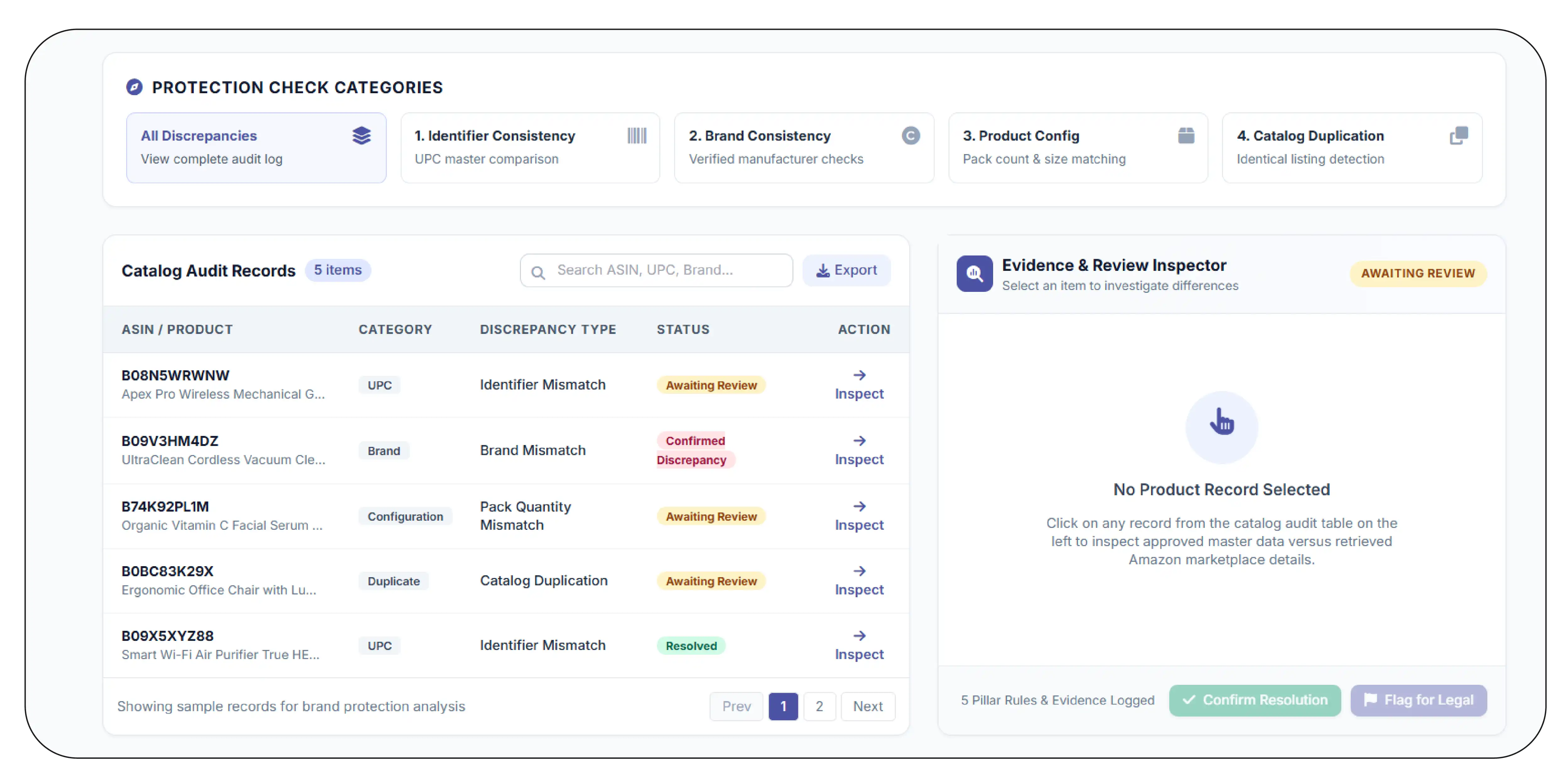
Product identification is important for more than price comparison. Brands, authorized resellers, and marketplace operators also need consistent product records to identify possible catalog inconsistencies and investigate questionable listings.
An Amazon Retail Product Intelligence Dataset can organize product identifiers alongside brand names, product titles, model numbers, categories, and other available attributes. This gives catalog teams a structured reference for comparing product information across internal systems and permitted external sources.
For example, a brand may have an approved product master containing official UPCs, product names, and packaging information. When catalog records are retrieved through an authorized Amazon integration, the team can compare the returned information against its approved records. Differences can be flagged for investigation rather than automatically treated as violations.
This supports Brand Protection research by helping businesses identify potential data inconsistencies, unauthorized identifier use, and product information that requires further review. A UPC mismatch alone does not prove counterfeiting or infringement. Investigation requires additional evidence, such as packaging details, manufacturer confirmation, seller information, and applicable intellectual property documentation.
Retailers should organize their checks around clear categories:
- Identifier consistency: Compare UPC values against authorized product master records.
- Brand consistency: Review whether the returned brand information matches verified manufacturer records.
- Product configuration: Check pack quantity, model, size, and variation details.
- Catalog duplication: Identify records that appear to describe the same product.
- Evidence management: Preserve source references, timestamps, and review notes.
A useful product intelligence dataset should also distinguish between confirmed discrepancies and records awaiting review. This prevents teams from making unsupported conclusions based on incomplete catalog information.
Amazon's product detail page policies explain requirements concerning product identifiers and the use of authorized GTINs. Retailers should consult current marketplace policies before acting on suspected listing violations.
How can UPC matching improve catalog completeness?
Retail product catalogs often contain missing attributes, inconsistent product names, outdated descriptions, and incomplete category assignments. These issues make product discovery, inventory synchronization, and internal reporting more difficult.
UPC-Based Product Catalog Enrichment uses product identifiers as a starting point for finding corresponding catalog information. When a valid match is available, retailers can review the returned attributes and compare them with their internal records. Missing fields can then be flagged for enrichment using approved sources.
For example, an internal product master might contain a UPC and supplier reference but lack a standardized product title or category. A catalog lookup may return a candidate listing with additional descriptive information. The retailer can verify the match and update its internal record where permitted.
The process should include several safeguards:
- Identifier validation: Check the UPC before submitting a lookup request.
- Match verification: Compare brand, model, size, and pack quantity.
- Field mapping: Map external attributes to the retailer's internal schema.
- Conflict management: Retain both source and internal values when they differ.
- Quality scoring: Assign a review status based on the evidence available.
- Audit history: Record the source and date associated with each update.
A well-managed Amazon product data lookup from a UPC list Scraping workflow should never assume that every UPC produces one exact and usable match. Some identifiers may return no results, multiple candidate products, or listings that refer to different variations. Those cases need explicit handling.
Catalog enrichment quality indicators
| KPI | What it measures | Why it matters |
|---|
| UPC match rate | Share of submitted UPCs with a usable candidate match | Shows lookup coverage |
| Attribute completeness | Share of records containing required fields | Measures catalog quality |
| Duplicate rate | Repeated product records | Helps identify catalog duplication |
| Manual review rate | Matches requiring human confirmation | Indicates ambiguity |
| Update freshness | Age of the last verified source observation | Helps manage outdated information |
| Identifier conflict rate | Records with inconsistent product identifiers | Supports quality investigations |
These metrics should be calculated from the retailer's own records. No universal Amazon-wide match-rate benchmark is assumed here.
How can retailers compare product prices using UPC identifiers?
Price comparison becomes more reliable when businesses first establish that they are comparing the same product. Product titles alone can be misleading because sellers may use different wording, abbreviations, or promotional descriptions. UPC identifiers can help narrow the comparison to products that share a recognized identifier.
Amazon Price Data Lookup Using UPCs can be part of a broader pricing research workflow. Retailers begin with an approved UPC list, identify candidate catalog records, validate product configurations, and then collect permitted pricing information using an appropriate authorized source.
The price dataset may include fields such as:
- Product identifier and ASIN, where available.
- Product title and brand.
- Marketplace and seller context.
- Displayed offer price.
- Currency and collection timestamp.
- Product condition, where available.
- Shipping or delivery information, where available through the source.
- Availability status, subject to source permissions.
The comparison must account for product configuration. A single-unit product should not be compared directly with a multi-pack listing. Similarly, used, renewed, refurbished, and new products may have different pricing contexts.
Amazon provides specific APIs for different purposes. Its Selling Partner API includes pricing operations for seller-related pricing information, while Catalog Items operations are designed to retrieve catalog information. Retailers should not assume that a UPC catalog lookup automatically returns every offer price or competitor pricing field.
The Selling Partner API pricing reference describes competitive pricing information for seller offer listings based on seller SKU or ASIN. Access and usage are subject to the relevant API permissions and rate limits.
For practical analysis, retailers can calculate:
- Price differences between verified comparable offers.
- Price movement between authorized collection timestamps.
- The proportion of products with available pricing observations.
- The frequency of missing or incomplete price records.
- Differences between single-unit and multipack offers.
These measurements support pricing decisions without assuming that one displayed price represents the entire market.
How can retailers maintain product information over time?
A UPC lookup is not a one-time catalog cleanup task. Product titles, descriptions, offer conditions, and marketplace availability can change. Retailers therefore need a repeatable process for checking product records and managing updates.
Amazon Product Information Monitoring should begin with a clear schedule based on business priorities and the permitted refresh rules of the chosen data source. High-priority products may require more frequent checks than slow-moving catalog items. The schedule should also account for API rate limits, source restrictions, and the cost of collecting unnecessary information.
A sustainable monitoring workflow includes:
- Maintain a master UPC list: Keep a clean reference file with internal product IDs and approved identifiers.
- Track marketplace coverage: Record which marketplace each lookup relates to.
- Schedule authorized checks: Use supported API calls or licensed data sources according to their terms.
- Compare new and previous records: Identify changes in titles, categories, identifiers, or permitted pricing fields.
- Review exceptions: Send conflicting or incomplete matches to a manual review queue.
- Preserve provenance: Store collection timestamps and source references.
- Apply retention rules: Follow the applicable data licence and marketplace policies.
A structured Amazon product data lookup from a UPC list Scraping process should also include clear rules for data storage. For example, Amazon's Product Advertising API licence restricts how long certain product advertising content may be cached. Its current policy states that non-image content may generally be cached for up to 24 hours under the specified conditions, while image content has separate restrictions. The exact licence and applicable API terms must be checked before designing a storage process.
The Amazon Associates Operating Policies and Product Advertising API policies explain these requirements. Selling Partner API users must separately follow the relevant Selling Partner API agreements and documentation.
The goal is to create a traceable product information process—not to collect data indefinitely or bypass marketplace restrictions.
Why Choose Product Data Scrape?
Retailers need product datasets that are accurate, consistent, and suitable for their commercial workflows. Product data projects require more than retrieving product names; they need identifier validation, match review, attribute mapping, and clear source documentation. Amazon product data scraping projects should also account for marketplace permissions, API access, data retention, and applicable usage restrictions. A structured approach can help retailers organize product information for catalog management, product comparison, and market research. With a focus on data quality and practical delivery requirements, businesses can build workflows that support reliable product intelligence without relying on unsupported matches or unverified product attributes.
Conclusion
UPC-based product research can help retailers identify catalog matches, improve product records, and organize competitive analysis. The strongest workflows combine identifier validation, authorized catalog access, product-level verification, and documented data quality checks. Businesses seeking Real-time price tracking should use suitable authorized pricing sources and respect their refresh and storage conditions. A scalable Amazon product data lookup from a UPC list Scraping solution can support structured product research when designed around these requirements. Contact Product Data Scrape to discuss your UPC list, required product fields, marketplace coverage, and a compliant data collection workflow.
FAQs
1. What is UPC-based Amazon product lookup?
It is a process of using Universal Product Codes to search for matching Amazon catalog records through authorized tools, helping retailers identify products and organize catalog information.
2. What product fields can be retrieved?
Depending on API access and requested data, available fields may include titles, identifiers, brand information, product types, descriptions, images, variations, and other catalog attributes.
3. Can every UPC find an Amazon product?
No. Some UPCs may return no matching records or ambiguous results. Retailers should validate product configuration, brand, and identifier details before accepting a match.
4. Can UPC lookup provide competitor prices?
UPC matching identifies candidate catalog products. Pricing information requires an appropriate authorized pricing source, applicable permissions, and careful comparison of equivalent product conditions.
5. How can Product Data Scrape support retailers?
Product Data Scrape can help plan structured product-data workflows, organize identifier lists, define required fields, and establish validation and delivery requirements for catalog research.


 Singapore
 EMAIL
 PHONE














.webp)