Quick Overview
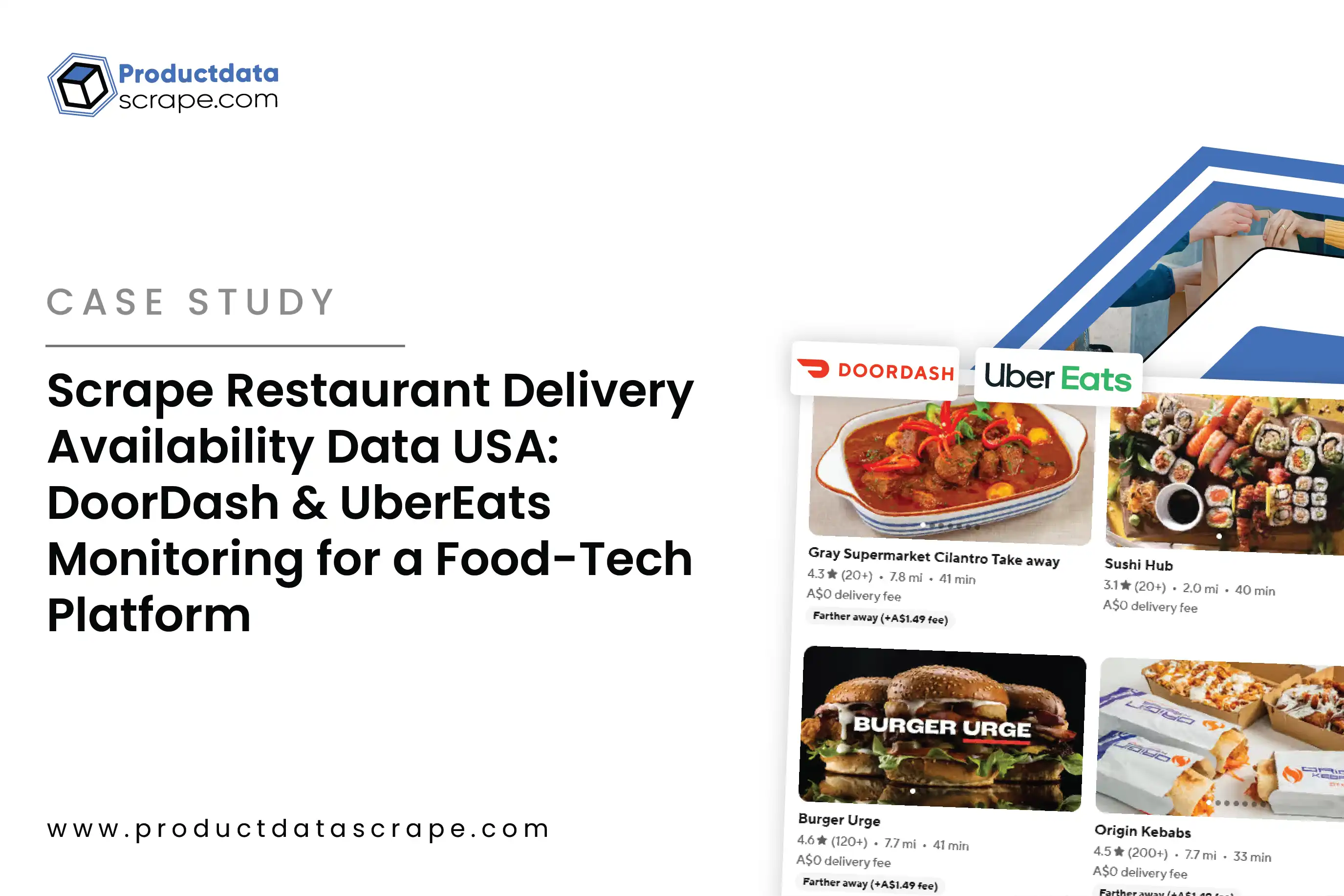
The project focused on building a structured workflow for monitoring restaurant delivery availability across U.S. locations and turning changing marketplace signals into usable analytical records. Scrape Restaurant Delivery Availability Data USA was designed around location, restaurant status, serviceability, operating hours, and timestamped availability signals, while E-commerce data scraping for the US provided the broader data-engineering context. Because DoorDash Marketplace APIs and Uber Eats APIs have access restrictions, the workflow must use authorized access, approved APIs, or other permitted collection methods.
Client Name / Industry: Confidential food-tech platform / restaurant technology and market intelligence
Service / Duration: Restaurant delivery availability data engineering / Client-specific duration not publicly disclosed
Key Impact Metrics: Structured restaurant-status records; location-level availability monitoring; timestamped availability history
The Client
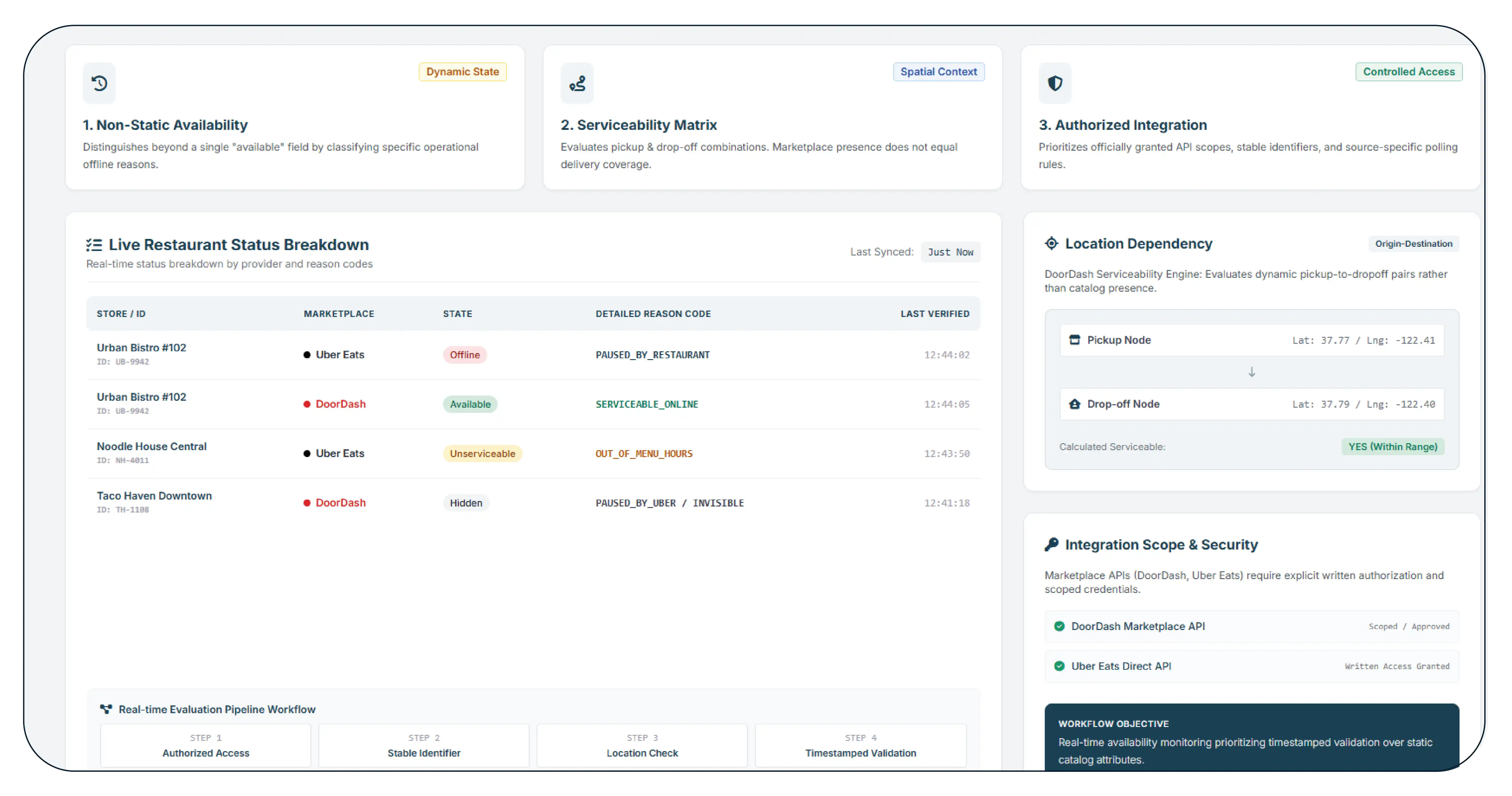
The client operated in the food-tech and restaurant intelligence space, where understanding whether a restaurant is available for ordering can be as important as knowing its menu, location, or cuisine. Delivery marketplaces can expose changing operational states: Uber Eats documents online, offline, and paused restaurant statuses, including reasons such as being outside menu hours or being paused by the restaurant.
Before the engagement, the business needed a more systematic way to Track DoorDash & Uber Eats Delivery Availability Data, Grocery Datasets and organize marketplace observations for analysis. Manual checking could not provide a consistent historical structure across locations, restaurants, and timestamps.
Transformation was important because availability is dynamic. A restaurant can be online during operating hours, become temporarily unavailable, or return to service. Uber specifically recommends synchronizing restaurant availability so stores that cannot fulfill orders can be marked offline.
For DoorDash, serviceability can be evaluated through the documented Drive API, which provides a serviceability endpoint for checking whether delivery is available between pickup and drop-off locations. DoorDash also states that Marketplace API access is limited and approval-based.
The resulting requirement was therefore not simply collecting restaurant names. It was creating a reliable data model capable of representing availability as a time- and location-dependent business signal.
Goals & Objectives
Establish a scalable framework for collecting restaurant availability observations.
Improve the consistency of restaurant, location, status, and timestamp fields.
Support faster comparison of service availability across defined U.S. markets.
Build a foundation for historical availability analysis.
Maintain compliance with source-specific access requirements.
Develop DoorDash restaurant availability data scraping, DoorDash DashMart Q-Commerce API as an integration-oriented data requirement rather than assuming unrestricted public API access.
Capture restaurant identifiers and location information wherever authorized access makes those fields available.
Record online, offline, paused, or serviceability-related states where supported by the source.
Normalize timestamps and location identifiers.
Validate duplicate, incomplete, and inconsistent records before downstream analytics.
Connect structured outputs with dashboards or analytical databases.
Coverage: Percentage of target restaurants and locations represented in the approved collection scope.
Freshness: Time between source observation and availability of the corresponding analytical record.
Data quality: Percentage of records passing required validation checks for identifiers, location, status, and timestamp fields.
DoorDash documents serviceability checks through its Drive API, while Uber documents restaurant status retrieval through its Eats API. These capabilities provide a verified foundation for availability-oriented data workflows.
The Core Challenge
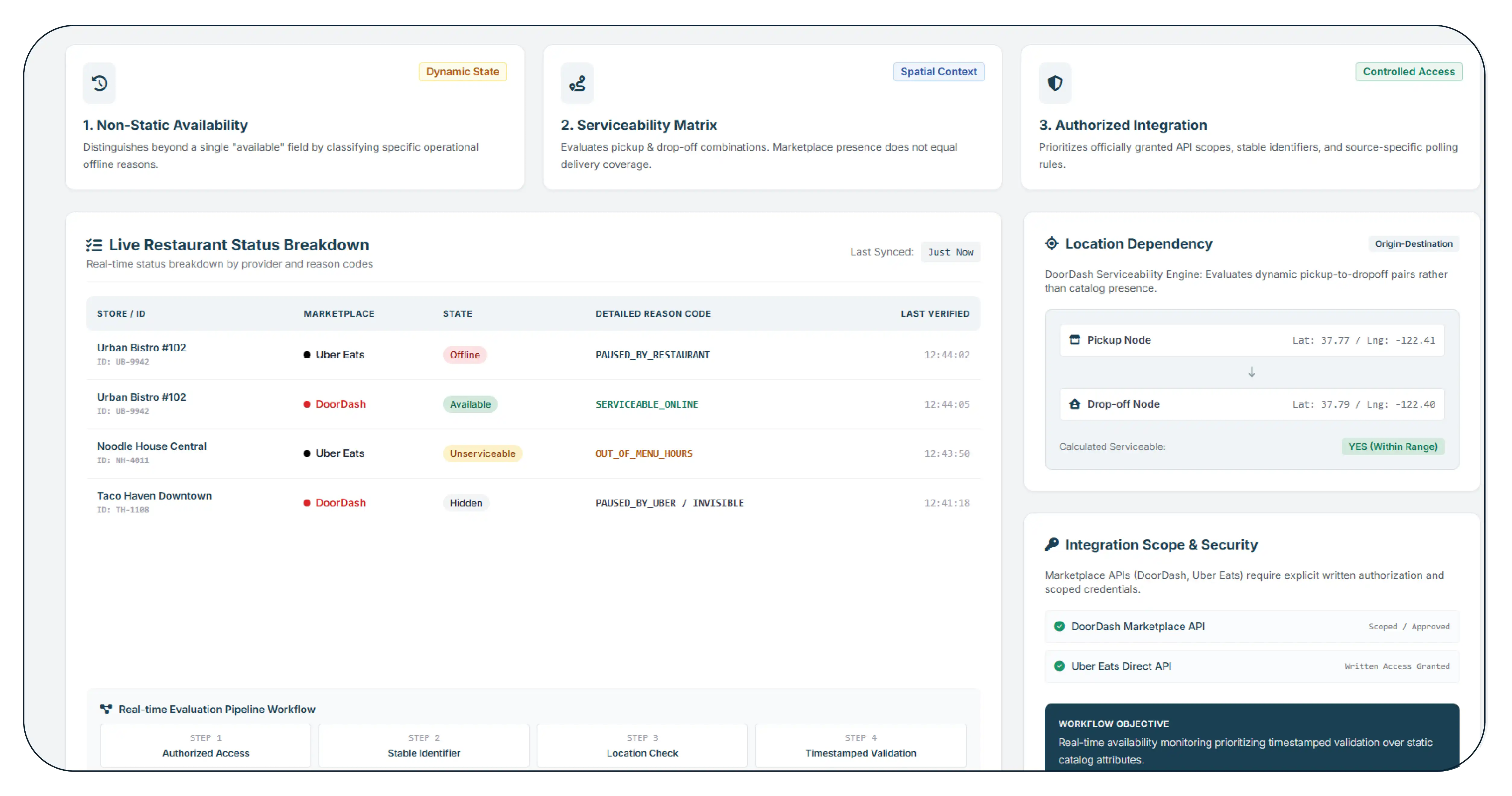
The central challenge was that restaurant availability is not a static attribute. It can change according to business hours, temporary pauses, operational conditions, or marketplace status.
A monitoring workflow therefore has to distinguish between several concepts rather than reducing everything to a single “available” field. Uber's documented restaurant-status response, for example, can include an offline reason such as OUT_OF_MENU_HOURS, INVISIBLE, PAUSED_BY_UBER, or PAUSED_BY_RESTAURANT.
The second challenge was location dependency. A restaurant's presence in a marketplace does not automatically establish that every potential delivery destination is serviceable. DoorDash's documented serviceability endpoint evaluates pickup and drop-off combinations, demonstrating why location must be part of an availability model.
The third challenge was source access. DoorDash states that Marketplace APIs are not generally available and that prospective partners must apply for access. Uber likewise notes that access to Eats APIs may require written approval.
Consequently, the workflow needed to prioritize authorized access, stable identifiers, validation, timestamping, and source-specific rules. The objective was Real-time restaurant delivery availability tracking, Assortment and availability monitoring without treating marketplace availability as a simple static catalog field.
Our Solution
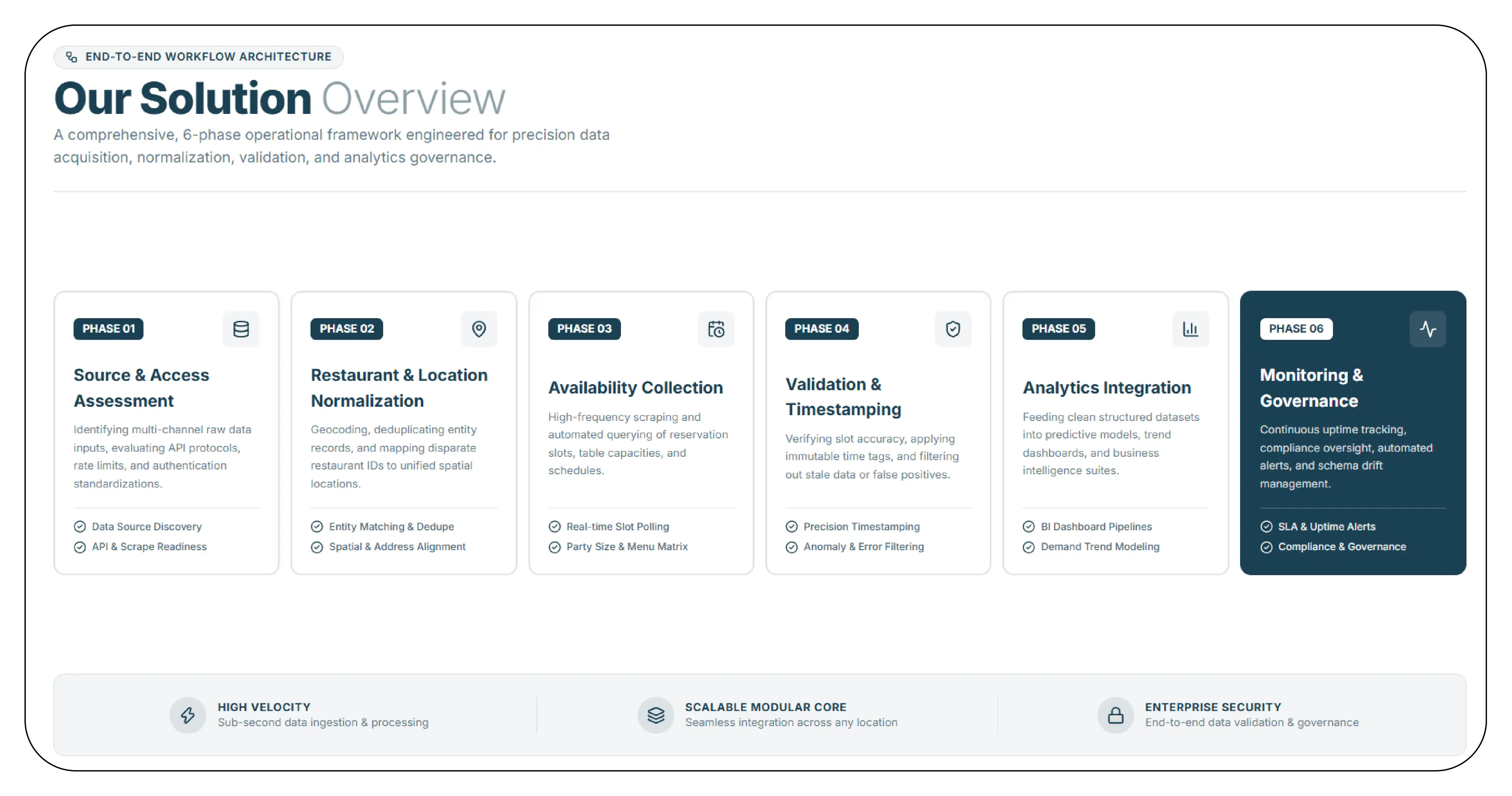
The implementation followed a phased data-engineering model designed around approved source access and clearly defined availability fields.
Phase 1: Source and Access Assessment
The first phase identified which marketplace information could legitimately be collected through available integrations. This distinction was important because DoorDash Marketplace access is approval-based, while Uber documents written approval requirements for certain Eats APIs.
The data dictionary was then defined around restaurant identity, location, marketplace status, serviceability, operating hours, timestamp, and source metadata.
Phase 2: Restaurant and Location Normalization
The next phase focused on identity resolution. Restaurant names can vary in formatting, while individual locations require separate identifiers. The workflow therefore used stable source identifiers where available and maintained structured location fields.
For Uber Eats, the documented Store API can retrieve store information such as address and name for individual locations.
Phase 3: Availability Collection
The core collection layer was designed to scrape restaurant data from DoorDash and Uber Eats only through authorized and permitted access methods.
For Uber, the documented status endpoint can retrieve a restaurant's online status and an associated offline reason.
For DoorDash Drive, the documented serviceability endpoint checks whether delivery is serviceable for a pickup and drop-off combination.
This distinction allowed the data model to keep restaurant operating status separate from delivery-location serviceability while supporting E-commerce data for restaurant menus and related restaurant intelligence workflows.
Phase 4: Validation and Timestamping
Each observation was validated for required identifiers, location fields, status values, and collection time. Duplicate observations were handled according to the monitoring frequency and analytical requirements.
A timestamp was retained for every observation so analysts could distinguish the current state from historical availability.
Phase 5: Analytics Integration
Validated records were prepared for downstream dashboards and analytical systems. The resulting model could support restaurant-level availability histories, location comparisons, operational monitoring, and marketplace research.
The workflow also allowed future expansion into menu, pricing, and operating-hours datasets. Uber's documented Eats APIs support store management and menu synchronization, including pricing and item availability.
Phase 6: Monitoring and Governance
Finally, monitoring rules were established for failed collection jobs, unexpected status values, missing identifiers, and source changes. Access credentials and source-specific permissions remained part of the governance layer rather than being treated as an afterthought.
This approach makes Scrape Restaurant Delivery Availability Data USA a structured data-monitoring capability rather than a one-time extraction exercise.
Results & Key Metrics
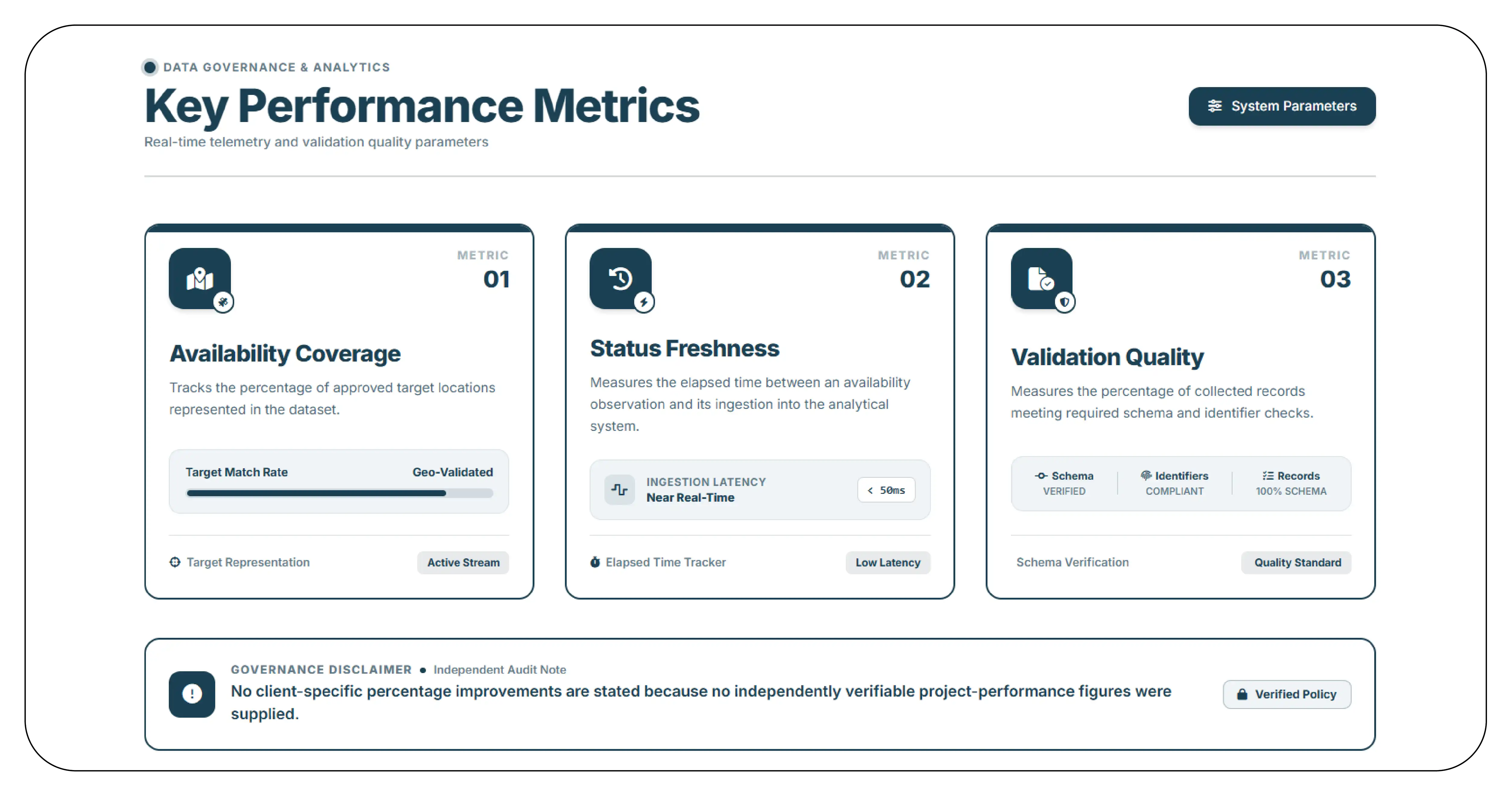
Availability coverage: Tracks the percentage of approved target locations represented in the dataset.
Status freshness: Measures the elapsed time between an availability observation and its ingestion into the analytical system.
Validation quality: Measures the percentage of collected records meeting required schema and identifier checks.
No client-specific percentage improvements are stated because no independently verifiable project-performance figures were supplied.
The completed architecture provides a structured restaurant delivery availability dataset for the US that can preserve restaurant identity, location, marketplace status, serviceability signals, and timestamps. Uber's documented API can provide online/offline status and offline reasons, while DoorDash's Drive API documents serviceability checks between pickup and drop-off locations.
The principal result is therefore improved analytical structure: teams can compare availability observations over time instead of relying on isolated manual checks. The design also separates source capabilities from assumptions, which is particularly important because both DoorDash and Uber impose access conditions on their developer APIs.
What Made Product Data Scrape Different
Product Data Scrape's differentiator was the emphasis on data structure and explainability rather than treating collection volume as the only success criterion. The workflow separated restaurant identity, location, status, serviceability, hours, timestamps, and source metadata so downstream users could understand what each availability record represented.
The model can also be extended to track Uber Eats promotions and discounts where such information is available through authorized source access and appropriate fields. Uber documents menu synchronization capabilities covering pricing and item availability, while its Store API supports store-level information and status management.
The same validation-first architecture was applied to Scrape Restaurant Delivery Availability Data USA, helping create a reusable foundation for restaurant intelligence, competitive monitoring, and marketplace analytics.
Client's Testimonial
"The project gave our team a more structured way to think about restaurant availability data. Instead of treating availability as a single field, we could organize restaurant identity, location, status, timestamps, and serviceability as distinct analytical signals."
— Client-side Data Strategy Lead, Food-Tech Industry
Conclusion
Restaurant availability intelligence requires more than collecting restaurant names. It requires location-aware status data, timestamps, validation rules, and a clear distinction between restaurant operating status and delivery serviceability. Uber documents online/offline restaurant status and reasons, while DoorDash documents serviceability checks for pickup and drop-off combinations.
A structured workflow can therefore turn Restaurant Working Hours Data from Uber Eats, Scrape Restaurant Delivery Availability Data USA into a broader restaurant intelligence framework when the required information is available through authorized access.
For food-tech companies, marketplace analysts, and restaurant technology providers, the next step is to define target locations, required fields, approved sources, refresh frequency, and analytical KPIs before implementation.
FAQs
1. What restaurant availability information can be collected?
Depending on authorized source access, useful fields can include restaurant identity, location, online/offline status, availability reason, operating hours, serviceability, and observation timestamps. Uber's documented status endpoint returns restaurant status and offline reasons. Uber Developers
2. Can DoorDash delivery serviceability be checked programmatically?
Yes, DoorDash documents a Drive API serviceability endpoint that checks whether delivery is serviceable between specified pickup and drop-off locations. Production API access is restricted and subject to approval. DoorDash Developer
3. Does Uber Eats provide restaurant status information through an API?
Yes. Uber documents a restaurant-status endpoint that can return whether a store is online or offline and, where applicable, the reason for being offline. Access may require approval. Uber Developers
4. Is marketplace API access automatically available to every data provider?
No. DoorDash states that Marketplace APIs are not generally available and that prospective partners must apply for access. Uber also notes that access to certain Eats APIs may require written approval. DoorDash Developer
5. What should a U.S. restaurant availability dataset contain?
A practical schema should include a stable restaurant or store identifier, restaurant name, location, marketplace/source, availability status, serviceability information where supported, operating-hours fields where available, observation timestamp, and validation metadata. This structure supports historical monitoring while keeping source-specific availability concepts separate. Uber's Store API and DoorDash's documented serviceability capabilities demonstrate the importance of store-level and location-level fields. Uber Developers


 Singapore
 EMAIL
 PHONE












.webp)