Introduction
Building a verified business database across multiple Indian cities requires more than collecting names and addresses. Businesses need structured, current, and consistently validated information, including business categories, locations, contact details, websites, and operating status. An India-wide Google Maps business dataset can support this process when information is collected from authorized sources, standardized, and checked against reliable records.
For ecommerce, market researchers, sales teams, and location-intelligence providers, the main challenge is maintaining consistent business information across different regions. Manual research often creates duplicate entries, inconsistent category labels, and outdated contact details. A structured automated Google Maps data scraping workflow can help organize permitted business information, apply validation rules, and prepare records for analysis.
The key is to build a database that is useful, traceable, and compliant—not simply large. This guide explains how to plan city-level coverage, validate business records, organize listings, monitor changes, and create datasets that support practical business decisions.
Why is a structured business database important for Indian e-commerce markets?
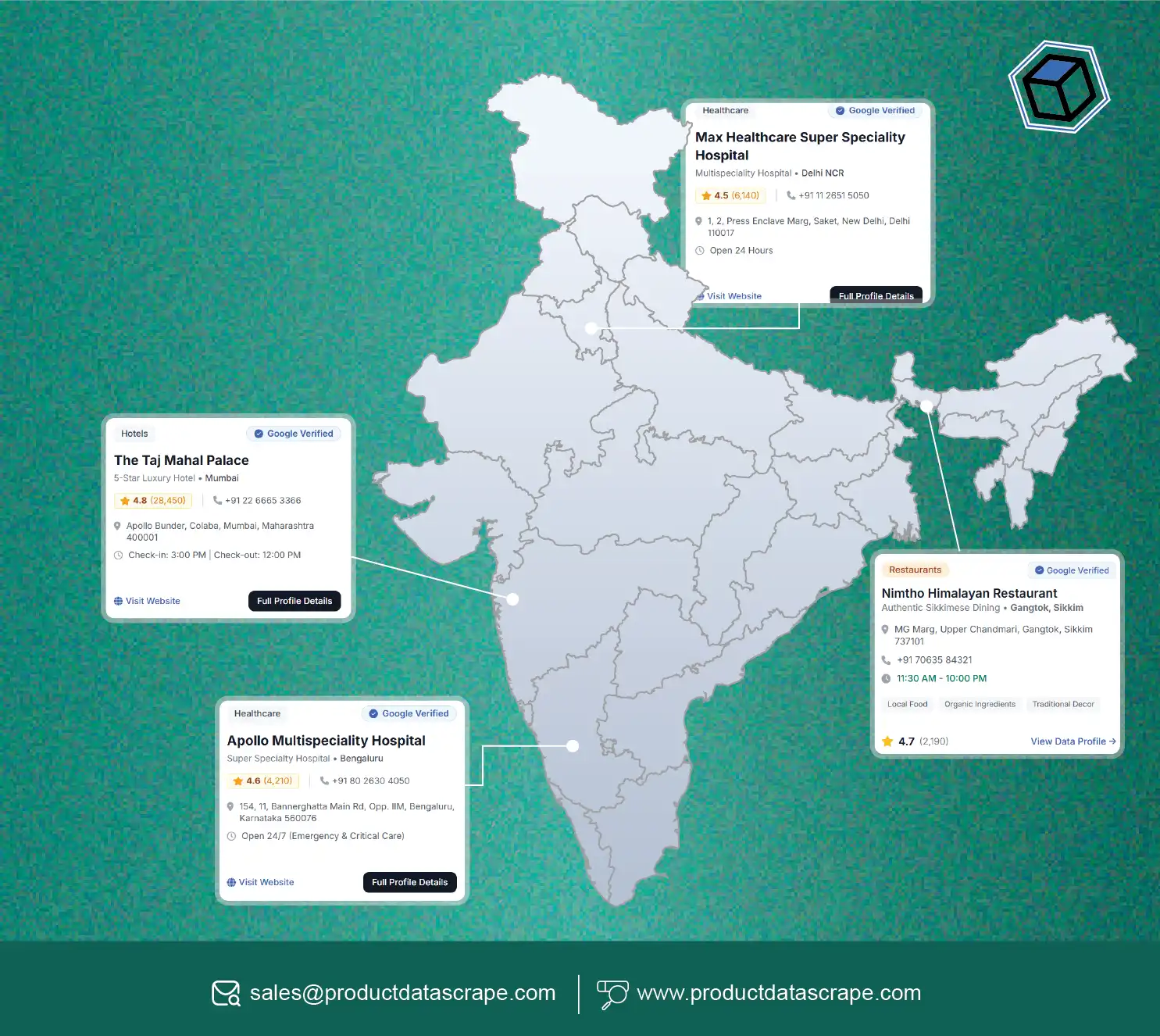
India's business landscape is geographically diverse. Retailers, wholesalers, restaurants, healthcare providers, and service businesses operate across metropolitan areas, smaller cities, and rural markets. A nationwide database must therefore account for differences in business categories, local naming conventions, addresses, and regional coverage.
The scale of the opportunity is reflected in official government statistics. The Ministry of Statistics and Programme Implementation (MoSPI), through its Annual Survey of Unincorporated Sector Enterprises (ASUSE), estimated 7.92 crore unincorporated non-agricultural establishments in 2025, compared with 7.34 crore in 2023–24. These estimates cover manufacturing, trade, and other services—not Google Maps listings—and should not be interpreted as a count of e-commerce stores alone.
For businesses developing a national database, this distinction matters. A listing found online is not automatically a registered establishment, an active outlet, or a verified sales prospect. Records need clear evidence, source dates, and confidence labels.
Retail Store Listings Data Scraping India can support retail research when it uses authorized sources and validation processes. For example, a retailer expanding into new markets may need to identify relevant store categories, map locations, and compare regional coverage. Commerce Intelligence becomes more useful when the underlying records are traceable and consistently classified.
A practical database should answer three questions: where does a business operate, what does it offer, and how recently was its information checked?
How can businesses plan nationwide coverage and regional analysis?
A nationwide database should be built in manageable geographic stages rather than collecting every available listing at once. Start by defining the target states, districts, cities, localities, and business categories. Then establish a coverage plan that identifies which locations and categories have been researched, validated, or left pending.
This approach supports India-Wide Local Business Intelligence by making regional gaps visible. A retail chain can compare the presence of relevant business categories across target markets, while a distributor can identify areas requiring additional research. Retailers Use Scraped Data most effectively when the information answers a specific commercial question rather than simply increasing the number of records.
Use a consistent geographic hierarchy:
- National level: State and union territory coverage.
- State level: District and city segmentation.
- City level: Localities, commercial areas, and postal codes.
- Business level: Individual outlet, category, address, and source record.
The official ASUSE survey provides useful context for regional market research. Its 2025 methodology covers rural and urban areas across India, with district-level estimates made possible through its revised sampling design. It is an establishment survey, not a directory of individual online business listings.
For a business database, record the geographic unit used for every entry. Avoid treating a city name, postal code, and district as interchangeable. This prevents location mismatches during territory planning, sales routing, and regional comparisons.
What information should a business database contain?
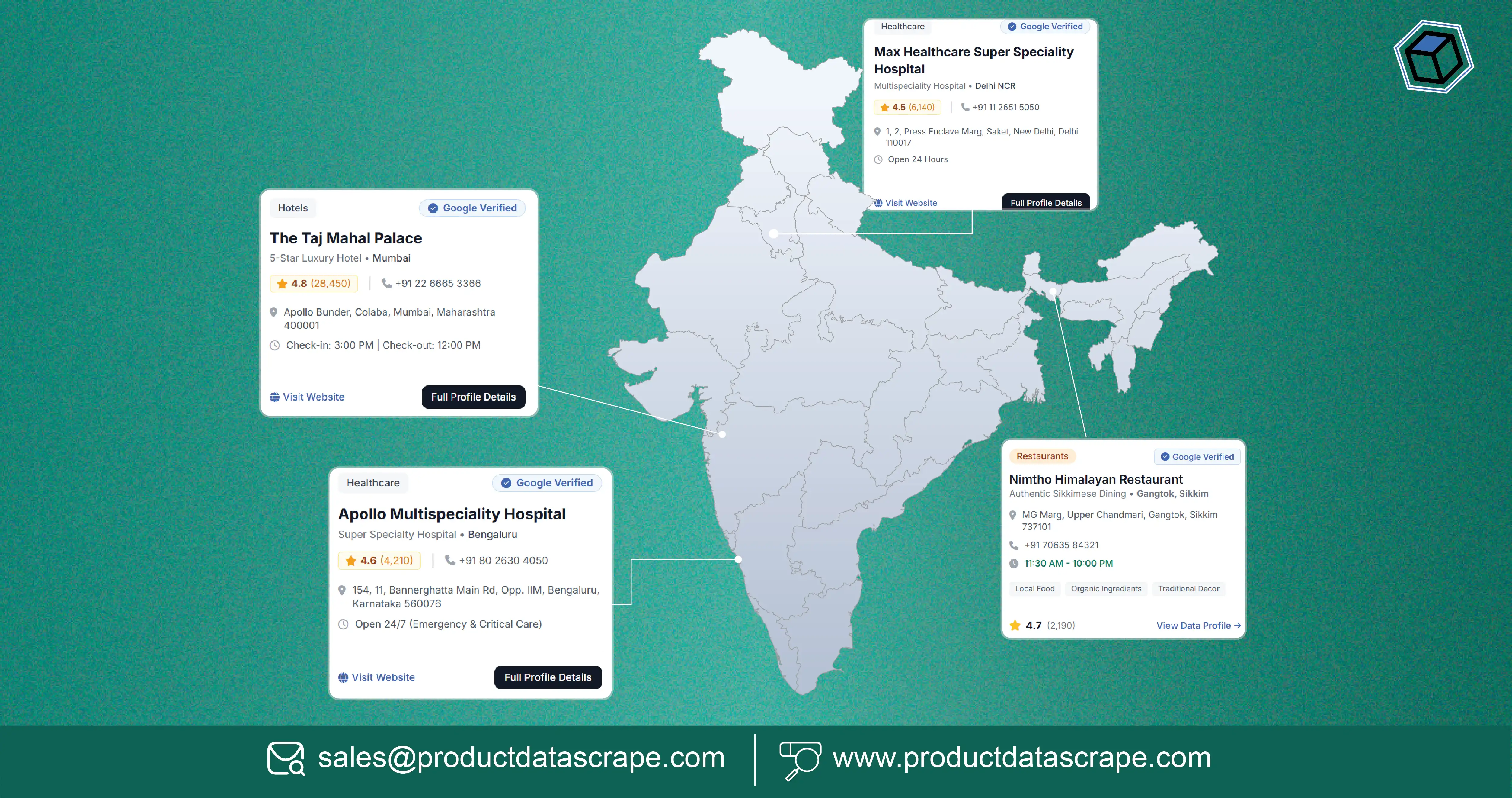
A useful business database needs consistent fields that help users identify, classify, locate, and verify each establishment. A Google Maps Store Details Dataset for Retail may be a useful search concept, but the actual dataset should be assembled from sources that permit the intended collection, storage, and reuse. Do not assume that information visible on a map can automatically be copied into a separate commercial database.
For every outlet, define a record structure with fields such as:
- Business name and trading name
- Primary and secondary business categories
- Full address, locality, city, district, state, and PIN code
- Public business telephone number and website, where permitted
- Source URL or reference and collection date
- Verification status and last-checked date
- Branch or outlet identifier, where available
The following government statistics provide context for the scale of India's establishment landscape. They are not Google Maps listing counts.
| Year or survey period | Verified official indicator | What it tells database planners |
|---|
| 2020 | Udyam Registration Portal launched on 1 July 2020 | A formal MSME registration channel became available |
| 2021–22 | 5.97 crore estimated unincorporated establishments | Establishment research needs broad sector coverage |
| 2022–23 | 6.50 crore estimated establishments | The estimated establishment base increased |
| 2023–24 | 7.34 crore estimated establishments | Continued expansion across covered sectors |
| 2024 | Included in the October 2023–September 2024 ASUSE period | Avoid treating it as a separate annual estimate |
| 2025 | 7.92 crore estimated establishments | The official estimate continued to increase |
| 2026 | ASUSE 2026 fieldwork is underway; 24,800 first-stage units are selected | Current survey activity is not a final 2026 establishment estimate |
Sources: Government of India and MoSPI releases. The figures describe different official survey periods and indicators; they do not measure online listings or a single Google Maps dataset.
How should business information be verified and updated?
A business listing should not be labelled verified simply because its name and address appear in an online result. Verification requires checking whether the record refers to a real, relevant establishment and whether its key details are supported by dependable evidence.
A robust India-Wide Local Business Information Tracking process uses multiple checks. First, standardize business names by removing unnecessary punctuation and normalizing common abbreviations without changing the actual trading identity. Second, compare addresses using locality, PIN code, city, and state. Third, check public business websites, official business profiles, permitted directories, or direct confirmation where available. Fourth, record the date and source of each check.
Use clear verification labels:
- Verified: Key fields have been checked against an appropriate source.
- Partially verified: The business appears credible, but one or more important fields remain unconfirmed.
- Needs review: Conflicting addresses, names, or categories require investigation.
- Inactive or closed: Closure is supported by a reliable and recent source.
- Unverified: The record has not passed the required checks.
Do not silently delete uncertain records. Retain their status and review history so users can understand why they were excluded from a campaign or analysis. Recheck high-priority records more frequently, and set a review schedule for the rest. This makes database quality measurable through completeness, duplicate rates, verification coverage, and record freshness.
What are the rules for collecting and using location-based business data?
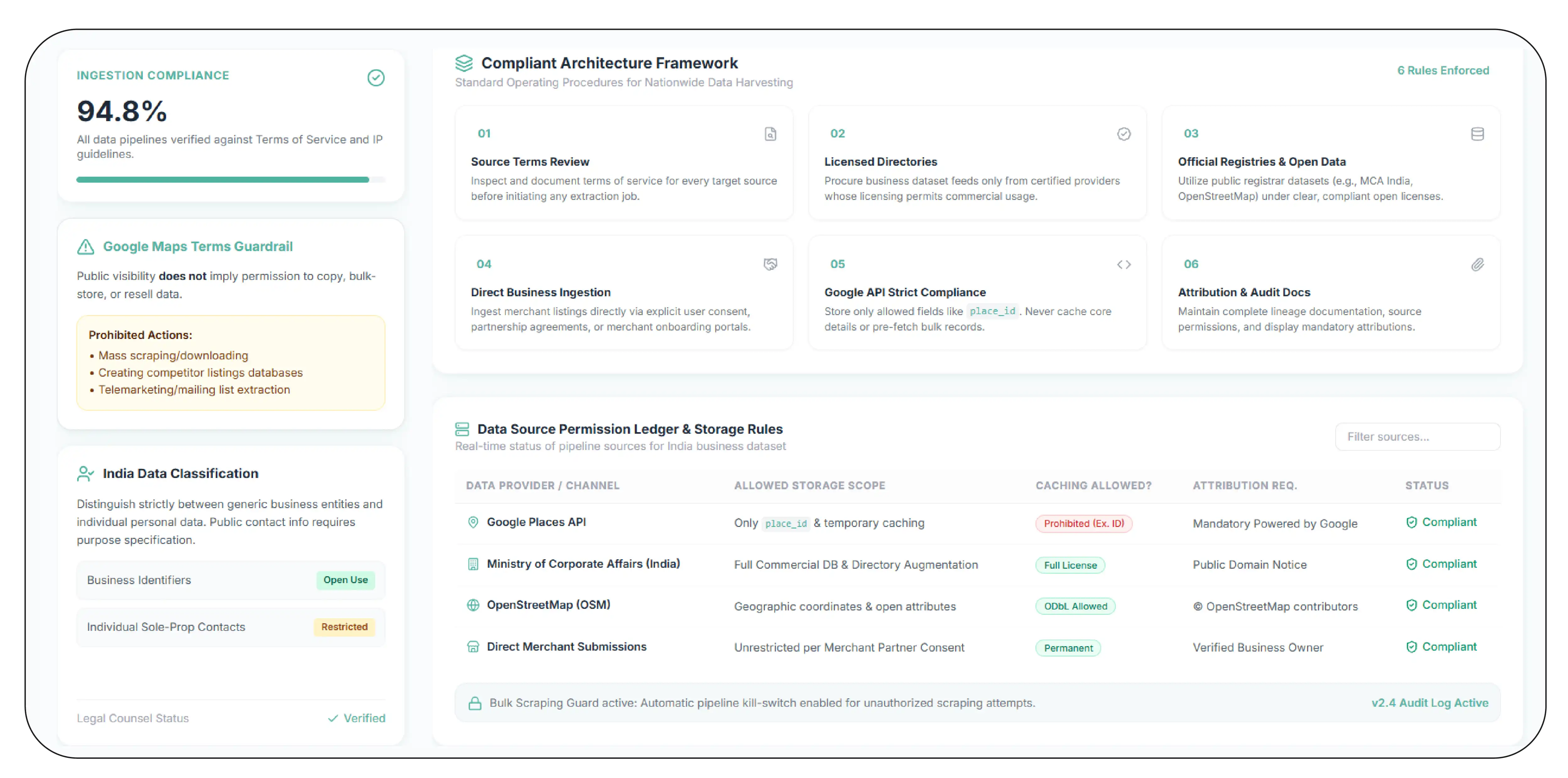
A critical part of building a nationwide business database is understanding the permissions attached to each information source. Public visibility does not automatically mean unrestricted permission to copy, store, redistribute, or sell data.
Google's current Maps Additional Terms prohibit copying content except where expressly permitted, mass downloading, and using Google Maps to create or augment a business-listings database, mailing list, or telemarketing list for a service that substitutes for or is substantially similar to Google Maps.
Google Places API also has specific storage and display rules. Its policies restrict pre-fetching, caching, and storing Places content beyond stated exceptions; the place_id field is exempt from caching restrictions. Attribution requirements also apply when displaying Places content.
Therefore, Google Maps Retail Data Extraction should not be treated as permission to scrape Google Maps pages or bulk-copy its listings into a separate commercial database. A compliant project should instead:
- Review the terms of every source before collection.
- Use licensed business directories or data providers whose agreements permit the intended use.
- Use official public registries and open datasets under their applicable reuse licences.
- Collect information directly from businesses through authorized submissions or partnerships.
- Use Google Maps Platform services only within their current contractual and storage restrictions.
- Keep source-level permissions and attribution requirements with the dataset documentation.
An India-wide Google Maps business dataset project should also distinguish between business information and personal information. Publicly displayed contact details may still require careful handling, particularly when they identify an individual. Establish a purpose for collection, limit fields to what is necessary, restrict access, and obtain appropriate legal review before using contact records for outreach.
How can a nationwide dataset be organized for long-term use?
Once records have been collected from permitted sources and verified, they need a consistent structure. A Google Maps Store Address Dataset should make it possible to search by location, category, business identity, and verification status without creating duplicate outlets or confusing branches with headquarters.
A practical data model can use separate tables for businesses, locations, categories, sources, and verification history. Each outlet should have a stable internal record ID. Where a business has multiple branches, each location should receive its own outlet record while retaining a link to the parent business.
| Dataset component | Recommended fields | Business use |
|---|
| Business identity | Internal ID, trading name, registered name where verified | Identify and deduplicate businesses |
| Location | Address, locality, city, district, state, PIN code | Territory planning and regional analysis |
| Classification | Primary category, secondary category, industry code if verified | Category-level market research |
| Contact information | Public phone, business email, website, where permitted | Authorized business communication |
| Source history | Source name, source reference, collection date, licence | Traceability and compliance |
| Verification | Status, evidence type, reviewer, last-checked date | Quality management |
| Branch relationships | Parent business ID, branch ID | Chain and outlet analysis |
For large datasets, use controlled category lists rather than allowing every researcher to create new labels. For example, distinguish a supermarket from a grocery store and a department store. Keep the original category alongside the normalized category so that classification decisions remain auditable.
Finally, establish a maintenance cycle. Monitor priority outlets more frequently, review lower-priority records on a planned schedule, and preserve historical changes instead of overwriting every previous value. This makes the database more useful for market sizing, territory planning, expansion, and lead research.
Why Choose Product Data Scrape?
A nationwide business dataset is valuable only when its coverage, accuracy, and permitted use are clearly defined. Product Data Scrape can help businesses plan structured data projects around target locations, industry categories, required fields, source permissions, and delivery formats. Its approach can include data normalization, duplicate identification, validation workflows, and organized records for business analysis. For market research teams, Geo and store-level pricing data can complement location information when collected from authorized sources and linked through reliable identifiers. A well-documented India-wide Google Maps business dataset strategy should prioritize traceability, useful coverage, and ongoing data quality rather than record volume alone.
Conclusion
Building a reliable nationwide business database requires a clear geographic plan, consistent data fields, source verification, and regular maintenance. Government establishment statistics show the scale and diversity of India's business landscape, but they should not be confused with online listing counts. A compliant India-wide Google Maps business dataset project should use authorized sources and respect platform-specific restrictions. Businesses can also combine location research with Pricing strategy services to support expansion and planning.
Contact Product Data Scrape to discuss a structured business-data project, define your target coverage, and identify the appropriate sources and delivery format for your requirements!
FAQs
1. What is a nationwide business dataset?
A nationwide business dataset organizes outlet names, categories, addresses, and permitted contact details across cities so teams can conduct location research, territory planning, and market coverage analysis consistently and efficiently.
2. Can businesses scrape Google Maps to create a commercial database?
No. Google Maps terms restrict copying, mass downloading, and certain database uses of Maps content; teams should review current terms and choose authorized sources for separate commercial datasets before collection.
3. Which sources can support business database creation?
Suitable sources include licensed business directories, official public registries, open datasets with reuse permissions, company websites, and information submitted directly by businesses through authorized channels.
4. How can business listing accuracy be maintained?
Use standardized fields, source references, verification dates, duplicate checks, address validation, and clear record statuses. Review high-priority businesses regularly and retain evidence for important changes.
5. How often should a business database be updated?
Update frequency depends on business needs, source permissions, and data availability. Product Data Scrape can help define suitable refresh schedules and validation requirements for different business categories.


 Singapore
 EMAIL
 PHONE












.webp)