Introduction
pharmacy weekly ad circular scraping helps retailers, pharmacies, and market research teams collect advertised product prices, discounts, promotional dates, and offer details from publicly accessible weekly circulars. By organizing these details into structured datasets, businesses can compare competitors, monitor changing promotions, and make better-informed pricing decisions. Scrape US Pharmacy Market Data workflows can support this process across pharmacy chains, independent retailers, and online pharmacy storefronts.
The market context makes this research valuable. According to the U.S. Census Bureau's annual economic data, U.S. pharmacies and drug stores generated approximately $295.0 billion in sales in 2020, increasing to $372.3 billion in 2024. The National Community Pharmacists Association reported that independent community pharmacies represented a $103 billion marketplace in 2024. These figures describe pharmacy sales, not the value of advertised discounts or weekly circulars.
For pharmacy retailers, the challenge is collecting promotional information consistently across different websites and circular formats. Offers may include product names, regular prices, promotional prices, discount conditions, loyalty requirements, and expiration dates. A structured collection process helps teams compare equivalent products, identify price differences, and maintain historical records. This gives category managers, pricing analysts, and retail intelligence teams a stronger foundation for competitive research.
What information should retailers collect from pharmacy advertisements?
pharmacy weekly ad data extraction turns information presented in digital circulars and promotional webpages into structured records that analysts can compare. Depending on what a retailer publishes, useful fields include product names, brands, package sizes, advertised prices, discount descriptions, offer start and end dates, loyalty-card requirements, and source URLs.
A pharmacy product monitoring API can help teams integrate collected information into their internal reporting systems. The resulting data can support product comparisons, promotion calendars, and price-change alerts. However, data collection should preserve the original offer conditions because a displayed price may depend on membership, purchase quantity, coupon redemption, or a limited promotional period.
The scale of the pharmacy sector reinforces the importance of reliable market intelligence. The U.S. Census Bureau's annual sales series reported $295.0 billion in pharmacy and drug-store sales in 2020, rising to $312.7 billion in 2021, $323.0 billion in 2022, $343.6 billion in 2023, and $372.3 billion in 2024. These are reported national sales figures, not measurements of advertising expenditure.
U.S. pharmacy and drug-store sales
| Year |
U.S. pharmacy and drug-store sales |
| 2020 |
$295.0 billion |
| 2021 |
$312.7 billion |
| 2022 |
$323.0 billion |
| 2023 |
$343.6 billion |
| 2024 |
$372.3 billion |
Source: U.S. Census Bureau data via FRED. Figures rounded from reported annual values.
Retailers can use these market figures to understand the industry's scale, while their own collected circular data reveals the specific advertised prices and promotions competitors publish. The two data types should remain separate in reporting.
How can promotional records be organized for historical comparison?
Businesses that scrape pharmacy weekly ad deals into a database can create a searchable history of advertised offers instead of relying on scattered screenshots or manually maintained spreadsheets. A structured database makes it easier to compare products across retailers, track changes between weekly circulars, and retrieve offers that were available during a particular period.
Each record should include the retailer, product identifier where available, product name, package size, advertised price, offer conditions, observation date, validity period, and source URL. Where possible, the system should retain the original offer text so analysts can verify how a promotion was presented. Normalized fields make comparisons easier, while the original source preserves important context.
The database should also distinguish a new offer from an update to an existing one. If the same product appears in consecutive circulars, the system should record whether its price, discount conditions, or expiration date changed. Product matching requires care: similar names may refer to different strengths, quantities, brands, or package sizes.
The following table uses actual monthly U.S. pharmacy and drug-store sales observations from the Census Bureau's retail trade series. It offers recent market context for a promotional intelligence workflow; it does not measure the number of pharmacy ads collected or the discounts advertised.
Reported monthly sales
| Period |
Reported monthly sales |
| December 2020 |
$27.798 billion |
| December 2021 |
$30.448 billion |
| December 2022 |
$30.547 billion |
| December 2023 |
$32.918 billion |
| December 2024 |
$34.925 billion |
| December 2025 |
$38.231 billion |
| July 2026 |
$34.722 billion |
Source: U.S. Census Bureau monthly pharmacy and drug-store sales series. Figures are not seasonally adjusted. July 2026 is the latest monthly observation shown in the cited series, not a full-year total.
A database built around consistent identifiers and dates helps pricing teams answer practical questions: Which products repeatedly receive promotions? Which offers have changed since the previous circular? Which competitor prices should be checked before a new campaign is launched?
How can retailers compare promotions across competing pharmacy chains?
pharmacy promotional data scraping enables analysts to collect publicly displayed offer information from multiple pharmacy retailers and place it into a consistent comparison framework. The goal is to compare equivalent products and promotion conditions, not simply identify the lowest number displayed on a page.
For example, one retailer may advertise a discount for loyalty members, while another displays a standard promotional price available to all customers. A meaningful comparison needs to retain those conditions. It should also account for differences in product size, quantity limits, offer duration, and coupon requirements.
A structured approach to pharmacy weekly ad circular scraping can support category-level research across personal care, vitamins, first-aid products, over-the-counter medicines, and other items that appear in public retail promotions. Analysts can compare advertised prices, identify repeated promotional patterns, and see whether certain products are featured during specific campaign periods. Prescription drug pricing and access require additional care and should not be inferred from general retail circulars.
The independent pharmacy market offers additional context. The National Community Pharmacists Association's 2025 Digest reported 18,960 independent community pharmacy locations as of July 2025. Its 2024 Digest reported 18,984 locations in June 2024, down from 19,432 in 2023. These figures indicate the size and changing footprint of the independent pharmacy sector, not the number of retailers publishing weekly circulars.
Source: NCPA's 2025 Digest announcement and 2024 Digest announcement.
To make competitive analysis actionable, businesses should maintain a consistent product taxonomy, preserve offer conditions, and flag records where product equivalence is uncertain. Price comparisons should be based on verified, like-for-like offers rather than assumptions drawn from similar product names.
What should analysts consider when monitoring large retail pharmacy websites?
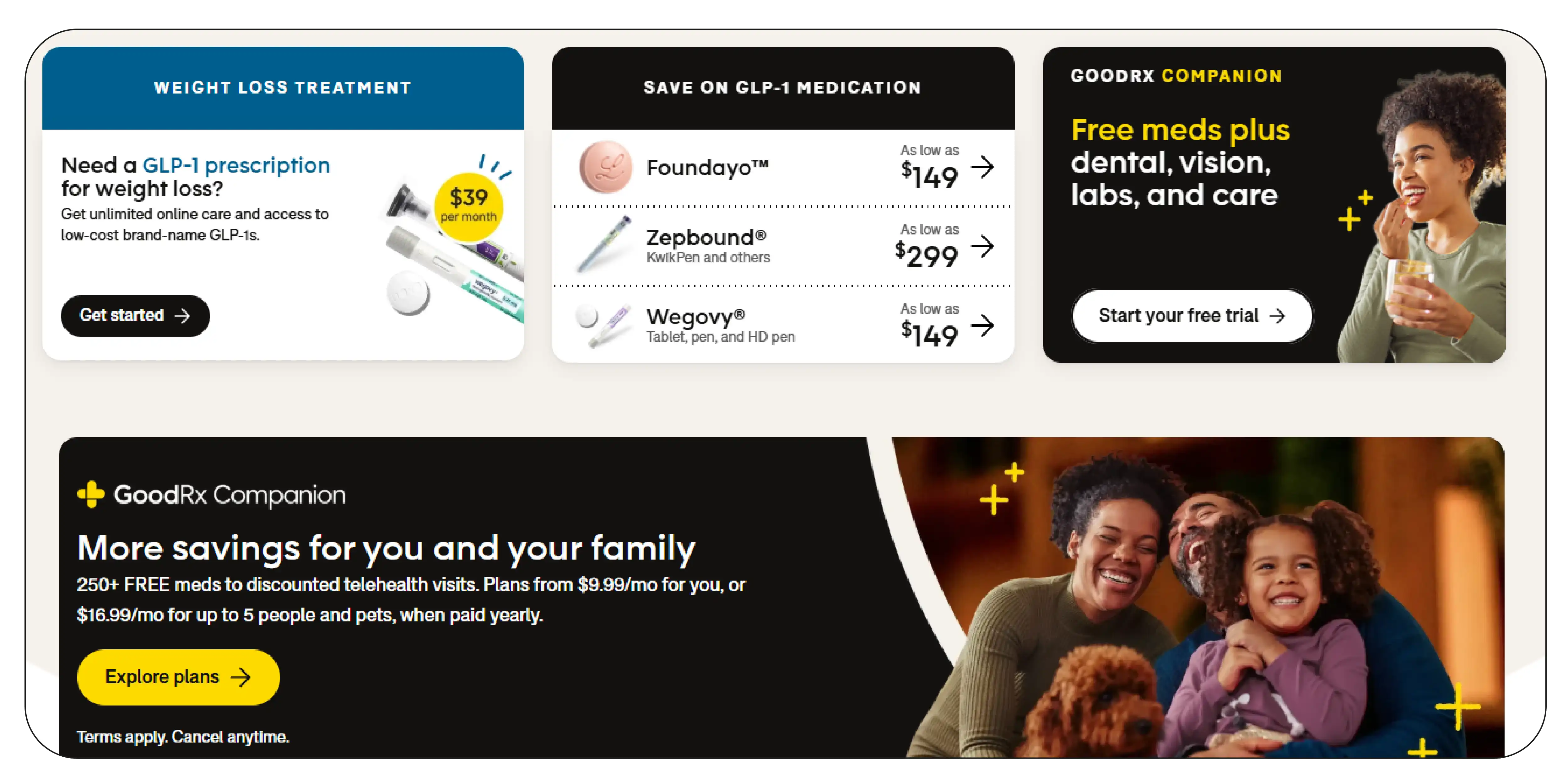
Walmart pharmacy weekly ad scraping requires clear distinctions between general merchandise promotions, pharmacy-related retail products, and prescription services. Walmart publishes a wide range of retail offers, but a weekly-ad collection project should capture only the product and promotion fields relevant to its research objectives.
For advertised over-the-counter products, health and personal care items, vitamins, and first-aid supplies, useful fields can include the displayed product title, brand, package size, advertised price, promotion dates, conditions, and source page. Where the website presents an offer through an image or circular viewer, the extraction process may also need text recognition and validation to make the information searchable.
The U.S. pharmacy retail market is large enough to make consistent category-level comparisons valuable. Census Bureau annual sales data show that pharmacies and drug stores recorded $372.3 billion in sales in 2024, compared with $295.0 billion in 2020. These official figures provide a real-world measure of the industry's scale but do not identify Walmart's pharmacy sales or reveal its weekly promotional strategy.
Source: U.S. Census Bureau pharmacy and drug-store sales data.
A reliable monitoring process should preserve the retailer name, source URL, capture date, offer validity dates, and any loyalty or quantity restrictions. It should also verify that the extracted price belongs to the correct product and variant. When an advertised deal changes, the system should store the new observation instead of overwriting the previous record without an audit trail.
Businesses should respect website terms, access restrictions, and applicable data rules. The aim is to build dependable competitive intelligence from available public promotional information, not to assume that every displayed price applies to every customer or location.
How can historical circular records reveal pricing patterns?
A pharmacy circular scraper can collect recurring promotional details and preserve them for historical comparison. When a business retains dated records from each circular, analysts can investigate how often particular products are discounted, how long offers remain active, and whether the same items appear in repeated campaigns.
Historical data becomes more useful when product records are standardized. Brand names, package sizes, quantities, and units should be normalized so that comparisons do not mix different products. Advertised prices should also be stored with their conditions. A loyalty-only price, a multi-buy offer, and an unrestricted sale price are not necessarily equivalent.
Using pharmacy weekly ad circular scraping, retailers can build a promotion timeline for selected products and compare their own campaigns with publicly advertised competitor offers. Category managers can use this timeline when planning promotions, while analysts can identify changes that merit manual verification. The system should retain source links and capture dates so that results can be traced back to the original advertisement.
The independent pharmacy sector provides a useful example of why market context matters. NCPA's 2025 Digest reported that independent pharmacies represented a $103 billion marketplace in 2024, and the average independent pharmacy filled 67,601 prescriptions during that year. The organization also reported that gross profit margins fell to 18.2% in 2024, down from 19.7% in 2023.
Source: NCPA's 2025 Digest announcement.
These figures describe independent pharmacy economics, not the profitability of individual advertised products. Still, they illustrate why retail decision-makers benefit from separating prescription-related business measures from promotional pricing on consumer products. Circular data can support comparisons of advertised offers, but it cannot independently establish sales volume, profit margins, or the cause of a retailer's financial performance.
How can collected promotional data reach business systems efficiently?
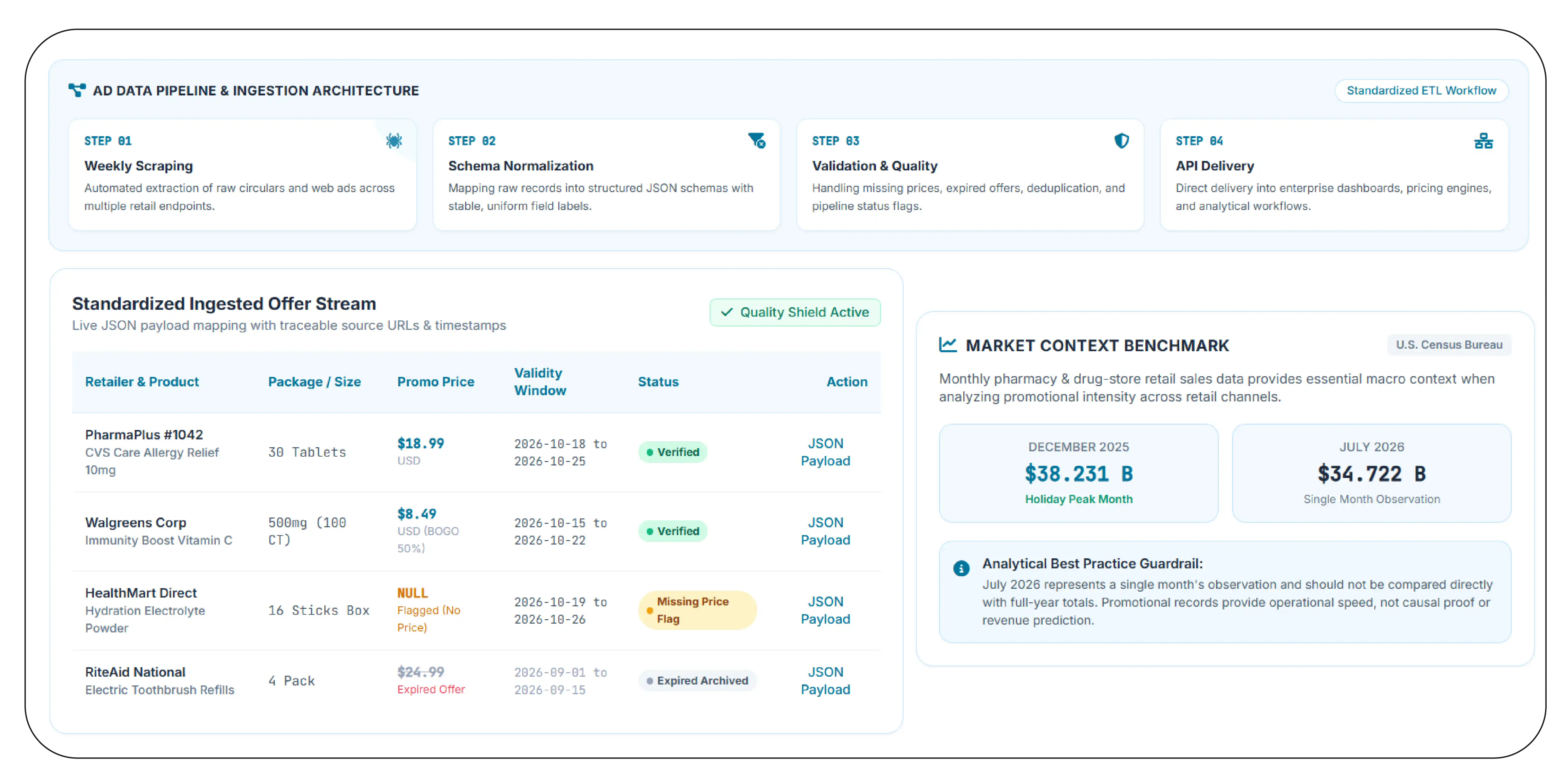
weekly ad scraping with API delivery gives businesses a way to move structured offer records into dashboards, databases, pricing tools, and internal reporting workflows. Rather than reviewing every circular manually, teams can consume standardized records and apply their own comparison rules.
A useful delivery structure includes retailer identifiers, product names, brand, package size, advertised price, currency, promotion conditions, start and end dates, capture timestamp, source URL, and data-quality status. Stable field names make records easier to integrate with existing systems. A clear update policy helps downstream applications distinguish newly collected offers from changes to existing ones.
Data validation remains essential. A missing price should not be converted to zero, and an expired offer should not be presented as currently available. Duplicate records should be identified without deleting meaningful changes in offer terms. Businesses should also define how corrections, collection failures, and unavailable pages are represented.
Official monthly retail sales data can provide context for reporting. The U.S. Census Bureau's monthly series reported pharmacy and drug-store sales of $38.231 billion in December 2025 and $34.722 billion in July 2026. The July value is a single month's observation, so it should not be compared with a full-year total as if the periods were equivalent.
Source: U.S. Census Bureau monthly pharmacy and drug-store sales data.
For decision-makers, API delivery is valuable when the data arrives with clear timestamps, consistent schemas, and traceable sources. Teams can then combine current promotional records with their own product catalogs, pricing rules, and historical observations. The resulting workflow supports faster review and repeatable analysis without claiming to predict sales or prove that a promotion caused a business outcome.
Why Choose Product Data Scrape?
Product Data Scrape helps businesses explore structured collection workflows for retail promotion research, product comparisons, and competitor monitoring. A well-defined solution can organize advertised prices, product details, offer conditions, source links, and capture timestamps into a consistent format. This helps analysts reduce repetitive manual work and build searchable records for reporting.
For teams working with E-commerce data for pharma, clear product matching and accurate promotion conditions are particularly important. A reliable process should distinguish loyalty prices from general offers, preserve expiration dates, and flag records that need validation. These controls support more meaningful comparisons across pharmacy retailers.
Businesses should define their target retailers, product categories, refresh frequency, required fields, and delivery format before implementation. Collection should follow applicable website terms and access restrictions. The objective is practical market intelligence based on verifiable advertised information rather than unsupported assumptions.
Conclusion
Pharmacy circular data can help retailers compare publicly advertised prices, monitor promotion changes, and build a historical view of competitor activity. Real U.S. Census Bureau statistics show that pharmacy and drug-store sales reached $372.3 billion in 2024, highlighting the scale of the sector. However, these sales figures do not measure weekly-ad volume or the discounts retailers publish.
Scraping Pharmacy E-Commerce Websites can support a structured workflow for collecting public product offers, retaining promotion conditions, and delivering records to reporting systems. Reliable results depend on comparable products, accurate dates, traceable sources, and consistent validation.
Ready to improve your retail promotion intelligence? Contact Product Data Scrape to discuss a data collection workflow tailored to your target pharmacy retailers, product categories, and reporting requirements!
FAQs
1. What is pharmacy weekly ad circular scraping?
It is the collection of publicly available pharmacy advertisement information, such as product names, advertised prices, discounts, offer conditions, and validity dates, for structured retail analysis.
2. Which data fields are useful for pharmacy promotion research?
Useful fields include retailer, product name, brand, package size, advertised price, offer conditions, promotion dates, capture timestamp, and source URL for verification.
3. Can circular data show which pharmacy has the lowest prices?
It can compare advertised prices for equivalent products, but analysts must account for package sizes, loyalty requirements, coupons, quantities, and offer expiration dates.
4. Are pharmacy sales statistics the same as promotional data?
No. Sales statistics measure reported retail activity, while circular data records advertised offers. Sales figures cannot establish discount frequency or the performance of individual promotions.
5. How can Product Data Scrape help with pharmacy circular research?
Product Data Scrape can discuss structured collection options for public pharmacy promotions, product-level price comparisons, historical offer records, and delivery formats suited to business reporting.


 Singapore
 EMAIL
 PHONE










.webp)