Quick Overview
This case study shows how a large-scale grocery intelligence project helped a market research business transform fragmented e-commerce information into structured, analysis-ready product intelligence. The project focused on collecting, organizing, and enriching grocery listings across categories such as snacks, beverages, breakfast foods, pantry staples, and household grocery essentials. Using Top 1 Million records of Grocery Category Data from Amazon.com and Grocery data scraping, the project improved research scalability, reduced manual processing, and created a more consistent foundation for competitive analysis. The engagement combined automated collection, structured processing, validation, enrichment, and API-ready delivery to support faster grocery market research and recurring analytical workflows.
Client Name: Confidential Grocery Market Intelligence Company
Industry: Grocery Retail & Market Research
Service: Product Data Scrape and Competitive Product Intelligence
Duration: 12 Months
Key Impact Metrics: 1M+ product records processed; 90%+ reduction in manual data handling; 3x faster research preparation
The Client
The client was a grocery market intelligence company supporting retailers, consumer brands, distributors, and research teams with product and competitive analysis. Its customers needed detailed information across grocery categories, including product names, brands, pack sizes, pricing, ratings, availability, category placement, and other publicly visible attributes.
Competitive pressure in online grocery was increasing rapidly. Brands such as Kellogg's, Nestlé, PepsiCo, Coca-Cola, General Mills, Quaker, and Amazon Basics compete across overlapping product categories, making accurate assortment and pricing intelligence increasingly important.
Before the partnership, the client relied heavily on fragmented research workflows. Analysts manually collected product information, organized spreadsheets, checked duplicates, and repeatedly validated changing attributes. As the number of products increased, these processes became difficult to scale.
The client required a more automated and standardized approach. An Amazon grocery data scraper for 1 million products became an important part of the transformation strategy, while Grocery Datasets provided the structured foundation needed for historical comparison, competitive research, and category-level analysis.
The transformation was essential because manual workflows could not consistently support large-scale research cycles. A structured product intelligence pipeline enabled the client to move from repetitive collection toward automated analysis and faster business reporting.
Goals & Objectives
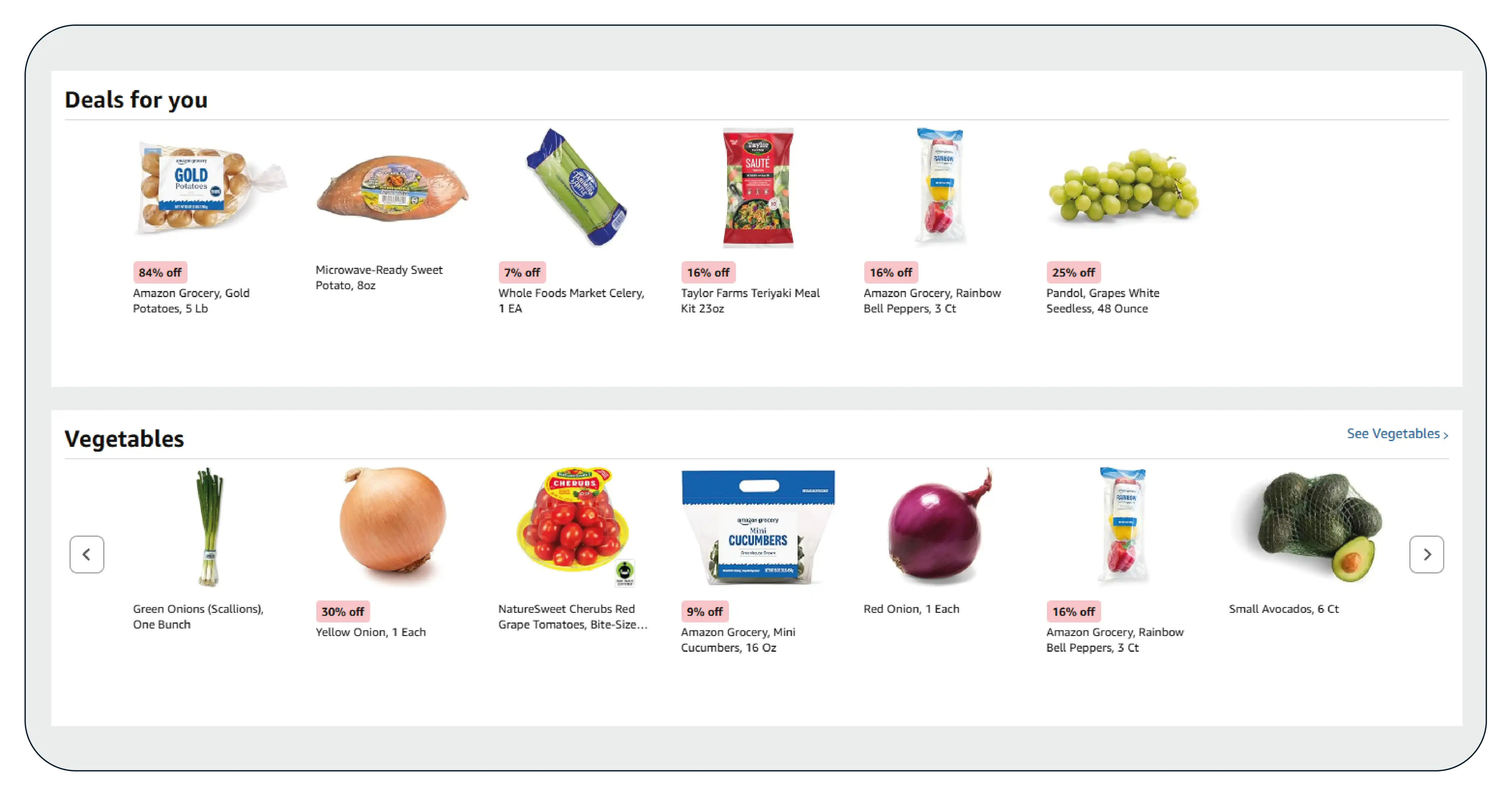
The project was designed around three connected priorities: scalability, operational speed, and data quality. The client wanted a system capable of handling a substantially larger product universe while maintaining consistent fields and minimizing repetitive analyst intervention.
Build a scalable product intelligence workflow capable of handling millions of grocery records.
Improve the speed of competitive product research.
Increase consistency across product attributes, categories, brands, and pricing fields.
Reduce repetitive spreadsheet-based data preparation.
Support recurring research requirements across multiple grocery segments.
Automate collection and structured processing of publicly available grocery product information.
Establish standardized product fields for downstream analysis.
Create workflows suitable for integration with internal databases and analytics systems.
Enable faster category-level comparison across brands and products.
Prepare structured information for recurring reporting and market intelligence.
The technical foundation included an Amazon grocery scraper for large datasets, designed to support high-volume processing while maintaining validation and normalization workflows.
Process more than 1 million grocery product records.
Reduce manual data preparation by at least 90%.
Improve research preparation speed by approximately 3x.
Maintain high field-level consistency through automated validation.
Enable repeatable data refresh workflows for ongoing analysis.
The Core Challenge
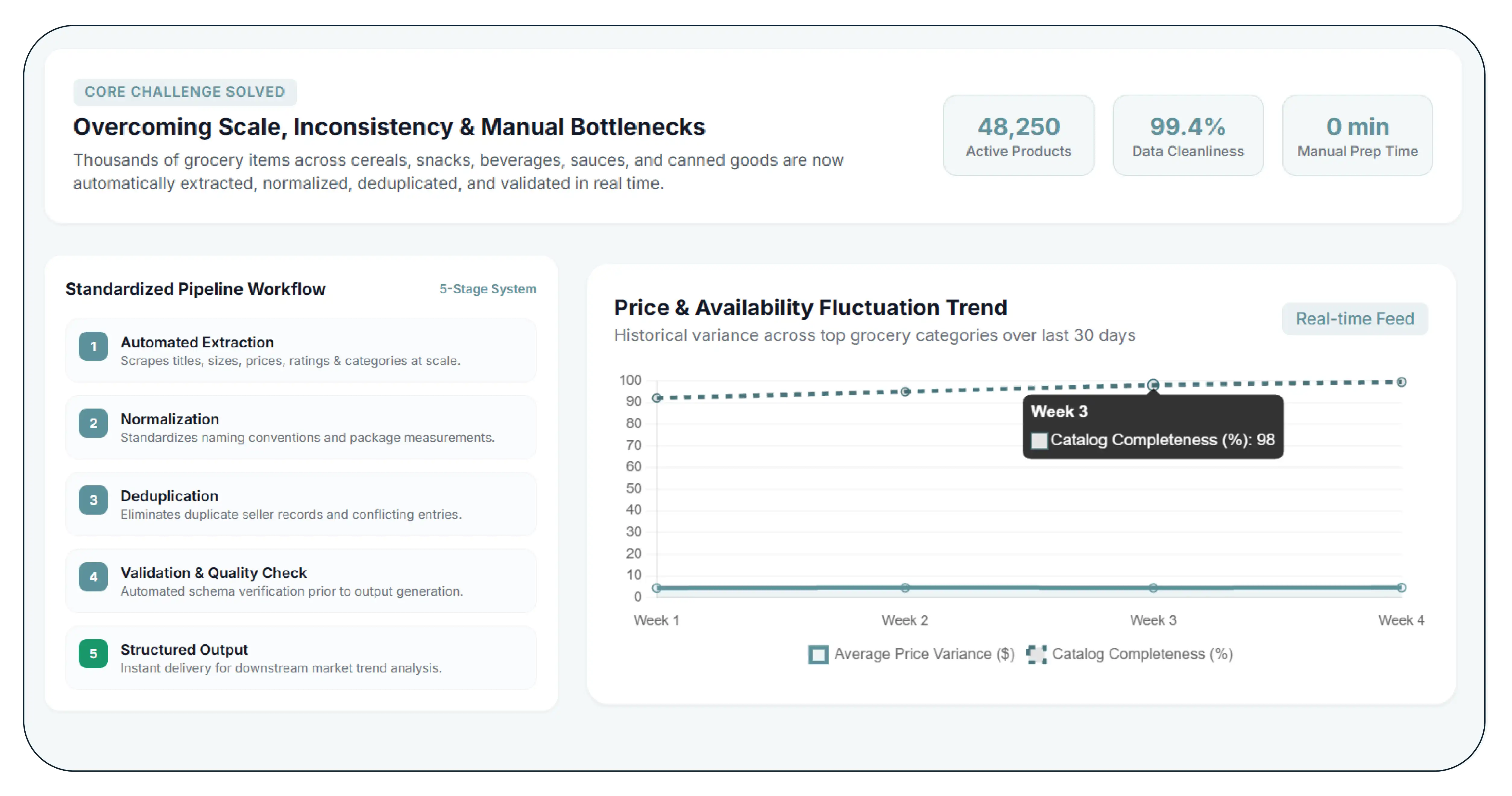
The client's primary challenge was scale. Grocery categories contain thousands of products with constantly changing attributes. Product titles, package sizes, prices, availability, ratings, brands, and category placements can vary across listings and change over time.
Previously, analysts depended on multiple manual processes to gather and organize information. This created operational bottlenecks, especially when researchers needed to compare large product groups from categories such as cereals, snacks, beverages, sauces, canned foods, baking products, and packaged meals.
Another issue was inconsistency. Different analysts could structure similar product information differently, creating duplicate records or inconsistent naming conventions. This reduced the efficiency of downstream analysis and increased the time required for quality checks.
The client needed to scrape Amazon grocery category data at scale while preserving useful product attributes and maintaining a repeatable processing framework.
Performance was another concern. Large datasets could not simply be collected and placed into spreadsheets without creating processing challenges. The workflow needed automated extraction, normalization, deduplication, validation, and structured output.
The absence of a standardized pipeline also made recurring research difficult. Analysts spent valuable time preparing information instead of interpreting market movements. The solution therefore needed to address both data volume and operational efficiency without compromising the usefulness of the final dataset.
Our Solution
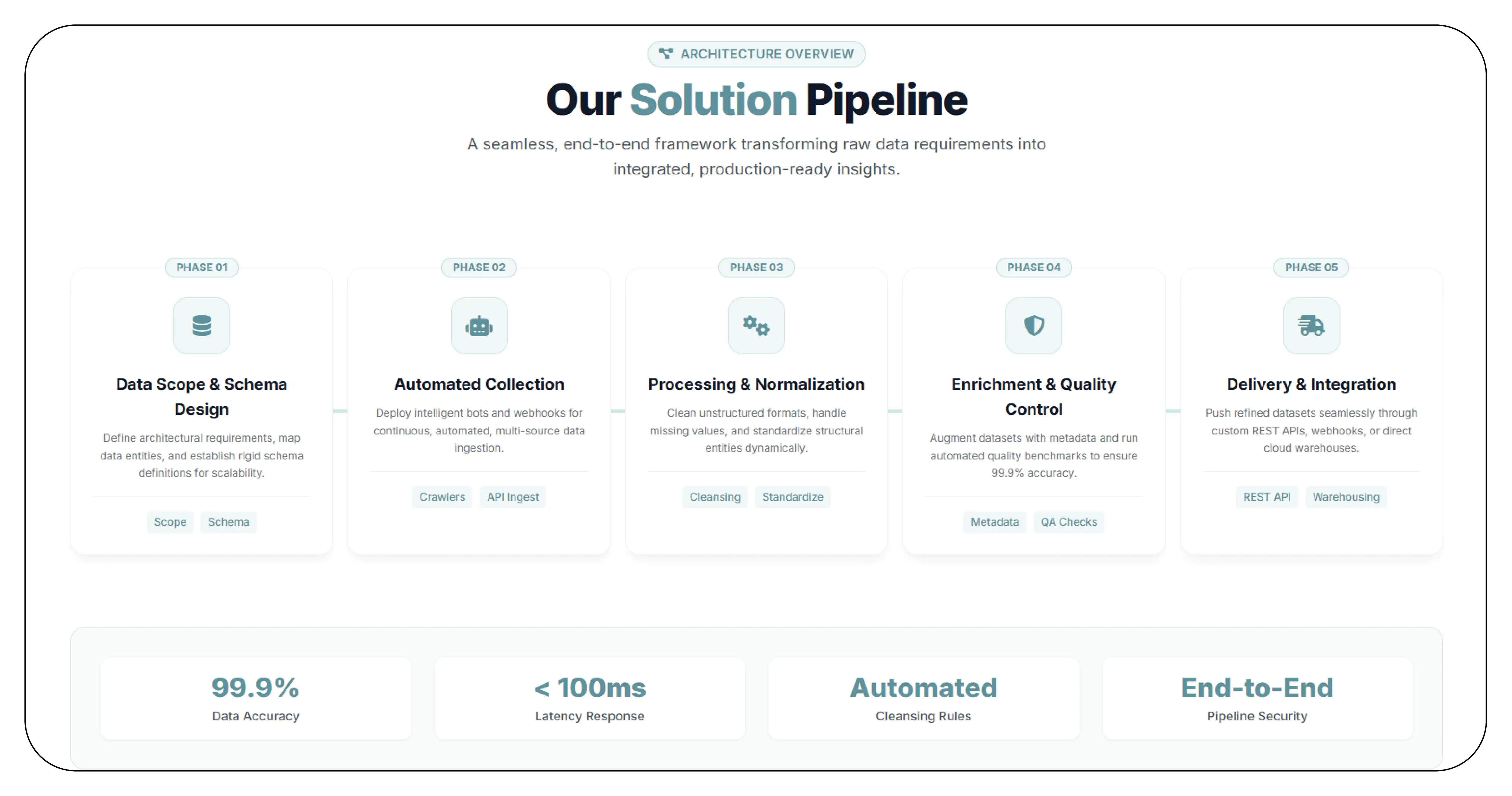
The implementation followed a phased approach designed to make large-scale grocery product intelligence more manageable, consistent, and reusable.
Phase 1: Data Scope and Schema Design
The first phase established the required product fields and category structure. The schema covered attributes such as product title, brand, category, subcategory, price, package information, rating, review count, availability, product URL, and other relevant listing information. Products representing brands such as Kellogg's, Nestlé, General Mills, Quaker, PepsiCo, Coca-Cola, and Amazon Basics were organized into standardized structures where applicable.
Phase 2: Automated Collection
The next stage introduced automated collection workflows for publicly accessible product information. Instead of relying on analysts to manually copy product details, automated processes gathered product-level information according to defined category and field requirements. The workflow was designed around Amazon grocery product catalog extraction, allowing large volumes of product information to move through the pipeline systematically.
Phase 3: Data Processing and Normalization
Raw information was then processed through normalization routines. Product names were standardized, brand values were cleaned, category relationships were organized, and inconsistent formatting was addressed. Duplicate detection helped prevent repeated listings from unnecessarily inflating the dataset. Validation routines also checked whether essential fields met predefined quality requirements.
Phase 4: Enrichment and Quality Control
The dataset was enriched with structured attributes that improved its analytical usefulness. Product categories, brand information, package details, ratings, and other relevant attributes were organized for easier filtering and comparison. Quality-control rules were applied before records entered the final analytical environment. This helped identify missing, malformed, or inconsistent values.
Phase 5: Delivery and Integration
The final phase converted the processed information into structured outputs suitable for database storage, analytics platforms, and research workflows. The resulting Top 1 Million records of Grocery Category Data from Amazon.com provided the client with a scalable foundation for competitive grocery research. Instead of repeatedly rebuilding datasets manually, research teams could work with standardized information prepared for analysis, reporting, benchmarking, and future refresh cycles.
Results & Key Metrics
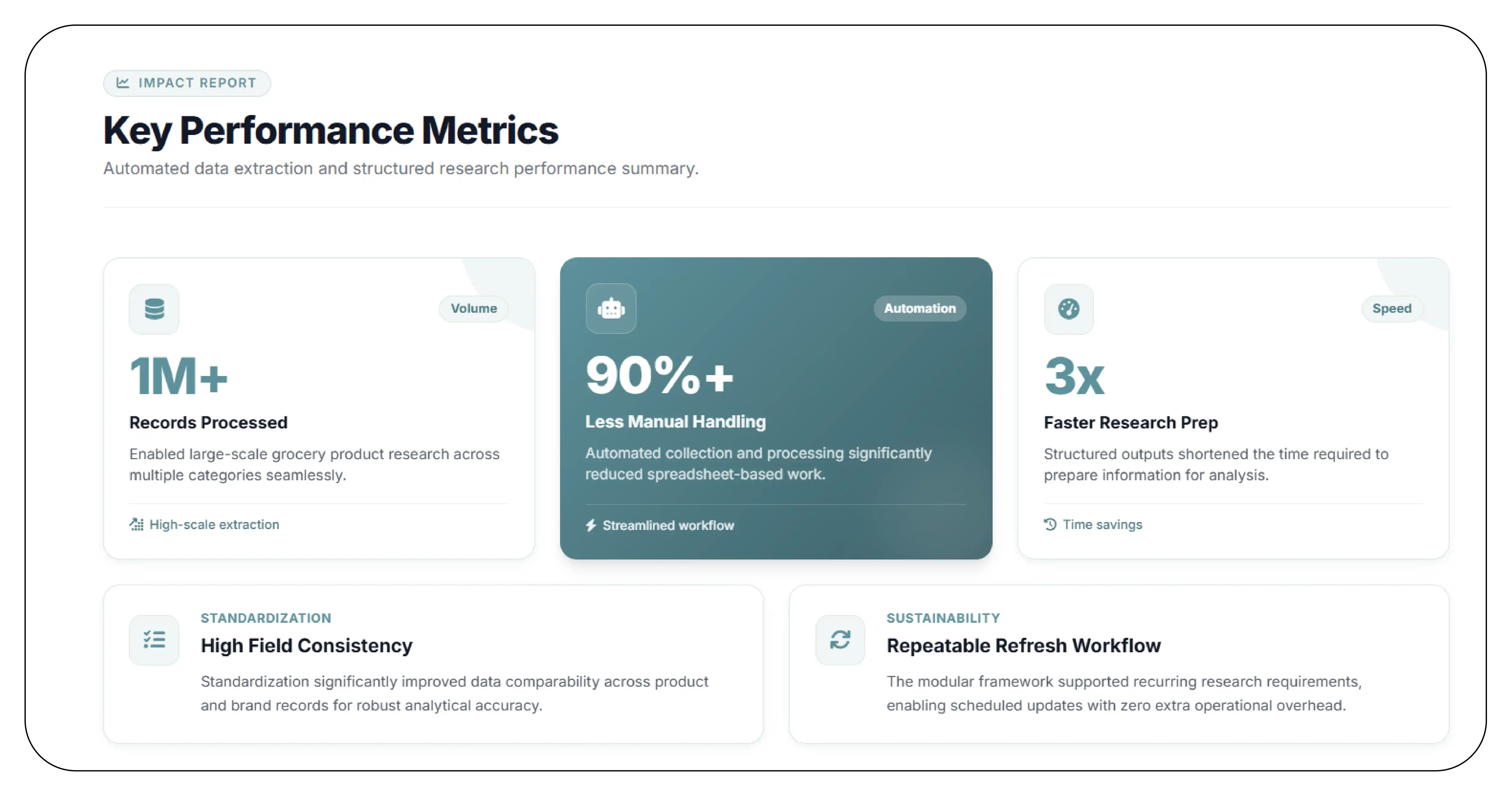
1M+ records processed: Enabled large-scale grocery product research across multiple categories.
90%+ less manual handling: Automated collection and processing significantly reduced spreadsheet-based work.
3x faster research preparation: Structured outputs shortened the time required to prepare information for analysis.
High field consistency: Standardization improved comparability across product and brand records.
Repeatable refresh workflow: The framework supported recurring research requirements.
Results Narrative
The project transformed a fragmented product research process into a scalable data workflow. The Amazon grocery product data extraction API approach enabled structured information to move more efficiently from collection into analytical environments.
The Top 1 Million records of Grocery Category Data from Amazon.com created a broad product intelligence foundation covering grocery categories and competitive product listings.
For analysts, the biggest improvement was operational efficiency. Instead of spending substantial time collecting, cleaning, and organizing individual listings, teams could focus more attention on interpreting category movements, comparing products, monitoring competitive positioning, and developing market insights.
What Made Product Data Scrape Different
The key differentiator was the combination of scale, structured processing, automation, and enrichment. Rather than treating grocery listings as isolated records, the workflow transformed them into standardized product intelligence suitable for comparison and analysis.
The Catalog Enrichment process added analytical value by organizing attributes such as product category, brand, package information, pricing, ratings, and availability into consistent structures.
Automation reduced repetitive analyst intervention, while validation routines improved data consistency. The architecture was also designed around scalable processing so that future category expansion would not require completely rebuilding the workflow.
The Top 1 Million records of Grocery Category Data from Amazon.com served as a large-scale foundation for competitive grocery research, giving teams a broader view of product assortment and market positioning.
Client's Testimonial
"Before this project, our analysts spent a significant amount of time preparing grocery product information before they could even begin market analysis. The new workflow changed that process completely. We now have structured product information that can be filtered, compared, enriched, and analyzed much faster. The ability to work with a million-plus records has also expanded the scope of research we can deliver to our clients. The automation and validation layers have made our research workflow considerably more reliable and scalable."
— Director of Market Intelligence, Confidential Grocery Research Company
The implementation of an Amazon Product Data Scraper helped the client establish a repeatable product intelligence workflow for ongoing competitive research.
Conclusion
Large-scale grocery research requires more than simply collecting product listings. Businesses need structured, consistent, scalable information that can support competitive analysis, category research, pricing intelligence, and product benchmarking.
The project demonstrated how automated workflows can transform high-volume grocery information into a practical research asset. By combining structured collection, normalization, validation, enrichment, and scalable delivery, the client significantly improved its research preparation process.
The ability to Scrape Amazon Review & Rating Data can further strengthen product intelligence by helping businesses evaluate customer sentiment and product performance alongside assortment and pricing information.
With the Top 1 Million records of Grocery Category Data from Amazon.com serving as a broad analytical foundation, the client is positioned to expand category coverage, automate future refreshes, and develop deeper competitive grocery insights as market conditions evolve.
Frequently Asked Questions
1. What information can a large grocery product dataset contain?
A structured grocery dataset can contain product titles, brands, categories, prices, package sizes, ratings, review counts, availability, product URLs, and other publicly visible product attributes. The exact fields depend on the research requirements and intended analysis.
2. How can large-scale grocery product information support competitive research?
Large product collections allow analysts to compare assortment, pricing, product positioning, brands, package sizes, ratings, and category coverage. This helps businesses identify competitive patterns and potential opportunities across grocery segments.
3. Why is automation important for grocery product research?
Automation reduces repetitive manual work and makes recurring research easier to manage. It can support consistent collection, normalization, validation, deduplication, and structured delivery while allowing analysts to spend more time interpreting results.
4. Which grocery categories can be analyzed?
Potential categories include cereals, snacks, beverages, coffee, tea, canned foods, sauces, baking products, breakfast foods, packaged meals, frozen foods, and other grocery segments. Category scope can be customized according to project requirements.
5. How can structured grocery data improve market intelligence?
Structured information makes it easier to filter, compare, aggregate, and analyze large product collections. Research teams can use standardized records to examine category trends, competitive assortment, product positioning, pricing patterns, and other market signals.


 Singapore
 EMAIL
EMAIL
 PHONE
PHONE










.webp)