The Client
A pet accessories D2C brand — collars, harnesses, beds, and feeding products — selling across marketplaces and its own site. Its products had a loyal following and a nagging, unexplained undercurrent of returns and mixed reviews the team couldn't get to the bottom of.
Client details are anonymised. Figures are representative of the engagement.
The Problem: A Return Rate Nobody Could Explain
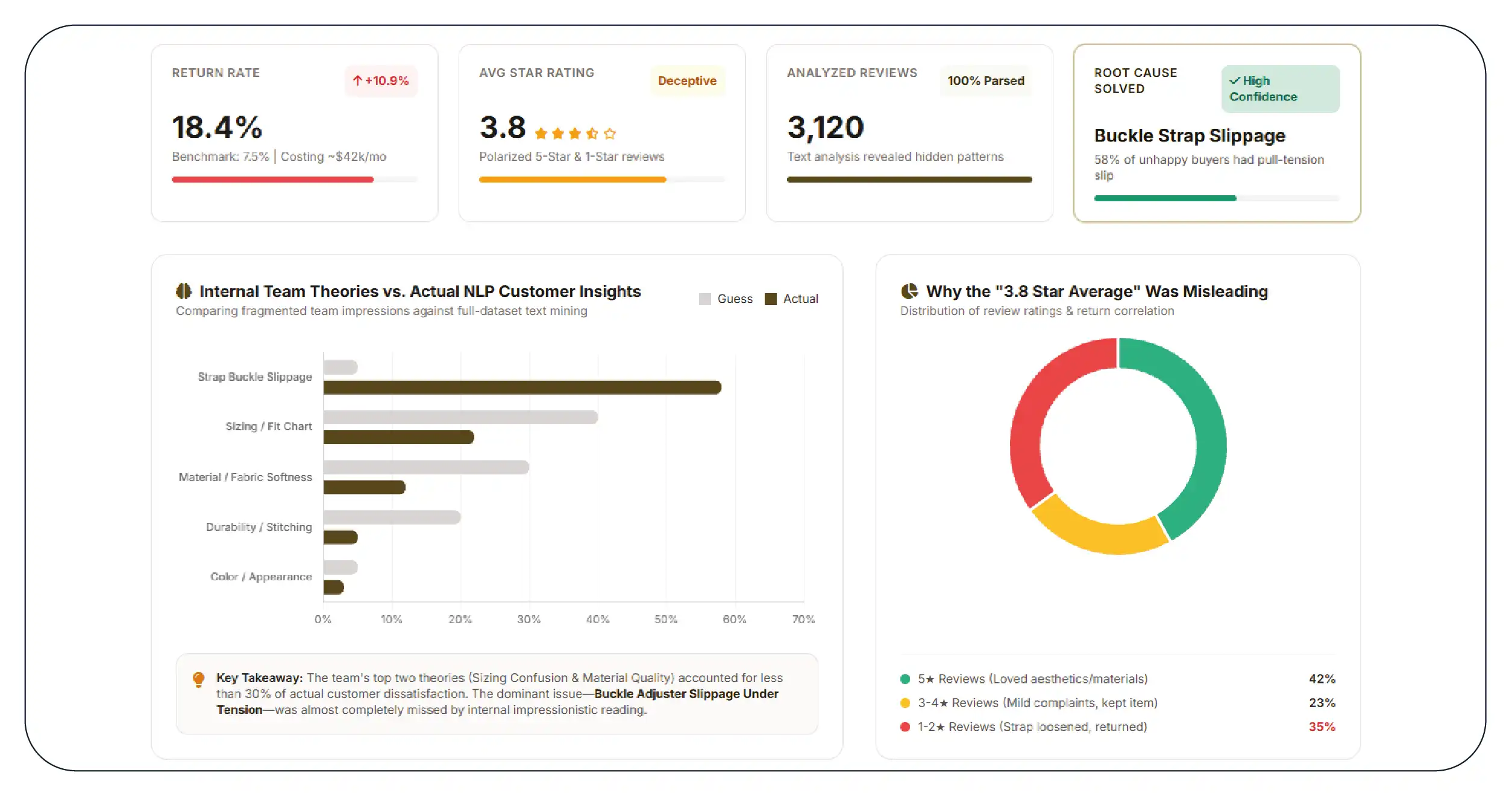
The brand had a hero product — an adjustable harness — that sold well and returned at a rate the team found frustrating and inexplicable. The reviews were mixed in a way that averaged to "fine" and hid whatever was actually wrong. Some customers loved it; a meaningful minority were unhappy; and nobody could say precisely why the unhappy ones were unhappy.
The team read reviews the way most teams do — a handful, occasionally, forming impressions. One person thought it was a durability issue. Another blamed sizing confusion. A third suspected the material. Everyone had a theory from the reviews they'd happened to read, and the theories contradicted each other because each was based on a different, tiny, non-representative sample.
Meanwhile the returns continued, the mixed reviews dragged the rating, and the brand kept guessing at a problem its customers were describing in detail, thousands of times, in text nobody was systematically reading.
The product lead's summary: our customers are telling us exactly what's wrong with this harness in the reviews. We just can't read three thousand of them, so we're guessing.
Why Reading Reviews by Hand Failed
Reviews are the richest product feedback a brand gets and are nearly useless read casually.
Volume defeats manual reading. Thousands of reviews across marketplaces can't be read and categorised by hand. Whoever tries reads the recent or the extreme and mistakes them for the pattern.
Mixed ratings hide the cause. A rating that averages to "fine" is the least informative outcome — it means real problems are being cancelled out by real strengths, and the average tells you nothing about either. The cause lives in what the unhappy reviewers specifically complain about, which a star average can't show.
Contradictory theories win by volume. Without a count, the loudest or most recent theory wins the meeting. Someone's single vivid durability review drives a decision the actual distribution wouldn't support.
Returns and reviews aren't connected. The reason for a return often sits in the reviews, but without structuring the review text, the brand couldn't link the return rate to the specific complaint driving it.
The Solution: Aspect-Based Pet Product Review Sentiment Analysis
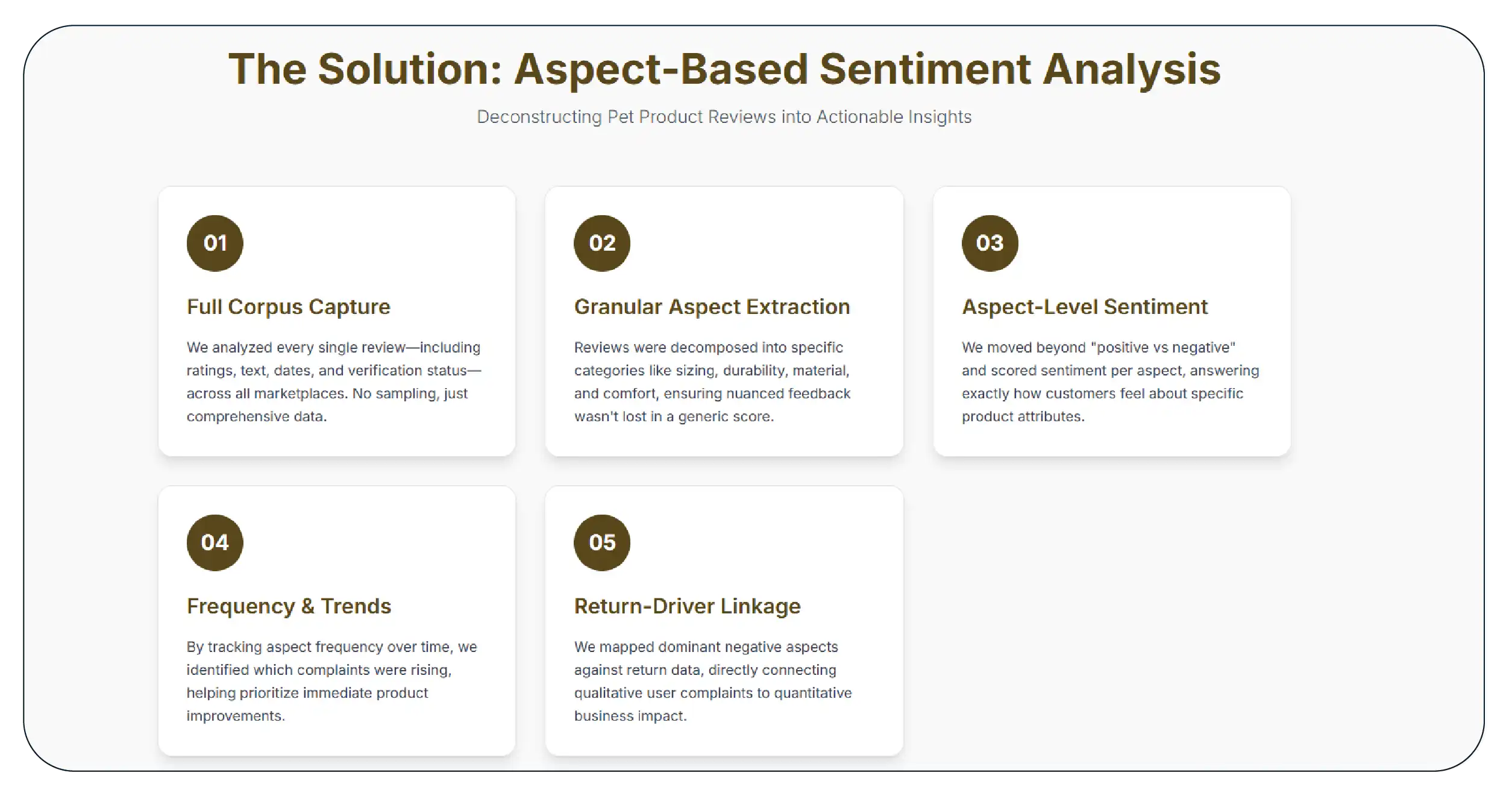
Product Data Scrape built pet product review sentiment analysis across the harness's reviews on every marketplace it sold on.
- Full review capture. Every review — rating, text, date, verified-purchase status — was captured across marketplaces, so the analysis ran on the whole corpus, not a sample.
- Aspect extraction. Each review was decomposed into the specific aspects it addressed — sizing/fit, durability, material, comfort for the animal, ease of use, value — because a single review often praised one and criticised another, and whole-review scoring would blur them.
- Aspect-level sentiment. Sentiment was scored per aspect, so the output answered "how do customers feel about the fit?" rather than "is this review positive?"
- Frequency and trend. Each aspect was counted and tracked, revealing which complaint dominated and whether it was rising.
- Return-driver linkage. The dominant negative aspects were placed against the return pattern, connecting the complaint in the reviews to the returns it was driving.
Sample Data: The Aspect Breakdown
An illustrative aspect-based sentiment summary for the harness.
| Aspect |
Mentions |
Positive |
Negative |
Trend |
| Sizing / fit |
High |
34% |
66% |
Worsening |
| Durability |
Medium |
78% |
22% |
Stable |
| Material quality |
Medium |
81% |
19% |
Stable |
| Comfort for pet |
High |
74% |
26% |
Stable |
| Ease of use |
Medium |
69% |
31% |
Stable |
| Value |
Medium |
72% |
28% |
Stable |
Illustrative.
The structured record:
{
  "product_id": "PET-HARNESS-ADJ-HERO",
  "reviews_analysed": 3120,
  "sources": ["amazon_in", "marketplace_2"],
  "average_rating": 3.9,
  "aspect_sentiment": [
    {"aspect": "sizing_fit",    "mentions": 1680, "positive_pct": 34, "trend": "worsening"},
    {"aspect": "durability",    "mentions": 720,  "positive_pct": 78, "trend": "stable"},
    {"aspect": "material",      "mentions": 640,  "positive_pct": 81, "trend": "stable"},
    {"aspect": "comfort_pet",   "mentions": 1210, "positive_pct": 74, "trend": "stable"},
    {"aspect": "ease_of_use",   "mentions": 590,  "positive_pct": 69, "trend": "stable"}
  ],
  "dominant_negative_aspect": "sizing_fit",
  "return_linkage": "sizing complaints align with size-related returns",
  "common_fit_theme": "runs_small_between_sizes"
}
The finding settled every competing theory at once. The problem was not durability, material, or comfort — all of which scored well. It was sizing and fit: two-thirds of fit mentions were negative, the complaint was rising, and it aligned directly with the size-related returns. The specific theme within the fit complaints was consistent — the harness ran small and sat awkwardly between sizes. No individual's theory had identified it, because the fit complaints were spread across two- and three-star reviews, not concentrated in the one-stars the team had skimmed.
What the Brand Did
Fixed the sizing, not the guesses. The brand addressed the specific, data-identified problem — revising the size chart with clearer guidance, adding fit information to the listing, and adjusting the sizing in the next production run to resolve the "runs small between sizes" theme.
Left the strengths alone. Durability, material, and comfort scored well, so the brand didn't touch them — spending its effort on the one aspect that mattered instead of chasing the contradictory theories across all of them.
Reduced size-driven returns. With clearer sizing guidance up front and a corrected fit, the returns driven by sizing confusion fell, directly addressing the return rate that had started the whole investigation.
Kept monitoring. Aspect sentiment is now tracked continuously, so the fix's reception could be measured on the same axis it was diagnosed on, and new issues would surface as counts, not guesses.
The Results (Two Quarters)
| Metric |
Before |
After Fix |
| Positive sentiment on sizing/fit |
34% |
71% |
| Positive sentiment on durability (protected) |
78% |
79% (held) |
| Average rating |
3.9 |
4.4 |
| Size-related return rate, indexed |
100 |
58 |
| Hero product revenue, indexed |
100 |
126 |
| Repeat purchase rate, indexed |
100 |
119 |
Figures are representative of the engagement outcome.
The product lead's follow-up: the customers had been telling us it ran small for two years, three thousand times. We just needed to count the complaints instead of arguing about the few we'd read.
The Lesson
Reviews are the most detailed, most honest product feedback a brand receives, and most brands squander them because reviews are unreadable at volume by hand — so decisions get made on a skimmed handful, weighted by whichever was most memorable rather than most common. A mixed rating is the worst case for this, because it hides a real problem behind a real strength and averages both into "fine."
The sizing problem was described thousands of times, spread across two- and three-star reviews no casual reading would ever have aggregated. Aspect-based sentiment analysis didn't discover anything the customers hadn't already said — it counted what they said, at scale, and turned a two-year argument and an unexplained return rate into a single, correct product fix. In any category with a fit or sizing dimension, that count is the difference between guessing and knowing.
Work With Product Data Scrape
Product Data Scrape delivers pet product review sentiment analysis across marketplaces: full review capture, aspect-level extraction and sentiment, frequency and trend tracking, and linkage between dominant complaints and return patterns — so product decisions run on what all your customers say, not the few you read.
We capture publicly available review content only, structured for analysis.
Ask us for a sentiment breakdown on your hero product — we will show you which single flaw is driving your returns and dragging your rating.
Product Data Scrape — turning marketplace complexity into decision-ready data.


 Singapore
 EMAIL
EMAIL
 PHONE
PHONE














.webp)