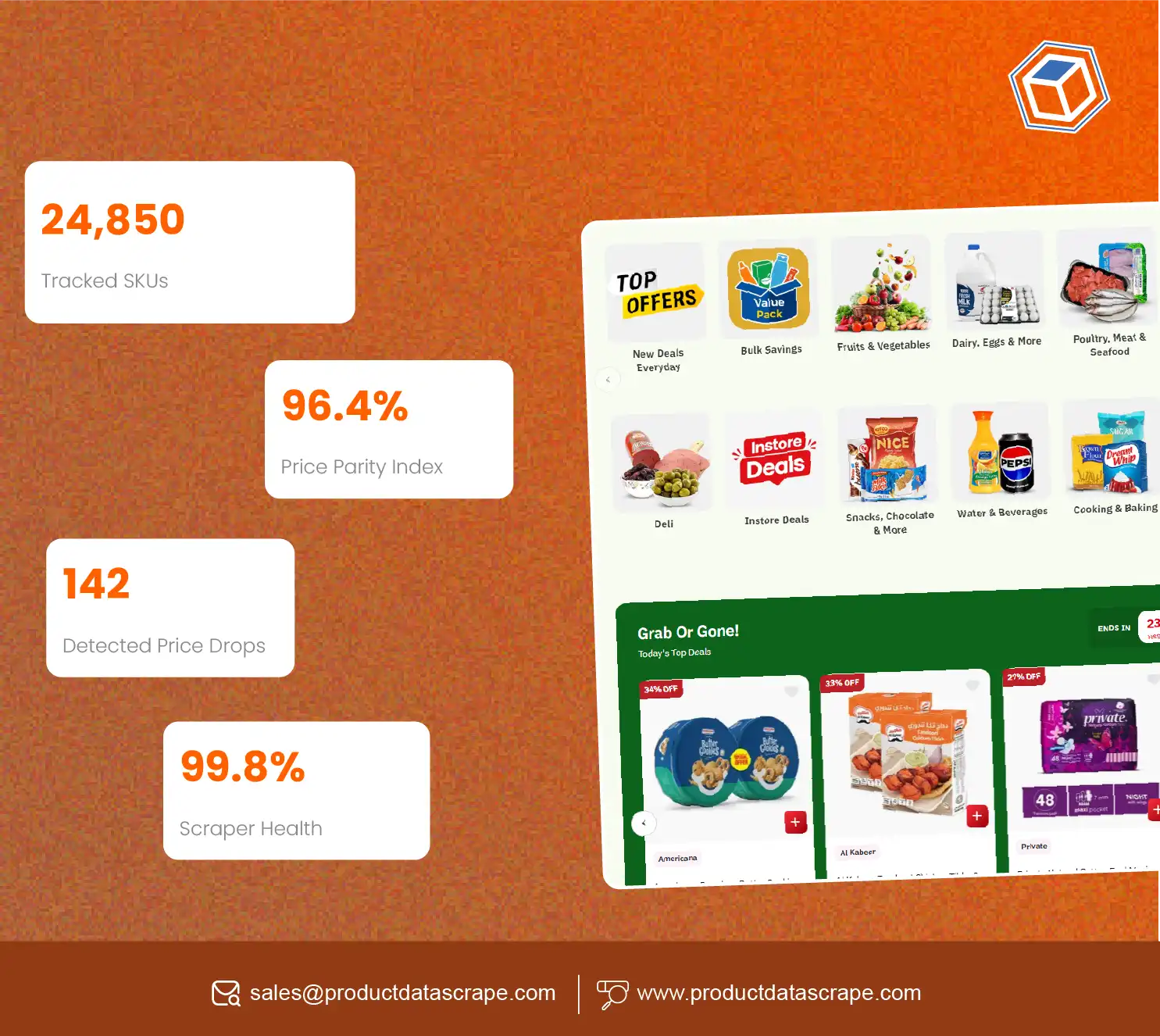
How Retail Brands Use Instamart Data Scrapping from Mobile App for Real-Time Grocery Intelligence

Introduction

For resellers, deal sites and brand teams in Canada, timing is everything. A new product, a limited release or a clearance item that appears on walmart.ca can sell through in hours. Whoever sees it first, whether to buy it, to write about it or to check its price against their own, has the advantage.

In September 2026 a Canadian buyer asked Product Data Scrape to "build a custom web scraping API specifically for Walmart Canada to monitor new products the moment they are scanned into their system." The request is specific, but the need is common. This guide explains how Walmart Canada Data Scraping detects new listings quickly, what data each alert should carry, and how to keep the system reliable.

Who needs new-listing alerts

User Why speed matters
Resellers Limited items, collectibles and clearance stock sell out fast
Deal and coupon sites First to publish a new deal wins the traffic
Brands Confirm that new products launched correctly, with the right price and content
Competitor brands See rival launches the day they go live
Retail analysts Track how quickly Walmart Canada expands categories

What "new" means on walmart.ca

What new means on walmart.ca

A product can appear "new" in several ways, and each needs a different detection method:

  • Brand-new item ID. A product page that did not exist before.
  • Newly visible item. A product page that existed but was hidden, out of stock or not searchable, and now appears in search or category listings.
  • New seller offer. An existing product that gains a new marketplace seller.
  • Price drop or clearance. An existing product whose price falls sharply, often signalling clearance.
  • Store availability change. A product that becomes available for pickup at specific stores.

Walmart Canada data scraping should tag each alert with the event type, so users can filter for what matters to them.

How detection works

Category and search sweeps

Collectors repeatedly scan category pages and search results sorted by "newest" where available, in the categories you care about. Each item ID found is compared with a database of known IDs. Any unknown ID triggers a product-page collection and an alert.

Brand and keyword watchlists

For specific brands or product lines, targeted searches run more often. For example, a reseller tracking a toy brand might run brand searches every 10 minutes, while general category sweeps run hourly.

Product-page monitoring

Known items on a watchlist are re-checked for changes in price, stock, seller and store availability.

Store-level checks

For items where in-store pickup matters, availability is checked for a list of stores identified by postal code.

What each alert should contain

{
  "event_type": "new_item",
  "detected_at": "2026-10-06T14:22:10-04:00",
  "item_id": "6000000000000",
  "title": "Example Collectible Figure Series 5",
  "brand": "Sample Toys",
  "category": "Toys > Collectibles",
  "price_cad": 24.97,
  "was_price_cad": null,
  "seller": "Walmart",
  "online_availability": "in_stock",
  "store_availability": [
    {"store_id": "1234", "postal_code": "M5V 0A0", "status": "limited_stock"},
    {"store_id": "5678", "postal_code": "L5B 0A0", "status": "out_of_stock"}
  ],
  "upc": "000000000000",
  "product_url": "https://www.walmart.ca/en/ip/example/6000000000000",
  "image_url": "https://i5.walmartimages.ca/example.jpg"
}

The record above is illustrative. Alerts can be delivered by webhook, email, Slack or Discord, or written to a database that your own app reads.

How fast is fast enough?

Use case Typical detection target
Collectibles and limited releases Under 15 minutes for watchlisted brands
Deal publishing Under 1 hour for chosen categories
Brand launch checks Same day
Analyst category tracking Daily

Faster detection costs more, because it needs more frequent sweeps. Most projects use a tiered approach: very frequent checks for a short watchlist and slower sweeps for everything else.

Reliability: avoiding missed and false alerts

Missed alerts usually happen when a product appears in a category that is not swept, or when it is not yet searchable. Broad category coverage plus brand searches reduces this risk.

False alerts happen when a product temporarily disappears and reappears, or when the same item appears with a different URL. A "first seen" database with item IDs, not URLs, prevents duplicates. Items that reappear after a short absence are tagged as "restock" rather than "new".

Site changes. Walmart Canada updates its website regularly. Product Data Scrape monitors collectors continuously and fixes changes quickly so alerts keep flowing.

Beyond alerts: building a history

Every alert also feeds a history table. Over time this shows:

  • How many new items Walmart Canada adds per week in each category.
  • How quickly new items are discounted.
  • Which brands launch most often.
  • How long limited items stay in stock.
Category (illustrative, 4 weeks) New items detected Share discounted within 30 days Median days in stock
Toys 1,240 22% 19
Electronics 860 31% 34
Home 1,980 18% 41
Grocery 2,410 12% n/a

Designing your watchlist

Designing your watchlist

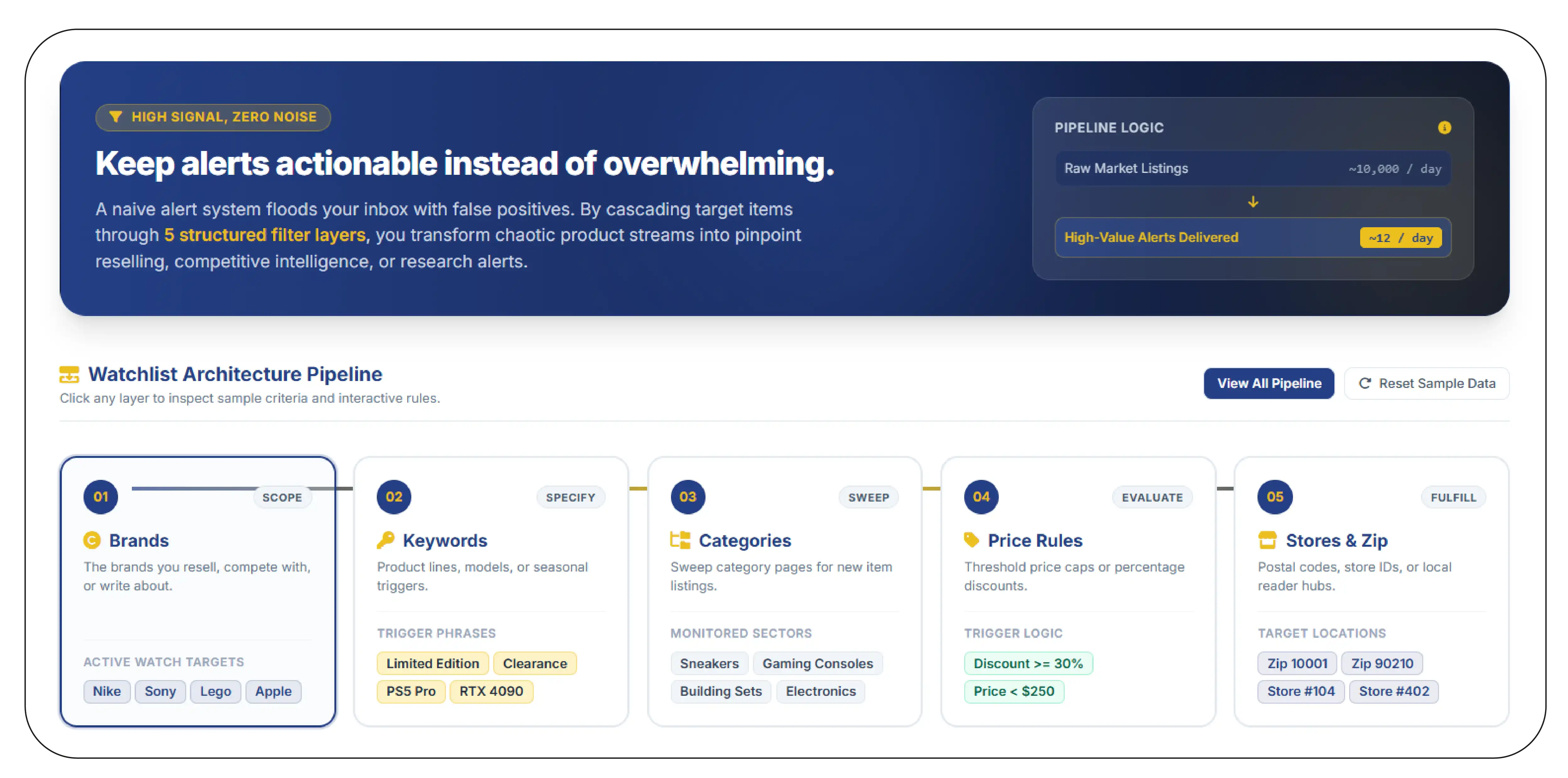
A good watchlist keeps alerts useful instead of overwhelming. Build it in layers:

  • Brands. The brands you resell, compete with or write about.
  • Keywords. Product lines, characters, model numbers or seasonal terms such as "limited edition" or "clearance".
  • Categories. The category pages to sweep for anything new.
  • Price rules. Alert only when a price is below a threshold, or when a discount exceeds a percentage.
  • Stores. The postal codes or stores where you can actually buy or where your readers live.

Each rule can carry its own frequency and delivery channel. For example, a brand watchlist might alert to Discord every 10 minutes, while a weekly category summary goes by email.

Using alerts for brand compliance

Brands selling through Walmart Canada use the same system differently. When a new product goes live, the alert confirms that title, images, price and description match what was supplied. Missing images, wrong prices or incorrect categories can be fixed on launch day rather than weeks later. Marketplace seller alerts also show when third-party sellers list a brand's products on walmart.ca, which helps brands enforce their distribution agreements.

Responsible collection

Walmart Canada data scraping collects publicly visible product, price and availability information. It does not collect customer data, does not place orders and does not bypass purchase limits. Request rates are managed to avoid placing a burden on the site.

Frequently asked questions

Can Walmart Canada data scraping detect items before they are searchable?
Detection relies on publicly accessible pages. Items are detected as soon as they become visible in categories, searches or product pages that are publicly reachable.

Can I track specific stores?
Yes. Provide postal codes or store IDs, and availability is checked for those stores.

Can the same system cover Walmart US or other Canadian retailers?
Yes. The same approach works for other retailers, each with its own collectors.

Is there an API?
Yes. Alerts can be pushed by webhook, and a REST API returns current status for any tracked item.

Key takeaways

  • New listings, restocks, price drops and store availability are different events and should be tagged separately.
  • Tiered detection gives very fast alerts for a watchlist and broad coverage for categories.
  • A first-seen database keyed on item ID prevents duplicate alerts.
  • Alert history becomes a valuable dataset in its own right.

Set up Walmart Canada alerts

Product Data Scrape builds Walmart Canada data scraping APIs and alert feeds for resellers, deal sites, brands and analysts. Share your categories, brands and stores, and we will set up a free trial with a 1,000-record sample.

LATEST BLOG

Catching New Listings on Walmart Canada the Moment They Go Live with Walmart Canada Data Scraping

How Walmart Canada data scraping detects new products on walmart.ca as soon as they appear, with price, stock and store availability alerts for resellers and brands.

Scraping East Asian Marketplaces: A Guide to Momo Taiwan Data Scraping, Shopee Taiwan and Rakuten Japan

A practical guide to Momo Taiwan data scraping with Shopee Taiwan and Rakuten Japan: fields, language handling, price formats and a cross-market sample dataset.

How to Scrape Lulu hypermarket target daily pricing data for Smarter Retail Pricing Decisions

Scrape Lulu hypermarket target daily pricing data to monitor product prices, discounts, promotions, competitors, and retail market changes at scale.

Case Studies

Discover our scraping success through detailed case studies across various industries and applications.

WHY CHOOSE US?

Product Data Scrape for Retail Web Scraping

Choose Product Data Scrape to access accurate data, enhance decision-making, and boost your online sales strategy effectively.

Reliable Insights

Reliable Insights

With our Retail Data scraping services, you gain reliable insights that empower you to make informed decisions based on accurate product data and market trends.

Data Efficiency

Data Efficiency

We help you extract Retail Data product data efficiently, streamlining your processes to ensure timely access to crucial market information and operational speed.

Market Adaptation

Market Adaptation

By leveraging our Retail Data scraping, you can quickly adapt to market changes, giving you a competitive edge with real-time analysis and responsive strategies.

Price Optimization

Price Optimization

Our Retail Data price monitoring tools enable you to stay competitive by adjusting prices dynamically, attracting customers while maximizing your profits effectively.

Competitive Edge

Competitive Edge

THIS IS YOUR KEY BENEFIT.
With our competitive price tracking, you can analyze market positioning and adjust your strategies, responding effectively to competitor actions and pricing in real-time.

Feedback Analysis

Feedback Analysis

Utilizing our Retail Data review scraping, you gain valuable customer insights that help you improve product offerings and enhance overall customer satisfaction.

5-Step Proven Methodology

How We Scrape E-Commerce Data?

01
Identify Target Websites

Identify Target Websites

Begin by selecting the e-commerce websites you want to scrape, focusing on those that provide the most valuable data for your needs.

02
Select Data Points

Select Data Points

Determine the specific data points to extract, such as product names, prices, descriptions, and reviews, to ensure comprehensive insights.

03
Use Scraping Tools

Use Scraping Tools

Utilize web scraping tools or libraries to automate the data extraction process, ensuring efficiency and accuracy in gathering the desired information.

04
Data Cleaning

Data Cleaning

After extraction, clean the data to remove duplicates and irrelevant information, ensuring that the dataset is organized and useful for analysis.

05
Analyze Extracted Data

Analyze Extracted Data

Once cleaned, analyze the extracted e-commerce data to gain insights, identify trends, and make informed decisions that enhance your strategy.

Start Your Data Journey
99.9% Uptime
GDPR Compliant
Real-time API

See the results that matter

Read inspiring client journeys

Discover how our clients achieved success with us.

6X

Conversion Rate Growth

“I used Product Data Scrape to extract Walmart fashion product data, and the results were outstanding. Real-time insights into pricing, trends, and inventory helped me refine my strategy and achieve a 6X increase in conversions. It gave me the competitive edge I needed in the fashion category.”

7X

Sales Velocity Boost

“Through Kroger sales data extraction with Product Data Scrape, we unlocked actionable pricing and promotion insights, achieving a 7X Sales Velocity Boost while maximizing conversions and driving sustainable growth.”

"By using Product Data Scrape to scrape GoPuff prices data, we accelerated our pricing decisions by 4X, improving margins and customer satisfaction."

"Implementing liquor data scraping allowed us to track competitor offerings and optimize assortments. Within three quarters, we achieved a 3X improvement in sales!"

Resource Hub: Explore the Latest Insights and Trends

The Resource Center offers up-to-date case studies, insightful blogs, detailed research reports, and engaging infographics to help you explore valuable insights and data-driven trends effectively.

Get In Touch

Catching New Listings on Walmart Canada the Moment They Go Live with Walmart Canada Data Scraping

How Walmart Canada data scraping detects new products on walmart.ca as soon as they appear, with price, stock and store availability alerts for resellers and brands.

Scraping East Asian Marketplaces: A Guide to Momo Taiwan Data Scraping, Shopee Taiwan and Rakuten Japan

A practical guide to Momo Taiwan data scraping with Shopee Taiwan and Rakuten Japan: fields, language handling, price formats and a cross-market sample dataset.

How to Scrape Lulu hypermarket target daily pricing data for Smarter Retail Pricing Decisions

Scrape Lulu hypermarket target daily pricing data to monitor product prices, discounts, promotions, competitors, and retail market changes at scale.

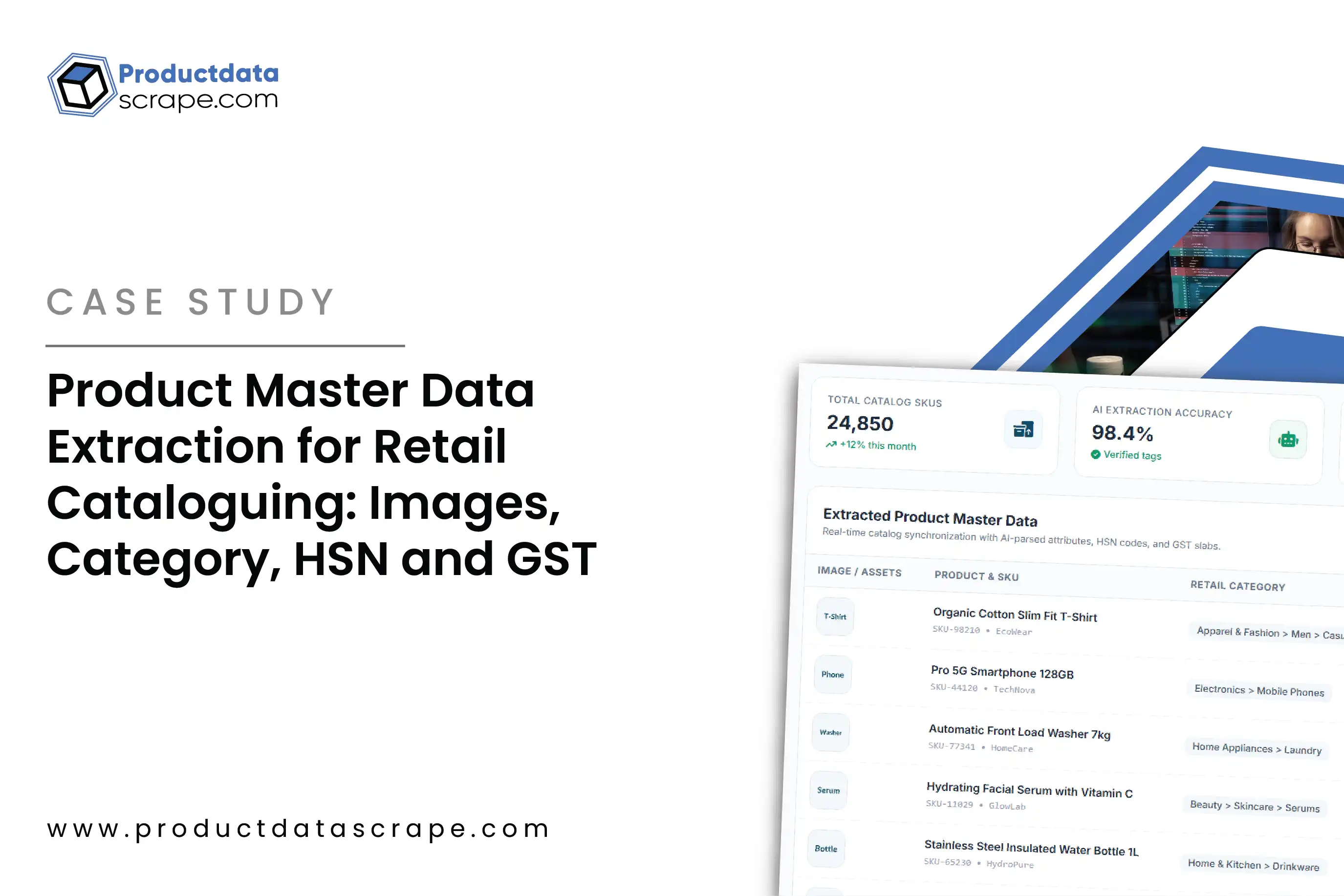
Product Master Data Extraction for Retail Cataloguing: Images, Category, HSN and GST

Product master data extraction built a clean stationery and FMCG catalogue with images, categories, HSN codes, GST rates and MRP for an Indian retailer.

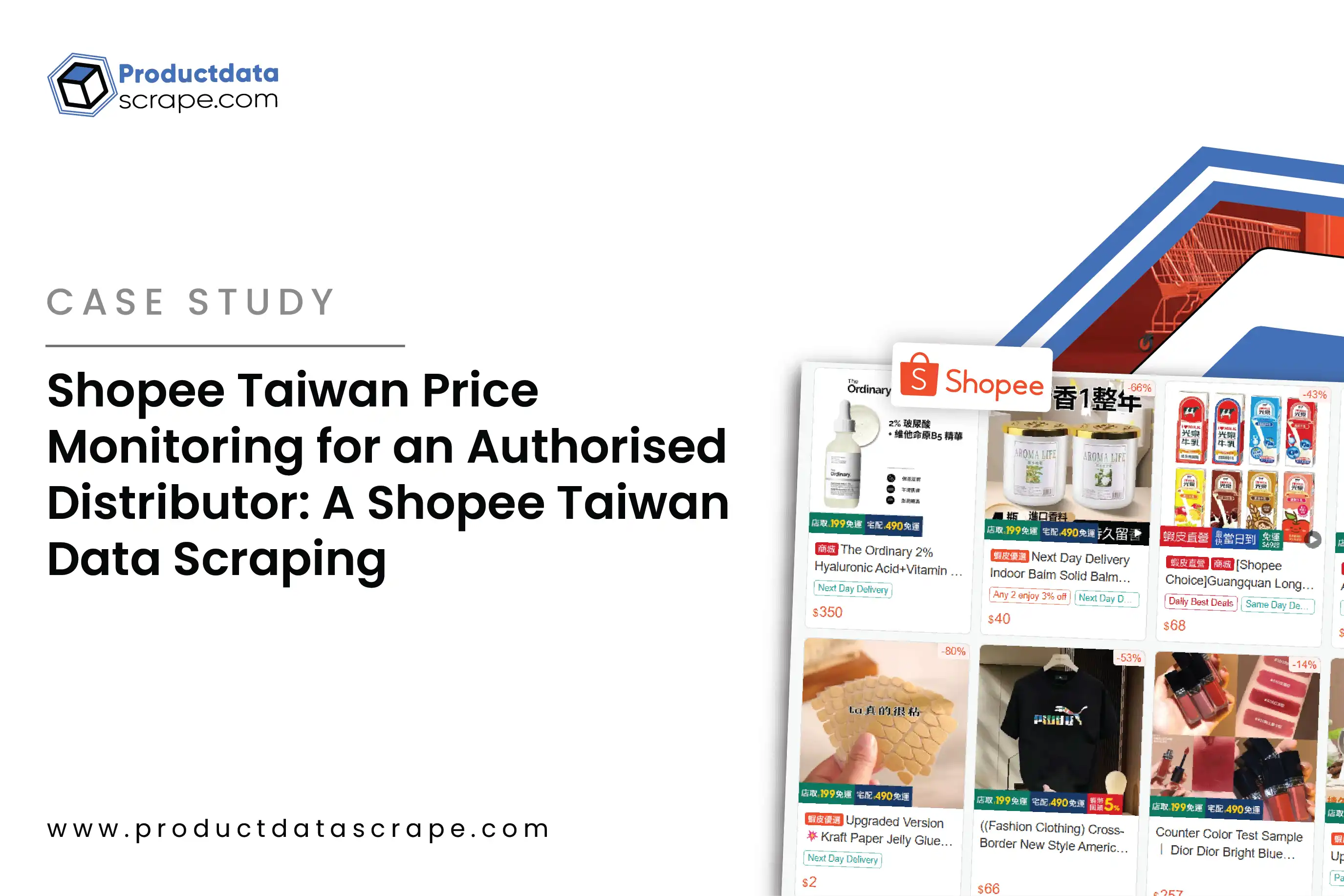
Shopee Taiwan Price Monitoring for an Authorised Distributor: A Shopee Taiwan Data Scraping

Shopee Taiwan data scraping helped an authorised distributor monitor 200 products daily, find unauthorised sellers and stop price-policy breaches.

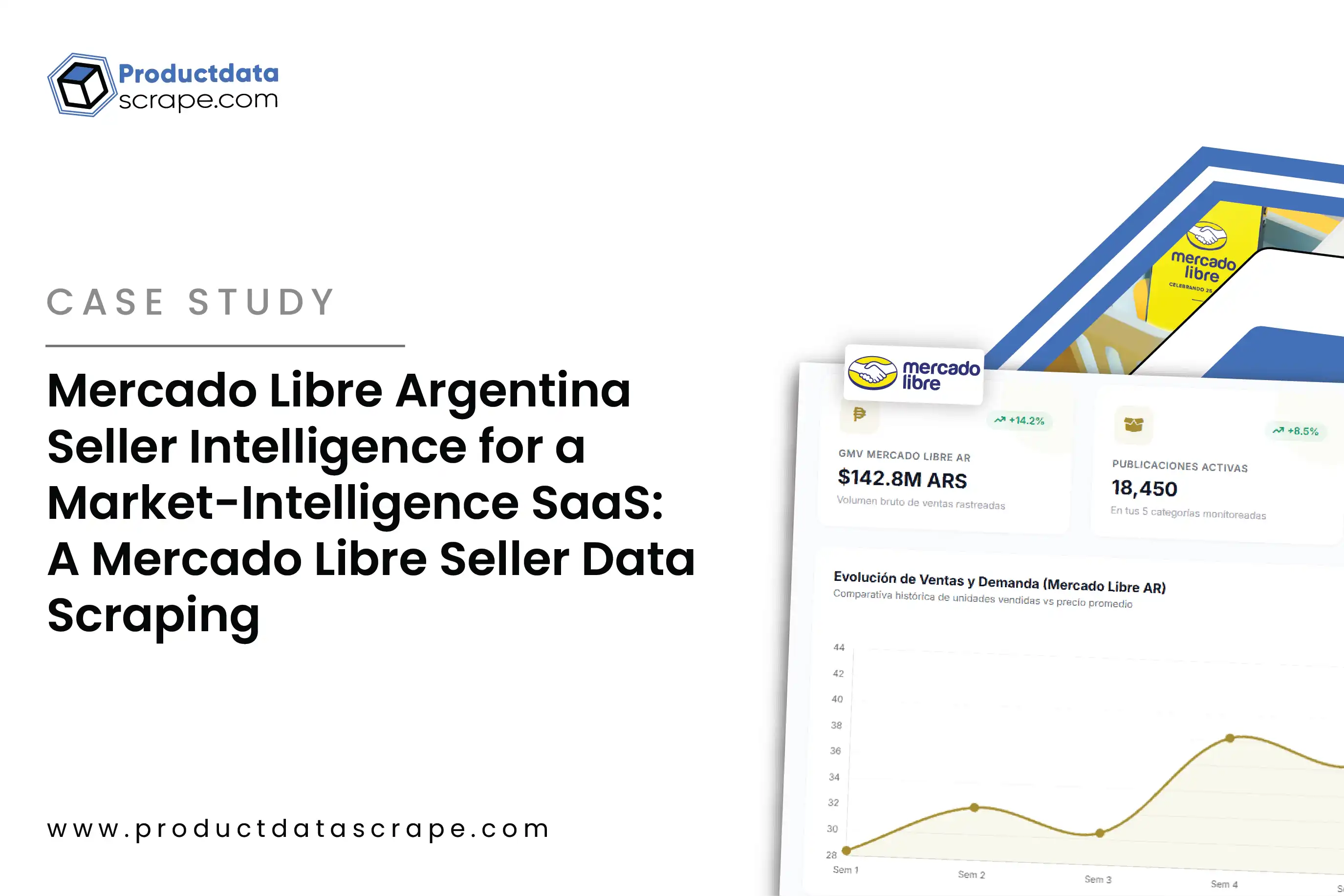
Mercado Libre Argentina Seller Intelligence for a Market-Intelligence SaaS: A Mercado Libre Seller Data Scraping

Mercado Libre seller data scraping powered a market-intelligence SaaS in Argentina with seller rankings, prices, sales indicators and category trends.

Albertsons Grocery Delivery Scraper API - Market Intelligence, Inventory Monitoring, and Grocery Retail Benchmarking

ASDA Grocery Data Scraping helps track grocery prices, promotions, inventory, and competitor trends across the UK retail market.

Costco Alcohol & Liquor Price Data scraping to Track Consumer Buying Trends and Inventory Intelligence

Costco Alcohol & Liquor Price Data scraping helps brands track pricing, promotions, inventory trends, and competitor insights.

B&M Stores Pet Supplies Data Scraping for Market Research and Pet Product Trend Analysis in Retail Chains

B&M Stores Pet Supplies Data Scraping helps businesses collect pricing, stock, and product insights to optimize pet retail strategies.

Reducing Returns with Myntra AND AJIO Customer Review Datasets

Analyzed Myntra and AJIO customer review datasets to identify sizing issues, helping brands reduce garment return rates by 8% through data-driven insights.

Before vs After Web Scraping - How E-Commerce Brands Unlock Real Growth

Before vs After Web Scraping: See how e-commerce brands boost growth with real-time data, pricing insights, product tracking, and smarter digital decisions.

Scrape Data From Any Ecommerce Websites

Easily scrape data from any eCommerce website to track prices, monitor competitors, and analyze product trends in real time with Real Data API.

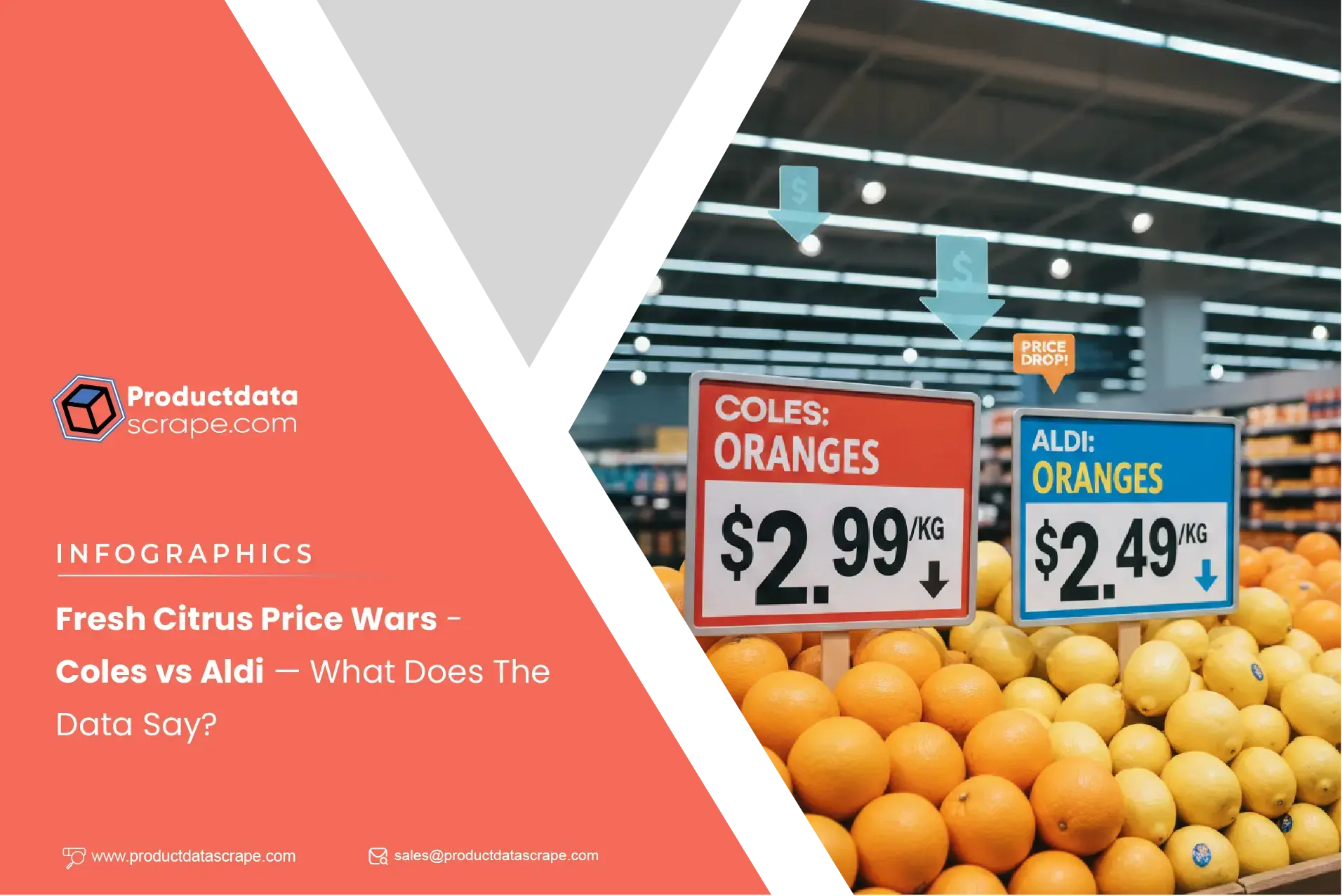
Fresh Citrus Price Wars - Coles vs Aldi — What Does the Data Say?

Fresh Citrus Price Wars — Coles vs Aldi: data-driven comparison of prices, trends, and savings to see which retailer wins on value for shoppers.

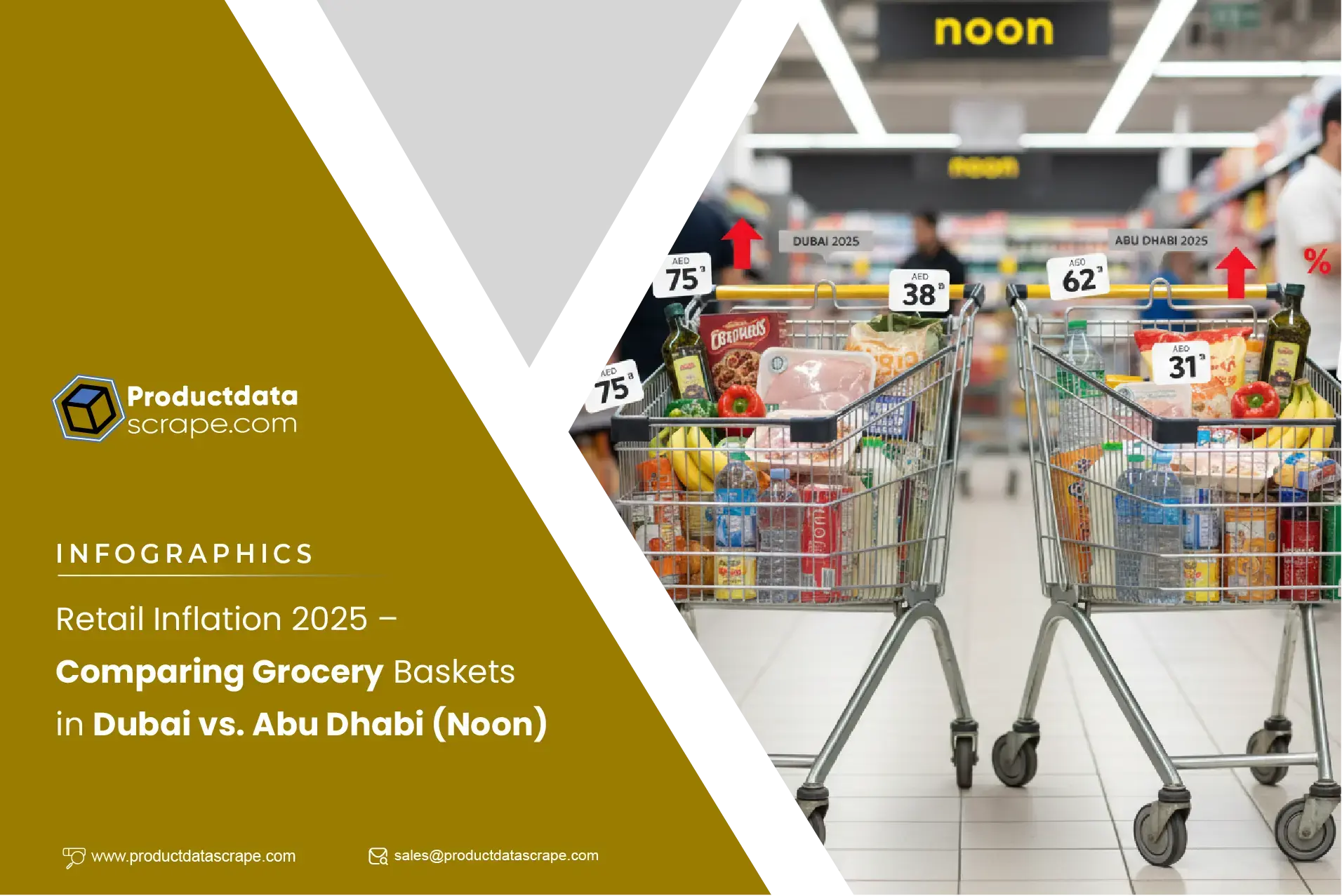
Retail Inflation 2025 – Comparing Grocery Baskets in Dubai vs. Abu Dhabi (Noon)

Retail Inflation 2025 – Comparing Grocery Baskets in Dubai vs. Abu Dhabi (Noon) highlights price differences and real-world grocery costs across UAE cities.

Unlock Winning Products on Pinduoduo - How Scraping Bestseller Data Reveals Top Titles, Prices & Sales Trends

Scrape Pinduoduo bestseller data to analyze top-selling products, pricing trends, sales performance, for smarter eCommerce and intelligence decisions.

FAQs

E-Commerce Data Scraping FAQs

Our E-commerce data scraping FAQs provide clear answers to common questions, helping you understand the process and its benefits effectively.

E-commerce scraping services are automated solutions that gather product data from online retailers, providing businesses with valuable insights for decision-making and competitive analysis.

We use advanced web scraping tools to extract e-commerce product data, capturing essential information like prices, descriptions, and availability from multiple sources.

E-commerce data scraping involves collecting data from online platforms to analyze trends and gain insights, helping businesses improve strategies and optimize operations effectively.

E-commerce price monitoring tracks product prices across various platforms in real time, enabling businesses to adjust pricing strategies based on market conditions and competitor actions.

Get a free sample dataset

See the exact fields, accuracy and format — for your products, on your target sites — before you spend a rupee or a dollar.

  • ✓Sample delivered within 24 hours
  • ✓Scoped to your real use case, not a generic demo
  • ✓No obligation, no long contract

Tell us what you need

A specialist replies within one business day.