Introduction
Tracking competitor prices across Latin American marketplaces helps e-commerce businesses protect profit margins, identify pricing gaps, and respond to market changes. Scrape Mercado Libre Product Prices Across LATAM enables retailers, brands, distributors, and pricing analysts to collect structured product information, compare seller offers, monitor discounts, and understand price movements across different countries.
Mercado Libre is one of Latin America's largest e-commerce and fintech platforms, operating across multiple markets with different currencies, product categories, and competitive conditions. Its growing transaction volumes make marketplace intelligence increasingly valuable for businesses competing in the region. A Mercado Libre Product Data Scraping API can support structured collection of product titles, seller information, listed prices, product identifiers, categories, and other accessible listing attributes.
For businesses managing operations across Brazil, Mexico, Argentina, Chile, Colombia, and other LATAM markets, consistent price monitoring helps identify country-specific pricing differences. It also supports competitor benchmarking, assortment planning, and promotional analysis.
The following sections explain how businesses can use marketplace data to improve pricing decisions, track listing availability, identify seller-level opportunities, and build reliable product intelligence datasets.
How Has Mercado Libre's Marketplace Expanded Between 2020 and 2026?
Mercado Libre's reported growth demonstrates why marketplace pricing intelligence matters to regional retailers. Its annual financial reports show substantial increases in gross merchandise volume (GMV) and the number of items sold.
The following table uses reported company figures. GMV is expressed in US$ billions, and items sold are expressed in millions.
| Year | Gross merchandise volume | Items sold |
|---|
| 2020 | $20.93 billion | 719.3 million |
| 2021 | $28.35 billion | 1,014.3 million |
| 2022 | $34.45 billion | 1,147 million |
| 2023 | $44.75 billion | 1,404 million |
| 2024 | $51.47 billion | 1,787 million |
| 2025 | $65.04 billion | 2,429 million |
| 2026 (January–September) | $63.69 billion | 2,384 million |
Sources: Mercado Libre annual reports and Q3 2026 financial results. The 2026 figures cover nine months and are not full-year results.
These figures represent the company's consolidated marketplace activity, not the number of listings or the price changes of individual products. Nevertheless, they demonstrate the scale of commercial activity that sellers and brands need to understand.
In Q3 2026, Mercado Libre reported approximately $22.8 billion in quarterly GMV and 867 million items sold. Its year-over-year GMV growth was 33% on an FX-neutral basis. Mexico, Brazil, and Argentina also recorded positive GMV growth on an FX-neutral basis during the quarter.
For marketplace sellers, these developments make accurate competitor monitoring important. Price intelligence can help businesses understand how competing offers change across countries, categories, and individual product listings.
How Can Regional Price Intelligence Help Sellers Protect Their Margins?
Selling across Latin America requires businesses to account for different currencies, purchasing conditions, competitor strategies, and marketplace environments. A product priced competitively in Brazil may have a different competitive position in Mexico or Argentina. Businesses need country-specific information instead of relying on one regional price benchmark.
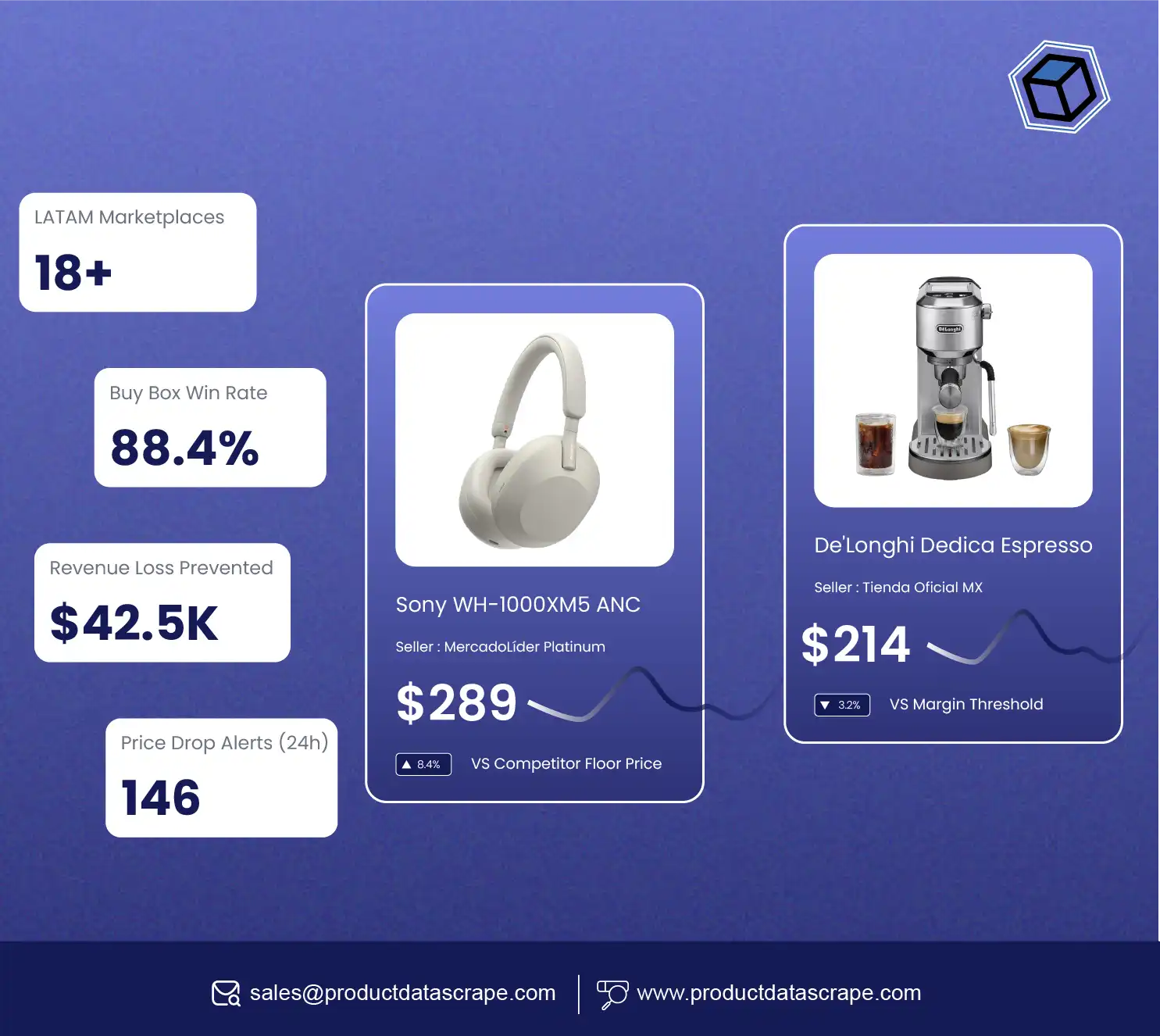
LATAM Ecommerce Seller Pricing Intelligence helps retailers compare product prices, identify pricing gaps, and understand competitor positioning across marketplaces. By collecting product-level information from different Mercado Libre country sites, businesses can evaluate how similar products are priced in each market.
For example, a distributor can compare the listed prices of matching electronics products across multiple countries. The comparison can reveal differences in advertised prices, promotional discounts, and seller positioning. However, prices must be normalized carefully because local currencies, taxes, shipping charges, and exchange rates can affect the final customer cost.
E-commerce data scraping supports this process by collecting structured information at regular intervals. Businesses can maintain historical price records rather than relying on occasional manual comparisons.
Important pricing fields include:
- Product title, brand, and marketplace category.
- Current listed price and original price when available.
- Currency code and marketplace country.
- Seller name and listing identifier.
- Promotional information and observation timestamp.
- Shipping charges when publicly displayed.
Retailers should also distinguish between advertised prices and landed costs. A lower product price does not necessarily mean a more competitive final offer when shipping and other applicable charges differ.
Combining these fields helps pricing teams understand market differences, evaluate competitor strategies, and make informed pricing decisions without depending on incomplete regional averages.
How Can Listing Changes Help Businesses Identify Stock Risks?
Product prices alone cannot explain every competitive change. A product may become unavailable, a seller may pause a listing, or an alternative offer may replace the original listing. These developments can affect competitor benchmarking and product availability analysis.
Mercado Libre Listing-Level Stock Monitoring helps businesses track visible listing conditions, product availability indicators, and changes in seller offers. This information is particularly useful for retailers managing large catalogs across multiple countries.
The Mercado Libre developer documentation explains that listing information includes fields such as item ID, site ID, price, currency, status, and available quantity. Importantly, some stock information is restricted to the listing owner, while public resources may provide only referential availability ranges.
A structured Mercado Livre Data Scraping Service can organize accessible listing information into historical datasets for competitor research. Businesses can identify when a listing changes status, disappears from search results, or becomes unavailable according to the information exposed by the platform.
| Monitoring field | Business application |
|---|
| Listing ID | Identify individual offers |
| Seller ID | Track competing sellers |
| Listing status | Monitor active or paused listings |
| Available quantity | Analyze accessible stock indicators |
| Listed price | Compare competitor pricing |
| Currency | Maintain country-specific price records |
| Last observed date | Establish a historical timeline |
An important distinction is that a missing listing does not automatically indicate a stockout. It may have been removed, paused, modified, or excluded from a particular search result.
Businesses should therefore classify observations carefully and verify important changes before making replenishment or pricing decisions. This approach helps reduce false stockout alerts and improves the quality of marketplace intelligence.
Why Is Seller-Level Price Tracking Important for Competitive Analysis?
Multiple sellers can offer the same product at different prices on Mercado Libre. Their offers may also differ in shipping conditions, listing types, promotional participation, and product condition. Monitoring only the lowest displayed price can therefore produce incomplete competitive insights.
Mercado Libre Item-Wise Seller Price Tracking allows businesses to compare individual offers associated with matching products. Instead of evaluating an entire category using average prices, analysts can identify seller-specific pricing movements and understand how competing offers change over time.
This is particularly important for brands, wholesalers, and distributors that compete with multiple marketplace sellers. They can evaluate whether their products are priced consistently, identify unusually low offers, and investigate changes in competitor positioning.
Another useful application is Out-of-stock monitoring. By maintaining timestamped availability observations, businesses can identify listings that repeatedly change between visible availability states. Such observations can help identify products requiring further inventory investigation.
A reliable tracking workflow should include:
- Product identification using item IDs, GTINs, and relevant product attributes.
- Seller identification using marketplace seller identifiers.
- Collection of listed prices and currency information.
- Recording of listing status and accessible availability indicators.
- Historical comparison of individual seller offers.
- Validation of significant changes before reporting them.
For accurate comparisons, analysts should separate new and used products, different package sizes, and different product configurations. Otherwise, an apparently cheaper competing offer may actually represent a different product.
Seller-level analysis becomes especially useful when businesses need to distinguish genuine pricing competition from differences in product condition, shipping, or listing configuration.
What Should a Regional Seller Assortment Dataset Include?
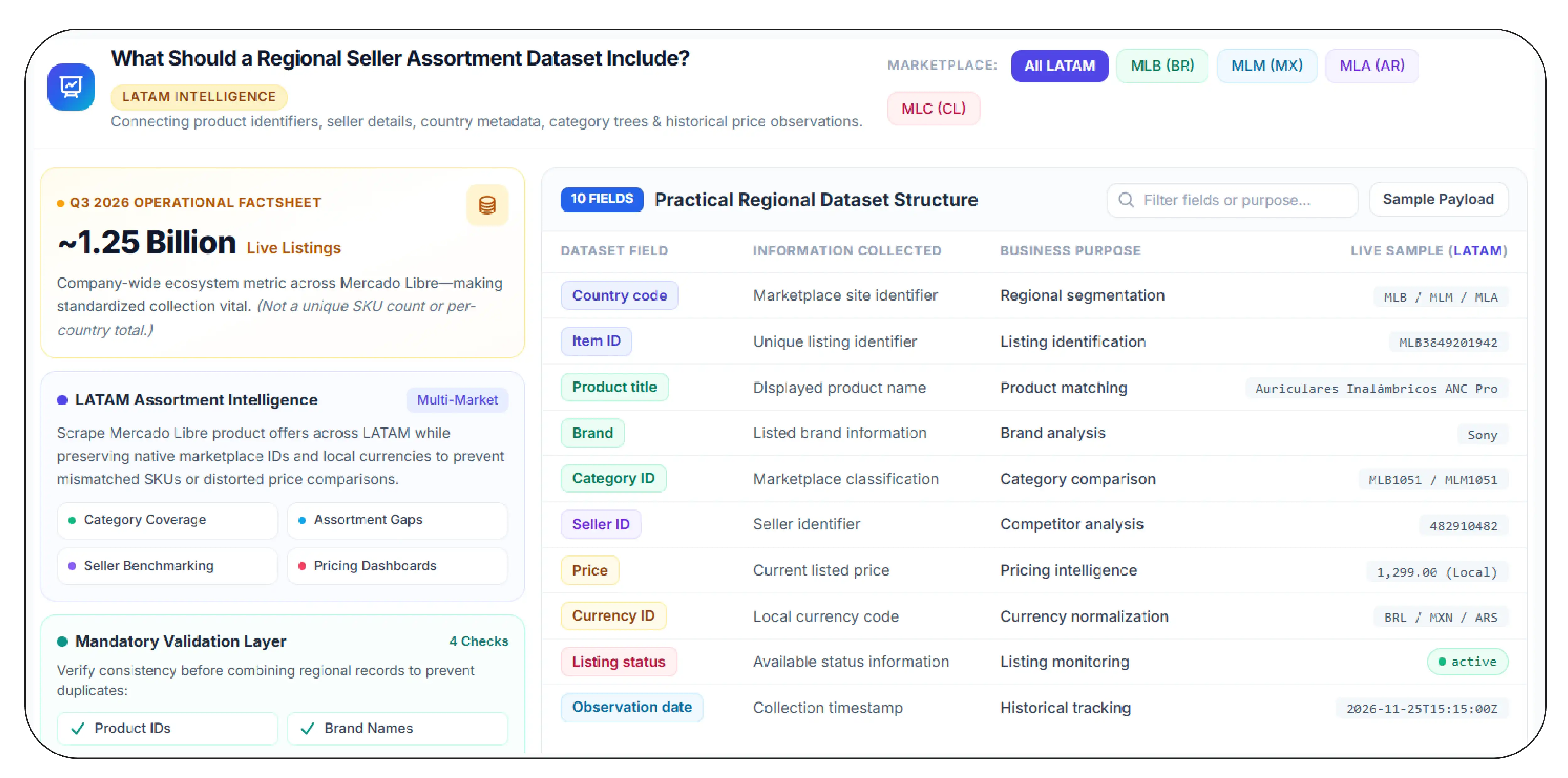
A regional marketplace dataset should provide more than a list of product names and prices. It should connect product identifiers, seller details, country information, category classifications, and historical observations.
A LATAM Seller Assortment Dataset helps businesses understand which products are listed across different country marketplaces and how their competitive positions differ. Retailers can use it to compare category coverage, identify assortment gaps, and evaluate competing sellers.
Scrape Mercado Libre Product Prices Across LATAM to create a structured view of product offers across relevant markets. The dataset should preserve the original marketplace identifiers and currency information to prevent incorrect product matching or price comparisons.
A practical dataset structure includes:
| Dataset field | Information collected | Business purpose |
|---|
| Country code | Marketplace site identifier | Regional segmentation |
| Item ID | Unique listing identifier | Listing identification |
| Product title | Displayed product name | Product matching |
| Brand | Listed brand information | Brand analysis |
| Category ID | Marketplace classification | Category comparison |
| Seller ID | Seller identifier | Competitor analysis |
| Price | Current listed price | Pricing intelligence |
| Currency ID | Local currency code | Currency normalization |
| Listing status | Available status information | Listing monitoring |
| Observation date | Collection timestamp | Historical tracking |
The scale of Mercado Libre's marketplace also makes standardized collection important. Its Q3 2026 operational factsheet reported approximately 1.25 billion live listings across its ecosystem. This is a company-wide listing metric, not a count of unique products or a measure of listings in every individual country.
Businesses should apply consistent data validation before combining regional records. Product identifiers, brand names, category labels, and currency codes should be checked to avoid duplicates and incorrect comparisons.
A well-organized dataset can support pricing dashboards, category reports, seller benchmarking, and product assortment decisions across Latin American markets.
How Does Variant-Level Monitoring Improve Price Comparisons?
Many marketplace products have multiple variations, including color, size, storage capacity, material, model, and package quantity. Comparing only parent product titles can create inaccurate pricing insights when individual variants have different prices.
Mercado Libre Product Variant Scraping helps businesses organize product variations and compare offers at a more detailed level. This is particularly valuable for electronics, apparel, footwear, beauty products, home appliances, and other categories where product configurations influence pricing.
For instance, two smartphone listings may share the same model name but have different storage capacities. Comparing their displayed prices without considering storage would produce an unreliable benchmark.
Scrape Mercado Libre Product Prices Across LATAM with relevant variant attributes so analysts can distinguish matching configurations from similar-looking products.
Useful variant-level fields include:
- Product family or parent product identifier.
- Individual item and variation identifiers.
- Brand and model information.
- Size, color, capacity, or package quantity.
- Variant-specific listed price where accessible.
- Currency and country marketplace.
- Product condition and listing status.
Mercado Libre's official developer documentation describes product variations and their associated attributes. Its listing documentation also explains that available quantities can be specified for individual variations in applicable listing workflows.
For businesses, this distinction improves competitor benchmarking. A retailer can compare the same product configuration across multiple sellers instead of combining different variants into one average price.
Data validation is equally important. Product matching should use identifiers such as GTIN or manufacturer model numbers when available, alongside relevant attributes. When identifiers are missing, matching rules should account for brand, model, size, and configuration.
This helps businesses produce more accurate price comparisons and avoid commercial decisions based on mismatched products.
How Can Seller and Product Mapping Improve Regional Market Research?
Regional marketplace analysis becomes more valuable when businesses can connect sellers, product records, and country-specific listings. Without consistent identifiers, the same seller or product may appear as multiple unrelated records in a reporting system.
Mercado Libre Seller Product Mapping helps businesses organize product listings according to seller identifiers, item IDs, product families, and marketplace locations. This structure allows analysts to compare seller assortments, evaluate price positioning, and identify competing offers across countries.
Scrape Mercado Libre Product Prices Across LATAM to build historical records that connect individual listings with their corresponding products and sellers.
For example, a distributor monitoring a product category can identify which sellers offer matching products, how their prices change, and whether their assortment differs between marketplaces. This information can help the distributor evaluate market coverage and identify opportunities for further research.
A practical mapping process includes:
- Seller mapping: Associate marketplace seller IDs with their observed listings.
- Product mapping: Group matching products using identifiers and attributes.
- Country mapping: Preserve each marketplace's site code and currency.
- Price mapping: Store observed prices with their original currency.
- Historical mapping: Connect each observation to a timestamp.
- Validation: Review duplicates, missing identifiers, and mismatched products.
Businesses should avoid treating the same seller's listings in different countries as identical commercial offers. Shipping arrangements, local pricing, product availability, and marketplace rules may differ.
The resulting dataset can support competitor dashboards, seller performance research, pricing comparisons, and regional assortment analysis.
For better decision-making, businesses should combine marketplace observations with their own sales, costs, inventory, and margin information. External marketplace data provides competitive context, while internal commercial records establish the actual profitability of each product.
Why Choose Product Data Scrape?
Product Data Scrape provides customized e-commerce data collection solutions for businesses seeking reliable marketplace intelligence. Our services help retailers, manufacturers, distributors, and pricing analysts organize product information across multiple LATAM marketplaces. The LATAM E-Commerce market report can be supported with structured product prices, seller information, category details, and historical listing observations. Businesses can use Scrape Mercado Libre Product Prices Across LATAM to improve competitor benchmarking, identify pricing differences, and monitor assortment changes. Our approach emphasizes consistent data formats, product matching, source traceability, and project-specific collection schedules to support informed commercial decisions.
Conclusion
Competitive pricing across Latin America requires accurate marketplace information, consistent product matching, and country-specific analysis. Businesses can Scrape Mercado Libre Mexico Products to understand local seller competition, monitor advertised prices, and identify product assortment changes. Extending this approach across regional marketplaces provides broader competitive insights and supports better pricing strategies.
Scrape Mercado Libre Product Prices Across LATAM to strengthen marketplace intelligence and make informed decisions using structured product information.
Ready to improve your regional pricing strategy? Contact Product Data Scrape today to discuss customized marketplace data extraction solutions for your business!
FAQs
1. Why should businesses monitor Mercado Libre prices across LATAM?
Monitoring prices helps businesses identify competitor pricing gaps, compare country-specific offers, understand promotional changes, and improve regional pricing decisions using structured marketplace information.
2. Which product information can businesses collect?
Businesses can collect accessible product titles, item IDs, seller identifiers, prices, currencies, categories, product variations, listing statuses, and other relevant marketplace attributes.
3. Can marketplace prices be compared across different countries?
Yes. Businesses can compare prices after accounting for local currencies, exchange rates, product configurations, shipping costs, and applicable taxes.
4. How frequently should marketplace prices be monitored?
Monitoring frequency depends on product category, competitor activity, pricing volatility, collection permissions, and business requirements. Scheduled observations help maintain historical comparisons.
5. How does Product Data Scrape support marketplace research?
Product Data Scrape provides customized data collection solutions that organize marketplace information into structured datasets for competitor analysis, pricing intelligence, and assortment research.


 Singapore
 EMAIL
 PHONE












.webp)