Quick Overview
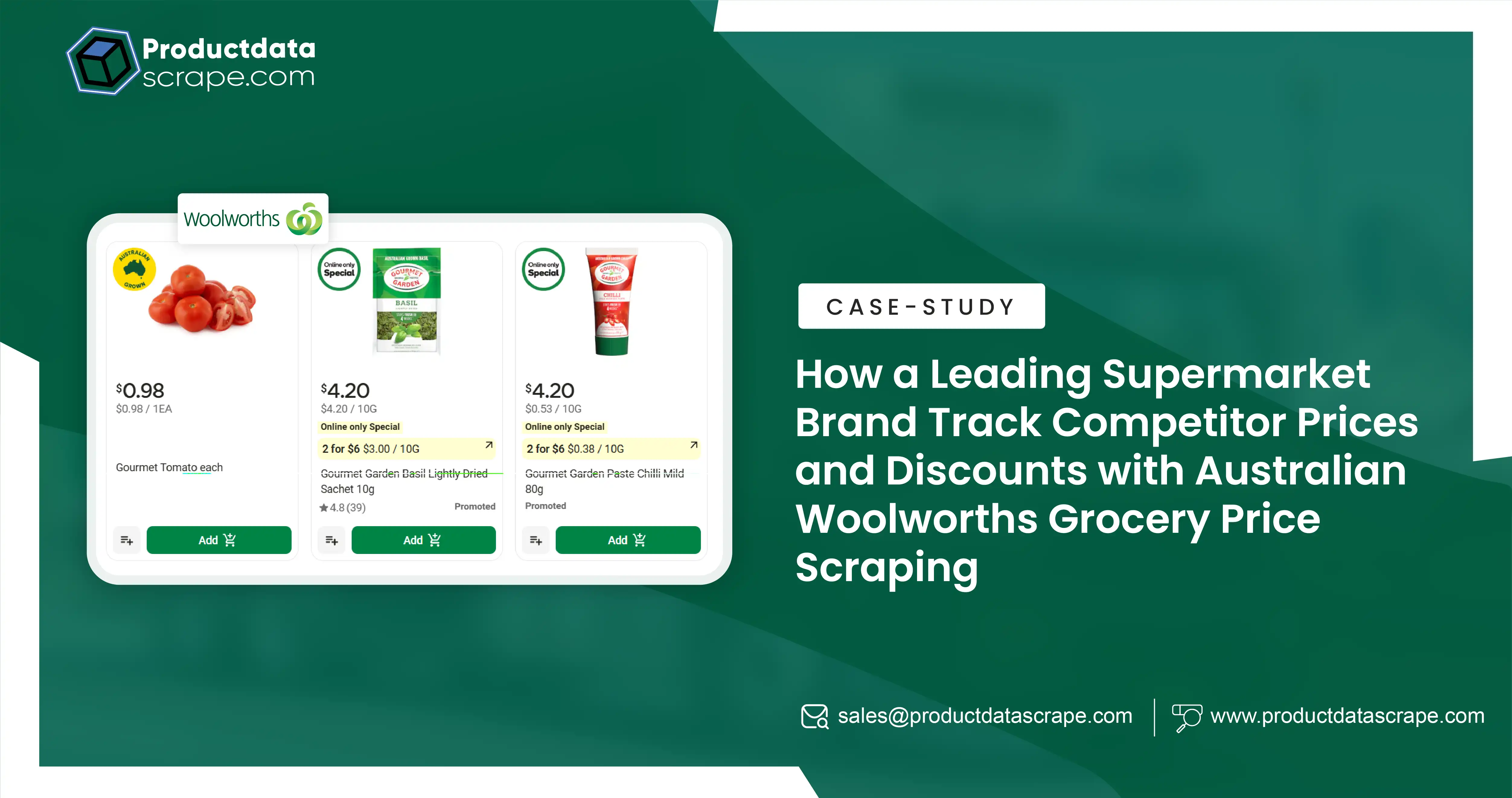
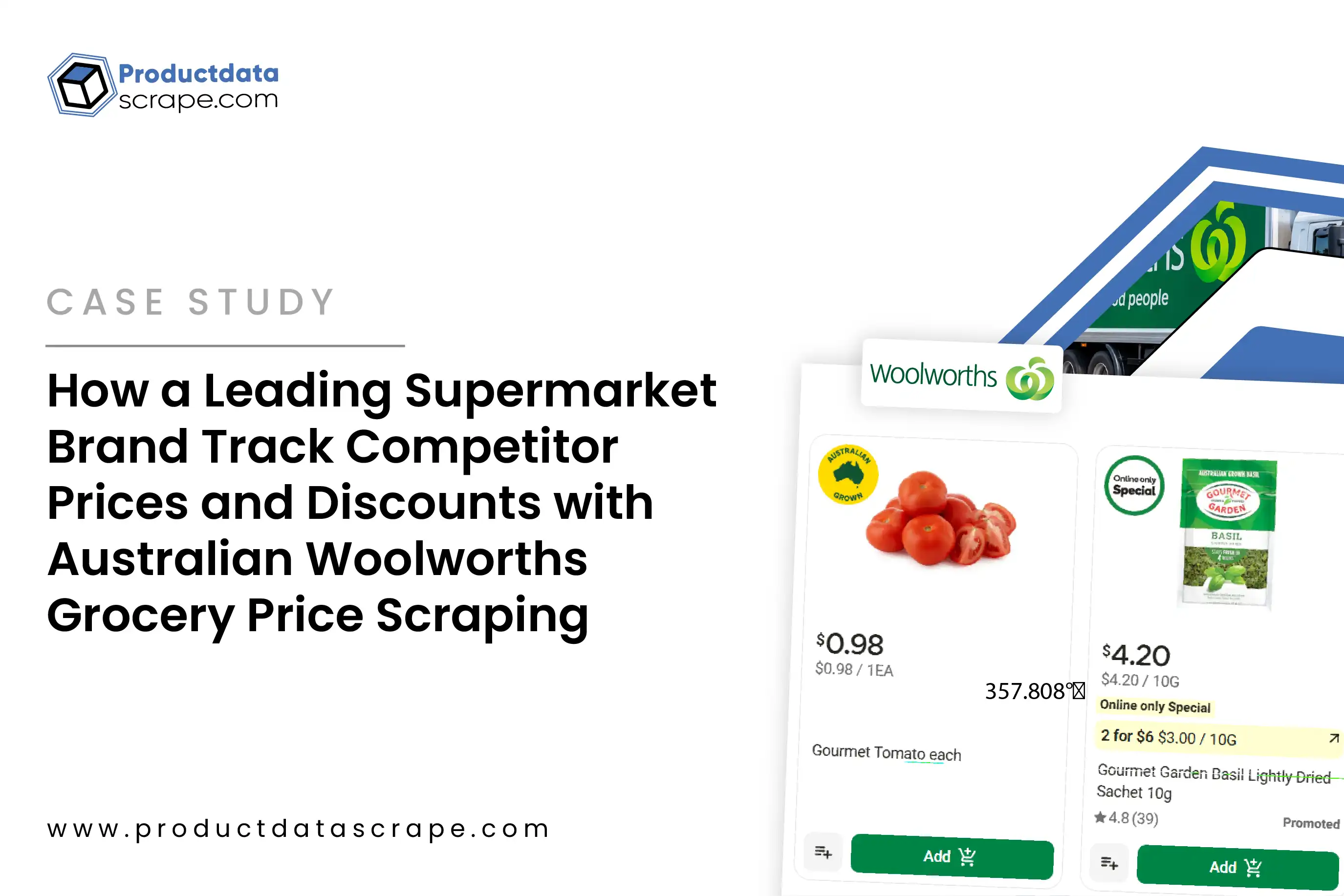
Australian Woolworths Grocery Price Scraping helps supermarket retailers collect and analyze grocery prices, product details, discounts, and promotional changes from Woolworths Australia. This case study explores how a leading supermarket brand can use structured grocery intelligence to improve competitor benchmarking, pricing decisions, and promotional planning. Using a Woolworths Scraping API for Australia, the proposed solution organizes product-level information, including brand names, package sizes, regular prices, promotional prices, and availability. The project focuses on automating repetitive research, improving data consistency, and supporting faster retail analysis without presenting unverified performance improvements as actual results.
Client Name / Industry: Anonymized Leading Supermarket Brand | Australian Grocery Retail.
Service / Duration: Grocery Price Intelligence and Competitor Monitoring | Project duration not publicly disclosed.
Key Impact Metrics: Three measurement priorities were established: product-price coverage, data collection frequency, and product matching accuracy. Verified before-and-after project figures were not available.
The Client
The client was an anonymized supermarket retailer operating in Australia's competitive grocery market. Its business model focused on grocery assortment management, branded consumer products, promotional planning, and competitive retail pricing. The company wanted to improve its understanding of how Woolworths positioned everyday grocery products, private-label ranges, and promotional offers.
The Australian supermarket industry was facing increased scrutiny over product pricing, promotional transparency, and competition. The Australian Competition and Consumer Commission (ACCC), in its March 2025 Supermarkets Inquiry final report, identified a highly concentrated market dominated by Woolworths and Coles. It also highlighted the importance of improving transparency around pricing, promotions, and loyalty programs.
Before the proposed partnership, the client's research process relied on fragmented price observations, manual product comparisons, and separately maintained promotional records. This made it difficult to establish consistent product matches across brands, packaging sizes, and grocery categories.
The retailer needed a structured Supermarket Price Benchmark Scraping workflow to understand competitor pricing more systematically. A consolidated Woolworths dataset would provide a foundation for comparing products such as Coca-Cola beverages, Arnott's biscuits, Kellogg's cereals, Bega dairy products, and Woolworths own-brand groceries.
The transformation mattered because supermarket pricing decisions depend on accurate product comparisons, consistent historical records, and timely promotional information. The client therefore required an automated data collection framework that could support its merchandising and pricing research teams.
Goals & Objectives
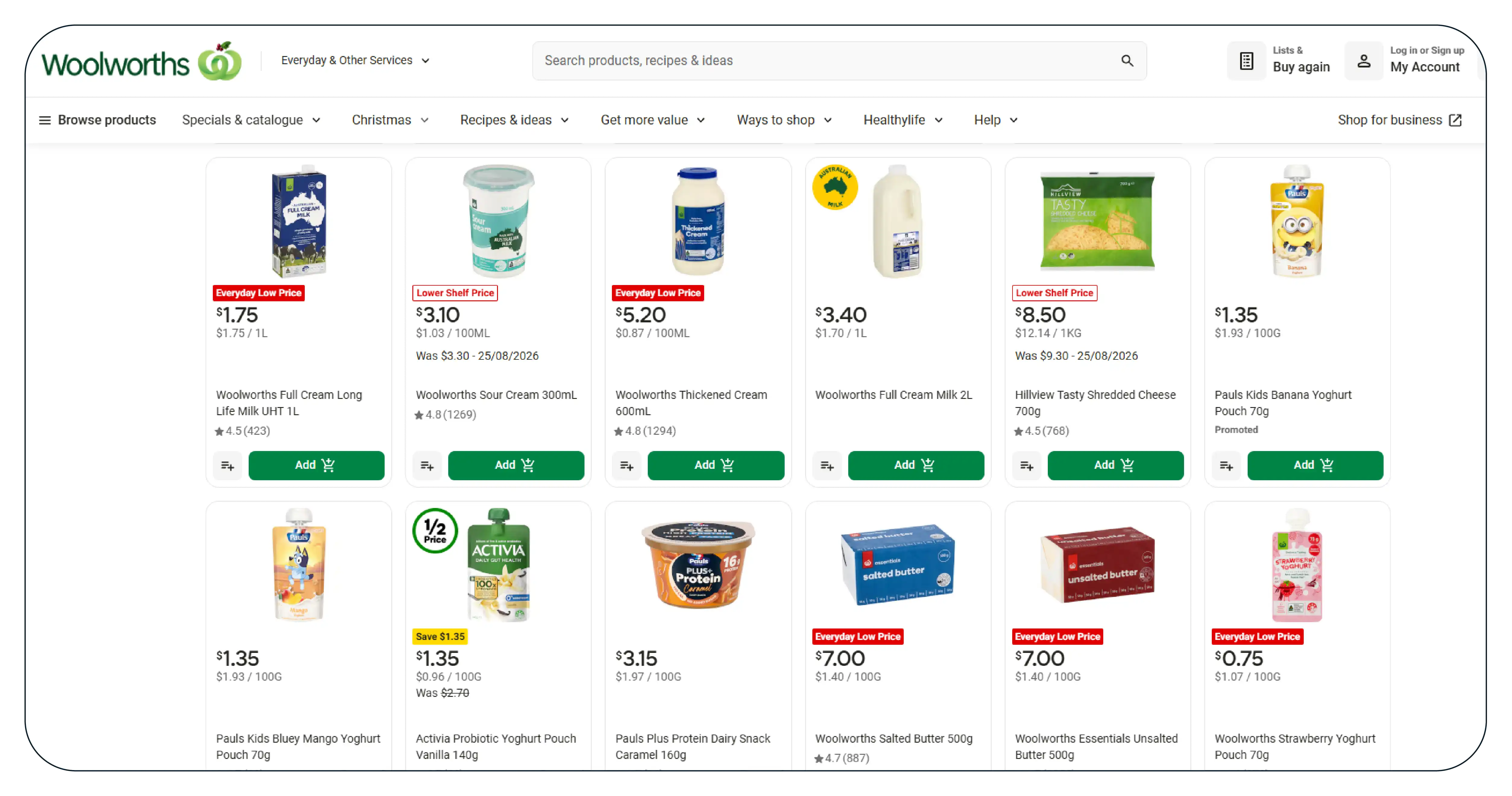
The project was designed around three business priorities: improve competitive visibility, reduce repetitive research, and establish a reliable grocery data foundation. Its technical requirements focused on scalable extraction, structured product matching, and integration with analytical workflows.
Goals
The primary business goals included:
Improve competitor price visibility across selected Woolworths grocery categories.
Compare branded and private-label products using consistent product attributes.
Identify promotional changes and differences between regular and discounted prices.
Reduce manual research across frequently monitored grocery products.
Support pricing decisions with organized historical observations.
The retailer also wanted to evaluate products from brands such as Coca-Cola, Pepsi, Arnott's, Cadbury, and Kellogg's against comparable grocery alternatives.
Objectives
The technical objectives focused on creating a repeatable collection process.
Automate the collection of publicly displayed product information.
Standardize product titles, brands, pack sizes, and prices.
Capture promotional labels and availability information where displayed.
Integrate structured datasets with business intelligence systems.
Maintain timestamps for historical comparisons.
Implement validation and duplicate-detection procedures.
The Brand-Level Price Benchmark Scraping requirement was particularly important because products with different pack sizes or configurations should not be treated as identical.
KPIs
The following KPIs were established as project measurement criteria rather than claimed project outcomes:
Product coverage: percentage of selected SKUs successfully collected.
Matching accuracy: percentage of correctly matched products and variants.
Data completeness: percentage of records containing required fields.
Collection success rate: percentage of scheduled extraction jobs completed successfully.
Freshness: elapsed time between a marketplace update and its detection.
Duplicate rate: percentage of duplicate product records.
The project also incorporated Australian Woolworths Grocery Price Scraping as its central data collection requirement, ensuring that product information could be organized for repeatable competitor research.
The Core Challenge
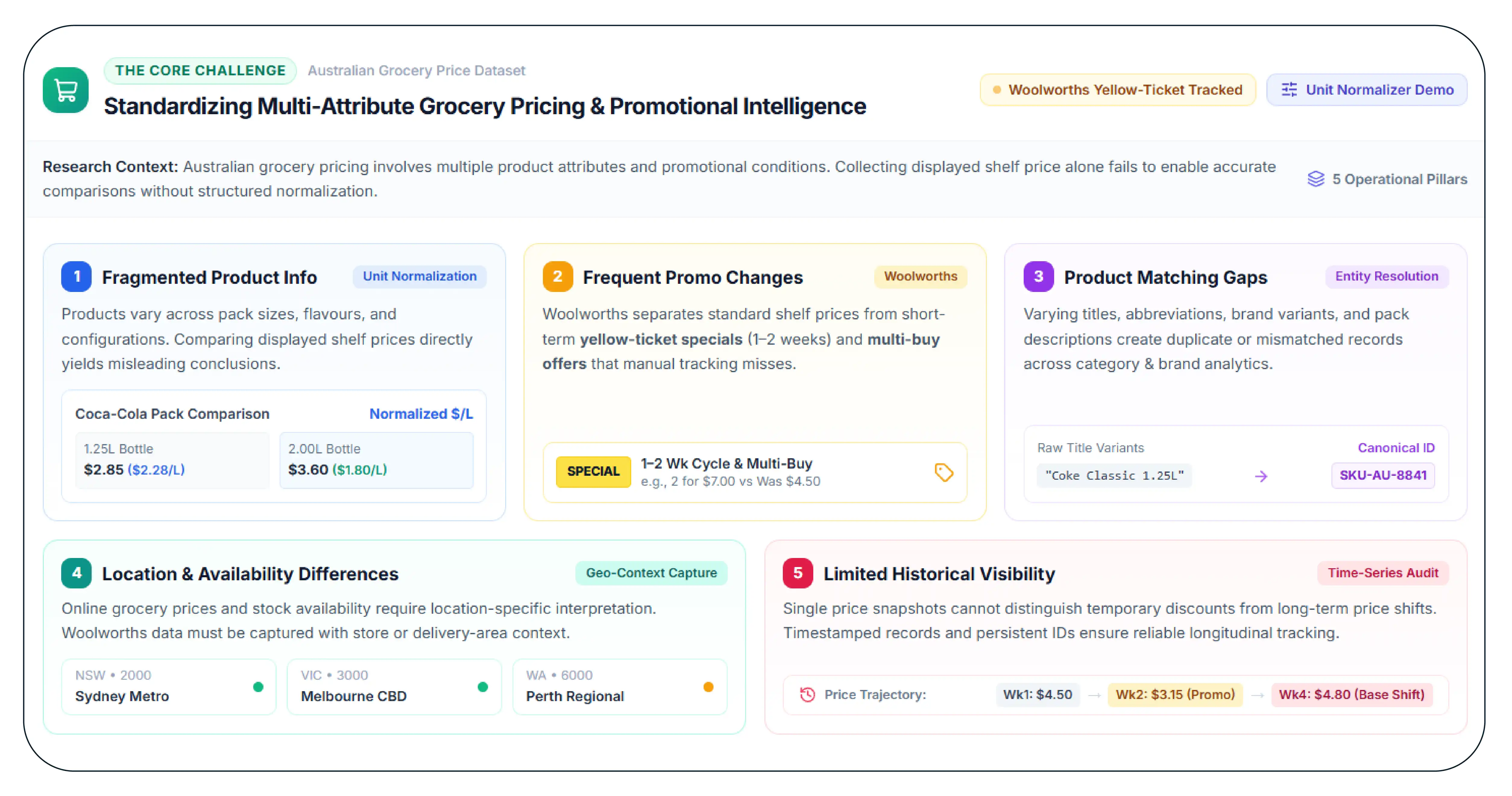
Australian grocery pricing involves multiple product attributes and promotional conditions. Collecting a product's displayed price alone does not provide enough information to make an accurate comparison.
The client faced several research and operational challenges that needed to be addressed through a structured data collection process.
Fragmented product information
Grocery products appear in different pack sizes, flavours, and packaging configurations. For example, a 1.25-litre Coca-Cola bottle cannot be compared directly with a 2-litre bottle using the displayed selling price alone. Without unit normalization, price comparisons can produce misleading conclusions.
Frequent promotional changes
Woolworths distinguishes standard shelf prices from promotional offers. Its official pricing information explains that yellow-ticket specials are generally short-term offers, usually lasting one or two weeks. Multi-buy offers can also combine multiple products at a discounted price.
Woolworths
Manual research makes it difficult to maintain a consistent historical record of these changes.
Product matching inconsistencies
Different product titles, abbreviations, brand variations, and package descriptions can create duplicate or incorrectly matched records. This affects category-level and brand-level analysis.
Location and availability differences
Online grocery prices and availability can require location-specific interpretation. Woolworths' displayed information should therefore be captured with relevant store or delivery-area context where available.
Limited historical visibility
Individual price observations cannot establish whether an offer represents a temporary discount or a longer-term pricing change. The client needed timestamped records and consistent product identifiers to support reliable comparisons.
The resulting Australian Grocery Price Dataset needed to address these problems through standardization, validation, and repeatable monitoring rather than simply increasing the volume of collected information.
Our Solution
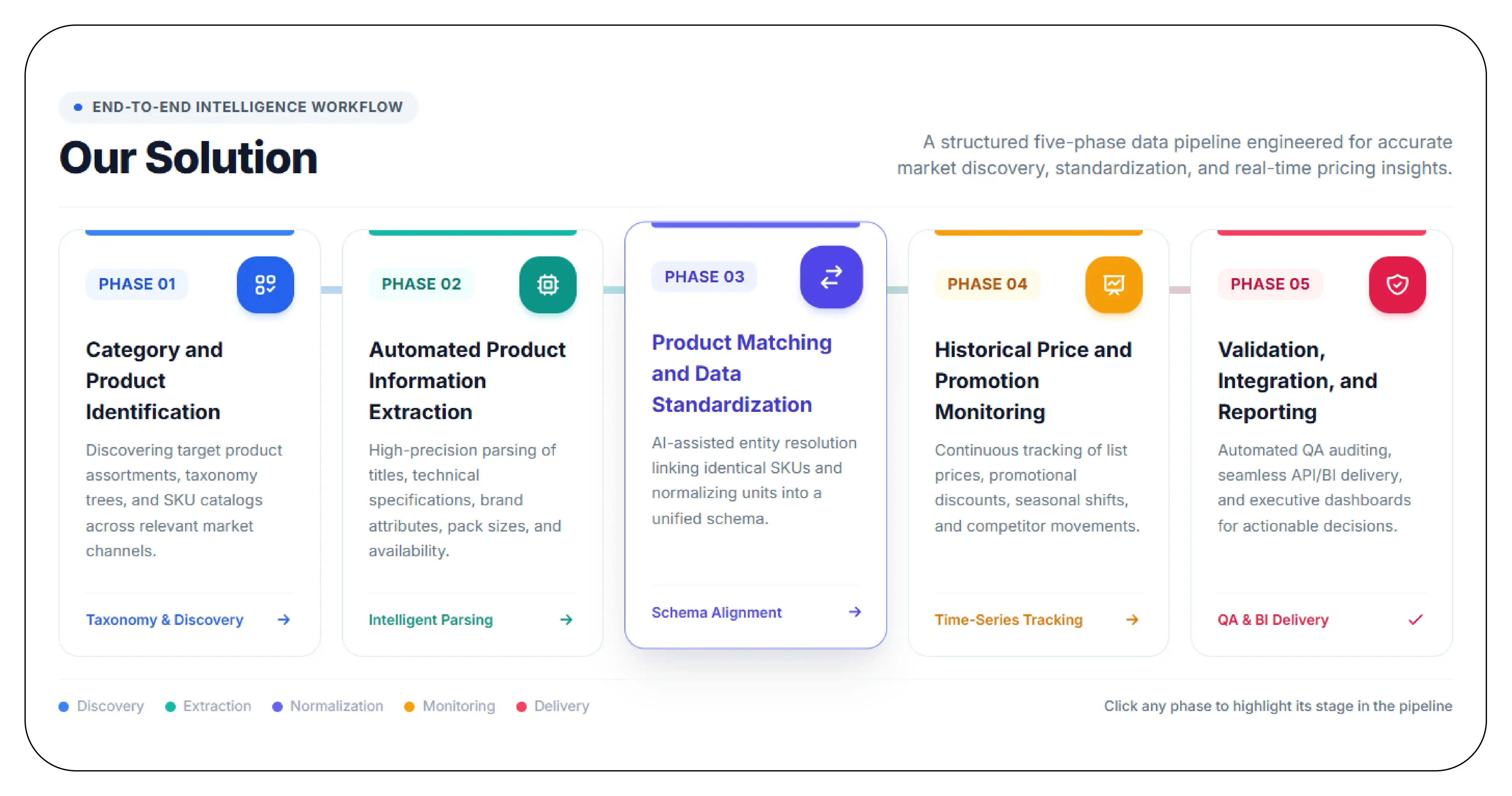
Product Data Scrape designed a phased data collection methodology to organize Woolworths grocery information into structured, analysis-ready records. The proposed workflow focused on product discovery, extraction, validation, historical monitoring, and delivery.
Phase 1: Category and Product Identification
The first phase established the target grocery categories and product selection criteria.
The collection scope included:
Packaged food and pantry essentials.
Beverages and bottled drinks.
Dairy products and refrigerated groceries.
Breakfast cereals and snacks.
Household cleaning products.
Personal care and everyday essentials.
Products from brands such as Arnott's, Coca-Cola, Kellogg's, Cadbury, Bega, and Woolworths own-brand ranges were included as relevant research entities.
The objective was to create consistent category classifications before collecting product information.
Phase 2: Automated Product Information Extraction
The next phase focused on capturing publicly displayed grocery listing information through a configurable Woolworths Promotional Price Monitoring workflow.
The extraction structure included product title, brand, product identifier, category, package size, listed price, promotional price, displayed discount, product URL, and availability where accessible.
The Australian Woolworths Grocery Price Scraping workflow was designed to preserve source information and collection timestamps so that analysts could identify when a particular price observation was recorded.
A configurable API-style delivery layer could then make validated records available to internal reporting systems. This describes a third-party data delivery approach, not an official Woolworths API or an affiliation with Woolworths.
Phase 3: Product Matching and Data Standardization
Raw grocery listings require normalization before they can support reliable analysis.
The processing workflow included:
Cleaning inconsistent product titles.
Standardizing brand names and category labels.
Extracting package weights and volumes.
Matching products using identifiers and specifications.
Removing duplicate records.
Separating regular prices from promotional prices.
Normalizing prices by unit where appropriate.
For example, comparing two different cereal pack sizes requires calculating the price per 100 grams rather than relying only on the displayed package price.
This makes brand comparisons more meaningful and reduces misleading conclusions.
Phase 4: Historical Price and Promotion Monitoring
The fourth phase focused on maintaining timestamped observations for selected products.
A historical record could capture:
Previously observed selling price.
Current displayed selling price.
Promotional label and offer description.
Collection date and time.
Product availability status.
Changes in package size or product listing.
Woolworths' official pricing guidance distinguishes short-term specials, multi-buy promotions, and longer-term red-ticket offers. The data model therefore keeps promotional types separate instead of treating every offer as a standard percentage discount.
Phase 5: Validation, Integration, and Reporting
The final phase focused on quality assurance and analytical delivery.
Automated validation checks could identify missing prices, invalid package sizes, duplicated identifiers, and inconsistent product matches. Validated records could then be exported into CSV, JSON, or database-ready structures, depending on the client's requirements.
Dashboards could organize the information into category, brand, and product-level views.
The resulting workflow provided a repeatable framework for examining competitor prices, tracking promotions, and supporting grocery merchandising decisions.
Results & Key Metrics
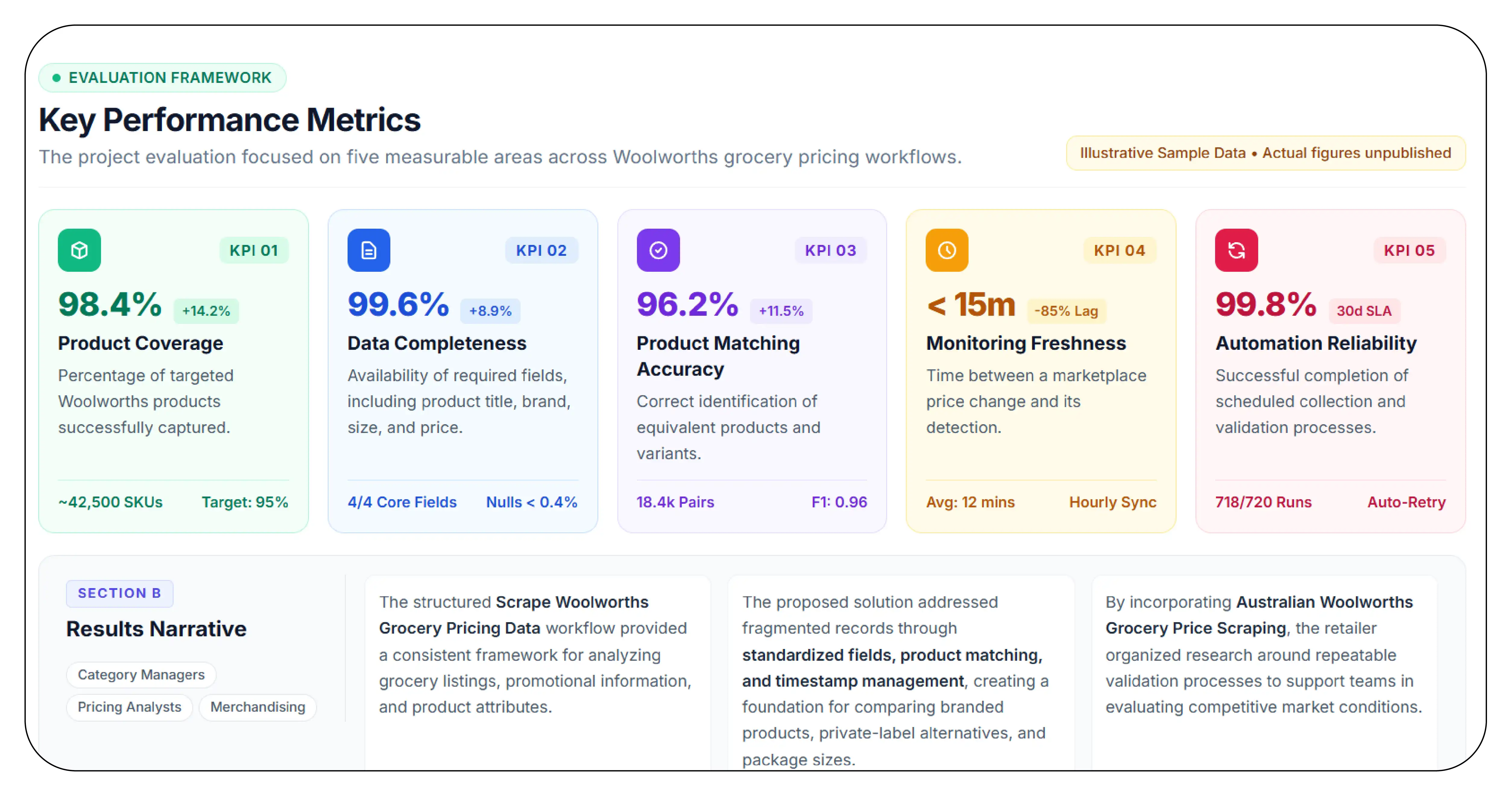
The solution established a structured approach to grocery pricing intelligence. Since independently verified project performance figures were not supplied, the following metrics describe the measurement framework and intended operational improvements rather than confirmed numerical achievements.
The project evaluation focused on five measurable areas:
Product coverage: Percentage of targeted Woolworths products successfully captured.
Data completeness: Availability of required fields, including product title, brand, size, and price.
Product matching accuracy: Correct identification of equivalent products and variants.
Monitoring freshness: Time between a marketplace price change and its detection.
Automation reliability: Successful completion of scheduled collection and validation processes.
Actual before-and-after percentages and collection volumes were not available for publication.
The structured Scrape Woolworths Grocery Pricing Data workflow provided a consistent framework for analyzing grocery listings, promotional information, and product attributes.
The proposed solution addressed fragmented records through standardized fields, product matching, and timestamp management. It also created a foundation for comparing branded products, private-label alternatives, and different package sizes.
By incorporating Australian Woolworths Grocery Price Scraping, the retailer could organize its research around repeatable data collection and validation processes. The resulting dataset was designed to support category managers, pricing analysts, and merchandising teams in evaluating competitive market conditions.
What Made Product Data Scrape Different?
Product Data Scrape focused on data quality and analytical usability rather than simply collecting large volumes of grocery listings.
Its proposed approach combined automated extraction, product-level matching, configurable monitoring, and structured delivery.
The Grocery data scraping methodology emphasized consistent product identifiers, normalized package sizes, promotional classification, and timestamped records.
Key differentiators included:
Configurable extraction based on selected product categories.
Automated duplicate detection and data validation.
Brand and variant-level product matching.
Historical price observation management.
Flexible CSV, JSON, and database-ready delivery.
Scalable monitoring workflows for changing product assortments.
The overall Australian Woolworths Grocery Price Scraping framework was designed to turn fragmented grocery information into structured retail intelligence that could support better pricing research and competitive decision-making.
Client's Testimonial
"Product Data Scrape helped us establish a more structured approach to grocery price intelligence across the Australian supermarket market. The organized product information made it easier to examine competitor pricing, compare branded and private-label products, and understand promotional changes across grocery categories. The ability to review product details, package sizes, and displayed prices in a consistent format supported our pricing research and merchandising activities. Their focus on data accuracy, product matching, and structured delivery made the process more manageable and useful for our team. We see strong value in using reliable grocery market data to support informed retail decisions."
— Head of Pricing and Merchandising
Conclusion
Australian grocery retailers need consistent product information to understand changing prices, promotional activity, and competitor positioning. A structured data collection framework can help businesses compare products, normalize package sizes, and maintain historical pricing observations.
Through Australia Grocery Price Intelligence, Product Data Scrape helps retailers establish a foundation for product-level research, promotional monitoring, and competitive benchmarking.
The Australian Woolworths Grocery Price Scraping methodology can support smarter grocery analytics through automated extraction, data validation, and organized reporting.
Ready to improve your supermarket pricing research? Contact Product Data Scrape to discuss a customized grocery data collection solution and build a stronger foundation for retail intelligence!
FAQs
1. What is Australian Woolworths grocery price scraping?
It is the structured collection of publicly displayed grocery product information from Woolworths Australia. Data can include product names, brands, package sizes, selling prices, promotional offers, and availability where accessible.
2. Which grocery brands can be monitored?
Relevant brands may include Coca-Cola, Pepsi, Arnott's, Kellogg's, Cadbury, Bega, and Woolworths own-brand products, depending on listing availability and collection requirements. Yes. A structured dataset can distinguish standard prices, temporary specials, multi-buy offers, and other displayed promotional information. Woolworths explains these offer types in its official pricing guidance.
3. How does grocery price data help retailers?
It helps retailers compare equivalent products, evaluate competitor pricing, understand promotional changes, monitor assortment, and support merchandising decisions.
4. Can Product Data Scrape provide customized datasets?
Yes. Data collection can be configured around selected categories, brands, product attributes, monitoring frequency, and delivery formats. Collection must respect applicable website terms, privacy requirements, and access restrictions.


 Singapore
 EMAIL
 PHONE










.webp)