Introduction
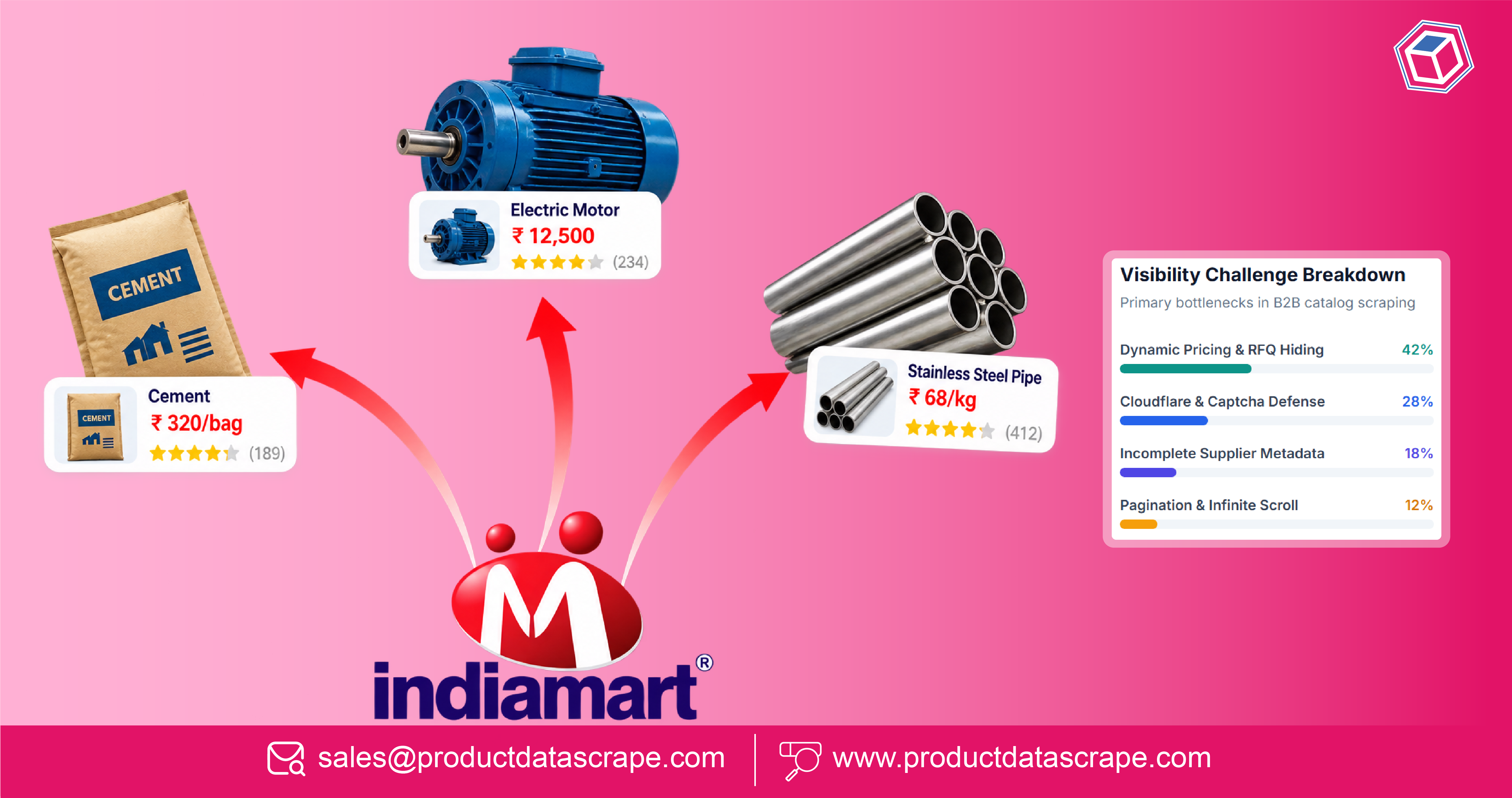
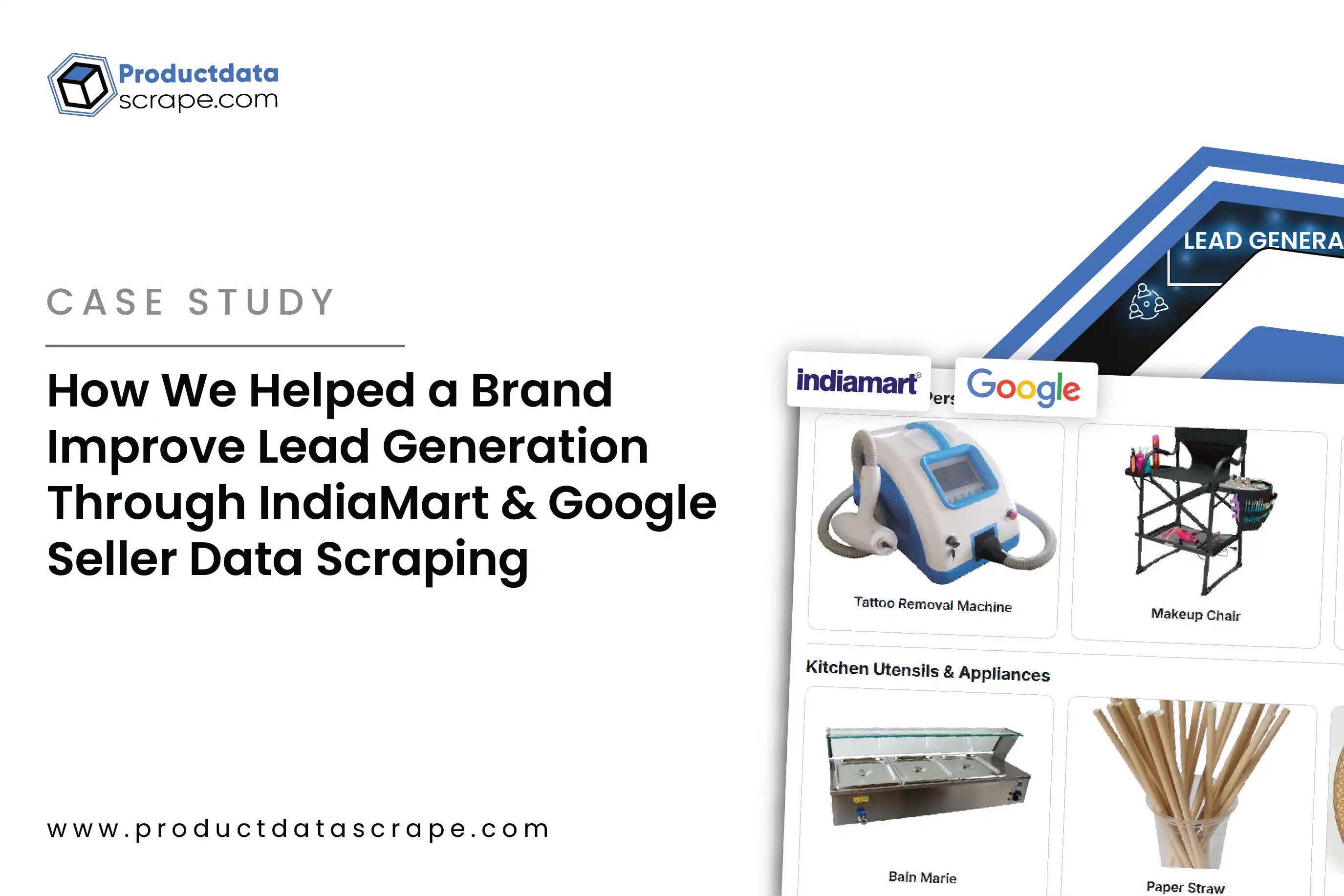
Businesses can overcome product, supplier, and pricing visibility challenges by converting marketplace information into structured, regularly refreshed datasets. Indiamart Industry Leader data scraping helps organizations organize supplier profiles, product catalogs, pricing signals, locations, categories, and business information for competitive and market intelligence.
B2B marketplaces contain large volumes of fragmented information. A buyer may need to compare dozens of suppliers for the same product, while procurement teams may need to understand pricing differences across cities or supplier types. Sales teams may want to identify new prospects, and category managers may need to monitor emerging product demand.
The challenge is not simply finding information. The real challenge is making information comparable, searchable, and useful for decision-making.
For example, a business researching grocery suppliers may need product names, brands, pack sizes, minimum order quantities, supplier locations, prices, certifications, and business details. Grocery data scraping can organize these attributes into structured records that support supplier discovery and market analysis.
The result is a more consistent information layer for procurement, sales intelligence, competitive research, pricing analysis, and category planning.
How Can Businesses Strengthen Supplier and Brand Visibility?
Extract IndiaMART Industry Leader Supplier Data can help businesses create structured supplier intelligence covering company names, categories, locations, product portfolios, business descriptions, contact-related fields where publicly available, and other marketplace attributes.
Supplier visibility is particularly important when companies operate across multiple product categories. Manual research can make it difficult to identify whether two listings represent the same supplier, whether a supplier has expanded its catalog, or whether new businesses have entered a category.
Brand protection is another important application. Structured supplier data can help companies identify potentially unauthorized listings, inconsistent product descriptions, duplicate business profiles, and unusual marketplace activity for their products or brands.
What can supplier intelligence capture?
| Data Attribute |
Business Use |
| Supplier name |
Supplier identification |
| Product category |
Category mapping |
| Product name |
Catalog comparison |
| Location |
Regional supplier discovery |
| Business description |
Supplier profiling |
| Product portfolio |
Assortment analysis |
| MOQ |
Procurement evaluation |
| Pricing fields |
Price benchmarking |
| Certifications |
Supplier qualification |
| Listing URL |
Source verification |
2020–2026 Evolution
Between 2020 and 2026, B2B purchasing increasingly moved toward digital discovery. Businesses became more dependent on online supplier directories and marketplace listings to identify potential vendors. This increased the volume of information available but also created a data-management problem.
In 2020, many teams still relied heavily on spreadsheets and manual supplier research. By 2022, digital procurement workflows created greater demand for structured supplier information. During 2023–2024, automated collection and data normalization became increasingly useful for businesses managing larger supplier universes. By 2025–2026, organizations increasingly expected marketplace intelligence to integrate with dashboards, CRM systems, procurement platforms, and analytics environments.
The key shift is from simply collecting supplier names to maintaining continuously usable supplier intelligence. Companies can use structured records to identify new entrants, compare supplier capabilities, detect changes in product portfolios, and support procurement teams with more organized information.
Impact metrics: Businesses implementing structured supplier-monitoring workflows may target 90%+ field completeness, 50%+ reductions in repetitive research, and significantly faster supplier comparison cycles. These figures are planning benchmarks rather than independently verified IndiaMART performance statistics.
How Can Companies Build a More Complete Marketplace View?
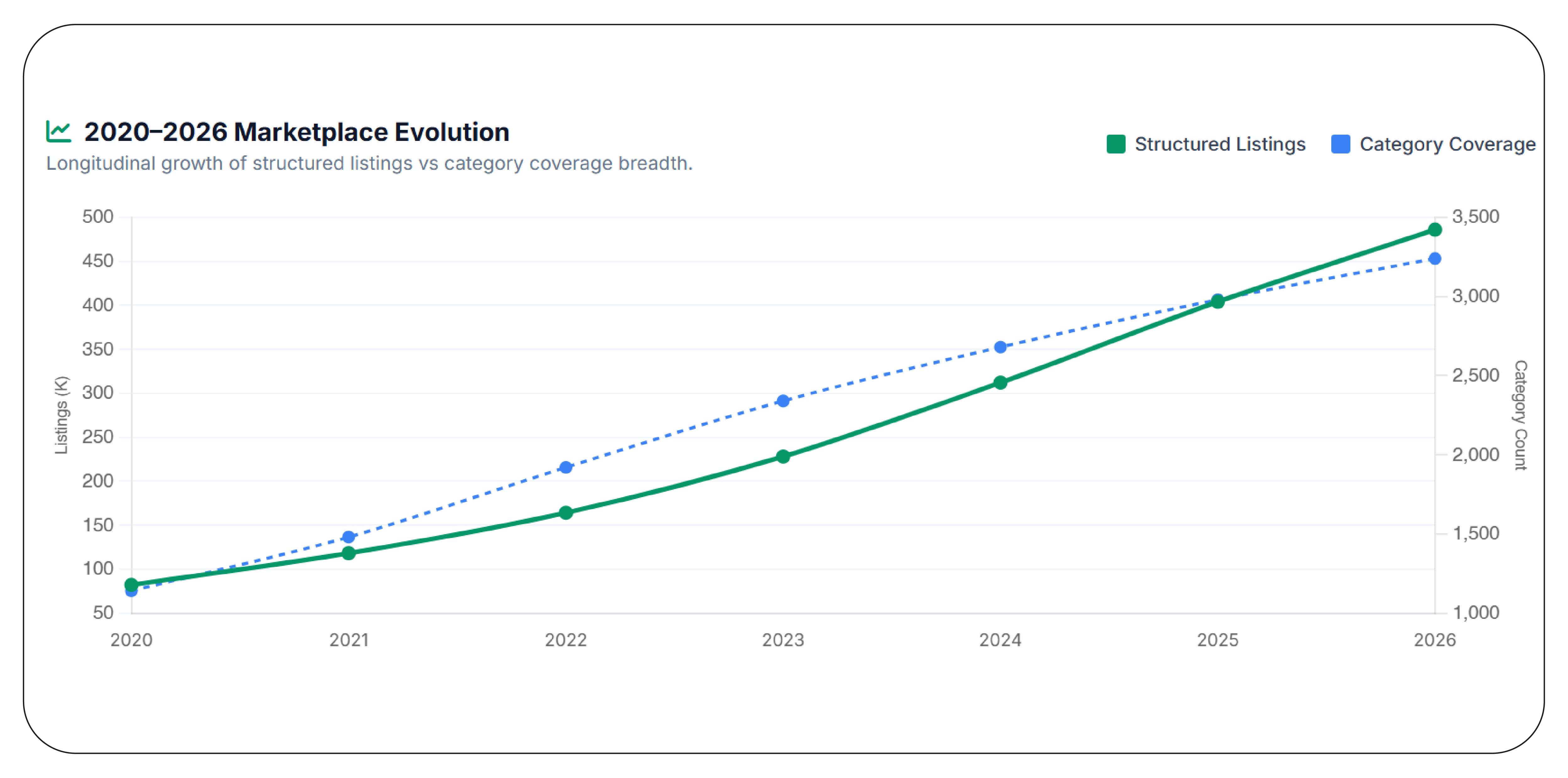
Scrape IndiaMART Industry Leader Business Listings to organize business profiles into a searchable dataset that can support supplier discovery, category research, regional analysis, and market mapping.
Business listings often contain valuable signals beyond a company name. Category information, product descriptions, business location, experience-related information, certifications, product ranges, and marketplace activity can help buyers understand the structure of a particular B2B segment.
A structured listing dataset can also make it easier to identify patterns across regions.
Which listing attributes matter most?
| Attribute |
Intelligence Application |
| Company name |
Business identification |
| Industry/category |
Market segmentation |
| Location |
Regional mapping |
| Product categories |
Portfolio analysis |
| Product descriptions |
Demand and assortment research |
| Business profile |
Supplier qualification |
| Listing activity |
Marketplace monitoring |
| Product URLs |
Record verification |
A company selling packaging materials, for example, could map suppliers across Mumbai, Delhi, Ahmedabad, Bengaluru, Hyderabad, and other commercial centers. This provides a regional perspective that is difficult to maintain manually.
2020–2026 Evolution
From 2020 onward, online B2B discovery expanded as businesses increasingly used digital channels for supplier identification. The growing number of digital listings created opportunities for companies to move beyond isolated searches and build structured market maps.
By 2023, businesses increasingly required datasets that could be filtered by category, geography, supplier type, and product. In 2024–2026, marketplace information became increasingly useful when connected to internal sales, procurement, and market-intelligence systems.
A structured business-listing dataset can therefore act as a foundation for territory planning and supplier benchmarking. Instead of searching individually for suppliers, analysts can work from a categorized dataset and identify patterns at scale.
Workflow benchmark: A structured workflow can target 95%+ standardized category fields, automated duplicate identification, and recurring refreshes based on business requirements.
How Can B2B Teams Identify Demand Signals Earlier?
IndiaMART Industry Leader B2B Leads can be enriched with product, category, supplier, and geographic information to support demand-trend intelligence and market opportunity analysis.
For B2B organizations, demand intelligence is not limited to sales leads. Product categories appearing frequently across listings, newly emerging product groups, expanding supplier portfolios, and changes in product descriptions can provide useful market signals.
For example, an industrial distributor could monitor categories such as packaging machinery, food-processing equipment, commercial refrigeration, warehouse equipment, or electrical components. Increasing supplier activity within a category may indicate a changing competitive environment, although listing volume alone should not be treated as a direct measure of actual market demand.
Which signals can businesses monitor?
| Signal |
Potential Interpretation |
| New product listings |
Possible category expansion |
| Supplier growth |
Increasing competitive activity |
| Product-category changes |
Portfolio movement |
| Geographic concentration |
Regional opportunity |
| Repeated product terms |
Category relevance |
| Listing frequency |
Marketplace activity |
| Pricing movement |
Competitive positioning |
2020–2026 Evolution
The period from 2020 to 2026 accelerated the importance of digital demand signals. During 2020–2021, businesses faced significant uncertainty around supply chains and procurement. Digital supplier discovery became increasingly valuable.
In 2022–2023, businesses began using broader datasets to understand category movement and supplier availability. By 2024–2025, analytics teams increasingly combined marketplace data with CRM, search, sales, and internal transaction information.
In 2026, the opportunity is to make these datasets more machine-readable. Structured marketplace information can be processed through analytics platforms and AI-assisted workflows to identify recurring patterns, classify suppliers, cluster products, and surface unusual changes.
The important distinction is between marketplace activity and confirmed market demand. A robust intelligence program should combine marketplace observations with internal sales data, customer inquiries, search behavior, and other relevant evidence before making strategic conclusions.
How Can Businesses Monitor Competitive Pricing More Effectively?
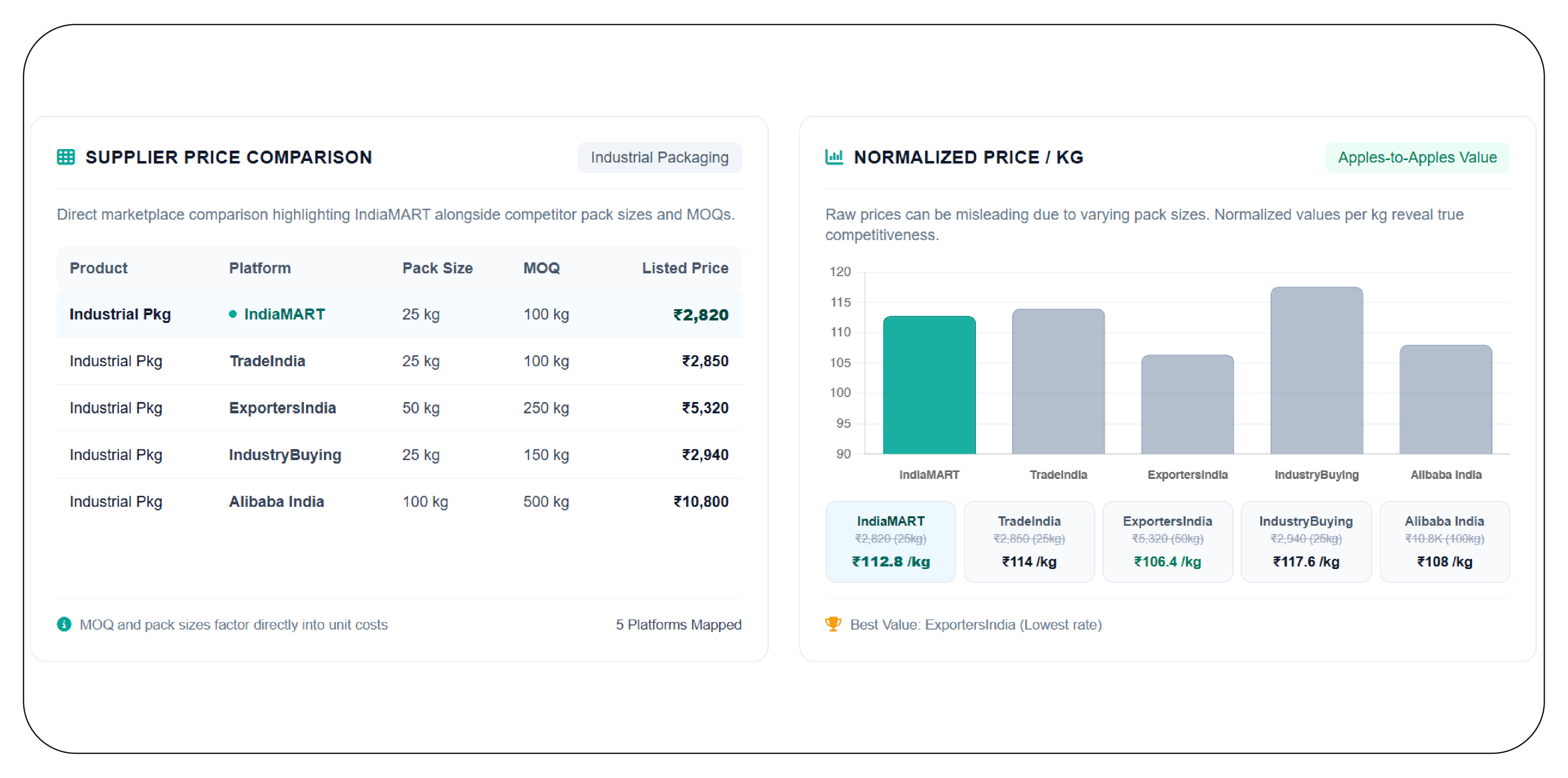
Track IndiaMART Industry Leader Pricing Data to build a consistent reference point for comparing product-level prices, supplier offers, pack sizes, minimum order quantities, and other pricing-related attributes.
Pricing visibility is challenging because suppliers may publish different units, quantities, packaging formats, or commercial terms. A listed price for one product may not be directly comparable with another supplier's offer.
For example, a supplier offering 25 kg industrial packaging material may display a different price structure from a supplier selling 50 kg quantities. Without normalization, a simple price comparison can produce misleading results.
How does structured pricing monitoring help?
| Pricing Field |
Use |
| Listed price |
Basic benchmark |
| Unit/pack size |
Normalized comparison |
| MOQ |
Procurement context |
| Product variant |
Like-for-like matching |
| Supplier location |
Regional pricing analysis |
| Discount information |
Promotional analysis |
| Collection date |
Historical tracking |
2020–2026 Evolution
Between 2020 and 2022, supply-chain volatility made price visibility increasingly important for procurement teams. Businesses needed faster ways to understand supplier offers and changing commercial conditions.
From 2023 onward, recurring price monitoring became more valuable as organizations sought historical context rather than one-time observations. By 2025–2026, structured pricing datasets could be connected to dashboards and analytics systems to compare suppliers and identify changes over time.
The most effective pricing workflows do not simply collect numbers. They normalize units, distinguish product variants, record timestamps, and retain historical observations.
KPI framework: A pricing-monitoring program could target 90%+ product matching accuracy, 95%+ timestamp completeness, and substantial reductions in manual price-checking time. These are operational targets, not verified marketplace-wide statistics.
What Makes a Supplier Dataset Useful for Procurement Teams?
A reliable IndiaMART Industry Leader Supplier Dataset should combine supplier identity, product information, geography, category classification, and relevant marketplace attributes in a standardized structure.
The value of the dataset depends on consistency. If the same supplier appears under multiple spellings, product categories are inconsistent, or location fields are incomplete, downstream analysis becomes difficult.
What should a supplier dataset contain?
| Dataset Layer |
Example Fields |
| Supplier identity |
Company name, profile URL |
| Product |
Product name, category |
| Geography |
City, state, region |
| Commercial |
Price, MOQ |
| Portfolio |
Product count/categories |
| Qualification |
Certifications where available |
| Source |
Listing URL |
| Tracking |
Collection date |
2020–2026 Evolution
Supplier datasets have evolved from static directories into continuously maintained intelligence resources. In 2020, companies often created lists for immediate procurement requirements. By 2022, businesses increasingly needed broader supplier coverage as supply-chain conditions changed.
In 2023–2024, normalization and deduplication became more important because larger datasets contained repeated or inconsistently formatted records. During 2025–2026, integration with procurement platforms, CRM systems, dashboards, and AI-enabled analytics increased the potential value of structured supplier datasets.
The strongest approach is to treat the dataset as a living information asset. New suppliers can be added, outdated records can be refreshed, product categories can be reclassified, and historical changes can be preserved.
This makes the dataset useful for procurement research, territory expansion, supplier benchmarking, category analysis, and strategic sourcing.
How Can Businesses Benchmark Sellers and Competitors?
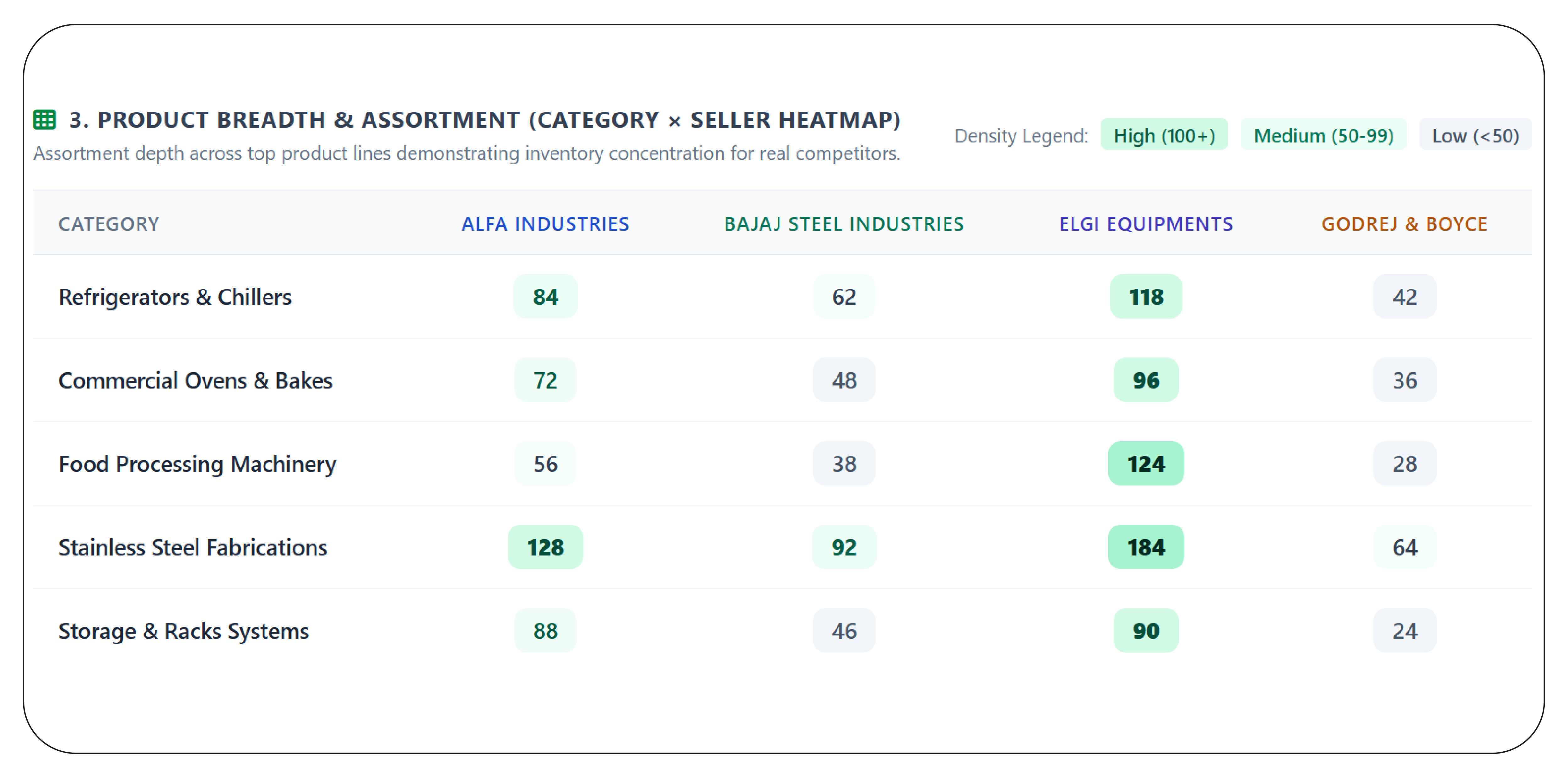
Indiamart Seller Competitor Analysis enables businesses to compare supplier positioning across product categories, locations, pricing attributes, product portfolios, and marketplace visibility. When combined with Indiamart Industry Leader data scraping, this analysis can move from individual supplier checks toward structured competitor intelligence.
Consider a business monitoring commercial kitchen equipment. It may compare suppliers offering refrigerators, ovens, food-processing machines, stainless-steel equipment, and storage solutions. Rather than reviewing individual listings manually, analysts can segment sellers by product category, geography, pricing structure, and catalog breadth.
What can competitor analysis reveal?
| Competitive Dimension |
Example Insight |
| Product breadth |
Category coverage |
| Geographic presence |
Regional competition |
| Pricing |
Relative positioning |
| MOQ |
Commercial requirements |
| Product variants |
Assortment depth |
| Supplier activity |
Marketplace presence |
| Category overlap |
Competitive proximity |
2020–2026 Evolution
From 2020 to 2022, competitor research was often reactive and manually performed. By 2023, businesses increasingly recognized the value of maintaining historical competitive datasets. In 2024–2025, automated monitoring made it easier to identify changes in product portfolios and pricing.
By 2026, competitive intelligence can become more structured by combining marketplace data with internal sales, CRM, customer inquiry, and category information.
However, marketplace presence should not automatically be treated as equivalent to business performance. A larger listing portfolio does not necessarily mean higher sales, stronger customer relationships, or greater market share. Businesses should combine marketplace intelligence with other evidence before making strategic decisions.
Why Should Businesses Choose a Specialized Data Partner?
E-commerce Data by Industry requires more than basic page extraction. Different industries have different attributes, matching requirements, update frequencies, and validation rules.
A specialized data partner can create schemas around the buyer's specific use case, automate collection, normalize records, remove duplicates, validate fields, and deliver information in analytics-ready formats.
Product Data Scrape focuses on structured web data workflows designed around business requirements. The process can support supplier intelligence, product monitoring, pricing research, competitive analysis, and market mapping.
For B2B marketplace intelligence, the emphasis should remain on data quality and usability. A smaller, accurately structured dataset can be more useful than a large dataset containing duplicates, inconsistent fields, and outdated records.
Conclusion
Businesses can overcome product, supplier, and pricing visibility gaps by converting marketplace information into structured, normalized, and regularly refreshed intelligence. Commerce Intelligence becomes more actionable when product, supplier, pricing, location, and category information can be compared consistently.
The approach described here helps procurement, sales, category, and market-intelligence teams reduce repetitive research and establish a stronger foundation for analysis. Indiamart Industry Leader data scraping can support supplier discovery, product intelligence, pricing monitoring, and competitor research when implemented with appropriate validation and context.
Product Data Scrape can help businesses design customized collection and data-processing workflows aligned with their specific marketplace intelligence requirements.
Contact Product Data Scrape to build a structured IndiaMART marketplace dataset tailored to your supplier, product, pricing, and competitive intelligence goals!
FAQs
1. What is IndiaMART data scraping?
It is the structured collection of publicly available marketplace information such as supplier profiles, product details, categories, locations, and pricing attributes for analysis.
2. Who can use marketplace data?
Manufacturers, distributors, procurement teams, sales organizations, researchers, and market-intelligence teams can use structured marketplace data for supplier and category research.
3. Can pricing data be monitored regularly?
Yes. Recurring collection workflows can capture pricing observations at defined intervals, enabling businesses to compare historical changes and supplier-level pricing patterns.
4. Why is supplier data normalization important?
Normalization makes inconsistent names, categories, units, and locations comparable, improving data quality and making supplier analysis more reliable.
5. Can Product Data Scrape customize the dataset?
Yes. Product Data Scrape can customize schemas, fields, collection frequency, validation rules, and delivery formats according to a business's intelligence requirements.


 Singapore
 EMAIL
EMAIL
 PHONE
PHONE










.webp)