Introduction
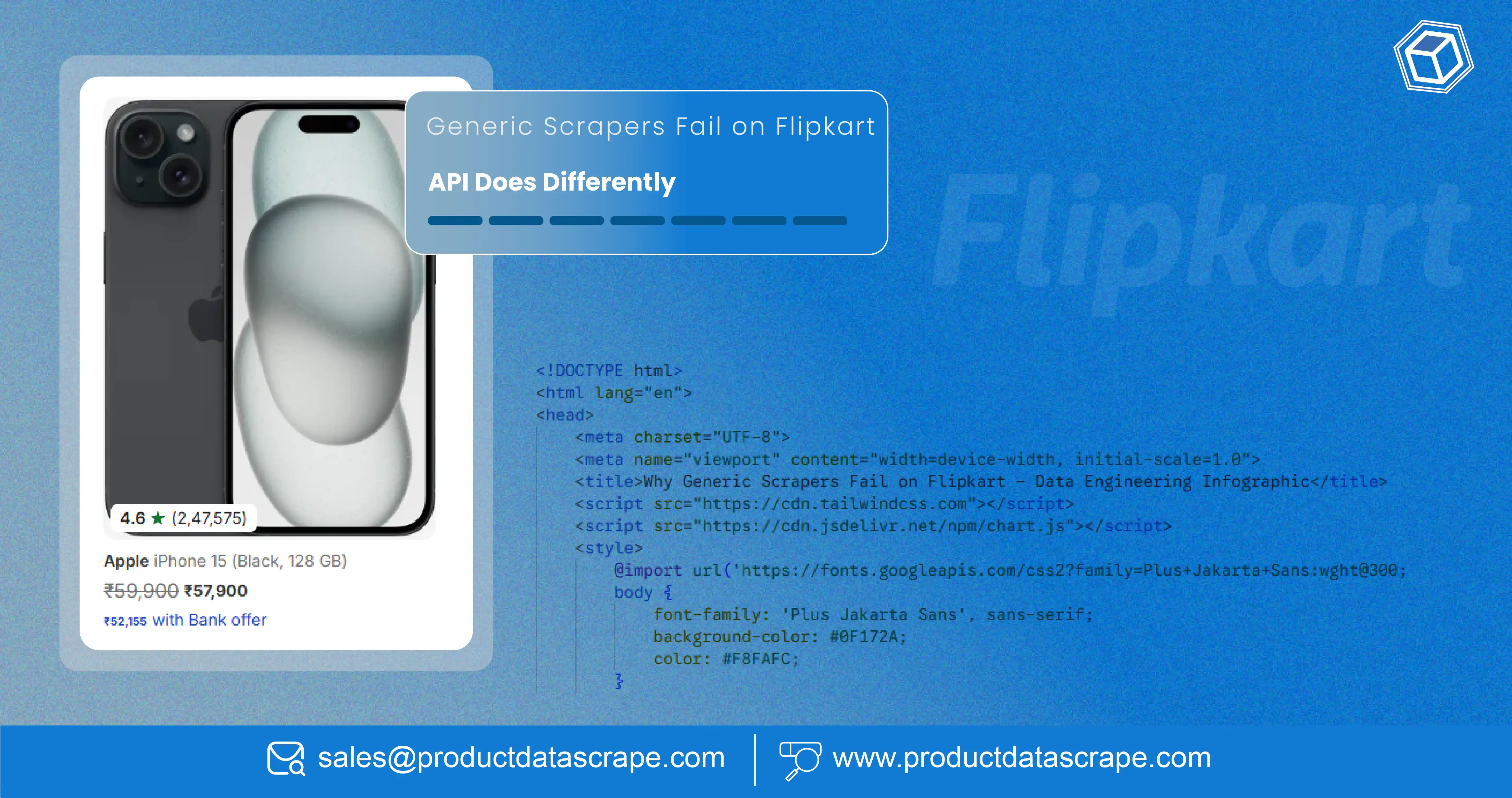
Most conversations about scraping quality get stuck on the wrong axis. People argue about parsing accuracy, uptime, proxy quality, and request throughput — all of which matter, and none of which is the reason generic scrapers fail on Flipkart.
They fail because of a modelling error, and it happens before a single line of parsing code is written.
A general-purpose scraper is built on an implicit model of what an e-commerce page is: one product, one price, one seller, one customer, one location. That model is a reasonable approximation of many websites. It is a poor approximation of Flipkart, and every downstream failure follows from the mismatch.
The failure is not that the scraper returns nothing. It is that the scraper returns something plausible and wrong, silently, forever, and nobody notices until a decision has been made on it.
The Five Assumptions, and Where Each One Breaks
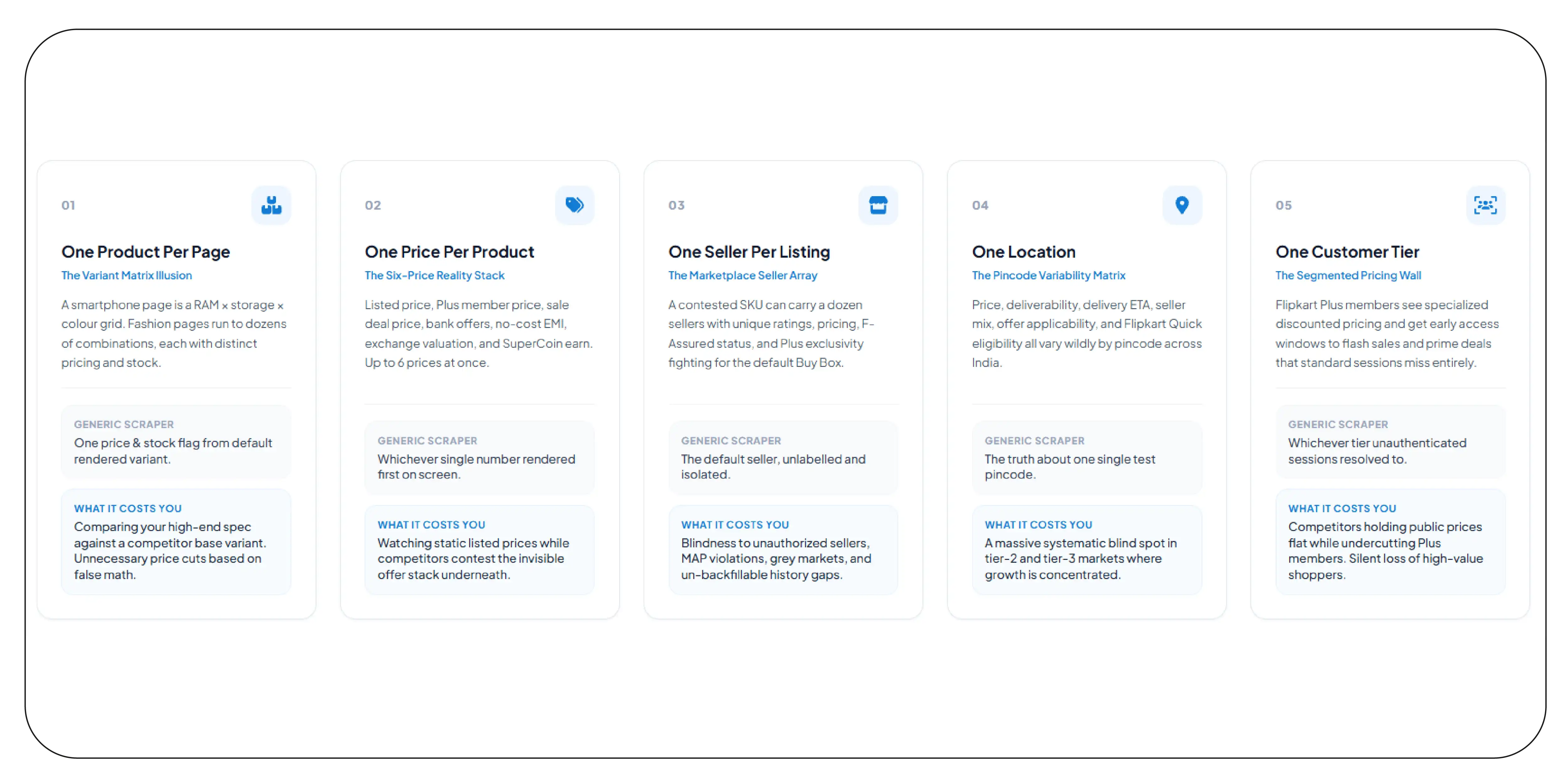
Assumption 1: One product per page
Reality: a Flipkart listing is a variant matrix. A smartphone page is a RAM × storage × colour grid. A fashion page is a size × colour grid running to dozens of combinations. Each cell has its own price and its own stock.
What a generic scraper returns: one price and one stock flag, drawn from whichever variant the page rendered by default.
What it costs you: you compare your 8 GB / 256 GB configuration against a competitor's captured price — which happens to be their base variant. You conclude you are 4,000 rupees more expensive. You cut price. You were never more expensive. You were comparing two different products.
Assumption 2: One price per product
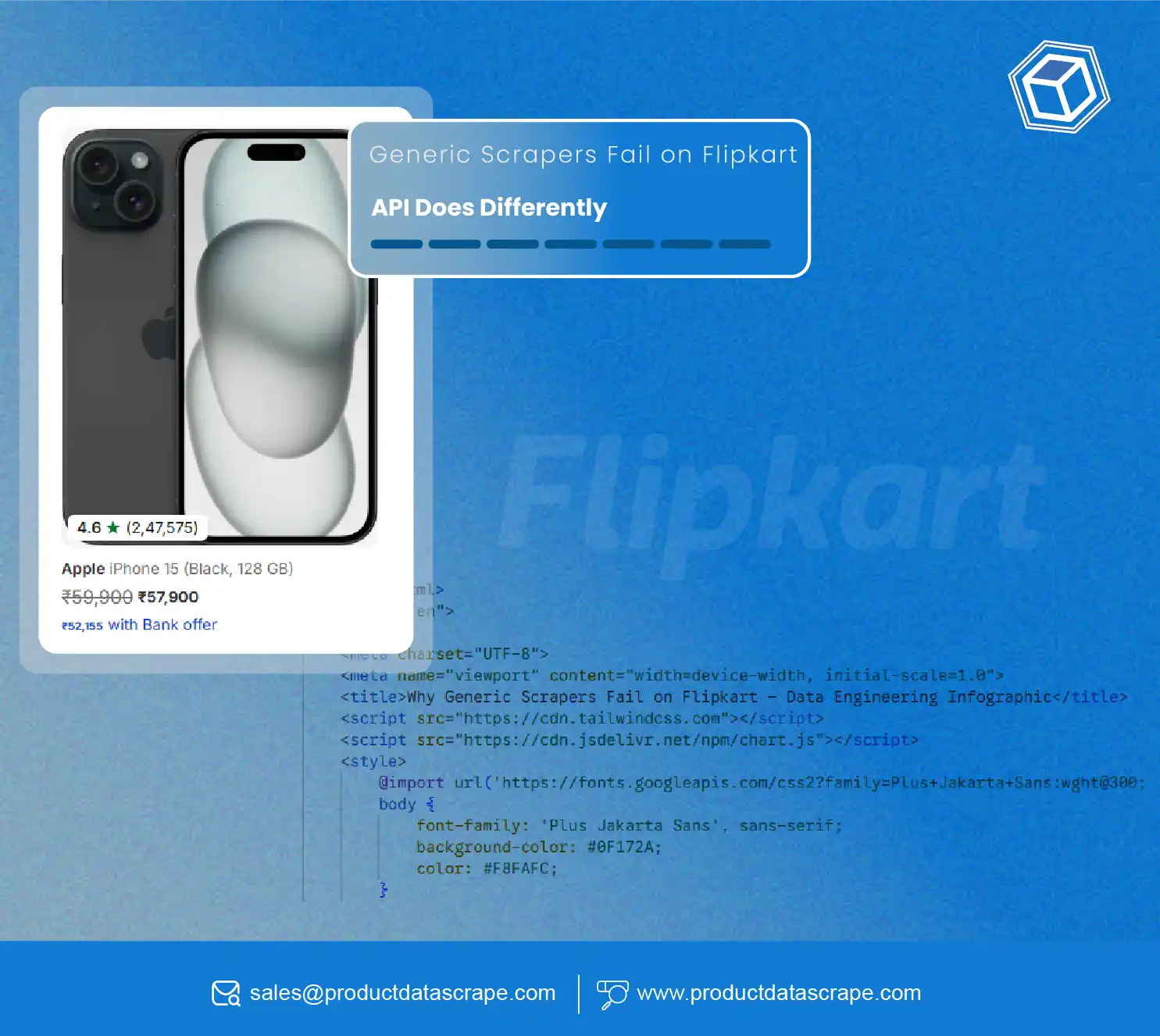
Reality: a Flipkart SKU carries a listed price, a Flipkart Plus member price, a deal price during sale events, and an effective price after bank offers, no-cost EMI, exchange valuation, and SuperCoin earn. That is up to six distinct prices for one product at one moment.
What a generic scraper returns: whichever number rendered first.
What it costs you: the layers you are not capturing are the layers your competitors are actually competing on — because moving the listed price is public, visible, and hard to reverse, and moving the offer stack is none of those things. You are watching the one number that moves least.
Assumption 3: One seller per listing
Reality: Flipkart is a marketplace. A contested SKU can carry a dozen sellers, each with a different price, rating, F-Assured status, and Plus exclusivity. One of them holds the default position and captures the overwhelming majority of the volume.
What a generic scraper returns: the default seller, unlabelled as such.
What it costs you: everything a brand-protection team exists to do. Unauthorised sellers, MAP violations, grey-market listings, and Buy Box loss are all invisible in the seller array you did not capture. And you cannot backfill it. The history either exists or it does not.
Assumption 4: One location
Reality: price, deliverability, delivery ETA, seller mix, offer applicability, and Flipkart Quick eligibility all vary by pincode across India.
What a generic scraper returns: the truth about one pincode, presented as the truth about the country.
What it costs you: for an FMCG brand whose growth is concentrated in tier-2 and tier-3 markets, this is not an approximation error. It is a systematic blind spot in exactly the regions that matter most.
Assumption 5: One customer tier
Reality: Flipkart Plus members see different prices and get early access to deals.
What a generic scraper returns: whichever tier the session resolved to.
What it costs you: a competitor can hold their public price flat while cutting the Plus price repeatedly. On your dashboard, they are stable. To their most valuable customers, they are running a sustained campaign.
The Failure Mode That Actually Hurts
Notice that none of the five failures above is a crash.
A scraper that breaks is annoying. Somebody gets paged, the parser gets fixed, a day of data is lost, and life continues. It is an operational cost, and it is a manageable one.
The failure mode that costs real money is the opposite: a pipeline that keeps running, keeps returning data, and returns the wrong number confidently. The dashboard populates. The chart is smooth. No alert fires, because from the pipeline's point of view nothing is wrong — it asked for a price, it got a price, it wrote a price.
The price is for the wrong variant, from the wrong seller, in the wrong tier, at the wrong location.
And then a pricing decision gets made on it.
We have seen this produce unnecessary price cuts, misdirected trade spend, and — in the most expensive case we have worked on — a brand that spent two quarters and a large ad budget diagnosing a conversion problem that turned out to be a size-level stockout its "in stock: true" pipeline had faithfully concealed.
A pipeline that fails loudly is a nuisance. A pipeline that fails silently is a liability.
What a Flipkart Scraping API Models Instead
The difference is not better parsing. It is a schema that matches the platform.
| Generic scraper output |
Flipkart-aware output |
| price |
listed_price, plus_exclusive_price, deal_price, effective_price, mrp |
| in_stock: true |
variants[] — each with variant_price, in_stock, stock_signal |
| seller |
all_sellers[] — each with price, is_f_assured, is_default_seller, seller_rating |
| (absent) |
bank_offers[] — structured with pct, cap, min_txn, cap_binding |
| (absent) |
no_cost_emi_available, emi_tenures, exchange_offer_max |
| (absent) |
supercoins_earnable, supercoin_earn_rate, category_baseline_earn_rate |
| (absent) |
is_f_assured — inside the seller array, where it belongs |
| (absent) |
pincode, deliverable, delivery_eta_days |
| (absent) |
flipkart_quick_eligible, quick_eta_minutes, dark_store_available |
| (absent) |
bbd_active, deal_type, deal_start, deal_end |
| scraped_at (sometimes) |
captured_at — mandatory, because duration is the metric |
Every row in the right-hand column exists because a real decision depends on it. None of them is a completeness exercise.
Side by Side, on One Real Question
Question: Are we price-competitive on our hero SKU?
Generic scraper answers:
{ "title": "Smartphone Model X Pro", "price": 24999, "in_stock": true }
Competitor: { "price": 24499, "in_stock": true }
Conclusion: we are 500 rupees more expensive. Cut price.
Flipkart-aware API answers:
{
  "our_sku": {
    "listed_price": 24999,
    "plus_exclusive_price": 23749,
    "best_bank_discount": 1500,
    "supercoins_earnable": 240,
    "effective_price_realised": 23158,
    "default_seller": "AuthorisedPartner A",
    "is_f_assured": true,
    "variant": "8GB/256GB",
    "variant_in_stock": true
  },
  "competitor_sku": {
    "listed_price": 24499,
    "plus_exclusive_price": null,
    "best_bank_discount": 500,
    "supercoins_earnable": 90,
    "effective_price_realised": 23962,
    "default_seller": "Unknown Seller 3",
    "is_f_assured": false,
    "variant": "6GB/128GB",
    "variant_in_stock": true
  }
}
Conclusion: we are not more expensive. We are 804 rupees cheaper on realised effective price. The competitor's listed price is lower because it is a different variant — a lower configuration. And the seller undercutting us is unbadged, unauthorised, and belongs in the brand-protection queue rather than the pricing review.
Same question. Same platform. Same moment. The generic answer would have triggered a price cut that destroyed margin and solved nothing. The Flipkart-aware answer triggers a takedown notice.
The Real Cost: Maintenance, Not Construction
Here is the thing that nobody accounts for when they decide to build.
Building a Flipkart scraper is not hard. A competent engineer will have a working version in a few weeks. That is the part everyone budgets for, and the budget is usually about right.
Maintaining it is a different job entirely, and it never ends.
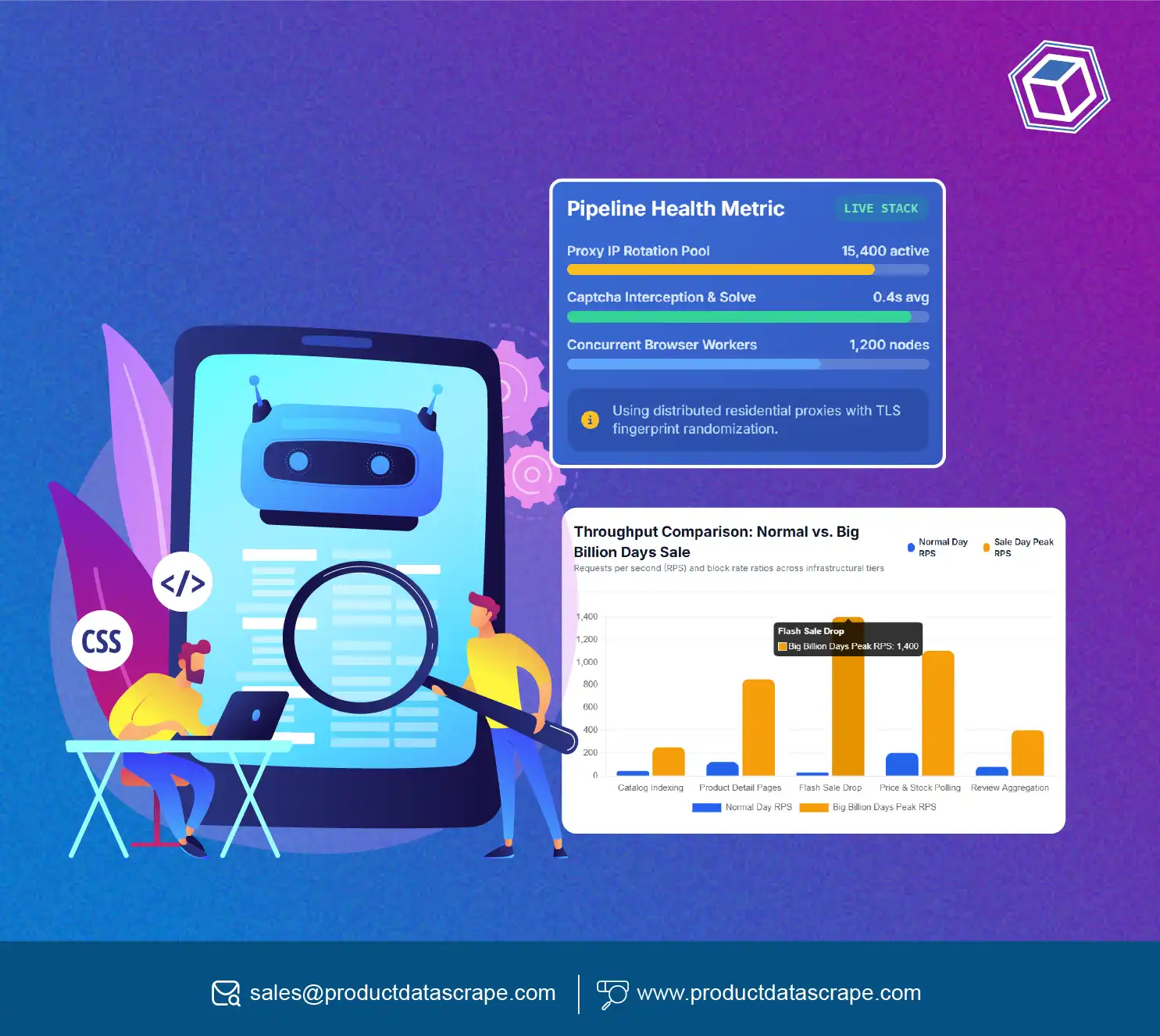
The front end changes. Deal structures appear during sale events that did not exist the week before. Offer formats shift. New fields appear; old ones move. Every one of those changes either breaks the parser — which is the good outcome, because you find out — or, more often, causes it to quietly return the wrong value.
And the maintenance burden is not evenly distributed. It concentrates precisely during sale events, which is exactly when the data matters most and exactly when your engineer least wants to be on call.
The honest total cost of ownership:
| Cost line |
Typically budgeted? |
| Initial build |
Yes |
| Proxy and infrastructure |
Usually |
| Ongoing parser maintenance |
Rarely |
| Sale-day capacity and on-call |
Almost never |
| Data validation and quality gates |
Almost never |
| The cost of one decision made on a silently wrong value |
Never |
That last line is not a joke, and in our experience it dwarfs the rest.
When You Should Build In-House
We would rather say this plainly than have you find out later.
Build in-house if:
- Your requirement is narrow and stable — a handful of SKUs, one location, price only, no seller array, no variants.
- You have a data engineer with capacity to own it as a standing responsibility, not a project.
- The data is directional and does not drive pricing, legal, or supply decisions.
- You are prototyping and want to learn the domain before committing.
Do not build in-house if:
- Brand-protection or legal decisions will rest on the data. Enforcement needs timestamped, defensible, continuous evidence, and a pipeline that has gaps is a pipeline whose evidence gets challenged.
- Sale events matter to your year. Your pipeline will be tested hardest on the days it is most likely to fail.
- You need pincode-level coverage. The complexity scales in a way that surprises people.
- You need the seller array. This is the single most maintenance-intensive part of the schema and the one most likely to break silently.
- Nobody owns it. An unowned pipeline is a liability with a cron job.
Frequently Asked Questions
Is a Flipkart scraping API just a scraper with better marketing?
The difference is the schema. A scraper returns what the page renders. An API returns a model of the platform — price tiers, seller arrays, variant matrices, structured offers, location resolution — with the fields a decision actually needs.
Can we start with a subset?
Yes. Most engagements start with hero SKUs and one or two field groups, then expand once the value is visible.
What formats do you deliver?
JSON with nested arrays, flattened CSV, REST API, and direct pushes to S3, GCS, Snowflake, or BigQuery.
How do you handle schema changes on Flipkart's side?
We absorb them. That is a substantial share of what the service is, and it is the part that in-house builds consistently underestimate.
How do you handle compliance?
Publicly available product information only — no personal data, no authenticated content, no circumvention of platform controls. Rate-limited, respectful collection.
Ask the Better Question
The question is not "can we scrape Flipkart?" You can. It is not hard.
The question is: when your pipeline returns 24,999, do you know which variant, which seller, which tier, and which pincode that number belongs to?
If you cannot answer all four, you do not have a price. You have a number.
Product Data Scrape delivers a Flipkart scraping API built on a schema that models the platform: every price tier, the full seller array with F-Assured status, complete variant matrices, structured bank offers with caps, no-cost EMI and exchange terms, SuperCoin earn rates, pincode-level resolution, Quick availability, and sale-event deal flags — with the maintenance burden on us rather than on your engineer.
Ask us for a side-by-side on your own hero SKU. Bring your current pipeline's output. The comparison usually makes the argument better than we can.
Product Data Scrape — turning marketplace complexity into decision-ready data.


 Singapore
 EMAIL
EMAIL
 PHONE
PHONE










.webp)