Quick Overview
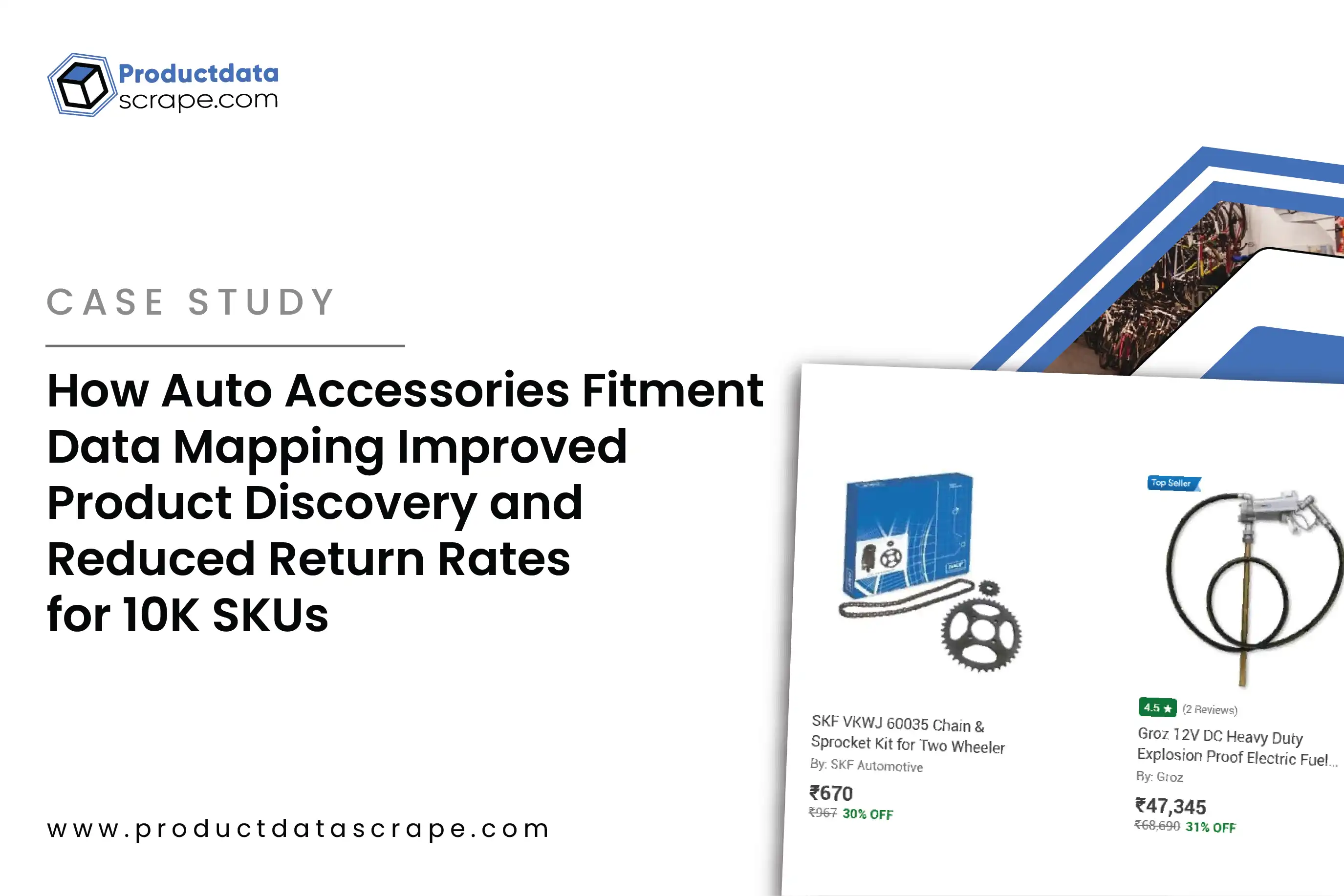
A leading automotive e-commerce retailer specializing in aftermarket accessories partnered with Product Data Scrape to modernize its product catalog for more than 10,000 SKUs. The objective was to improve search visibility, vehicle compatibility accuracy, and customer confidence through Auto Accessories Fitment Data Mapping while enriching listings with reliable Auto parts data. Over a 16-week engagement, our automated data extraction and mapping framework standardized product attributes across multiple sales channels. The project delivered a 42% improvement in product discovery, reduced return rates by 31%, and increased catalog accuracy to over 98%, enabling faster customer purchases and improved marketplace performance.
The Client
The client is a rapidly growing online retailer in the automotive aftermarket industry, offering thousands of accessories, replacement parts, and performance products across multiple digital marketplaces. As consumer expectations for precise vehicle compatibility continued to rise, maintaining an accurate and scalable catalog became increasingly difficult. Growing competition, expanding product assortments, and evolving marketplace standards placed additional pressure on the retailer to provide complete and reliable compatibility information.
Before partnering with Product Data Scrape, the company relied on fragmented supplier feeds, spreadsheets, and manual catalog updates. This resulted in inconsistent product attributes, duplicate listings, missing compatibility records, and delayed product launches. The absence of standardized vehicle fitment data mapping created confusion among customers, leading to incorrect purchases, higher return volumes, and increased customer support requests. Additionally, inconsistent catalog structures limited product discoverability across search engines and marketplace filters.
To overcome these challenges, the retailer required an automated solution capable of consolidating information from multiple suppliers while maintaining accuracy across thousands of SKUs. Product Data Scrape implemented advanced Auto Parts Data Scraping workflows that continuously collected, validated, and standardized catalog information. This transformation enabled the client to maintain accurate fitment relationships, improve product visibility, accelerate catalog updates, and deliver a seamless shopping experience that strengthened customer trust and supported long-term business growth.
Goals & Objectives
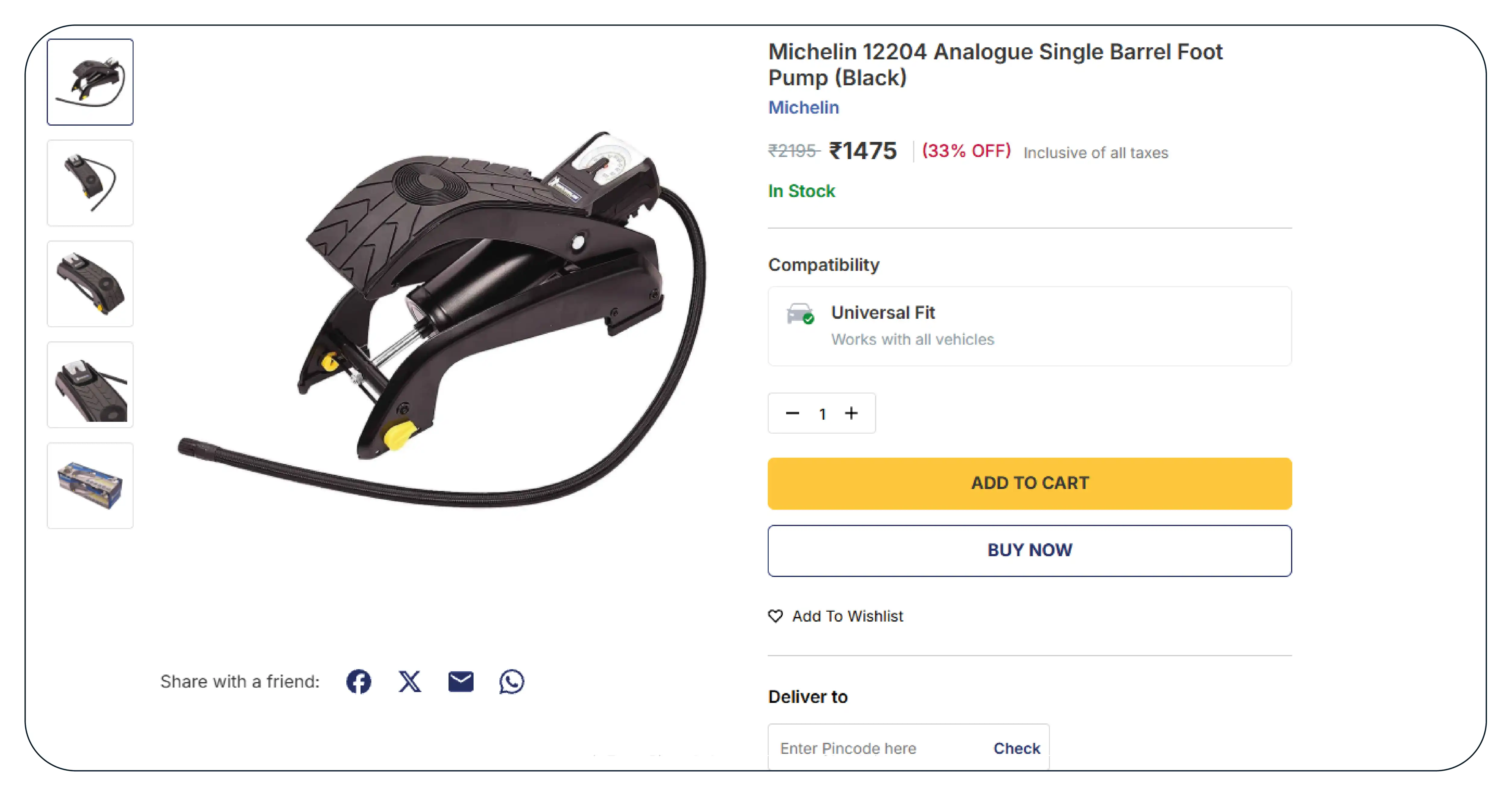
The primary business goal was to create a scalable catalog management system capable of supporting rapid inventory expansion without compromising data quality. The client also wanted to improve customer product discovery, reduce return rates, and increase purchasing confidence by implementing accurate Auto Accessories Fitment Data Mapping across every product listing.
From a technical perspective, Product Data Scrape aimed to automate workflows that Scrape auto parts compatibility data from multiple manufacturer and distributor sources. The project focused on integrating diverse datasets into a centralized platform, validating compatibility information in real time, standardizing product attributes, and synchronizing enriched listings across e-commerce marketplaces. Automation also minimized manual intervention while enabling faster updates and improved operational efficiency.
Increased catalog accuracy from approximately 82% to over 98%.
Reduced incorrect product purchases and return rates by 31%.
Improved product discovery through optimized compatibility mapping by 42%.
Automated more than 95% of catalog update workflows.
Reduced catalog publishing time from several days to a few hours.
Achieved consistent compatibility information across more than 10,000 automotive SKUs, supporting sustainable growth and enhanced customer satisfaction.
The Core Challenge
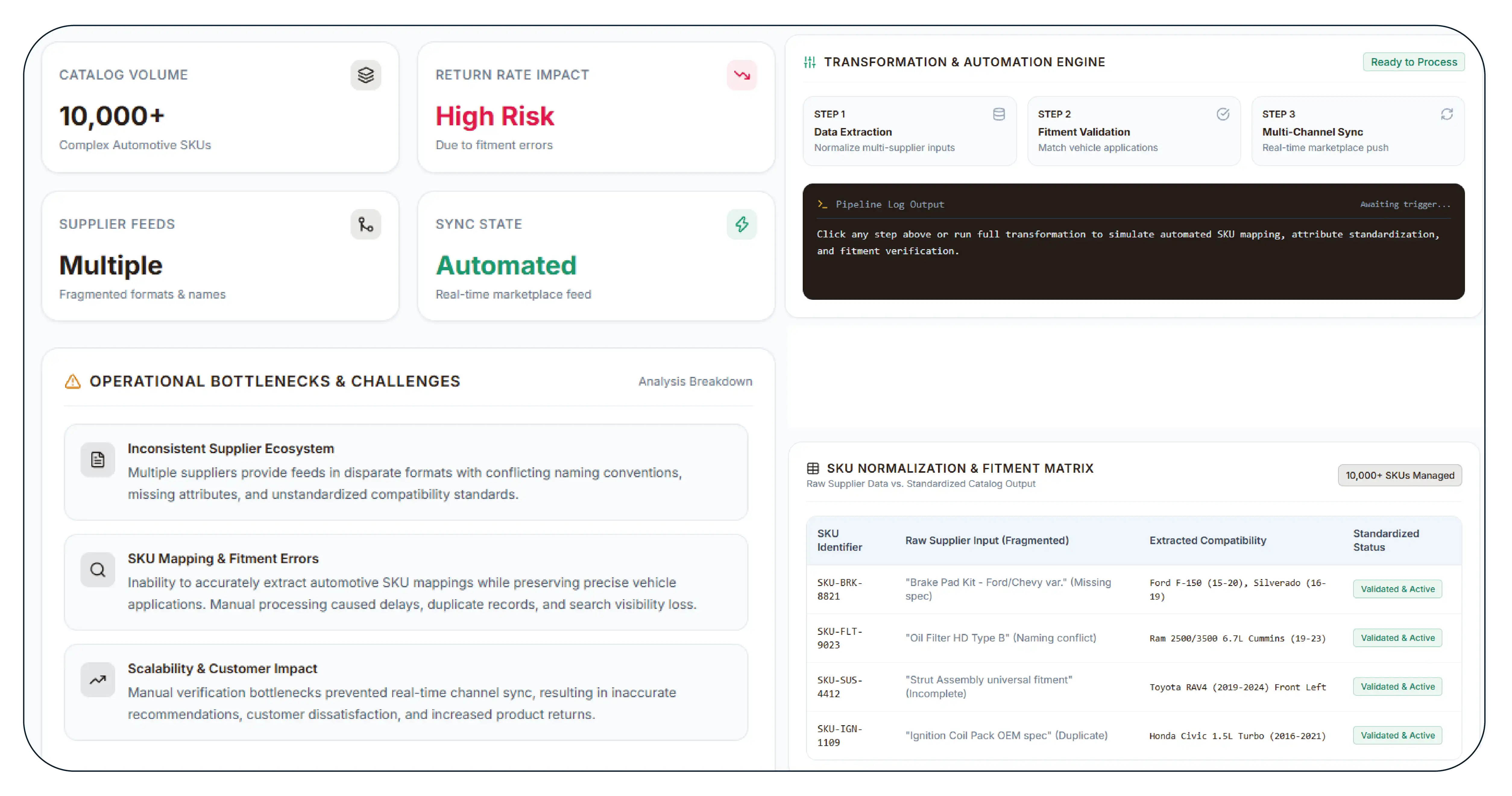
Managing an automotive catalog with over 10,000 SKUs became increasingly complex as new products, vehicle models, and compatibility updates were introduced regularly. The client depended on multiple suppliers, each providing data in different formats with inconsistent naming conventions, missing attributes, and varying compatibility standards. This fragmented ecosystem created significant operational bottlenecks and made catalog maintenance both time-consuming and error-prone.
One of the biggest challenges was the inability to accurately Extract Automotive SKU Mapping from diverse manufacturer catalogs while maintaining consistent relationships between products and vehicle applications. Manual processing slowed product onboarding, delayed marketplace updates, and introduced frequent compatibility errors. Duplicate records, incomplete specifications, and outdated fitment information negatively affected search visibility and customer confidence.
Performance issues also emerged as catalog updates required extensive manual verification before publication. The lack of automation increased processing times and prevented real-time synchronization across multiple sales channels. As product volumes expanded, maintaining high-quality data became increasingly difficult, resulting in inaccurate recommendations, incorrect purchases, and higher return rates.
The client needed a scalable solution capable of automating data extraction, validating compatibility information, and standardizing product relationships. Without this transformation, continued catalog growth would have further reduced operational efficiency, affected customer satisfaction, and limited the company's ability to compete in the rapidly evolving automotive e-commerce market.
Our Solution

Product Data Scrape designed a phased implementation strategy to modernize the client's catalog management process while ensuring minimal disruption to ongoing business operations. The solution combined intelligent automation, advanced validation workflows, and scalable integration capabilities to build a reliable automotive data ecosystem.
Phase 1: Data Collection and Standardization
During the first phase, our specialists collected supplier catalogs, manufacturer databases, and marketplace product information from multiple structured and unstructured sources. Automated extraction pipelines standardized product attributes, eliminated duplicate records, and unified incompatible data formats into a centralized repository. This foundation created reliable fitment data intelligence for auto parts that could support large-scale catalog management.
Phase 2: Compatibility Mapping and Enrichment
The second phase focused on enriching compatibility information using advanced validation rules and automated matching algorithms. Product specifications, vehicle make, model, year, engine configuration, trim levels, and OEM references were cross-verified before publication. This process significantly improved Auto Accessories Fitment Data Mapping accuracy while reducing manual intervention and eliminating inconsistencies between supplier datasets.
Phase 3: Catalog Integration and Synchronization
Next, Product Data Scrape integrated the standardized catalog with the client's inventory management platform and multiple online marketplaces through automated synchronization workflows. Real-time monitoring detected supplier updates, new vehicle releases, discontinued products, and compatibility changes, allowing continuous catalog refreshes without interrupting business operations.
Phase 4: Quality Monitoring and Optimization
To maintain long-term quality, intelligent validation dashboards monitored data completeness, mapping accuracy, synchronization status, and publishing performance. Automated alerts identified anomalies before they affected customer-facing listings, ensuring consistent catalog quality across every sales channel.
The final implementation delivered a scalable, automation-driven ecosystem capable of processing thousands of SKU updates daily with exceptional accuracy. By combining advanced extraction technologies, intelligent validation engines, API integrations, and continuous monitoring, Product Data Scrape enabled the client to maintain an accurate automotive catalog, accelerate product launches, improve customer search experiences, and support sustainable business growth while significantly reducing operational complexity.
Results & Key Metrics
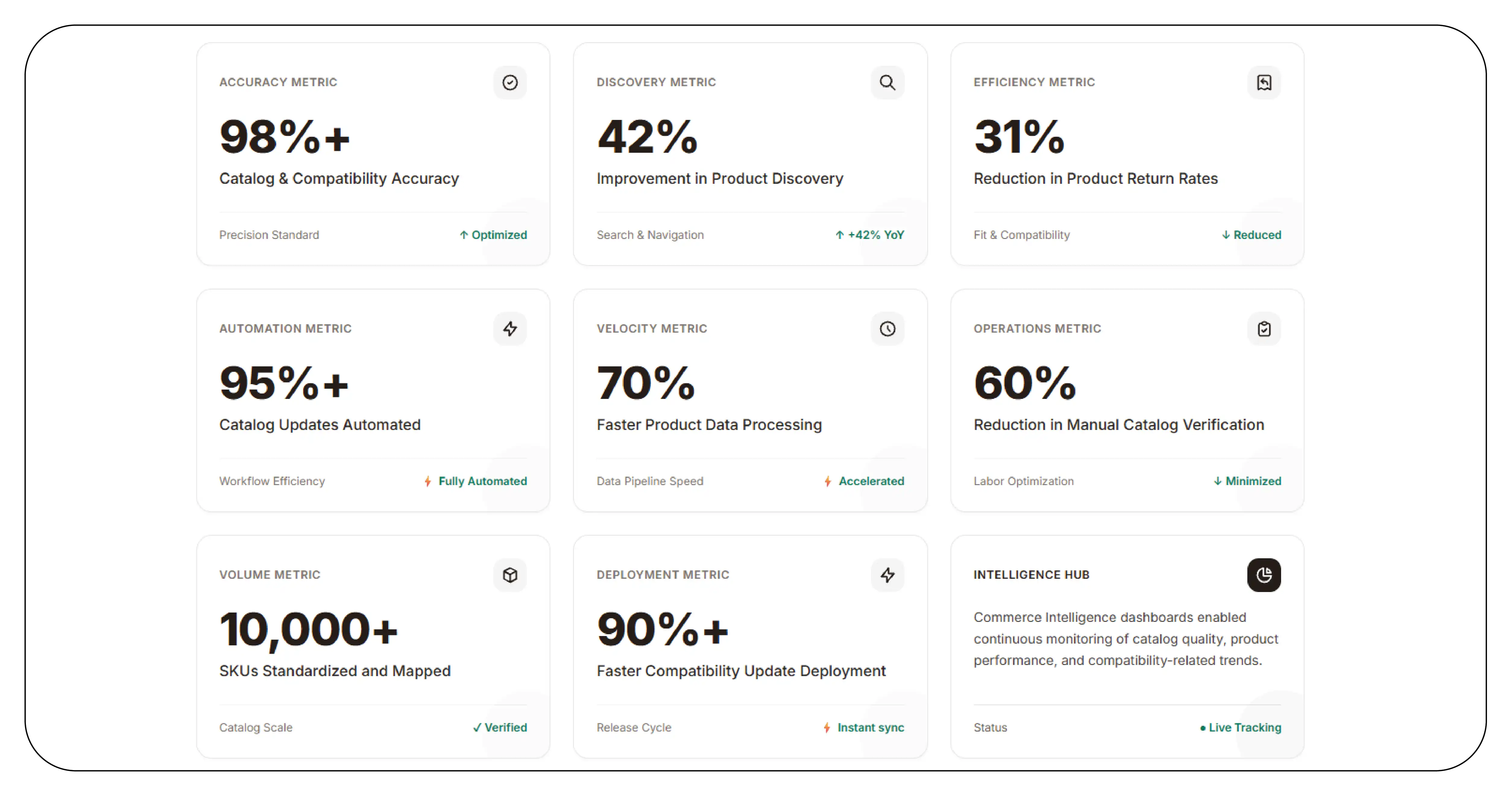
The implementation delivered measurable improvements across catalog accuracy, product discovery, processing speed, and customer experience. By replacing fragmented manual workflows with automated validation and synchronization, the client achieved stronger operational performance across its 10K-SKU catalog.
98%+ catalog and compatibility accuracy.
42% improvement in product discovery.
31% reduction in product return rates.
95%+ of catalog updates automated.
70% faster product data processing.
60% reduction in manual catalog verification.
10,000+ SKUs standardized and mapped.
90%+ faster compatibility update deployment.
Commerce Intelligence dashboards enabled continuous monitoring of catalog quality, product performance, and compatibility-related trends.
Results Narrative
The project transformed the client's automotive catalog from a fragmented data environment into a structured, scalable system. Automated extraction and validation improved compatibility accuracy while reducing the time required to process supplier updates. Better fitment relationships also helped shoppers find relevant accessories faster, contributing to stronger product discovery and fewer incorrect purchases. The 31% reduction in return rates demonstrated the direct operational value of more accurate compatibility information. Meanwhile, automated workflows allowed the client to expand its catalog without proportionally increasing manual data management requirements. The resulting infrastructure provided a reliable foundation for ongoing catalog expansion, marketplace synchronization, and data-driven automotive e-commerce growth.
What Made Product Data Scrape Different
Product Data Scrape differentiated its approach through a combination of automated extraction, intelligent normalization, validation, and scalable catalog synchronization. Instead of simply collecting product records, the solution connected vehicle attributes with accessory-level information to create structured compatibility relationships. Advanced matching rules identified inconsistencies across supplier feeds, while automated quality checks flagged missing or conflicting attributes before publication. The platform also supported continuous updates, helping the client maintain fresher product information across multiple channels. Its scalable E-commerce data scraping framework reduced manual processing and supported high-volume catalog operations. This combination of automation, data quality controls, and integration capabilities enabled faster decisions and more reliable product discovery.
Client's Testimonial
"Working with Product Data Scrape transformed the way we manage our automotive catalog. Managing thousands of accessories and their vehicle relationships manually was becoming increasingly difficult, especially as our product range expanded. The automated solution gave our team greater confidence in the accuracy and consistency of our listings while significantly reducing the time spent on catalog verification. We also noticed meaningful improvements in product discovery and fewer compatibility-related returns. The team understood the complexity of automotive catalog data and built a solution that could scale with our business. Their approach has created a much stronger foundation for our future e-commerce growth."
— Head of E-commerce & Catalog Operations, Automotive Retailer
Conclusion
Accurate vehicle compatibility is becoming increasingly important as automotive e-commerce continues to expand and shoppers expect precise product recommendations. For this retailer, transforming fragmented catalog information into a structured, automated data environment created measurable improvements in accuracy, discovery, and operational efficiency. The project demonstrated how reliable compatibility intelligence can reduce incorrect purchases while supporting faster catalog expansion across multiple channels. With improved product relationships, automated updates, and stronger monitoring capabilities, the client is now better positioned to respond to changing vehicle applications and customer demand. Combined with Competitive pricing data, accurate fitment information can provide an even stronger foundation for long-term automotive marketplace competitiveness.
FAQs
1. What is automotive fitment data?
Automotive fitment data connects a product or accessory with the vehicles it is compatible with. It can include make, model, year, trim, engine type, drivetrain, and other application-specific attributes.
2. Why is accurate fitment information important for e-commerce?
Accurate compatibility information helps customers identify the correct products before purchasing. It can improve product discovery, reduce incorrect orders, lower return rates, and create greater confidence during the shopping journey.
3. How can automated data collection improve automotive catalogs?
Automation can collect information from multiple sources, normalize different formats, identify duplicate records, validate attributes, and synchronize updated information across marketplaces. This reduces manual work and allows large catalogs to remain current.
4. Can the solution support thousands of automotive SKUs?
Yes. A scalable data workflow can process large product catalogs while maintaining structured relationships between SKUs and compatible vehicles. Automated validation and monitoring can also help maintain consistency as catalog volumes increase.
5. How does Product Data Scrape support automotive retailers?
Product Data Scrape can help retailers build structured automotive catalogs through automated extraction, normalization, validation, and integration workflows. The resulting datasets can support product discovery, catalog management, compatibility analysis, and marketplace operations.


 Singapore
 EMAIL
EMAIL
 PHONE
PHONE











.webp)