Introduction
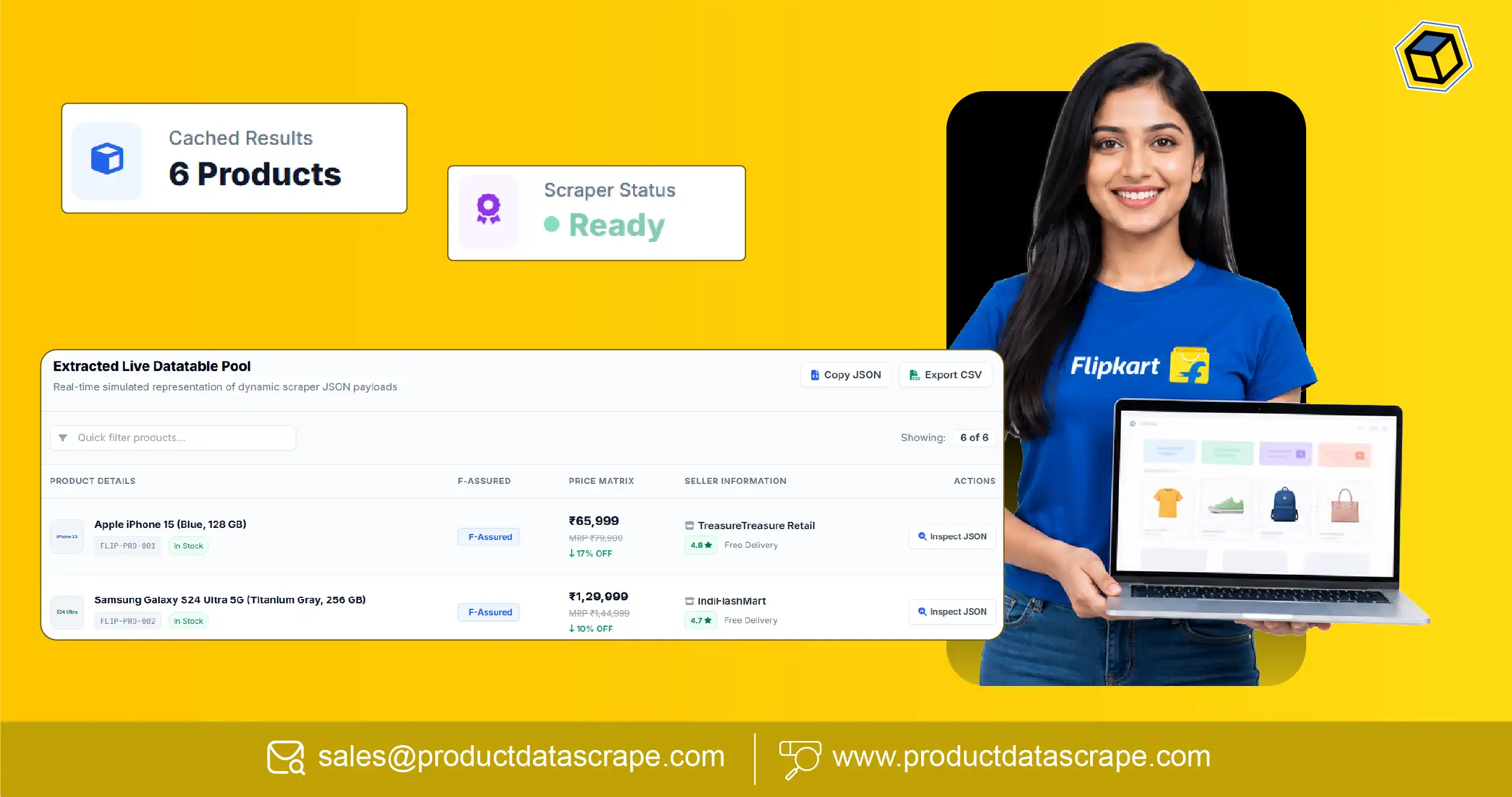
Flipkart is not a generic marketplace, and it cannot be treated like one. A product page on Flipkart carries a layer of India-specific commerce logic that simply does not exist on most global platforms: an F-Assured authenticity badge, a separate price tier for Flipkart Plus members, SuperCoin earn rates, pincode-dependent delivery and pricing, multi-seller listings competing for the same SKU, and a Big Billion Days calendar that rewrites the entire pricing landscape twice a year.
Most teams that try to extract Flipkart product data discover this the hard way. They deploy a general-purpose scraper, pull down the visible HTML, and end up with a title, an image URL, and one price. That price is often the wrong one. It may be the Plus price when the team needed the standard price. It may be the price for a pincode in one metro when the brand sells nationally. It may belong to a third-party seller who is not the brand's authorised partner at all.
This guide explains what it actually takes to extract Flipkart product data correctly, which fields matter, what the output should look like, and how brands turn that data into pricing, assortment, and brand-protection decisions. It is written from the workflows we run at Product Data Scrape for brands and analytics teams operating on Flipkart at scale.
Why Generic Scrapers Fail on Flipkart
A generic scraper is built on a simple assumption: that a product page contains one product, one price, and one seller. Flipkart violates all three assumptions.
One product page, many prices: The same SKU can show a standard price, a Flipkart Plus exclusive price, an effective price after a bank offer, a further-reduced price after an exchange offer, and a promotional price during a sale event. A scraper that captures "the price" is capturing whichever number happened to render first — and that number changes depending on session, membership tier, and location.
One product page, many sellers: Flipkart's marketplace model means a popular SKU can carry a dozen sellers, each with a different price, rating, return policy, and fulfilment status. Capturing only the default seller means capturing only a fraction of the competitive picture — and it means missing the unauthorised sellers a brand-protection team is specifically looking for.
One product page, many variants: A smartphone listing is not one product. It is a matrix of RAM and storage configurations, each with its own price and its own stock status. A fashion listing is a size and colour matrix. Flattening this into a single row destroys the exact detail that merchandising teams need.
Add pincode-level pricing and delivery variation across India, and it becomes clear that extracting Flipkart product data is not a parsing problem. It is a modelling problem. The output schema has to reflect how Flipkart actually works.
What "Flipkart-Aware" Data Extraction Means
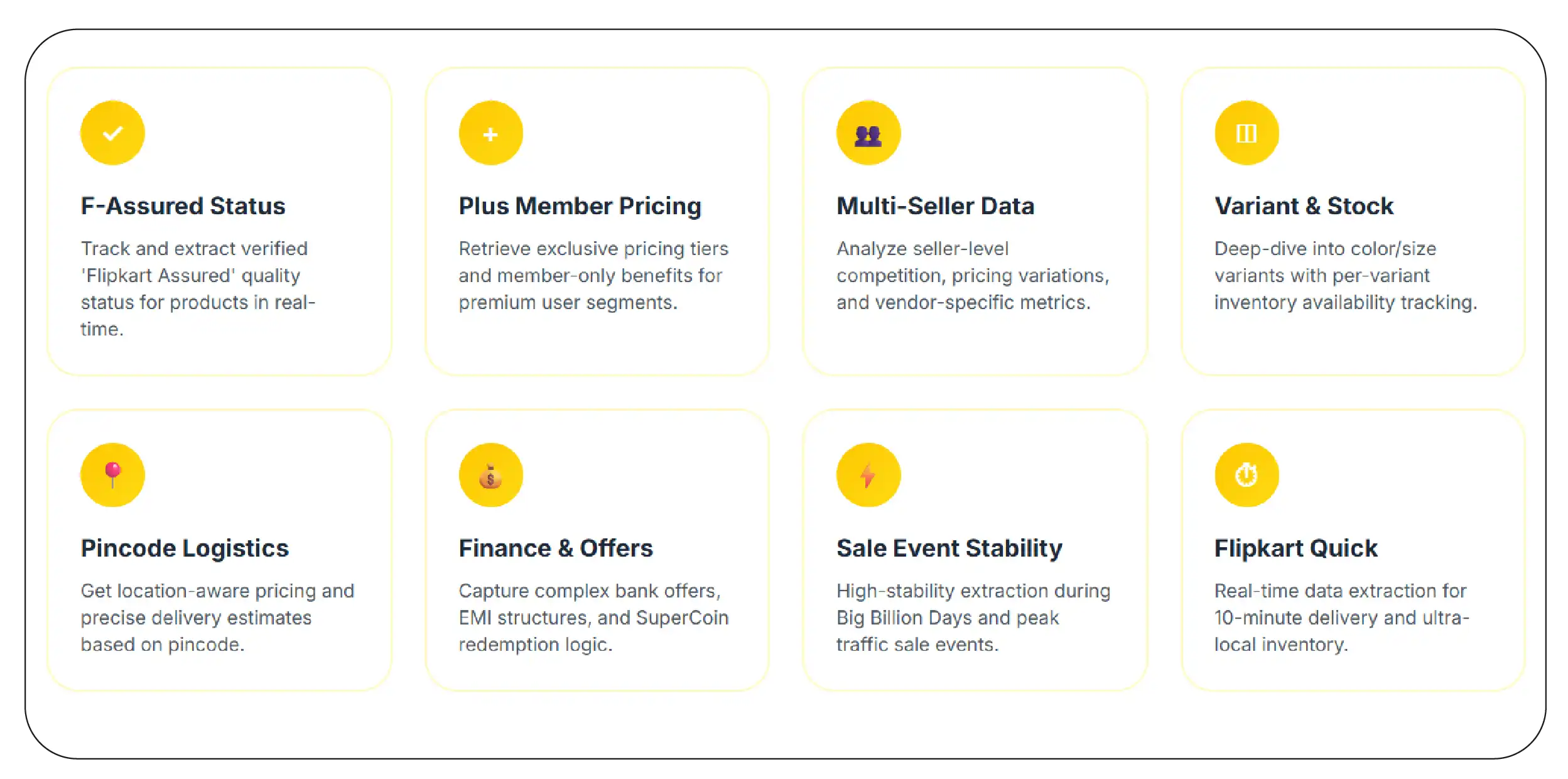
When we extract Flipkart product data at Product Data Scrape, we start from the platform's own commerce primitives rather than from the HTML. That produces a fundamentally different field set.
1. F-Assured Status Tracking
F-Assured is Flipkart's quality and delivery assurance badge. Products carrying it signal verified authenticity and faster delivery, and the badge measurably affects buyer trust. Critically, F-Assured status is assigned at the seller-SKU level, not at the product level — the same product can be F-Assured from one seller and not from another.
For a brand, this matters in two directions. First, it is an authenticity signal: if unauthorised sellers are listing your SKU without F-Assured, that is a lead for your brand-protection team. Second, it is a conversion signal: tracking the correlation between F-Assured status and review velocity gives merchandising teams evidence for which sellers to prioritise.
Field captured: is_f_assured (boolean, per seller-SKU).
2. Flipkart Plus Member Pricing
Flipkart Plus members frequently see exclusive prices and early access to deals. A dataset that captures only the standard price systematically understates how aggressively a competitor is discounting.
We return both price tiers on every record. That gives pricing teams the full competitive picture: what a non-member sees, what a member sees, and the delta between them. In several categories that delta is where the real competitive action is happening — the headline price barely moves while the Plus price is cut repeatedly.
Fields captured: standard_price, plus_exclusive_price, plus_price_delta.
3. Seller-Level and Multi-Seller Data
Flipkart's marketplace is a Buy Box equivalent. Multiple sellers compete on the same SKU, and the seller who wins the default position captures the overwhelming majority of sales. Extracting only the default seller tells you who won. Extracting all sellers tells you why.
We capture the full seller array per SKU: seller name, seller rating, price, F-Assured status, Plus exclusivity, return policy, and whether that seller currently holds the default position.
Fields captured: all_sellers[] with seller_name, seller_rating, price, is_f_assured, is_default_seller.
4. Variants and Per-Variant Stock
Every variant is a commercial unit with its own price and its own stock reality. A "product in stock" flag is close to useless when the only variant in stock is the one nobody wants.
Fields captured: variants[] with variant_label, variant_price, in_stock, stock_signal.
5. Pincode-Level Pricing and Delivery
Pricing, delivery ETA, and availability vary by pincode across India. For FMCG, grocery, and large-appliance categories, this is not a rounding error — it is the whole story. Product Data Scrape lets you pass any pincode and receive hyperlocal pricing, delivery, and availability data for that location.
Fields captured: pincode, deliverable, delivery_eta_days, pincode_price.
6. Bank Offers, EMI, and SuperCoins
The listed price is not the price the customer pays. Bank-specific discounts, no-cost EMI, exchange offers, and SuperCoin earn rates all compress the effective price. A competitive analysis that ignores them is comparing the wrong numbers.
Fields captured: bank_offers[], no_cost_emi_available, exchange_offer_max, supercoins_earnable.
7. Big Billion Days and Sale-Event Stability
Big Billion Days is India's largest sale event and the moment most scrapers break. Traffic spikes, page structures shift, and rate limits tighten precisely when the data is most valuable. Product Data Scrape maintains BBD-specific endpoints and promotional flags so that data capture stays stable through the event rather than collapsing at the worst possible moment.
Fields captured: bbd_active, bbd_deal_price, deal_end_timestamp.
8. Flipkart Quick (10-Minute Delivery)
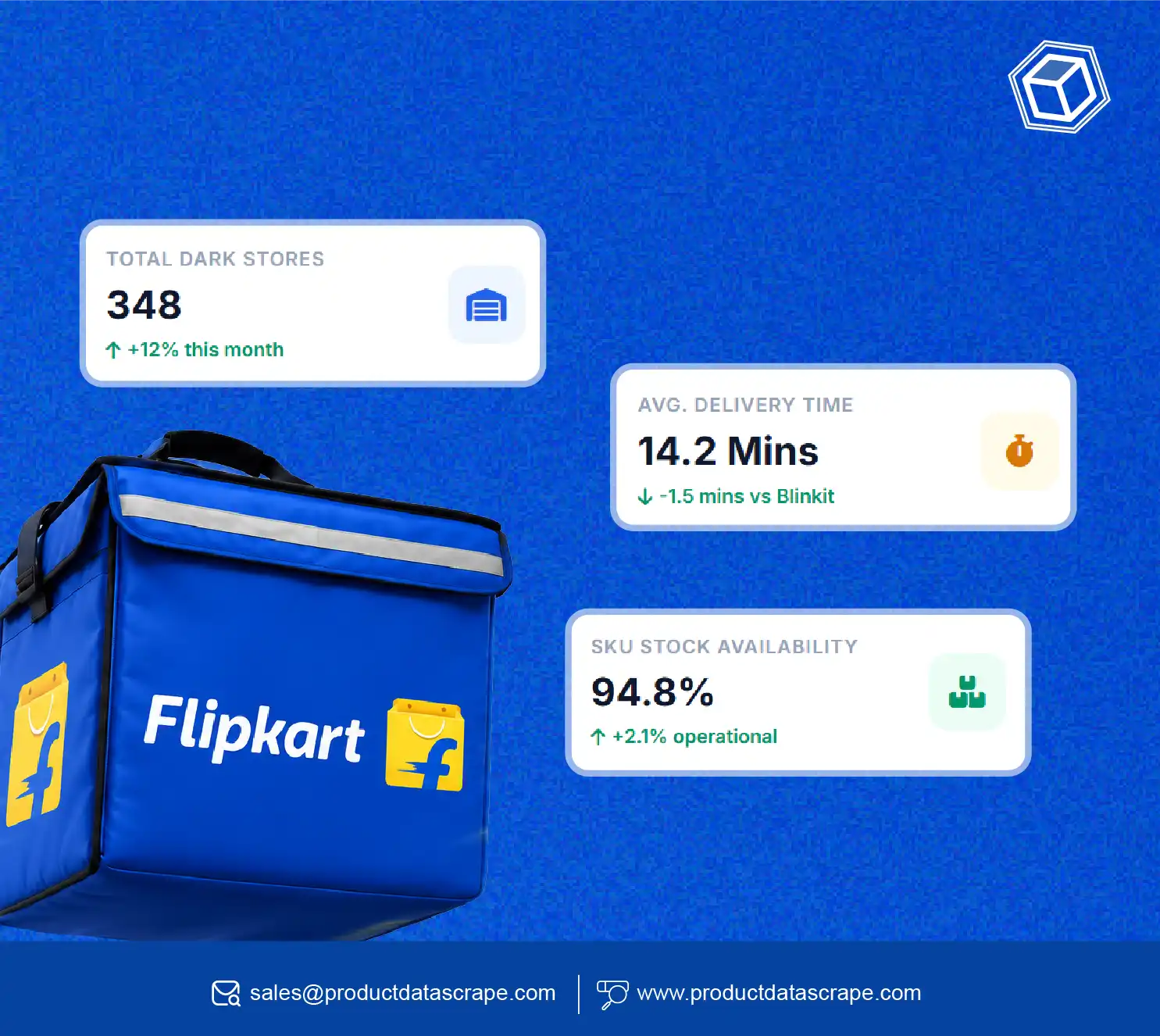
Flipkart Quick is the platform's q-commerce service in major Indian cities. Quick eligibility, delivery ETA, and dark-store availability form a distinct dataset for anyone tracking the quick-commerce shift in Indian retail.
Fields captured: flipkart_quick_eligible, quick_eta_minutes, dark_store_available.
Sample Data: What a Flipkart Record Actually Looks Like
Below is an illustrative record in the structure Product Data Scrape delivers. Values are representative examples, not live data.
{
  "product_id": "MOBH8G7ZQJ4XYZAB",
  "title": "Smartphone Model X Pro (Midnight Blue, 128 GB)",
  "brand": "BrandX",
  "category": "Mobiles > Smartphones",
  "url": "https://www.flipkart.com/...",
  "captured_at": "2026-07-14T09:12:04+05:30",
  "pincode": "380015",

  "standard_price": 24999,
  "plus_exclusive_price": 23749,
  "plus_price_delta": 1250,
  "mrp": 31999,
  "discount_pct": 21.9,

  "is_f_assured": true,
  "rating": 4.3,
  "review_count": 18742,

  "bbd_active": false,
  "supercoins_earnable": 240,
  "no_cost_emi_available": true,
  "exchange_offer_max": 15000,
  "bank_offers": [
    {"bank": "Bank A", "type": "instant_discount", "value": 1500, "min_txn": 20000},
    {"bank": "Bank B", "type": "cashback", "value": 1000, "card_type": "credit"}
  ],

  "flipkart_quick_eligible": false,
  "deliverable": true,
  "delivery_eta_days": 2,

  "all_sellers": [
    {
      "seller_name": "SellerOne Retail",
      "seller_rating": 4.6,
      "price": 24999,
      "is_f_assured": true,
      "is_default_seller": true
    },
    {
      "seller_name": "SellerTwo Enterprises",
      "seller_rating": 3.9,
      "price": 24499,
      "is_f_assured": false,
      "is_default_seller": false
    }
  ],

  "variants": [
    {"variant_label": "6 GB / 128 GB", "variant_price": 24999, "in_stock": true},
    {"variant_label": "8 GB / 256 GB", "variant_price": 28999, "in_stock": false},
    {"variant_label": "12 GB / 512 GB", "variant_price": 33999, "in_stock": true}
  ]
}
The same record flattened for a pricing analyst's spreadsheet:
| Field |
Value |
| Product ID |
MOBH8G7ZQJ4XYZAB |
| Standard Price |
24,999 |
| Plus Exclusive Price |
23,749 |
| Plus Delta |
1,250 |
| F-Assured |
Yes |
| Sellers on SKU |
2 |
| Lowest Seller Price |
24,499 |
| Default Seller |
SellerOne Retail |
| Variants Tracked |
3 |
| Variants Out of Stock |
1 |
| Effective Price (after best bank offer) |
23,499 |
| SuperCoins Earnable |
240 |
Two insights fall straight out of a single row. The lowest-priced seller is not the default seller and is not F-Assured — a brand-protection flag. And the effective price after the best bank offer sits below the Plus price — meaning any competitive benchmark built on the standard price alone is off by roughly six percent.
Building the Extraction Workflow: A Practical Sequence
Step 1 — Define the SKU universe. Start with your own catalogue, then expand to competitor SKUs identified through category crawls and search-term crawls. A useful rule: your monitoring universe should be roughly three to five times your own SKU count.
Step 2 — Define the pincode set. National brands should not monitor from a single location. Choose a representative pincode panel covering metros, tier-2 cities, and the regions where your distribution is weakest. Pricing and availability gaps show up in exactly those places.
Step 3 — Set the capture frequency by volatility. Fast-moving electronics and sale-period SKUs need intraday capture. Stable long-tail SKUs can run daily or weekly. Matching frequency to volatility keeps costs proportionate to value.
Step 4 — Capture the full seller array, always. Even if you only report on the default seller today, the historical seller array is what makes MAP-violation and unauthorised-seller analysis possible later. You cannot backfill data you never collected.
Step 5 — Normalise the price stack. Store standard price, Plus price, deal price, and effective price after offers as separate fields. Do not overwrite them into one column. Every downstream analysis depends on being able to distinguish them.
Step 6 — Deliver into the systems your teams already use. Product Data Scrape delivers Flipkart datasets as JSON or CSV, via API, or pushed directly to S3, Google Cloud Storage, Snowflake, BigQuery, or a BI layer. Data that lands in a dashboard your category managers already open gets used. Data that lands in a folder does not.
What Teams Actually Do With This Data

Pricing teams run daily price-gap reports against competitors, including the Plus tier and the post-offer effective price, and trigger repricing rules when a competitor crosses a threshold.
Brand-protection teams: watch the seller array for new entrants, price the brand has not authorised, and listings without F-Assured status — the three strongest early signals of grey-market activity.
Merchandising and supply teams: track per-variant stock to catch the pattern where a hero SKU shows "in stock" while the highest-velocity configuration has been unavailable for eleven days.
Category and strategy teams: use assortment data to find SKUs competitors list that the brand does not, and to size the gap before a quarterly planning cycle.
Q-commerce teams: track Flipkart Quick eligibility and dark-store availability city by city to benchmark against their own 10-minute delivery footprint.
Scale, Reliability, and Compliance
Extracting Flipkart product data at production scale is an infrastructure problem as much as a parsing problem. Three things determine whether a programme survives contact with reality:
Sale-day resilience. If your pipeline fails during Big Billion Days, it has failed on the only days that really matter. Infrastructure has to be provisioned for the spike, not the average.
Schema stability. Flipkart's front end changes. A managed data partner absorbs those changes so your downstream models do not break. This is the single largest hidden cost of an in-house scraper — not the build, but the maintenance.
Responsible collection. We collect publicly available product information only. No personal data, no account-gated content, no circumvention of authentication. Rate-limited, respectful collection is both an ethical baseline and, practically, the only way a programme stays stable long-term.
FAQs
1. Can you extract Flipkart product data for a specific pincode?
Yes. Pass any Indian pincode to receive product pricing, delivery ETA, and availability for that location. Most brands typically monitor a panel of 20 to 200 pincodes for regional pricing and inventory analysis.
2. Do you capture both standard and Flipkart Plus prices?
Yes. Every record includes both the standard price and the Flipkart Plus price, along with the price difference (delta) for accurate pricing intelligence.
3. How do you handle Big Billion Days sales data?
We capture BBD-specific deal flags, promotional fields, and pricing updates. Additional infrastructure is provisioned in advance to ensure reliable data collection throughout high-traffic sale events.
4. What delivery formats are supported?
Data can be delivered in multiple formats, including JSON, CSV, REST API, and direct integrations with cloud storage services and data warehouses.
5. How fresh is the data?
Data collection frequency is fully configurable, ranging from weekly updates to intraday refreshes for fast-moving products, promotional events, and volatile SKUs.
Get Flipkart Data That Reflects How Flipkart Actually Works
A generic scraper gives you HTML. What pricing, brand-protection, and merchandising teams actually need is a Flipkart-aware dataset: F-Assured status per seller, both price tiers, the full seller array, per-variant stock, pincode-level pricing, and the offer stack that determines what a customer really pays.
Product Data Scrape builds and operates that pipeline for brands and analytics teams across India's marketplace ecosystem. If you are ready to extract Flipkart product data at production scale — with the fields that actually drive decisions — talk to our team about a sample dataset built on your own SKUs.
Product Data Scrape — turning marketplace complexity into decision-ready data.


 Singapore
 EMAIL
EMAIL
 PHONE
PHONE


.webp)
.webp "thumb")
.webp "thumb")
.webp "thumb")








.webp)