Quick Overview
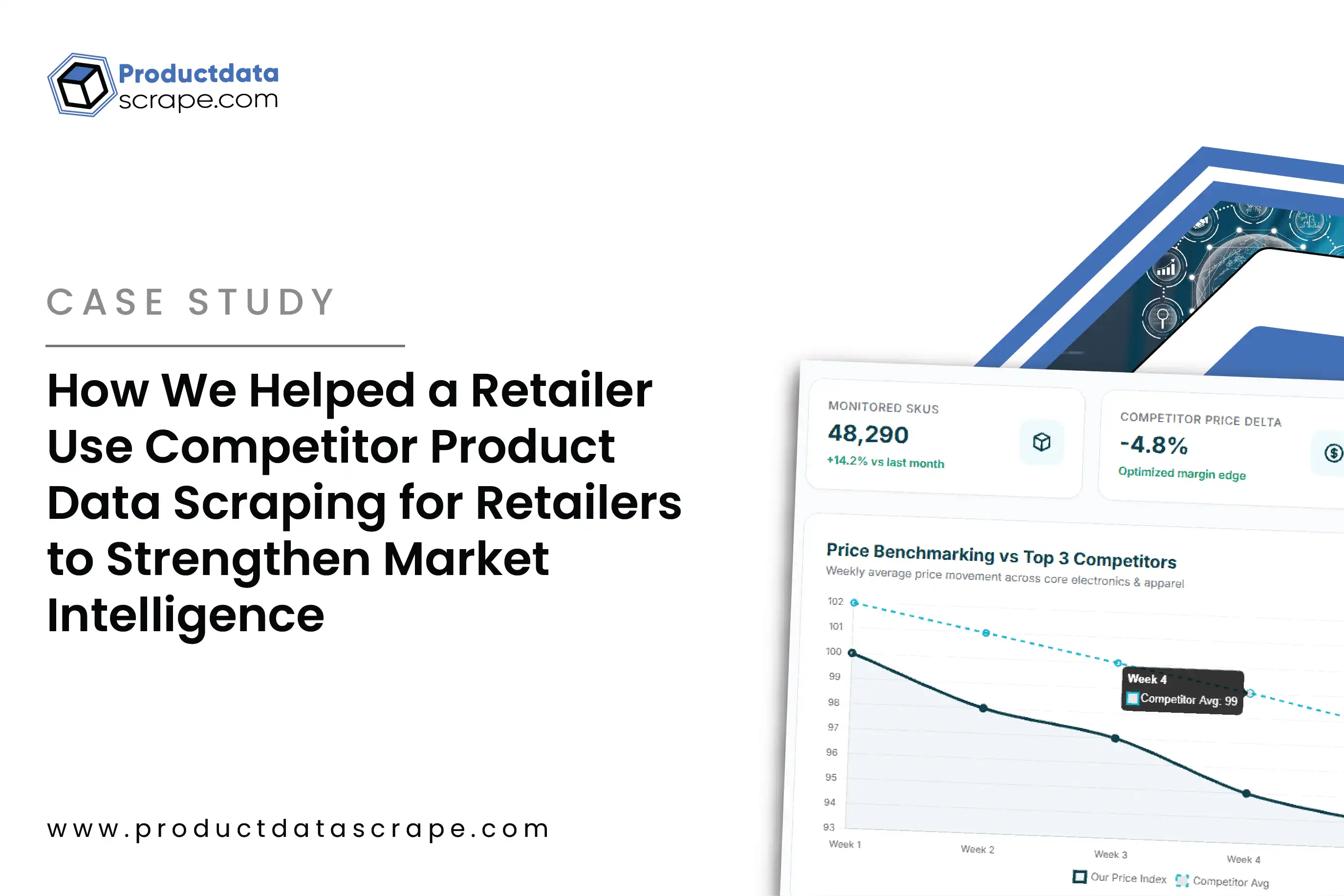
The client was a multi-category online retailer seeking stronger visibility into competitor products, prices, promotions, and assortment changes. The engagement used Competitor Product Data Scraping for Retailers to automate competitive product intelligence across selected retail websites. Over a six-month implementation, the solution helped Monitor Competitor Products at scale while reducing manual research by 82%, accelerating competitive data availability by 76%, and achieving 96%+ completeness across monitored product attributes. The project gave pricing, merchandising, and category teams a centralized source for comparing competitor SKUs, identifying assortment gaps, tracking price movements, and detecting market changes faster.
The Client
The client was an established multi-category retailer with a significant online presence and a broad product catalogue. It competed across several high-demand categories where prices, promotions, product availability, and assortment changed frequently.
The growing complexity of digital retail created pressure on the client's commercial teams. Competitors were continuously adding products, changing prices, introducing promotions, and adjusting their assortments. Without timely visibility, the retailer could react only after important market changes had already occurred.
Before the partnership, competitive research was primarily handled through manual website checks, spreadsheets, and periodic reports. Analysts selected competitor products, recorded prices, compared product attributes, and shared findings with pricing and merchandising teams. As the number of products and competitors increased, this workflow became difficult to scale.
The retailer also faced data-consistency challenges. Similar products could appear under different names, pack sizes, or category structures. Analysts needed to determine whether two listings represented identical products or different variants before making comparisons.
The transformation became essential because competitive intelligence needed to move from periodic research to continuous monitoring. The retailer required a structured dataset that could support Competitor Product Intelligence for Sales Growth and strengthen its Pricing strategy services.
The new approach allowed the business to establish a repeatable process for collecting competitor information and converting it into actionable intelligence for commercial teams.
Goals & Objectives

Build a scalable competitor-product monitoring framework.
Reduce manual competitive research.
Improve the speed of competitor data availability.
Increase accuracy and consistency across product comparisons.
Identify assortment gaps and pricing opportunities.
Provide commercial teams with continuously refreshed market intelligence.
Automate collection of competitor product information.
Capture product names, brands, categories, pack sizes, prices, MRP, discounts, ratings, and availability.
Standardize product information across different competitor websites.
Match comparable products for like-for-like analysis.
Preserve historical observations for trend analysis.
Integrate structured data into dashboards and analytical workflows.
Enable frequent refreshes and automated change detection.
The technical implementation combined Competitor Product Data Scraper for Retail Brands capabilities with Price Elasticity Analysis inputs to help the retailer understand how price changes and competitor movements could influence commercial decisions.
82% reduction in manual competitive research.
76% faster availability of competitor product information.
96%+ completeness across targeted product attributes.
Reduced duplicate-product comparison errors.
Faster identification of competitor price changes.
Increased frequency of assortment monitoring.
Improved turnaround time for category-level competitive reports.
These KPIs established measurable benchmarks for both operational efficiency and data quality.
The Core Challenge

The retailer's primary challenge was fragmented competitor information. Product data existed across multiple websites, but collecting and comparing it consistently required significant manual effort.
Analysts had to visit competitor websites, locate comparable products, copy information into spreadsheets, and manually calculate price differences. This became particularly challenging when competitors had thousands of SKUs.
Another issue was product matching. A product could have different titles across retailers while representing the same underlying item. Differences in pack size, flavor, model, variant, or quantity could also make direct comparisons misleading.
The absence of a centralized historical dataset created further limitations. Analysts could see the current competitor price but often lacked a reliable record showing when that price changed or how frequently it had moved.
The retailer also struggled to identify assortment opportunities. Competitor websites could contain products that were absent from the client's own catalogue, but discovering these gaps required extensive manual comparison.
Competitor Product Trend Analysis was therefore needed to understand not only what competitors offered but how their product portfolios evolved over time.
The problem affected multiple business functions. Pricing teams lacked timely benchmarks. Merchandising teams had limited visibility into new products. Category managers spent substantial time gathering information instead of interpreting it. Strategy teams lacked consistent historical evidence.
The project needed to solve four connected problems: automate collection, standardize product information, create reliable product matching, and make competitive changes visible quickly.
The ultimate requirement was a scalable data workflow that could transform fragmented competitor listings into a consistent source of commercial intelligence.
Our Solution

The solution was implemented through a phased competitive intelligence framework that connected automated collection, normalization, matching, historical storage, and analytics.
Phase 1: Competitor and Category Mapping
The project began by identifying priority competitors, categories, brands, and SKUs. The team mapped the data fields required for meaningful comparison, including product title, brand, category, pack size, price, MRP, discount, availability, ratings, and product URL. This created a standardized schema for collecting information from different sources.
Phase 2: Automated Data Collection
Automated scraping workflows were configured to collect competitor product information at scheduled intervals. Each observation was timestamped and stored for historical comparison. This eliminated much of the repetitive manual work involved in checking competitor websites.
Phase 3: Data Cleaning and Normalization
Raw competitor data was processed through validation and normalization rules. Product titles were standardized, categories were mapped, units were normalized, and duplicate records were identified. This improved the consistency of cross-retailer comparisons.
Phase 4: Product Matching
The system compared relevant product attributes to identify equivalent or comparable SKUs. Matching logic considered brand, product type, pack size, variant, quantity, and other identifying characteristics. This enabled the retailer to build more reliable competitor price and assortment comparisons.
Phase 5: Historical Tracking
Every collection cycle created a new observation rather than overwriting the previous record. This allowed the retailer to track price changes, availability movements, product introductions, and assortment changes over time. Historical records also enabled teams to distinguish temporary promotions from longer-term pricing movements.
Phase 6: Competitive Analytics
The structured dataset supported Competitor Product Insights for Retailers, including price-gap analysis, assortment comparisons, new-product detection, discount monitoring, and availability benchmarking. Dashboards allowed users to filter by competitor, category, brand, SKU, price range, and date.
Phase 7: Automated Change Detection
Rules were introduced to identify important changes automatically. These included significant price movements, new product listings, discontinued products, availability changes, and assortment expansions. Instead of reviewing every record, analysts could focus on exceptions and commercially important changes.
The phased approach ensured that every technical improvement addressed a specific business bottleneck. Automation reduced collection effort, normalization improved data quality, product matching strengthened comparison accuracy, and historical tracking transformed snapshots into actionable trends.
Results & Key Metrics

The implementation produced measurable improvements across the retailer's competitive intelligence workflow:
82% lower manual research workload across monitored competitor categories.
76% faster competitive data availability for commercial teams.
96%+ completeness across core product attributes.
Significant reduction in duplicate and inconsistent product records.
Faster detection of competitor price changes.
More frequent assortment-gap identification.
Improved access to historical competitor observations.
These results strengthened the retailer's ability to perform Competitor Product Opportunity Analysis and prioritize commercial actions using structured market data.
Results Narrative
The most important outcome was the shift from periodic competitor research to continuous intelligence. Pricing and merchandising teams could access updated competitor information without waiting for manually prepared reports.
Historical data made competitor movements easier to interpret. Teams could distinguish short-term promotional changes from sustained price movements and identify categories experiencing frequent competitive activity.
The retailer also gained a systematic way to identify assortment gaps. Products appearing consistently across competitors but missing from the client's catalogue could be prioritized for further commercial evaluation.
The improved workflow reduced repetitive analyst work and allowed teams to spend more time interpreting competitive patterns.
Overall, the project created a stronger data foundation for pricing, assortment, merchandising, and strategic decision-making.
What Made Product Data Scrape Different?
Product Data Scrape differentiated the solution by combining automated collection with product normalization, intelligent matching, historical tracking, and change detection.
Instead of delivering disconnected competitor snapshots, the framework created a continuously updated competitive dataset. Automated rules identified meaningful changes, allowing analysts to focus on commercially relevant events rather than manually inspecting every product.
The matching framework was particularly important because competitor websites frequently use different naming conventions and product structures. Standardizing these differences improved like-for-like comparisons.
The solution also supported Competitor Product Ranking Tracking, enabling teams to observe changes in product visibility, positioning, and competitive prominence across monitored categories.
This combination of automation, structured data, historical context, and business-focused analytics made the intelligence workflow more scalable and actionable.
Client's Testimonial
"Competitive product research had become increasingly time-consuming as our online assortment and competitor coverage expanded. Our teams were spending significant time collecting prices and product information instead of analyzing what those changes meant for the business.
The new automated workflow gave us a much clearer view of competitor products, pricing, availability, and assortment changes. We could identify important movements faster and compare products using a more consistent data structure.
The historical tracking capability was especially valuable because it helped us understand whether a price change was temporary or part of a broader competitive pattern.
The project improved the efficiency of our research process and gave our commercial teams stronger evidence for pricing and assortment decisions."
— Head of Competitive Intelligence, Multi-Category Retailer
How Does Competitor Price Monitoring Support Retail Decisions?
Competitor price monitoring provides retailers with continuous visibility into market pricing. Instead of checking competitor prices occasionally, businesses can maintain historical observations that reveal price changes, discount patterns, and relative positioning.
When connected with product and availability data, pricing information becomes more actionable. A competitor price reduction can be evaluated alongside stock availability, promotional activity, and product positioning.
Retailers can establish alerts for significant price movements and prioritize high-value categories for closer monitoring.
The same data can support price benchmarking, promotional analysis, assortment planning, and category reviews.
For commercial teams, the advantage is speed. When competitor prices change, teams can identify the movement, understand its context, and determine whether action is necessary.
Conclusion
Competitive retail decisions require current, consistent, and comparable product information. Competitor Stockout Intelligence adds another important dimension by showing whether competitor availability changes alongside pricing and assortment movements.
The case demonstrates how Competitor Product Data Scraping for Retailers can transform fragmented competitor information into a structured intelligence workflow. Automated collection, product matching, historical tracking, and change detection give pricing and merchandising teams greater visibility while reducing repetitive research.
The next opportunity is to expand monitoring across additional categories, competitors, locations, and digital channels while introducing deeper predictive analytics.
Partner with Product Data Scrape to build automated competitor product intelligence and turn market changes into faster, smarter retail decisions!
FAQs
1. What is competitor product data scraping?
Competitor product data scraping is the automated collection of publicly available product information such as names, brands, prices, discounts, pack sizes, categories, ratings, and availability for competitive analysis.
2. How does competitor product data help retailers?
It helps retailers compare assortments, monitor competitor prices, identify product gaps, detect new launches, understand promotional activity, and make better-informed merchandising and pricing decisions.
3. Can competitor product scraping track historical changes?
Yes. When observations are stored with timestamps, retailers can compare historical prices, assortment changes, availability movements, product introductions, and promotional patterns across defined periods.
4. How can retailers identify assortment gaps?
Retailers can compare their own catalogue against competitor product datasets, match comparable SKUs, and identify products or variants consistently offered by competitors but missing from their assortment.
5. Is competitor data useful for pricing teams?
Yes. Structured competitor data gives pricing teams benchmarks for comparable products, helping them evaluate price gaps, promotional intensity, market positioning, and significant competitor price movements.


 Singapore
 EMAIL
EMAIL
 PHONE
PHONE


.webp "thumb")








.webp)