The Client
An electronics and small-appliance seller across major marketplaces, competing on popular SKUs where several sellers stocked the same or near-identical products and demand regularly outran any single seller's inventory.
Client details are anonymised. Figures are representative of the engagement.
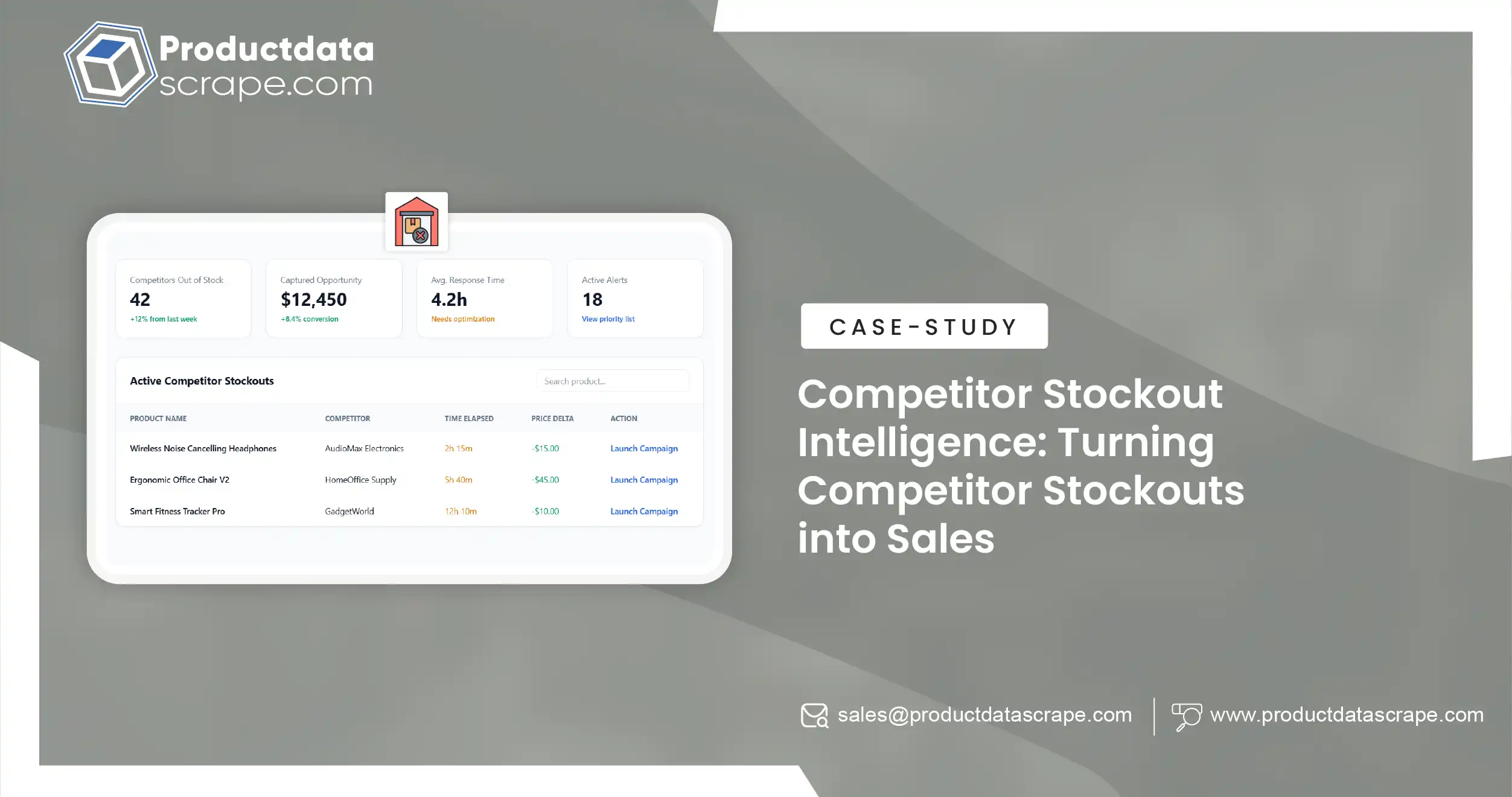
The Problem: A Rival's Stockout Is an Open Goal — If You See It in Time
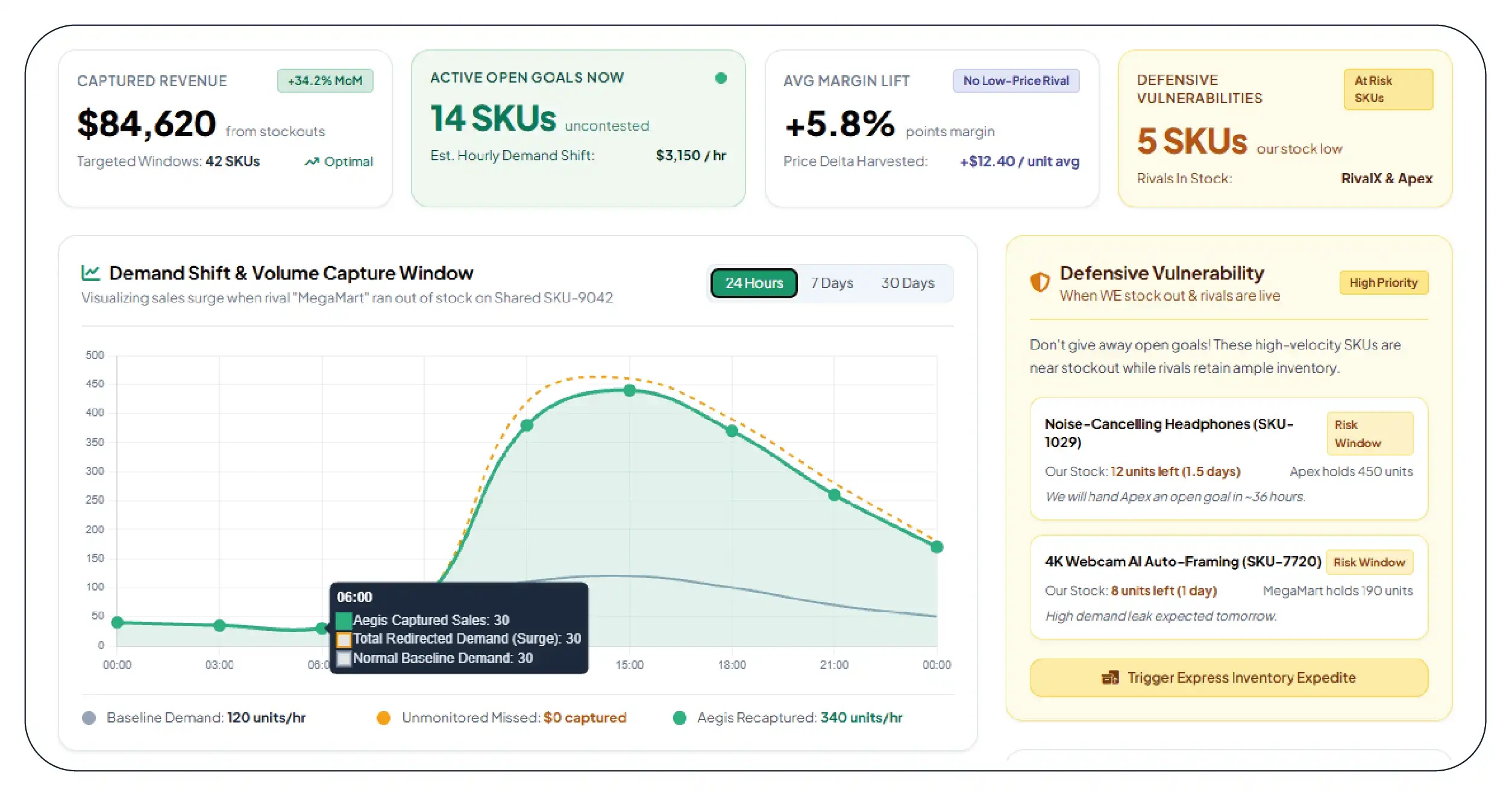
When a competitor selling the same product runs out of stock, the demand does not disappear. It redistributes to whoever is still available. For the sellers who remain in stock, a competitor's stockout is a window of concentrated demand and reduced price pressure — a chance to capture volume, and often to do it at a healthier margin, because the cheapest competitor is temporarily gone.
The seller was missing these windows entirely. It had no visibility into competitor stock, so a rival could sell out, the demand could shift, and the window could open and close without the seller ever knowing to lean into it. It was also caught the other way: when it stocked out and a competitor didn't, it lost demand it could have defended.
Stock, for this seller, was something it tracked only for itself. The competitive dimension — who else is available, and when do they run dry — was a blind spot.
The commercial lead's summary: our competitors hand us open goals every week when they run out, and we're not even looking at the net.
Why Competitor Stock Was Invisible
Availability is one of the highest-signal and least-monitored fields on a marketplace.
Stock status is not in a price feed. A seller monitoring only competitor prices sees nothing about availability. A competitor can be the cheapest listed price and completely out of stock — a price that cannot be bought — and a price-only view treats it as live competition when it is actually an open window.
Stockouts are short and unannounced. A competitor's out-of-stock window may last hours or days and gives no notification. Without continuous monitoring, most windows open and close unseen.
The demand shift is invisible without the cause. The seller sometimes noticed a sudden sales bump on a SKU and had no idea why. The cause — a competitor stockout redirecting demand — was knowable only by watching competitor availability, which the seller wasn't.
Its own defensive gaps were equally unseen. When the seller stocked out and rivals didn't, it had no view of the demand leaking to them, and no early signal to prioritise a restock.
The Solution: Competitor Stockout Intelligence
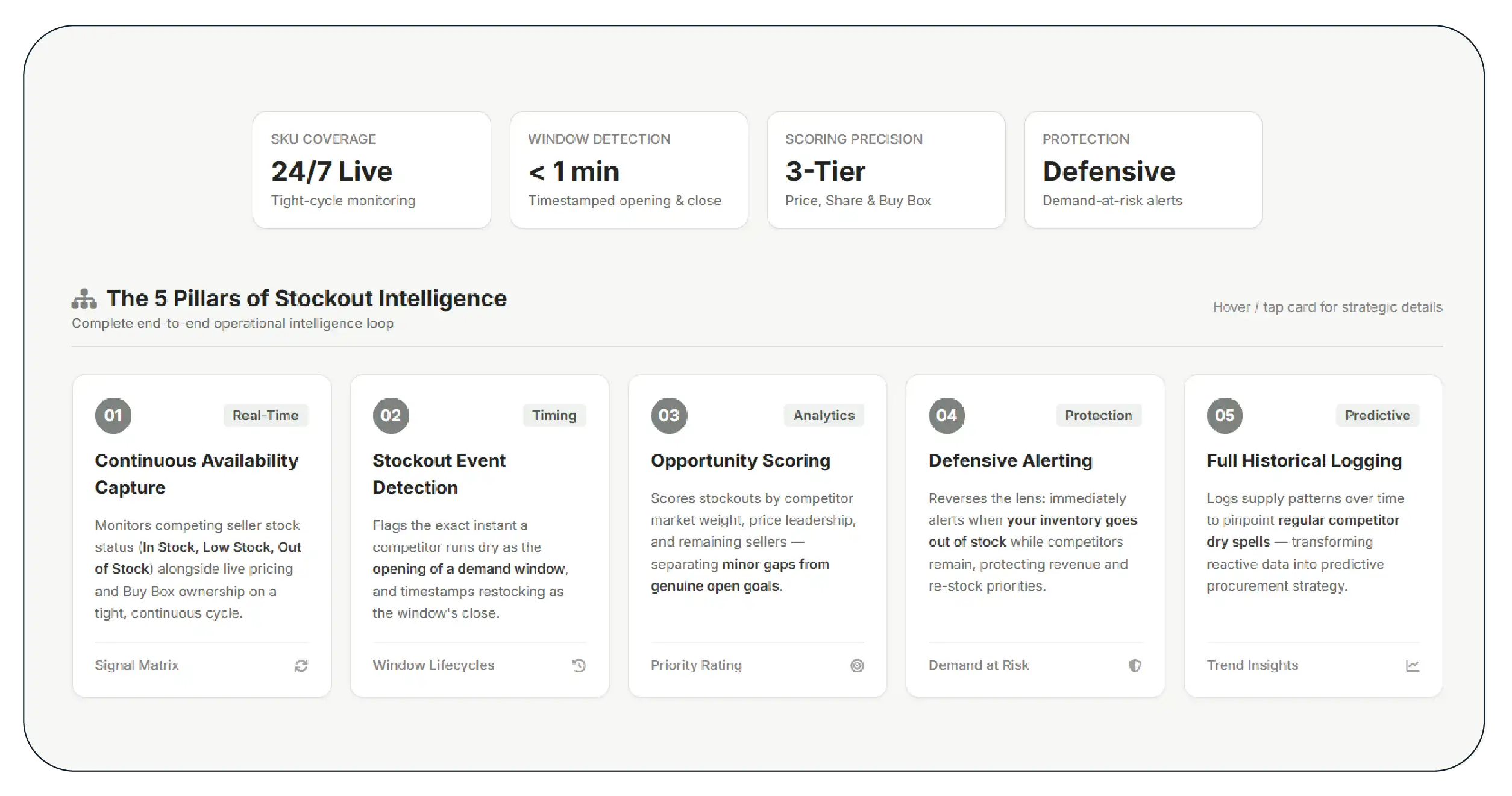
Product Data Scrape built competitor stockout intelligence that monitored availability across the seller's competitive set continuously.
- Continuous availability capture. For every monitored SKU, every competing seller's stock status — in stock, low stock, out of stock — was captured on a tight cycle, alongside price and Buy Box status, so availability became a live signal.
- Stockout event detection. The moment a competitor moved out of stock on a SKU, the event was flagged with a timestamp — the opening of a demand window — and when they restocked, that was flagged too, marking the window's close.
- Opportunity scoring. Each competitor stockout was scored by how much of a window it opened — how important that competitor was on the SKU, whether it was the price leader, how many other sellers remained — so the seller could tell a minor stockout from a genuine open goal.
- Defensive alerting. The reverse case — the seller stocking out while competitors remained — was alerted too, flagging demand at risk and SKUs to prioritise for restock.
- Full history. Stockout patterns were logged over time, revealing which competitors ran dry regularly, on which SKUs, and when — a predictive input, not just a reactive alert.
Sample Data: The Stockout Opportunity Map
An illustrative view of competitor stock events on one SKU.
| Time |
Our Stock |
Competitor A |
Competitor B (price leader) |
Window |
Action |
| Day 1 09:00 |
In stock |
In stock |
In stock (cheapest) |
Closed |
Normal pricing |
| Day 1 14:20 |
In stock |
In stock |
Out of stock |
Open — price leader gone |
Raise price, push spend |
| Day 2 11:00 |
In stock |
Out of stock |
Out of stock |
Wide open |
Capture demand |
| Day 3 10:00 |
In stock |
In stock |
Restocked (cheapest) |
Closed |
Revert pricing |
Illustrative series.
The structured record on Day 2:
{
  "sku": "APPL-SMALL-2270",
  "captured_at": "2026-07-15T11:00:00+05:30",
  "our_stock": "in_stock",
  "competitors": [
    {"seller": "Competitor A", "stock": "out_of_stock", "was_price": 2499},
    {"seller": "Competitor B", "stock": "out_of_stock", "was_price": 2399, "is_price_leader": true}
  ],
  "window_status": "wide_open",
  "opportunity_score": "high",
  "sellers_remaining_in_stock": 2,
  "recommended_action": "capture_demand_raise_spend"
}
The Day 1 14:20 line is the core of it: the price leader — the cheapest competitor — went out of stock, and the window opened. With the seller undercutting no longer available to buy, the seller could hold a firmer price and lean in ad spend into concentrated demand, capturing volume at a better margin than when the price leader was live.
What the Seller Did
Leaned into open windows. When a competitor stockout opened a window — especially when the price leader went dry — the seller raised its price toward a healthier margin and increased ad spend on that SKU, capturing the redirected demand while it lasted rather than leaving margin on the table.
Reverted the moment windows closed. When the competitor restocked, the seller reverted — because the intelligence flagged the close as clearly as the open, the seller did not hold an uncompetitive price after the window shut.
Defended its own gaps. Defensive alerts on its own stockouts let the seller prioritise restocks on SKUs where rivals were available to soak up the leaking demand.
Anticipated repeat offenders. The history revealed competitors that stocked out predictably on certain SKUs, letting the seller pre-position inventory and spend ahead of recurring windows.
The Results (One Quarter)
| Metric |
Before |
After One Quarter |
| Competitor stockout windows acted on |
Essentially none |
Majority of high-score windows |
| Median time to detect a competitor stockout |
Unmonitored |
Within the capture cycle |
| Margin on SKUs during competitor stockout windows |
Standard |
Materially higher |
| Own-stockout demand-at-risk alerts |
None |
All priority SKUs |
| Incremental revenue from captured windows, indexed |
100 |
144 |
| Margin during acted-on windows, indexed |
100 |
122 |
Figures are representative of the engagement outcome.
The commercial lead's follow-up: our competitors were handing us demand every time they ran out. Now we actually take it — and we give the price back the moment they return.
The Lesson
Availability is a competitive signal, not just an operational one. A competitor's stockout redistributes real demand to whoever remains, and for the sellers still in stock it is a window to capture volume — frequently at a better margin, because the cheapest seller is temporarily out of the race. But the window is invisible without monitoring competitor stock, and it is short enough that noticing late is the same as not noticing at all.
The sharpest part was margin, not just volume. When the price leader stocked out, the seller did not merely capture more units — it captured them at a firmer price, because the reason it had been discounting had temporarily disappeared. That is only possible if you can see, in real time, not just that a competitor is out of stock, but which competitor — and whether it was the one setting the floor.
Work With Product Data Scrape
Product Data Scrape delivers competitor stockout intelligence across your competitive set: continuous availability capture, stockout event detection with timestamps, opportunity scoring, defensive own-stockout alerting, and full stockout-pattern history — as JSON, CSV, API, or a live feed into your systems.
Ask us to map your competitors' stockouts on your key SKUs — we will show you the open goals you have been missing every week.
Product Data Scrape — turning marketplace complexity into decision-ready data.


 Singapore
 EMAIL
EMAIL
 PHONE
PHONE


.webp)
.webp "thumb")
.webp "thumb")
.webp "thumb")









.webp)