Quick Overview
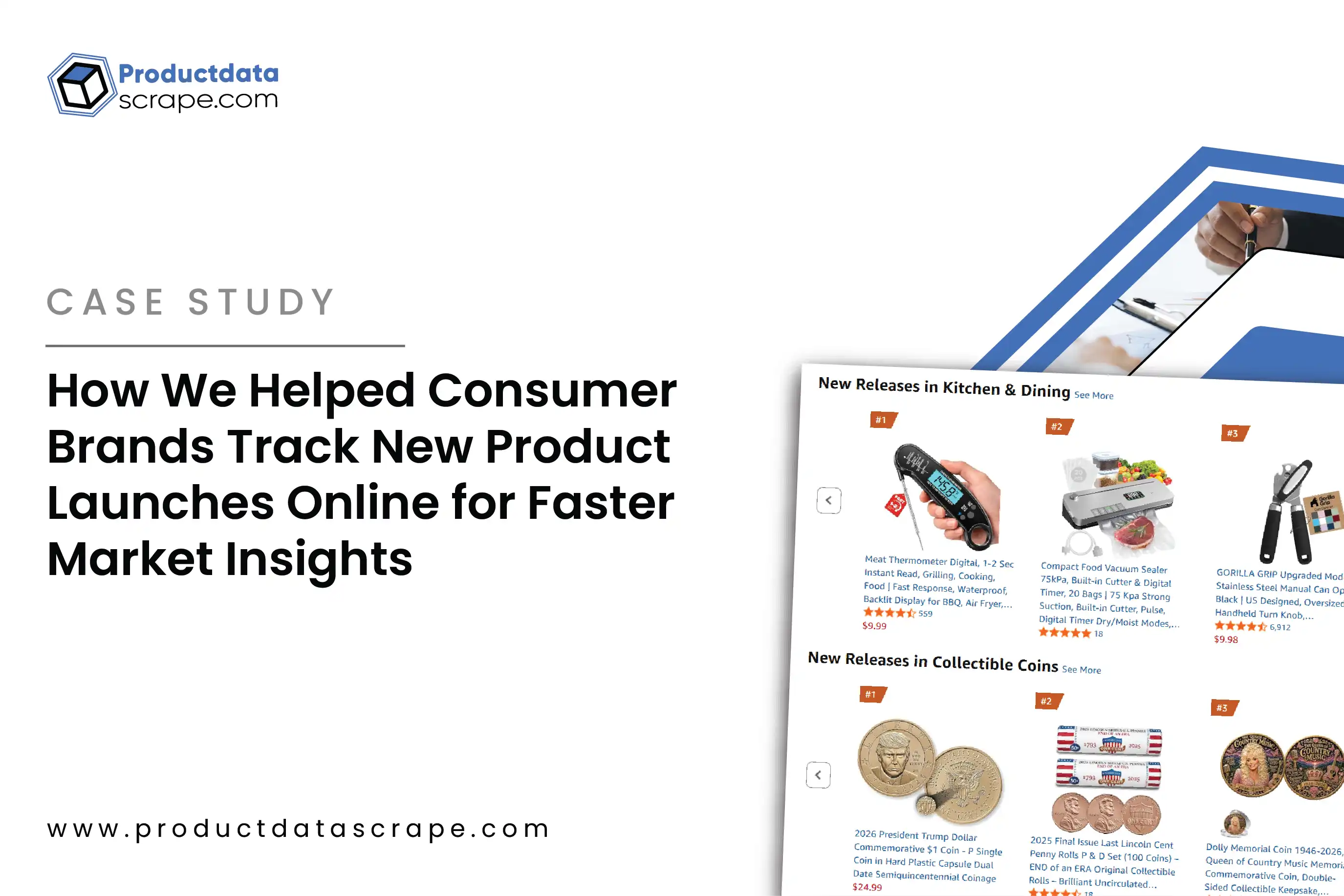
The client was a mid-to-large consumer goods brand operating across multiple online retail channels. The engagement focused on Consumer Brands Track New Product Launches Online to identify competitor SKUs, launch timing, pricing, packaging, and availability faster. The project combined automated product discovery with structured data collection and historical tracking. Over a six-month implementation, the workflow reduced manual launch discovery by 85%, improved new-SKU identification speed by 78%, and achieved 95%+ completeness across monitored product attributes. The solution enabled the client's category and strategy teams to Track Market Trends and Product Launches through a centralized, continuously refreshed intelligence workflow rather than relying on periodic manual research.
The Client
The client was an established consumer goods brand with products distributed through supermarkets, marketplaces, direct-to-consumer channels, and online retail platforms. As competition intensified, new products and variants were appearing online more frequently, creating pressure on the brand's product, category, and strategy teams.
The challenge was particularly significant because competitor launches could provide early signals about changing consumer preferences. A new flavor, pack size, formulation, price point, or product category could indicate where a competitor expected future demand.
Before the partnership, the client relied on a combination of manual searches, retailer visits, spreadsheets, and periodic competitive reports. Analysts had to check multiple websites individually and determine whether a listing represented a genuinely new SKU or an existing product with updated content.
This approach created delays. By the time a new competitor product appeared in an internal report, the product could already have expanded across several retailers.
The transformation therefore focused on creating automated New SKU Tracking Across Online Retailers supported by E-commerce data scraping. The objective was to establish a consistent product-discovery process capable of identifying new listings, recording their attributes, and preserving historical observations.
The project gave the client a scalable foundation for understanding competitor innovation and market movement without proportionally increasing manual research effort.
Goals & Objectives

Create a scalable framework for identifying newly listed products.
Reduce manual competitor research across online retailers.
Improve the speed of detecting competitor launches.
Increase consistency and accuracy in new-product identification.
Provide category teams with structured launch intelligence.
Build historical records for comparing launch activity over time.
Automate product discovery across selected online retail sources.
Capture SKU names, brands, categories, pack sizes, prices, images, and availability.
Detect newly appearing products against historical datasets.
Standardize product attributes across different retailer formats.
Connect new products to relevant categories and competitor brands.
Create dashboards and feeds for internal business users.
Support frequent data refreshes for faster market visibility.
The technical framework incorporated New Product Launch Data Scraping with a scalable Web Scraping API architecture. This allowed product information to move from source discovery through validation and normalization before becoming available for analysis.
85% reduction in manual launch-discovery effort.
78% faster identification of newly listed competitor products.
95%+ attribute completeness across monitored product records.
Reduced duplicate-product identification errors.
Faster delivery of launch intelligence to category teams.
Increased frequency of competitive product monitoring.
These KPIs provided measurable benchmarks for evaluating both operational efficiency and data quality.
The Core Challenge

The client's biggest problem was not a lack of competitive information. It was the speed and consistency with which that information could be collected and interpreted.
New products could appear across different online retailers at different times. Some listings contained complete information, while others used inconsistent product names, abbreviated descriptions, or different pack-size formats. This made manual comparison difficult.
Analysts also faced an important identification problem. A new listing did not always represent a new product. It could be a renamed SKU, a new pack size, a retailer-specific bundle, or an existing product with updated imagery.
Manual workflows therefore required significant verification.
The absence of a continuously updated historical dataset created another issue. Without previous observations, analysts had difficulty determining when a product first appeared online. They had to rely on retailer searches and scattered internal notes.
The project introduced Product Launch Tracking API for Brands capabilities to address these bottlenecks. The system preserved historical product observations and compared new records against previous snapshots.
The existing workflow also limited geographic and retailer-level visibility. A product could launch on one platform before appearing elsewhere, creating an early market signal that the client could miss.
The impact extended beyond research productivity. Delayed launch detection could affect assortment planning, pricing decisions, promotional preparation, and product positioning.
The client therefore required an automated process that could answer four practical questions quickly:
What new products have appeared?
Which competitor introduced them?
Where are they available?
How are they positioned in terms of price, pack size, and category?
The transformation needed to solve the data collection problem and the interpretation problem simultaneously.
Our Solution

The solution was implemented through a phased product-intelligence framework designed to detect, validate, classify, and monitor new online product launches.
Phase 1: Source and Category Mapping
The first phase identified relevant online retailers, marketplaces, product categories, brands, and competitive segments. Product fields were mapped into a common schema covering product name, brand, SKU, category, pack size, price, MRP, availability, imagery, retailer, and timestamp. This created a standardized foundation for comparing products across different online environments.
Phase 2: Automated Product Discovery
Automated collection workflows were configured to retrieve product information at scheduled intervals. New observations were stored with timestamps so the system could establish when individual products first became visible. This replaced repetitive manual searches with a repeatable discovery process.
Phase 3: Product Normalization
Retailers often describe similar products differently. The solution standardized brand names, product titles, quantities, variants, and category classifications. Normalization allowed the system to distinguish between genuinely new SKUs and duplicate representations of an existing product.
Phase 4: New-SKU Detection
Historical snapshots were compared with newly collected records. Products that did not previously exist in the monitored dataset were flagged for review. Additional rules helped differentiate new product launches, new pack sizes, new flavors or variants, rebranded products, retailer-specific bundles, and existing products with content changes. This created a more accurate launch-detection workflow.
Phase 5: Competitive Attribute Capture
For each detected product, the system captured relevant market-positioning information, including pricing, pack size, category, promotional status, availability, and product imagery. This allowed the client to understand not just that a competitor launched a product, but how the product was positioned.
Phase 6: Historical Tracking
Once a product entered the dataset, subsequent observations were retained. The client could therefore track how its availability and pricing changed after launch. Historical data also allowed teams to measure launch expansion across retailers and identify products gaining broader distribution.
Phase 7: Dashboard and Alerting
The final workflow presented new product records through an intelligence layer where users could filter by competitor, category, retailer, date, and product type. The eCommerce New Product Launch Tracking framework made new-product activity easier to identify and prioritize. Automated alerts could highlight important events, such as a new competitor SKU appearing in a high-priority category or an existing launch expanding into additional retailers.
The phased approach solved the client's primary issues sequentially: source fragmentation, manual collection, inconsistent product information, launch identification, and delayed reporting.
Results & Key Metrics

The implementation produced measurable improvements across the launch-intelligence workflow:
85% reduction in manual product-discovery activities.
78% faster identification of new competitor SKUs.
95%+ completeness across targeted product attributes.
90%+ automated processing of monitored product records.
Significant reduction in duplicate-product classification.
Faster availability of launch information for category and strategy teams.
These benchmarks demonstrated that New Product Price and Availability Tracking could be integrated into the broader competitive intelligence workflow without creating a proportionate increase in analyst workload.
Results Narrative
The most important outcome was the shift from periodic competitive research to continuous product discovery. The client could identify new online listings much earlier and determine whether they represented new SKUs, variants, or packaging changes.
Category managers gained a clearer view of competitor launch activity across monitored retailers. They could compare launch timing, pricing, pack sizes, and availability without manually consolidating multiple sources.
The historical dataset also created a new analytical capability. Instead of seeing a launch as a single event, the client could follow its progression after introduction.
This helped teams recognize which launches were expanding, which remained limited to specific retailers, and which showed changes in price or availability.
The result was faster market visibility and a more consistent basis for product and assortment decisions.
What Made Product Data Scrape Different?
The key differentiator was the focus on Product Launch Tracking API for Brands as a complete intelligence workflow rather than a simple product extraction service.
The framework combined automated discovery, historical comparison, product normalization, attribute validation, and launch classification. This helped reduce the risk of treating every newly detected listing as a genuinely new product.
Smart automation also allowed the client to prioritize important changes instead of reviewing every product record manually. Rules could identify high-priority launches based on competitor, category, price movement, or retailer coverage.
The solution was designed around business questions rather than raw data volume. Every collected field supported a specific use case, from identifying new SKUs to understanding launch positioning.
Client's Testimonial
"Before this project, identifying new competitor products required significant manual effort across multiple online retailers. The information was available, but it was difficult to collect consistently and quickly enough for our teams to act on it.
The new workflow gave us much better visibility into product launches, pricing, pack sizes, and availability. We particularly valued the historical tracking because it allowed us to see how a new product progressed after appearing online.
The automation also reduced repetitive research and allowed our category teams to focus more on interpreting market movements rather than gathering data.
The improved visibility has made competitive product monitoring a much more structured part of our decision-making process."
— Senior Category Strategy Manager, Consumer Goods Brand
How Does New Product Launch Support Scraping Improve Market Intelligence?
New Product Launch Supports Scraping by creating a continuous information layer around competitor innovation. Instead of waiting for manually compiled market reports, brands can identify product listings as they emerge across monitored online channels.
The workflow can capture launch timing, product attributes, prices, pack sizes, promotional information, and availability. Historical snapshots then show whether a product remains limited to one retailer or expands across multiple channels.
For category teams, this supports faster assortment reviews. For pricing teams, it provides early visibility into competitor positioning. For strategy teams, recurring launch patterns can reveal where competitors are investing.
The approach also creates a searchable historical record, allowing brands to study launch frequency and category expansion over time.
By combining automated collection with structured classification, businesses can turn online product activity into an ongoing competitive signal.
Conclusion
New product launches can provide some of the earliest signals of changing consumer demand and competitor strategy. Assortment and availability monitoring adds context by showing where new products appear, how widely they are distributed, and whether they remain consistently available.
The case demonstrates how Consumer Brands Track New Product Launches Online can move from a manual research activity to an automated intelligence process. Structured product data, historical comparisons, pricing information, and retailer-level observations help category teams respond faster to market changes.
The next opportunity is to expand monitoring across more categories, retailers, and geographic markets while adding deeper product-matching and launch-prediction capabilities.
Partner with Product Data Scrape to build automated product-launch intelligence and identify competitor innovations before they become mainstream market trends!
FAQs
1. Why should consumer brands monitor new product launches?
Monitoring new launches helps brands identify competitor innovation, emerging categories, new pack sizes, pricing strategies, and changing market priorities before these developments become widely established.
2. What information can be collected from new product listings?
A launch-monitoring dataset can capture product names, brands, categories, pack sizes, prices, discounts, availability, product descriptions, imagery, retailer information, and timestamps for historical analysis.
3. How can launch data support category managers?
Category managers can compare competitor launches, identify assortment gaps, evaluate new categories, monitor product expansion, and prioritize opportunities based on actual online market activity.
4. Can launch tracking identify products across multiple retailers?
Yes. A structured monitoring workflow can compare product listings across selected online retailers and identify where products first appear, where they expand, and how their availability changes.
5. How does automated launch monitoring save time?
Automation reduces repetitive retailer searches, data copying, and manual comparisons. It continuously identifies relevant product changes so analysts can concentrate on validation, interpretation, and strategic decisions.


 Singapore
 EMAIL
EMAIL
 PHONE
PHONE


.webp "thumb")









.webp)