Introduction
Pricing is one of the most important factors influencing customer purchasing decisions. Even a small change in price can significantly affect demand, sales volume, and profitability. Businesses that rely on assumptions instead of data often struggle to maintain competitive pricing while protecting profit margins.
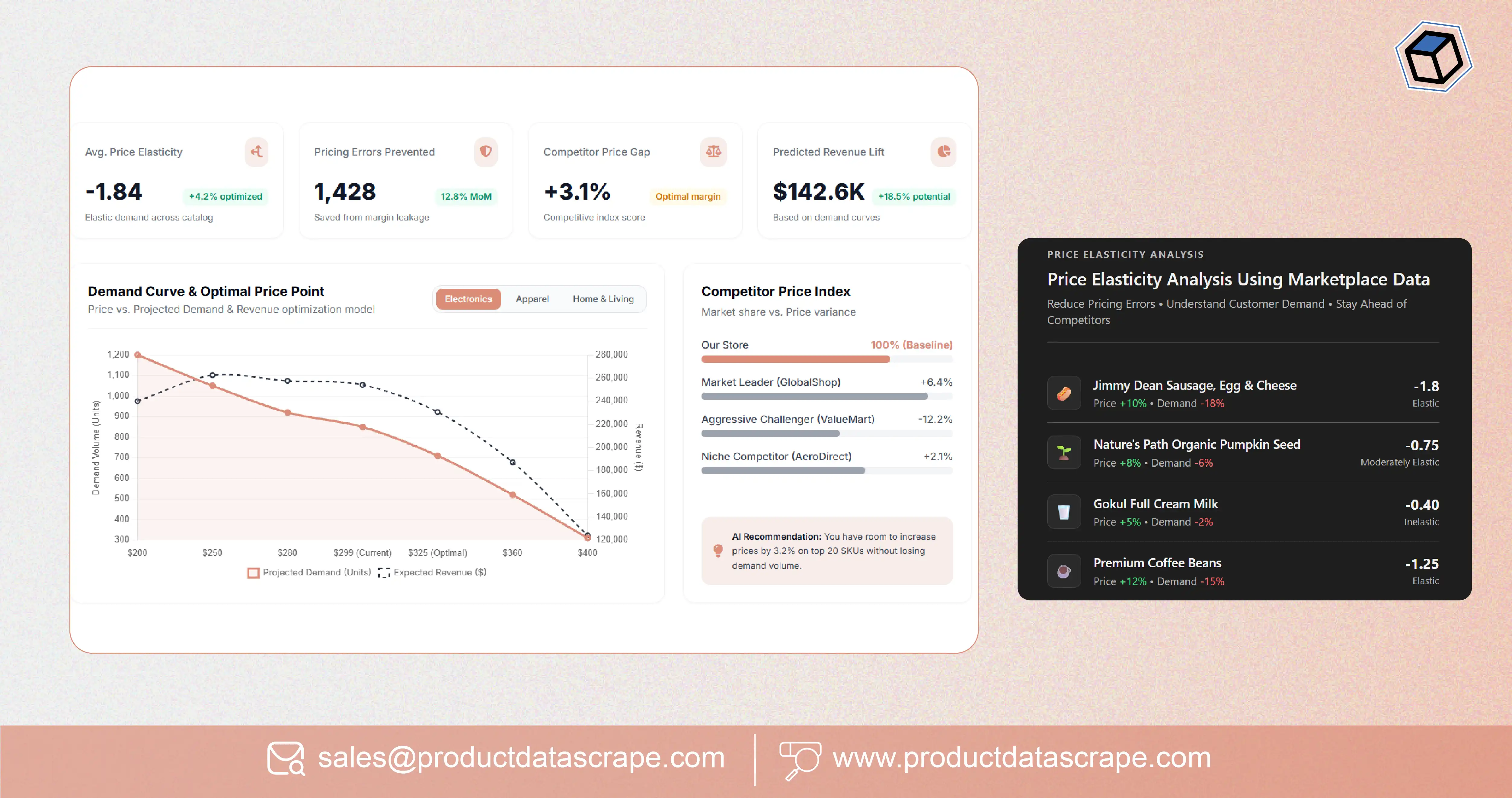
Implementing Price Elasticity Analysis Using Marketplace Data enables retailers and brands to understand how pricing changes influence customer demand across different products, categories, and marketplaces. Combined with market share analysis, organizations gain valuable insights into competitor performance, customer behavior, pricing sensitivity, and revenue opportunities. These insights help businesses make informed pricing decisions rather than reacting to competitors after market changes occur.
For pricing analysts, category managers, retail executives, and marketplace sellers looking to improve profitability, marketplace data provides the intelligence needed to optimize pricing strategies. Automated data collection and analytics support faster decision-making while reducing manual analysis.
This guide explains how competitor pricing, historical marketplace data, pricing trends, and real-time monitoring help businesses improve pricing accuracy and maximize profitability between 2020 and 2026.
How Can Competitor Pricing Reveal Customer Buying Behavior?
Customers constantly compare prices before making purchasing decisions. Understanding competitor pricing helps businesses identify how sensitive customers are to price changes and where pricing adjustments can improve sales without sacrificing profitability.
Using Competitor Price Data for Elasticity Analysis, businesses collect pricing information across marketplaces to evaluate competitor positioning, discount frequency, promotional strategies, and customer response. This data enables pricing teams to estimate demand elasticity and identify optimal pricing ranges for different product categories.
Retailers can also Spot trending products by monitoring fast-moving categories, promotional events, seasonal demand, and emerging consumer preferences. Combining pricing intelligence with trend analysis allows businesses to adjust prices proactively while maximizing conversions and protecting margins.
Instead of relying solely on historical sales data, organizations gain a comprehensive understanding of market dynamics that supports smarter pricing strategies.
Benefits of competitor pricing analysis
- Identify pricing gaps.
- Measure competitor discounting.
- Understand customer price sensitivity.
- Improve promotional planning.
- Increase pricing accuracy.
- Detect market opportunities.
- Improve sales forecasting.
- Maximize profitability.
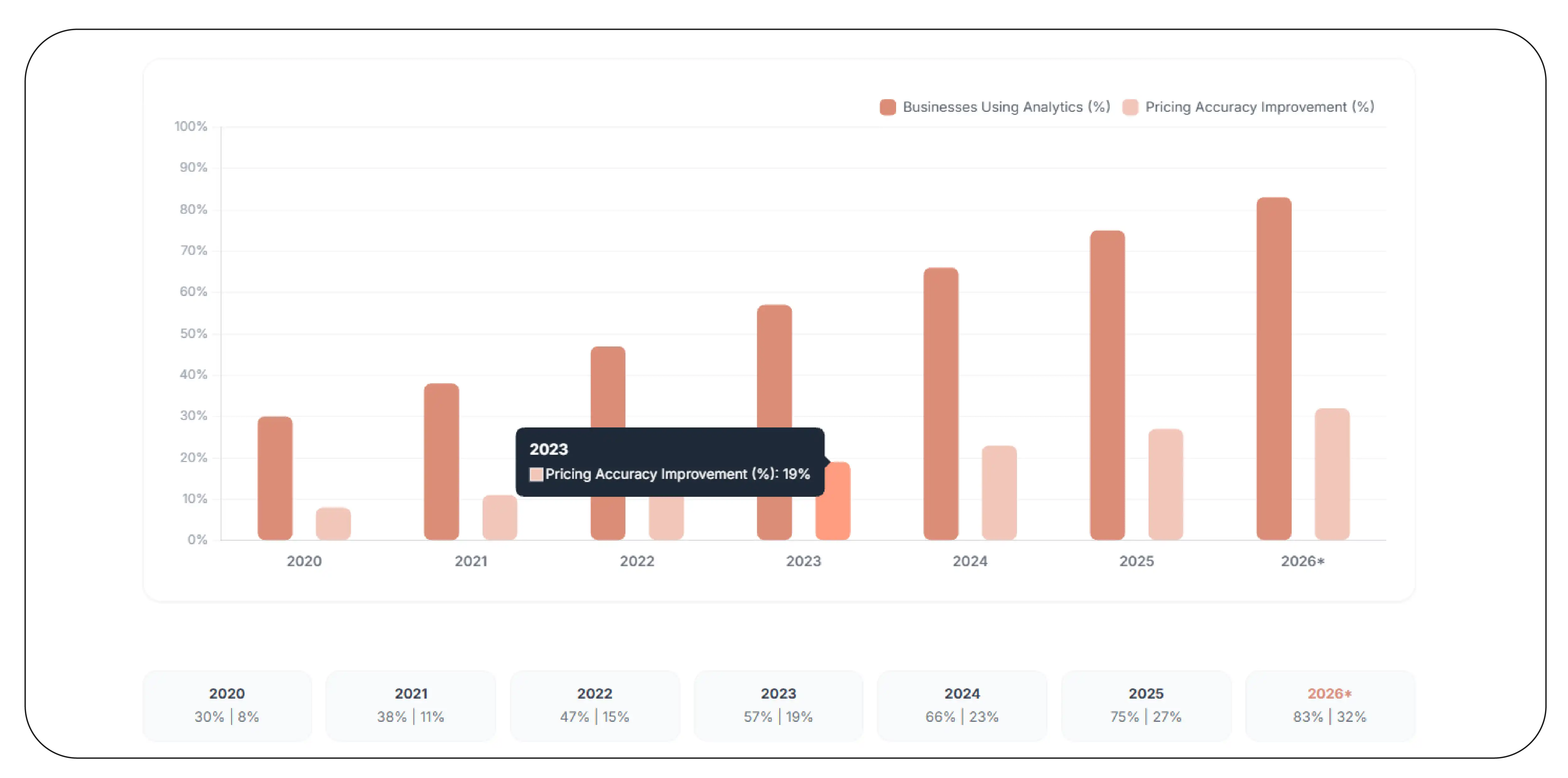
Competitor Pricing Intelligence Adoption (2020–2026)
| Year |
Businesses Using Competitor Pricing Analytics |
Average Pricing Accuracy Improvement |
| 2020 |
30% |
8% |
| 2021 |
38% |
11% |
| 2022 |
47% |
15% |
| 2023 |
57% |
19% |
| 2024 |
66% |
23% |
| 2025 |
75% |
27% |
| 2026* |
83% |
32% |
*Projected industry estimates.
Organizations leveraging competitor pricing intelligence consistently improve demand forecasting, optimize pricing decisions, and strengthen their competitive position in increasingly dynamic marketplaces.
How Do Marketplace Pricing Trends Improve Pricing Decisions?
Pricing trends provide valuable context beyond individual price changes. Businesses that continuously monitor pricing movements across marketplaces can identify seasonal fluctuations, promotional cycles, competitor behavior, and long-term pricing patterns that influence customer demand.
Implementing Marketplace Price Trend Analysis enables organizations to evaluate how prices evolve across brands, retailers, and product categories over time. Instead of reacting to isolated price changes, pricing teams gain a strategic understanding of market behavior that supports sustainable pricing decisions.
Trend analysis also helps businesses anticipate promotional events, optimize discount timing, and forecast future demand more accurately. Combined with inventory and sales performance data, marketplace pricing trends improve revenue planning while reducing unnecessary pricing adjustments.
Advantages of marketplace trend analysis
- Identify seasonal pricing patterns.
- Forecast demand more accurately.
- Improve promotional timing.
- Compare competitor pricing strategies.
- Detect market shifts early.
- Support pricing optimization.
- Improve revenue planning.
- Strengthen competitive positioning.
Marketplace Pricing Trend Growth (2020–2026)
| Year |
Companies Using Pricing Trend Analytics |
Average Margin Improvement |
| 2020 |
28% |
5% |
| 2021 |
36% |
7% |
| 2022 |
45% |
10% |
| 2023 |
55% |
13% |
| 2024 |
65% |
16% |
| 2025 |
74% |
19% |
| 2026* |
82% |
23% |
*Projected industry estimates.
Businesses that analyze long-term marketplace pricing trends gain stronger visibility into market dynamics, improve pricing stability, and make faster, data-driven decisions that support sustainable growth and higher profitability.
How Can Historical Marketplace Data Improve Pricing Accuracy?
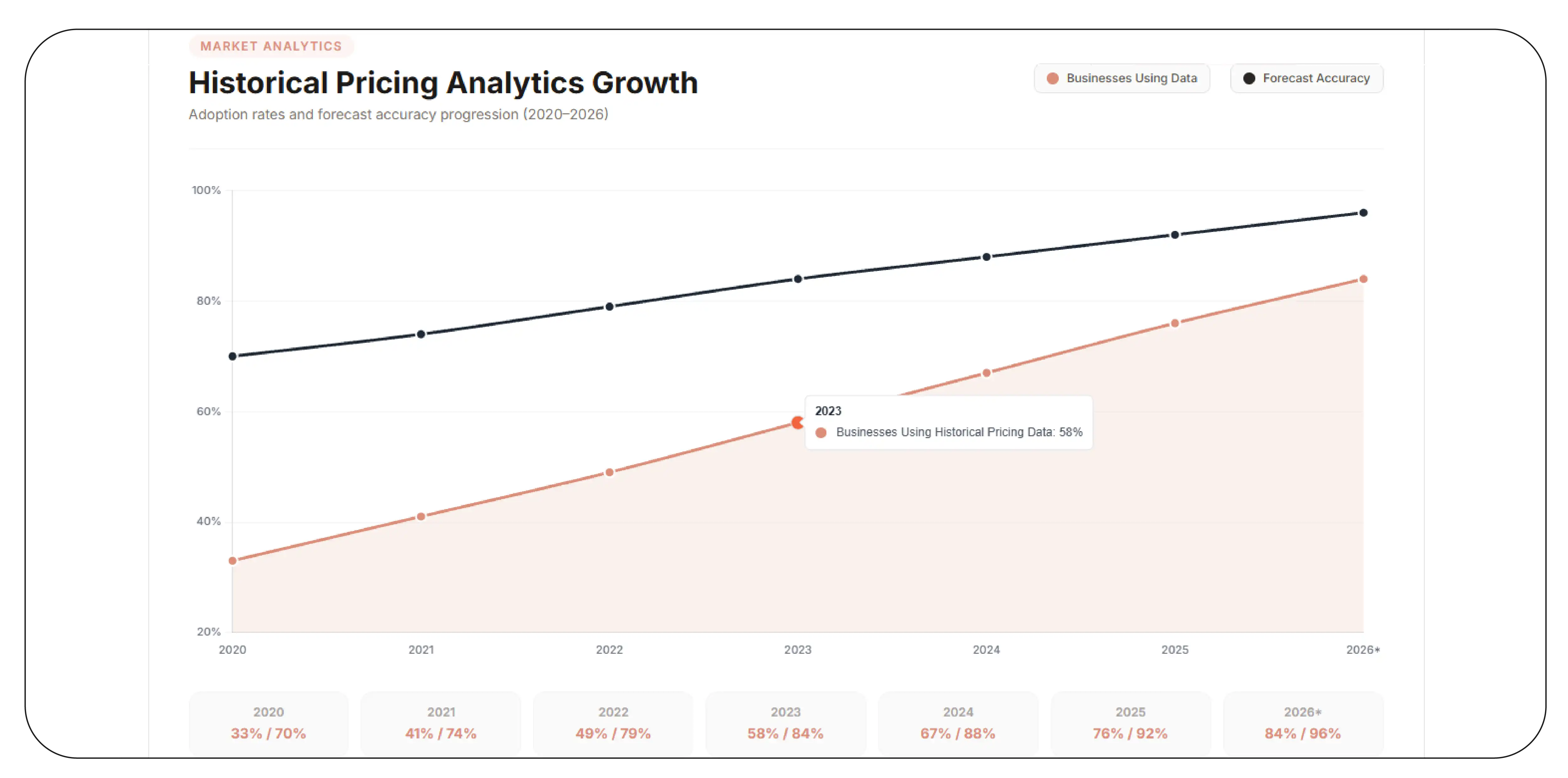
Understanding how prices changed in the past helps businesses make better pricing decisions for the future. Historical pricing data reveals seasonal demand, promotional cycles, competitor behavior, and customer buying patterns that are difficult to identify through real-time monitoring alone. These insights reduce pricing uncertainty and improve long-term planning.
Using Historical Marketplace Pricing Data, businesses can compare price movements across products, brands, marketplaces, and time periods. This information helps identify recurring trends, evaluate competitor discount frequency, and forecast demand more accurately. Historical analysis also supports pricing simulations before launching new products or promotional campaigns.
When combined with Commerce Intelligence, organizations gain a complete view of pricing, inventory, customer behavior, product performance, and market dynamics. Decision-makers can understand not only how prices changed but also why those changes affected customer demand and revenue.
Benefits of historical pricing analysis
- Improve pricing forecasts.
- Identify seasonal demand.
- Compare competitor pricing history.
- Optimize promotional planning.
- Improve inventory decisions.
- Reduce pricing risks.
- Support AI-based pricing models.
- Increase long-term profitability.
Historical Pricing Analytics Growth (2020–2026)
| Year |
Businesses Using Historical Pricing Data |
Forecast Accuracy |
| 2020 |
33% |
70% |
| 2021 |
41% |
74% |
| 2022 |
49% |
79% |
| 2023 |
58% |
84% |
| 2024 |
67% |
88% |
| 2025 |
76% |
92% |
| 2026* |
84% |
96% |
*Projected industry estimates.
Businesses using historical marketplace pricing data consistently improve forecasting accuracy, pricing confidence, and revenue planning while minimizing pricing errors in competitive retail environments.
How Can Businesses Turn Marketplace Data into Actionable Pricing Decisions?
Collecting pricing information is only the first step. The real value comes from transforming raw marketplace data into practical insights that guide pricing strategies. Businesses need analytics that identify opportunities, detect pricing anomalies, and recommend profitable pricing actions.
Using Marketplace Pricing Data Insights, organizations can analyze competitor pricing, product demand, promotions, inventory availability, and customer purchasing behavior within a single reporting framework. These insights help pricing teams recognize products with high price sensitivity, identify opportunities for premium pricing, and respond quickly to competitor price adjustments.
Advanced analytics also improve collaboration between pricing managers, category teams, marketing departments, and business leaders. Shared dashboards enable faster decision-making while reducing manual reporting and spreadsheet analysis.
Advantages of pricing insights
- Identify profitable pricing opportunities.
- Detect competitor price changes.
- Improve pricing consistency.
- Support promotional planning.
- Enhance demand forecasting.
- Improve cross-functional collaboration.
- Increase operational efficiency.
- Maximize revenue opportunities.
Marketplace Analytics Adoption (2020–2026)
| Year |
Companies Using Marketplace Analytics |
Average Revenue Improvement |
| 2020 |
29% |
6% |
| 2021 |
37% |
8% |
| 2022 |
46% |
11% |
| 2023 |
56% |
14% |
| 2024 |
66% |
17% |
| 2025 |
75% |
20% |
| 2026* |
83% |
24% |
*Projected industry estimates.
Organizations that convert marketplace pricing data into actionable insights respond faster to market changes, improve pricing precision, and create stronger competitive advantages through informed decision-making.
Why Is Continuous Product Price Monitoring Essential for Competitive Success?
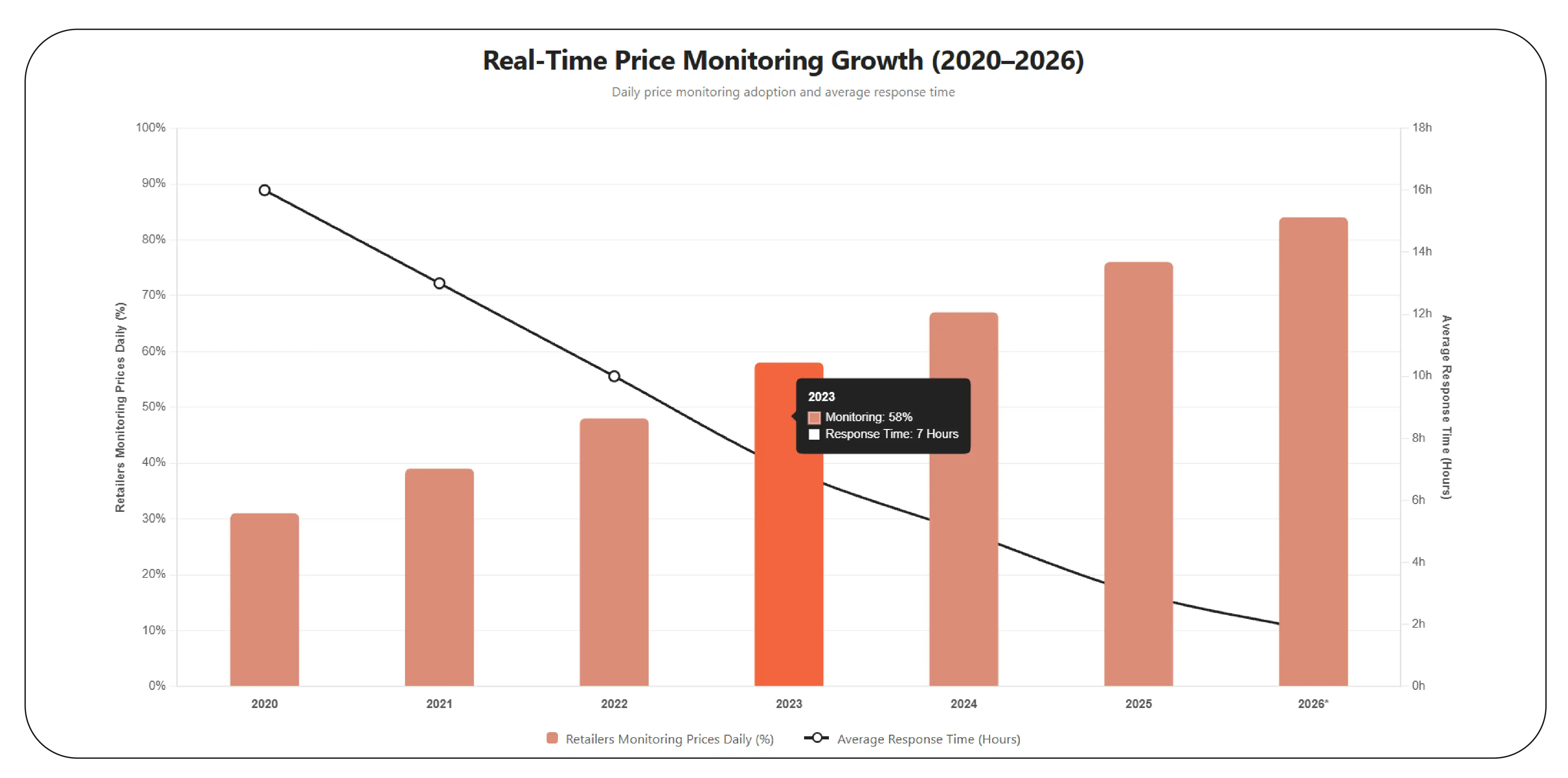
Online marketplace prices change frequently because of promotions, competitor activity, inventory fluctuations, and customer demand. Businesses that monitor prices only periodically risk missing important market changes that directly affect sales and profitability.
Implementing Marketplace Product Price Monitoring enables organizations to track product prices continuously across marketplaces, retailer websites, and competitor stores. Automated monitoring alerts pricing teams whenever significant price changes occur, allowing rapid responses that maintain competitiveness without sacrificing profit margins.
Continuous monitoring also helps businesses evaluate promotional effectiveness, identify pricing anomalies, monitor new product launches, and benchmark pricing performance across different regions. Instead of reacting after market conditions change, companies gain real-time visibility that supports proactive pricing strategies.
Benefits of continuous monitoring
- Detect competitor price changes instantly.
- Improve pricing responsiveness.
- Strengthen promotional planning.
- Monitor product launches.
- Protect profit margins.
- Improve market visibility.
- Support better pricing decisions.
- Increase customer satisfaction.
Real-Time Price Monitoring Growth (2020–2026)
| Year |
Retailers Monitoring Prices Daily |
Average Response Time |
| 2020 |
31% |
16 Hours |
| 2021 |
39% |
13 Hours |
| 2022 |
48% |
10 Hours |
| 2023 |
58% |
7 Hours |
| 2024 |
67% |
5 Hours |
| 2025 |
76% |
3 Hours |
| 2026* |
84% |
Less than 2 Hours |
*Projected industry estimates.
Continuous marketplace price monitoring enables businesses to respond faster to pricing changes, optimize competitiveness, and improve profitability in rapidly evolving eCommerce markets.
How Can Businesses Create a Sustainable Pricing Strategy for Long-Term Growth?
A successful pricing strategy combines real-time monitoring, historical analysis, competitor benchmarking, and customer demand insights. Businesses that continuously evaluate pricing performance can adapt quickly to market changes while protecting margins and increasing revenue. A proactive approach reduces pricing errors and strengthens competitive positioning.
Using Competitor Price Data for Elasticity Analysis, organizations can measure how competitor price changes influence customer demand, purchase behavior, and conversion rates. These insights help identify the optimal pricing range for different products and customer segments. Businesses can also compare pricing across regions, monitor promotional effectiveness, and refine discount strategies based on measurable results rather than assumptions.
A sustainable pricing framework also encourages collaboration between pricing analysts, category managers, marketing teams, and business leaders. Shared dashboards and automated reporting enable faster decision-making while improving consistency across every sales channel.
Best practices for pricing optimization
- Monitor competitor prices daily.
- Analyze customer demand regularly.
- Measure pricing elasticity frequently.
- Track promotional performance.
- Benchmark regional pricing.
- Review pricing trends monthly.
- Optimize discount strategies.
- Continuously improve pricing models.
Pricing Optimization Trends (2020–2026)
| Year |
Companies Using Elasticity Analytics |
Average Profit Margin Improvement |
| 2020 |
27% |
6% |
| 2021 |
35% |
8% |
| 2022 |
45% |
11% |
| 2023 |
55% |
14% |
| 2024 |
65% |
17% |
| 2025 |
75% |
20% |
| 2026* |
84% |
24% |
*Projected industry estimates.
Businesses that continuously evaluate price elasticity and competitor activity make more confident pricing decisions, improve customer satisfaction, and achieve sustainable growth in competitive marketplaces.
Why Choose Product Data Scrape?
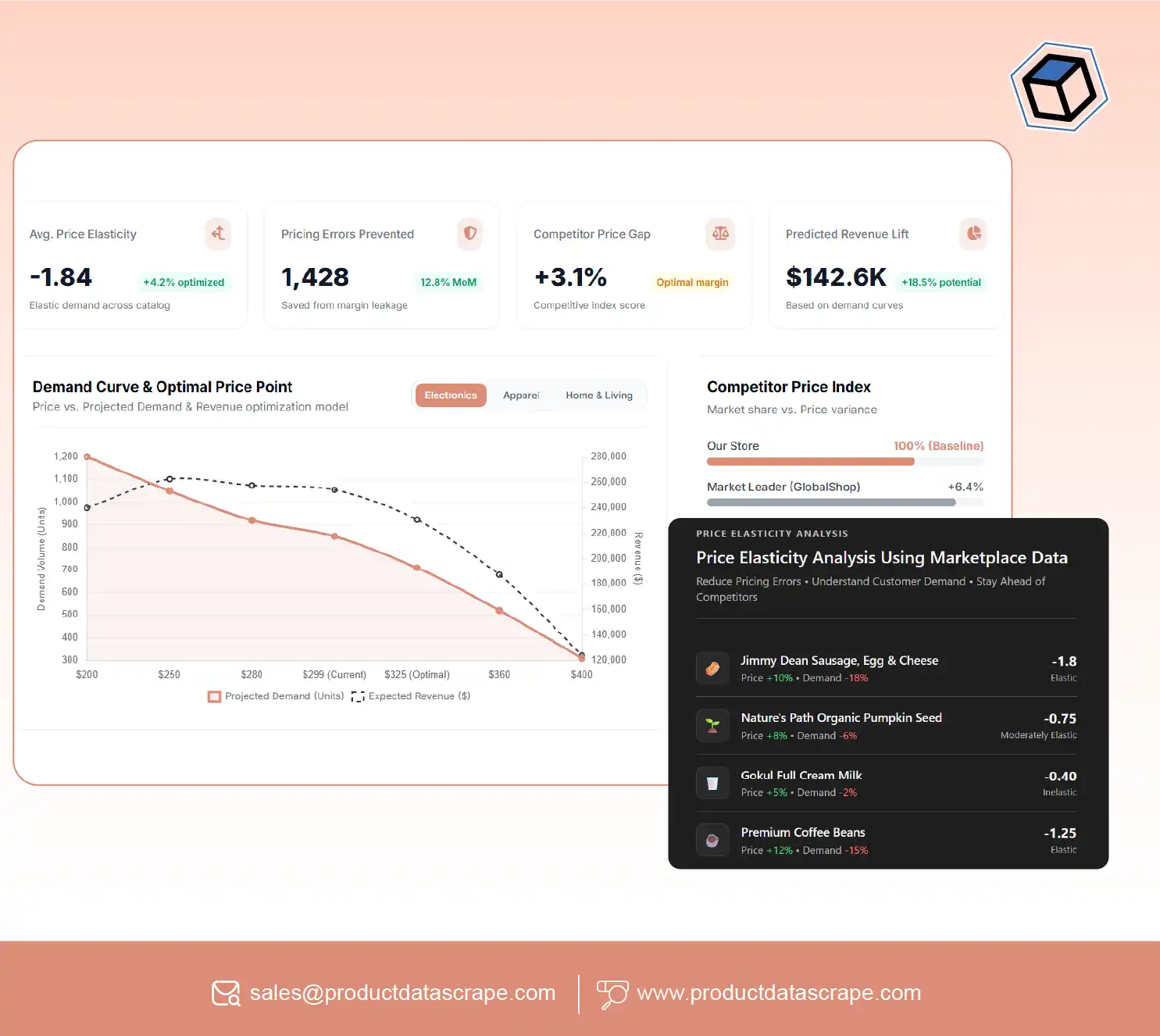
Accurate pricing decisions require reliable marketplace intelligence. Product Data Scrape delivers automated competitor tracking, historical pricing datasets, marketplace analytics, demand insights, and advanced Price elasticity analysis to help businesses optimize pricing with confidence. By leveraging Price Elasticity Analysis Using Marketplace Data, retailers and brands can understand customer price sensitivity, improve promotional effectiveness, maximize profit margins, and respond faster to changing market conditions. Scalable data extraction, customizable reporting, and actionable analytics empower organizations to make smarter pricing decisions while reducing manual effort and improving overall business performance.
Conclusion
Modern pricing strategies depend on accurate marketplace intelligence rather than assumptions. Continuous analysis of competitor pricing, customer demand, and market trends enables businesses to reduce pricing errors, improve revenue, and strengthen competitive positioning. Combining Price monitoring with Price Elasticity Analysis Using Marketplace Data provides the actionable insights needed to optimize pricing decisions and maximize profitability across dynamic eCommerce markets.
Ready to transform your pricing strategy with real-time marketplace intelligence? Contact Product Data Scrape today to implement advanced pricing analytics, monitor competitors continuously, and drive sustainable business growth through data-driven decisions!
FAQs
1. What is price elasticity analysis?
Price elasticity analysis measures how customer demand changes when product prices increase or decrease. It helps businesses identify optimal pricing strategies that maximize revenue while maintaining customer demand and profitability.
2. Why is marketplace pricing data important?
Marketplace pricing data provides visibility into competitor pricing, promotions, and demand trends. Businesses use these insights to improve pricing accuracy, strengthen competitiveness, and make informed pricing decisions.
3. How does historical pricing improve pricing strategies?
Historical pricing reveals seasonal trends, promotional patterns, and customer purchasing behavior. These insights improve forecasting accuracy, support demand planning, and help businesses optimize future pricing strategies.
4. Can automated price monitoring improve profitability?
Yes. Automated monitoring identifies competitor price changes in real time, enabling businesses to respond quickly, protect margins, improve pricing competitiveness, and increase sales opportunities.
5. How can businesses implement marketplace pricing analytics?
Businesses can partner with Product Data Scrape to automate marketplace data collection, analyze competitor pricing, monitor demand trends, and generate actionable pricing insights for long-term business success.


 Singapore
 EMAIL
EMAIL
 PHONE
PHONE


.webp "thumb")
.webp "thumb")









.webp)