Introduction
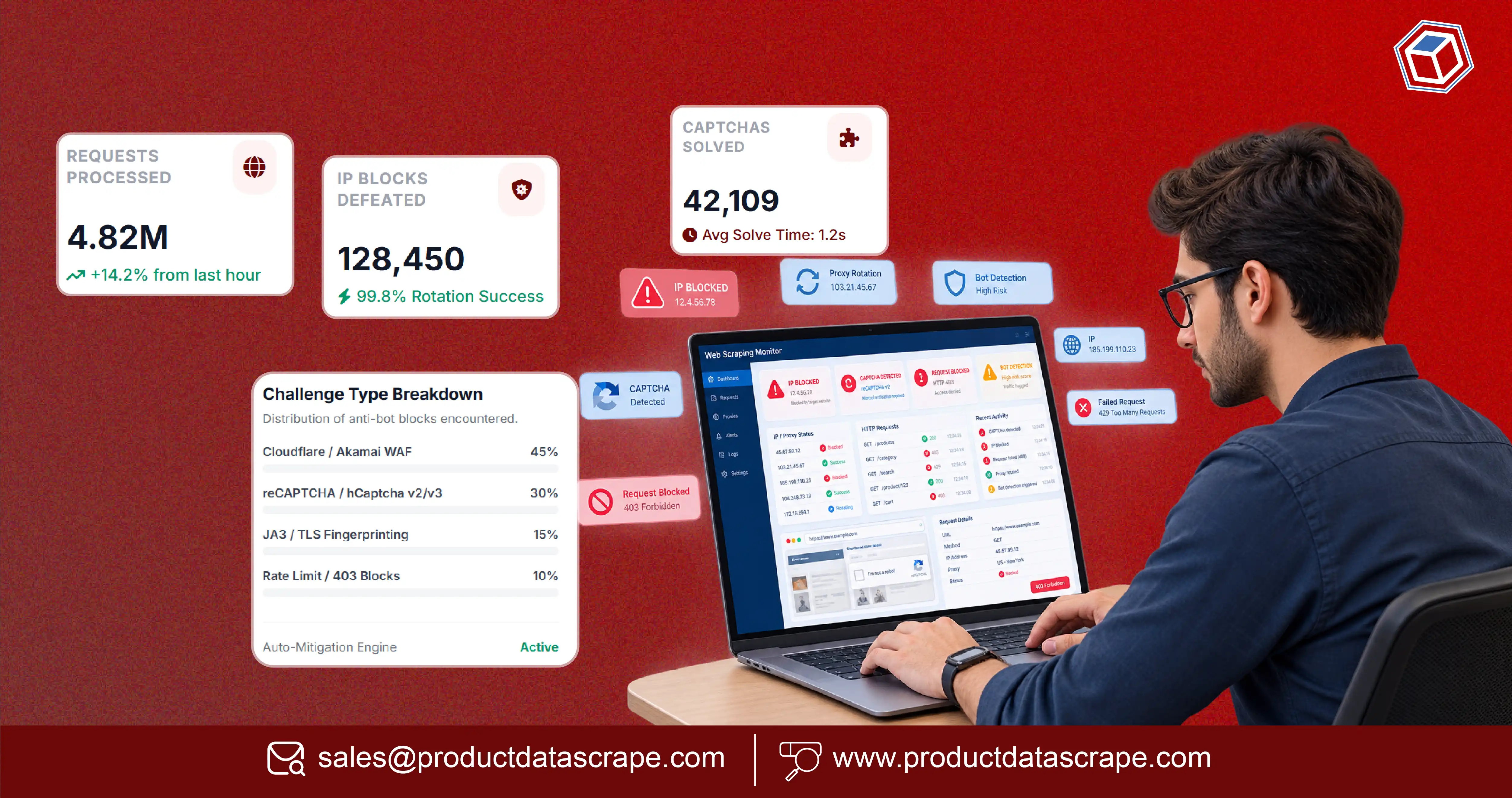
Brands can reduce marketplace data disruptions by using compliant collection architectures built around official APIs where available, sensible request rates, caching, retries, monitoring, and clear respect for website terms and access controls. Anti-Bot Protection for Marketplace Scraping should focus on reliable, responsible data collection—not bypassing CAPTCHAs, access controls, or restrictions.
For eCommerce brands, retailers, pricing teams, and market researchers, consistent marketplace data is essential for monitoring prices, product availability, ratings, reviews, assortment, and competitive positioning. When collection is interrupted, datasets become incomplete and pricing or merchandising decisions can quickly become outdated.
A robust data workflow combines source selection, structured extraction, validation, scheduling, and monitoring. Businesses can prioritize authorized APIs and permitted public data sources while adjusting collection frequency according to business requirements.
This approach also supports Price Monitoring Product Data APIs, where structured product and pricing information can be delivered into dashboards, analytics platforms, or internal applications.
The objective is straightforward: create a dependable marketplace intelligence pipeline that produces accurate, timely, and compliant data without treating access restrictions as obstacles to defeat.
How Can Businesses Collect Marketplace Data Responsibly?
Businesses need to balance data requirements with website policies, technical limitations, and applicable laws. The right approach is not to force access when a marketplace restricts automated requests. Instead, organizations should identify permitted data sources, use official interfaces where available, and design collection workloads responsibly.
scrape marketplaces without violating rules, E-commerce data scraping requires a governance-first approach. Before launching a project, teams should review the target website's terms, robots directives where relevant, API documentation, licensing requirements, and applicable privacy obligations.
| Year |
Collection Priority |
Recommended Business Practice |
| 2020 |
Basic source review |
Identify permitted sources |
| 2021 |
Structured collection |
Define required fields |
| 2022 |
API adoption |
Prefer authorized interfaces |
| 2023 |
Data governance |
Add validation and monitoring |
| 2024 |
Workload management |
Optimize request frequency |
| 2025 |
Automated quality control |
Detect incomplete datasets |
| 2026 |
Intelligent orchestration |
Prioritize reliable sources |
A marketplace project should begin with a clear data specification. For example, a pricing project may need product title, SKU, brand, current price, regular price, discount, currency, availability, category, and timestamp.
Collecting unnecessary fields can increase workload without creating additional business value. A focused schema makes the pipeline more efficient.
Request scheduling is another important consideration. Businesses should avoid unnecessarily aggressive collection patterns. If a product category changes only once per day, continuously requesting the same page provides limited additional value.
Caching can further reduce redundant requests. Previously collected information can remain available until the next scheduled refresh.
When a permitted API exists, it can often provide a more predictable data source than page-level collection. Where public web collection is permitted, businesses should respect technical and policy restrictions rather than attempting to circumvent them.
This creates a sustainable foundation for competitive intelligence while reducing the operational risk associated with unreliable or excessive collection.
What Should an eCommerce Data Compliance Process Include?
Compliance should be incorporated before data collection begins rather than treated as a technical issue after deployment. Businesses collecting marketplace information need a clear understanding of what information they are collecting, why they need it, where it comes from, and how it will be used.
An eCommerce web scraping compliance guide should therefore cover source permissions, terms of use, privacy considerations, intellectual-property requirements, retention policies, and applicable regional regulations.
| Year |
Governance Focus |
Operational Requirement |
| 2020 |
Source identification |
Document target websites |
| 2021 |
Terms review |
Record usage conditions |
| 2022 |
API governance |
Track API permissions |
| 2023 |
Privacy controls |
Minimize sensitive information |
| 2024 |
Data retention |
Define storage periods |
| 2025 |
Auditability |
Maintain collection records |
| 2026 |
Continuous governance |
Review requirements regularly |
The first step is identifying the purpose of collection. Product pricing for competitive benchmarking is different from collecting user-generated personal information. Data requirements should be limited to what is genuinely necessary.
Businesses should also distinguish between publicly visible product information and personal information. Names, contact details, account information, private reviews, or other sensitive attributes require additional consideration and should not be collected simply because they are technically accessible.
A compliance process should document data sources and collection dates. This makes it easier for teams to investigate questions about provenance or changes in source availability.
Legal requirements can vary by jurisdiction and use case, so businesses should obtain appropriate legal advice for high-risk projects.
Technical teams can support governance by implementing configurable source rules. If a source changes its conditions, the collection workflow should be capable of being paused or modified.
This makes compliance operational rather than theoretical.
The most sustainable marketplace intelligence programs treat website policies and access limitations as requirements that shape system architecture from the beginning.
How Can Businesses Improve Collection Reliability Without Circumventing Restrictions?
Marketplace websites may limit automated requests for several legitimate reasons, including traffic management, security, abuse prevention, and infrastructure protection. Businesses should not attempt to defeat those controls.
Instead, scrape eCommerce websites without getting blocked should be approached as a reliability and workload-management problem. The objective is to reduce unnecessary requests and use permitted collection channels appropriately.
| Year |
Reliability Practice |
Business Benefit |
| 2020 |
Scheduled collection |
Predictable workloads |
| 2021 |
Request optimization |
Lower redundancy |
| 2022 |
Caching |
Fewer repeated requests |
| 2023 |
Retry controls |
Better recovery |
| 2024 |
Data validation |
Higher completeness |
| 2025 |
Monitoring |
Faster issue detection |
| 2026 |
Adaptive scheduling |
Efficient refresh cycles |
One of the most effective techniques is prioritization. Not every SKU needs the same refresh frequency. Fast-moving products or highly volatile prices may justify more frequent checks where permitted, while stable products can be refreshed less often.
Caching is similarly valuable. If a product record has not changed, there is little reason to repeatedly request the same information.
Retry logic should also be controlled. When a source returns an error or temporary restriction, continuously retrying can make the situation worse. A better workflow pauses, records the event, and follows an appropriate recovery schedule.
Monitoring can identify patterns in collection failures. Teams can track successful records, missing fields, source response errors, and data freshness.
If a source provides an authorized API, switching to that channel can improve reliability significantly.
Businesses should also maintain fallback strategies that are compliant with source requirements. For example, a project might combine an official API for core product data with permitted public sources for supplementary information.
The principle is simple: design the workload around the source rather than forcing the source to accommodate the workload.
That approach improves sustainability while reducing operational disruption.
Should Businesses Use APIs or Web Collection for Marketplace Data?
The choice between an API and permitted web collection depends on the source, data requirements, coverage, cost, and business objective. Neither approach is universally superior.
API vs web scraping for marketplace data, Anti-Bot Protection for Marketplace Scraping should therefore be evaluated as an architecture decision rather than simply a technical preference.
| Year |
Data Strategy |
Primary Consideration |
| 2020 |
Page-based collection |
Data availability |
| 2021 |
API adoption |
Structured access |
| 2022 |
Hybrid architectures |
Coverage |
| 2023 |
Automated validation |
Data quality |
| 2024 |
API-first workflows |
Reliability |
| 2025 |
Multi-source pipelines |
Resilience |
| 2026 |
Intelligent source selection |
Efficiency |
APIs generally provide structured responses and documented access mechanisms. They can be easier to integrate into enterprise systems and may offer clearer usage expectations.
However, APIs can have limitations. Certain fields may not be available, historical coverage may be limited, or usage may involve quotas and commercial restrictions.
Permitted web collection can sometimes provide information visible on marketplace pages that is not exposed through an API. However, it requires greater attention to page changes, data parsing, collection frequency, and source policies.
A hybrid approach can therefore be useful. Businesses can use an authorized API for primary product attributes and permitted web data for supplementary fields when appropriate.
Data quality should also influence the decision. A technically accessible source is not automatically a reliable source. Businesses should evaluate freshness, completeness, consistency, and historical availability.
Cost is another factor. API usage fees, infrastructure costs, engineering effort, storage, and monitoring should all be considered.
The best architecture is the one that provides the required information through legitimate access channels with an acceptable level of reliability, cost, and maintenance.
How Do eCommerce Websites Detect Automated Collection?
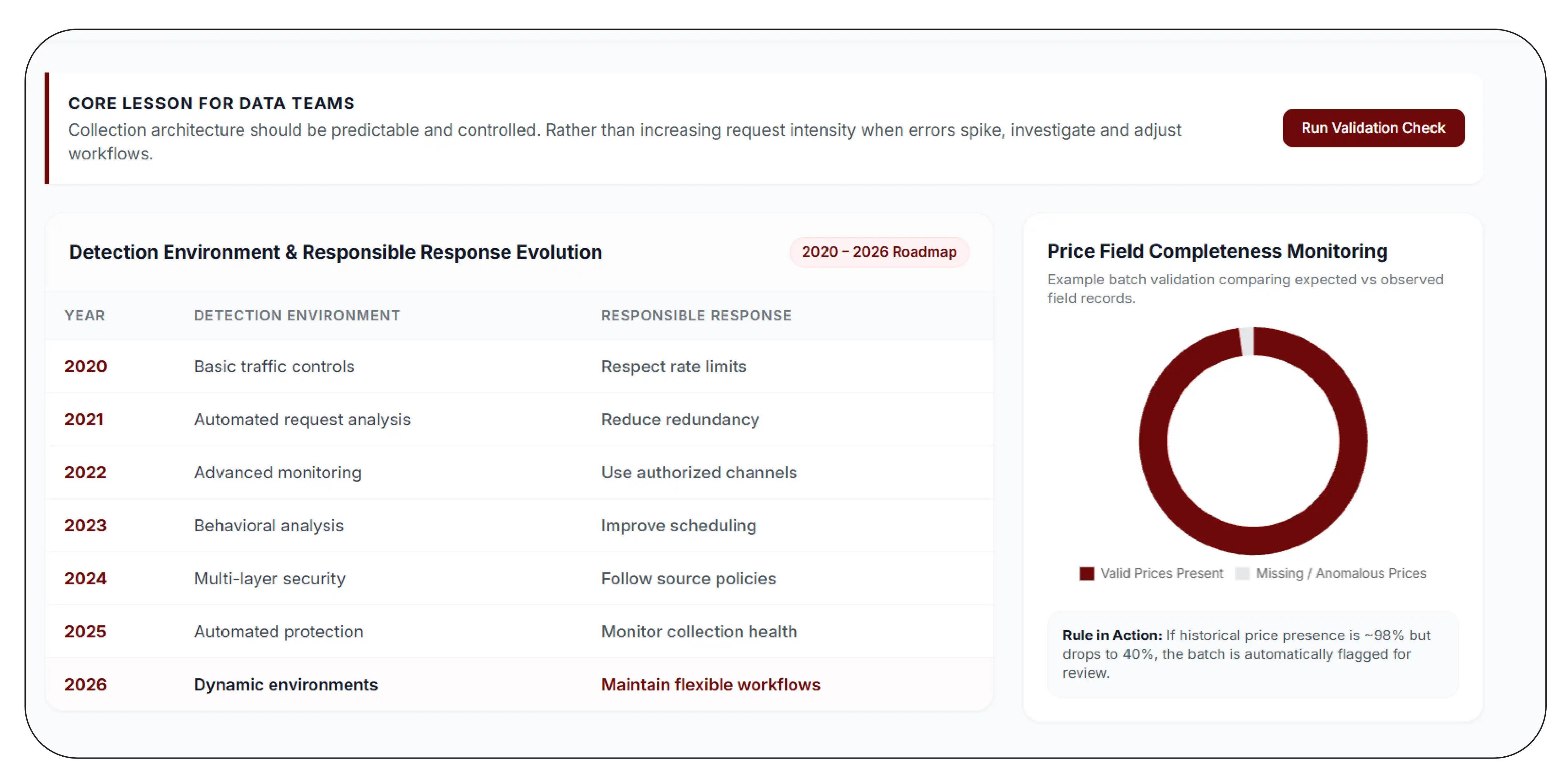
Understanding how websites identify unusual traffic is useful for designing responsible collection systems. eCommerce platforms may analyze traffic patterns to protect infrastructure and users.
eCommerce websites detect scraping through signals that can include request frequency, repeated access patterns, session behavior, unusual traffic volumes, and other security indicators.
Businesses should use this information to reduce unnecessary traffic—not to develop methods for bypassing security controls.
| Year |
Detection Environment |
Responsible Response |
| 2020 |
Basic traffic controls |
Respect rate limits |
| 2021 |
Automated request analysis |
Reduce redundancy |
| 2022 |
Advanced monitoring |
Use authorized channels |
| 2023 |
Behavioral analysis |
Improve scheduling |
| 2024 |
Multi-layer security |
Follow source policies |
| 2025 |
Automated protection |
Monitor collection health |
| 2026 |
Dynamic environments |
Maintain flexible workflows |
For data teams, the practical lesson is that collection architecture should be predictable and controlled.
A large number of repeated requests for the same product adds little analytical value. Caching can remove this redundancy.
Similarly, collecting every SKU at the same frequency may waste infrastructure resources. Prioritized scheduling can focus resources on products that matter most to the business.
Teams should also monitor response patterns. A sudden increase in errors may indicate a source change, access restriction, broken parser, or other operational issue.
Rather than automatically increasing request intensity, the correct response is to investigate the cause and adjust the workflow.
Source changes are another common challenge. Marketplace page structures can change without warning, causing parsers to return incomplete records.
Automated validation can detect unexpected changes by checking field completeness and data formats.
For example, if 98% of records previously contained prices but the latest collection contains prices for only 40%, the system can flag the batch for review.
This type of monitoring improves data reliability without requiring businesses to circumvent security mechanisms.
How Can Businesses Build Scalable Data Collection Across Multiple Sources?
Modern businesses rarely depend on a single marketplace. They may need product and pricing information from multiple retailers, marketplaces, comparison sites, and brand stores.
Extract Data From Any Website should not be interpreted as unrestricted access to every website. Each source needs to be evaluated according to its technical accessibility, permissions, terms, and data requirements.
| Year |
Multi-Source Capability |
Business Outcome |
| 2020 |
Single-source projects |
Basic intelligence |
| 2021 |
Multiple product sources |
Broader coverage |
| 2022 |
Unified schemas |
Easier comparison |
| 2023 |
Automated validation |
Better consistency |
| 2024 |
Centralized pipelines |
Scalable operations |
| 2025 |
Source monitoring |
Faster issue resolution |
| 2026 |
Intelligent orchestration |
Efficient data operations |
A scalable architecture starts with a common schema. Product title, brand, SKU, category, price, currency, availability, URL, and timestamp can serve as standard fields, while source-specific fields remain separate.
Normalization is then used to make records comparable.
For example, one marketplace may call a field "sale_price," another may call it "discounted_price," and a third may provide only a promotion value. A unified model can map these fields into a consistent analytical structure.
Data validation should operate continuously. Duplicate products, missing prices, unexpected currencies, invalid units, and stale timestamps can all affect downstream analysis.
Source monitoring is equally important. If a marketplace changes its product structure, the system should detect the resulting data-quality decline.
Businesses can also create source-specific refresh schedules. High-priority sources may require more frequent updates, while stable sources can use longer intervals.
This creates a scalable data operation without assuming that every source should be handled identically.
The strongest architecture is therefore modular. Each source has its own collection and validation logic, while the downstream data model remains consistent.
That structure makes it easier to add new marketplaces without redesigning the entire intelligence platform.
Why Choose Product Data Scrape?
Marketplace intelligence requires more than raw extraction. Web Scraping Top 15 Ecommerce Trends, Anti-Bot Protection for Marketplace Scraping projects benefit from structured pipelines that combine source evaluation, permitted data collection, validation, monitoring, and customized delivery.
Product Data Scrape can support businesses that need product, pricing, availability, ratings, reviews, and assortment datasets across selected marketplaces and retailers.
Collection workflows can be designed around required fields, refresh frequency, target sources, historical requirements, and delivery formats. Automated quality checks can identify missing records and unexpected changes before data reaches downstream analytics.
This approach helps brands and retailers build dependable competitive intelligence without relying on unnecessarily aggressive collection practices.
Conclusion
Marketplace data becomes valuable when it is accurate, fresh, structured, and collected through appropriate channels. Digital Shelf Analytics, Anti-Bot Protection for Marketplace Scraping can help businesses strengthen product intelligence by combining responsible source access, scheduling, caching, validation, monitoring, and authorized APIs where available.
IP restrictions and CAPTCHAs should not be treated as obstacles to bypass. They are signals that businesses need to reassess their collection architecture, source permissions, request frequency, or data-access strategy.
A sustainable system prioritizes the information that matters most, minimizes unnecessary requests, and continuously checks data quality.
Ready to build a reliable marketplace intelligence pipeline? Partner with Product Data Scrape to create customized product, pricing, availability, and competitive datasets using responsible, scalable data-collection workflows!
FAQs
1. Why do marketplaces restrict automated requests?
Marketplaces may restrict automated traffic to protect infrastructure, manage traffic volume, prevent abuse, and maintain platform security. Businesses should respect these controls.
2. Are APIs better than web scraping?
APIs can provide structured and predictable access, while permitted web collection may expose additional public information. The best approach depends on source availability and requirements.
3. How can businesses improve scraping reliability?
Use permitted sources, sensible schedules, caching, controlled retries, monitoring, validation, and appropriate APIs rather than attempting to bypass access restrictions.
4. What data can marketplace intelligence include?
Depending on source permissions, datasets may include product titles, SKUs, brands, prices, discounts, availability, categories, ratings, reviews, and collection timestamps.
5. Can Product Data Scrape create customized datasets?
Yes. Product Data Scrape can develop customized marketplace datasets around selected sources, product fields, refresh schedules, and delivery requirements.


 Singapore
 EMAIL
EMAIL
 PHONE
PHONE



.webp "thumb")









.webp)