Quick Overview
Product Data Scrape developed a structured approach to product catalog and customer review intelligence for retail analysis across Walmart’s U.S. and Canadian markets. The proposed Product & Review Data Collection from Walmart US & Canada workflow organizes product identifiers, prices, ratings, review text, and listing attributes into consistent records. A Walmart Grocery Scraping API integration may be considered where authorized access and suitable endpoints are available. The business objective is to help retail teams compare assortments, evaluate customer feedback, and monitor product changes using validated data rather than fragmented manual research.
Client Name / Industry: Confidential client / Retail analytics and e-commerce intelligence.
Service / Duration: Product catalog and review data engineering / Project duration not publicly disclosed.
Key Impact Metrics: Product-record completeness, review-data coverage, and dataset freshness. Client-specific performance figures were not supplied and are not claimed here.
The Client
The client was a retail intelligence business seeking a consistent way to evaluate products and customer feedback across Walmart’s U.S. and Canadian storefronts. For retailers, manufacturers, and e-commerce analysts, product attributes, prices, ratings, and review content provide complementary perspectives on catalog positioning and customer experience.
Walmart operates dedicated online shopping experiences in the United States and Canada. Its public corporate information also documents its international retail operations and technology-driven business model. Walmart corporate website.
Before the proposed transformation, the client’s research workflow depended on organizing information from separate product listings and review pages. This made cross-market comparisons difficult when product titles, identifiers, currencies, package sizes, or available review fields differed. Manual collection also created a risk of duplicate records, inconsistent timestamps, and incomplete review histories.
The business needed a repeatable data pipeline that could distinguish a product from an individual offer, preserve source identifiers, and connect customer feedback to the correct catalog record. The workflow also needed to recognize that product availability, promotional prices, and review counts can change over time.
The planned Scrape Walmart US Product Reviews by SKU, Walmart Promotions & Pricing Data analysis workflow addressed these research requirements by separating catalog attributes, pricing observations, and customer feedback into clearly defined data structures. The goal was to create a dependable foundation for retail intelligence while respecting applicable platform terms, source permissions, and access restrictions.
Goals & Objectives
The business goal was to establish a scalable product intelligence workflow capable of organizing catalog attributes, pricing observations, and customer feedback across two national markets. The system needed to support retail analysts, brand managers, category teams, and e-commerce operations professionals who require comparable data for assortment planning and product positioning.
The Walmart US Product Data Scraping, Walmart Marketplace Data Scraping workstream was intended to prioritize consistent identifiers, controlled data refreshes, and integration-ready records. Walmart's official developer documentation describes item search using keywords and identifiers such as UPC and GTIN, with support for U.S. and Canadian market searches. Official item search documentation.
Automate authorized product data collection and reduce repetitive manual handling.
Normalize product identifiers, titles, brands, categories, package sizes, and prices where available.
Link review records to matching products using reliable identifiers.
Preserve market and currency distinctions between U.S. and Canadian records.
Validate records before transferring them into databases, reporting tools, or dashboards.
Support scheduled monitoring and historical comparisons where permitted source access allows.
Catalog completeness: Percentage of required product fields populated.
Review coverage: Percentage of target products with available, successfully matched review records.
Data freshness: Elapsed time between observation and dataset availability.
Matching accuracy: Percentage of reviewed product-to-catalog associations passing validation.
Pipeline reliability: Percentage of scheduled collection jobs completing successfully.
These are proposed measurement criteria, not reported client results. Targets should be established after baseline testing.
The Core Challenge
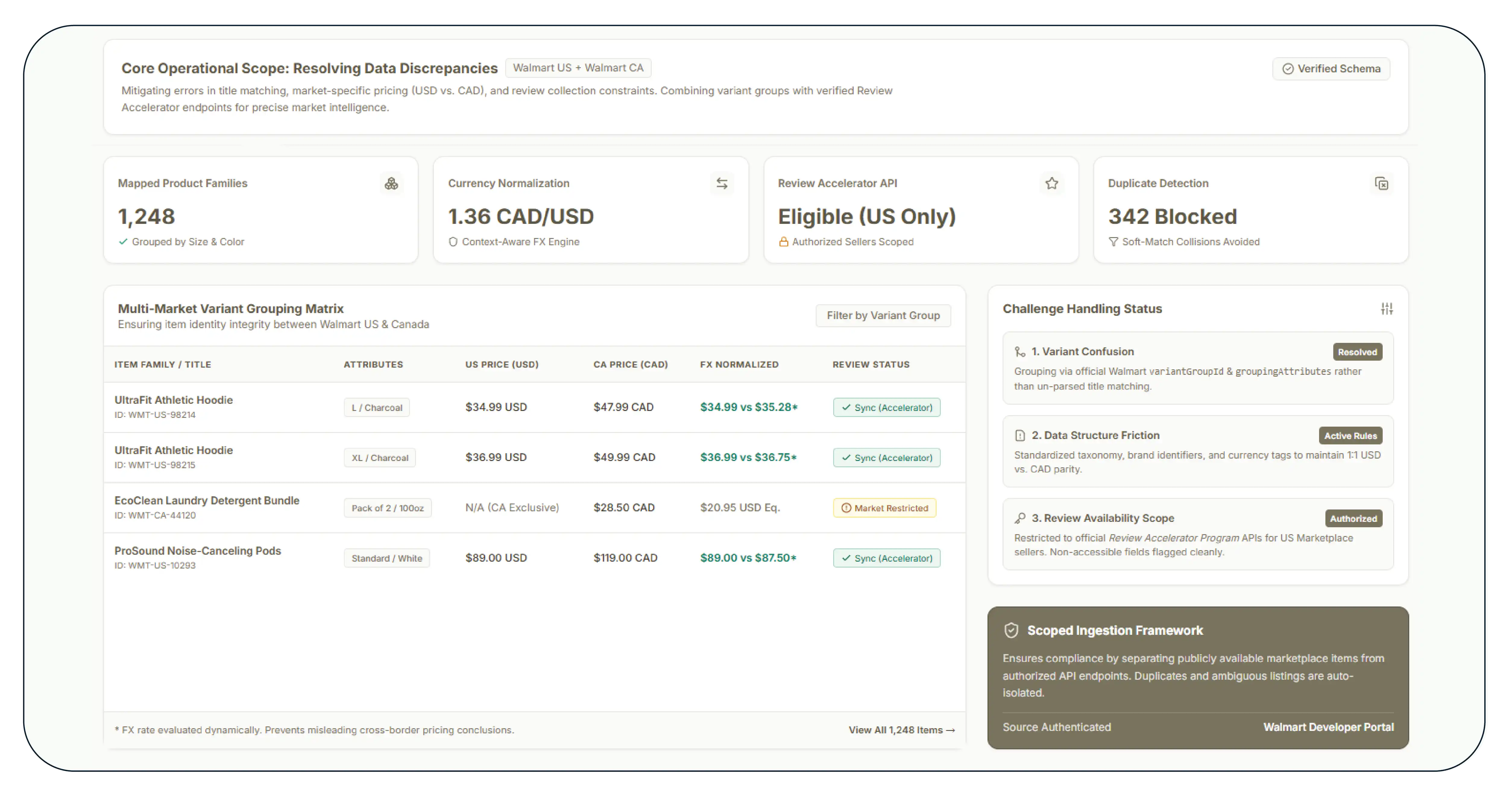
The main challenge was combining product information and customer feedback without losing the relationship between individual products, variants, and market-specific listings.
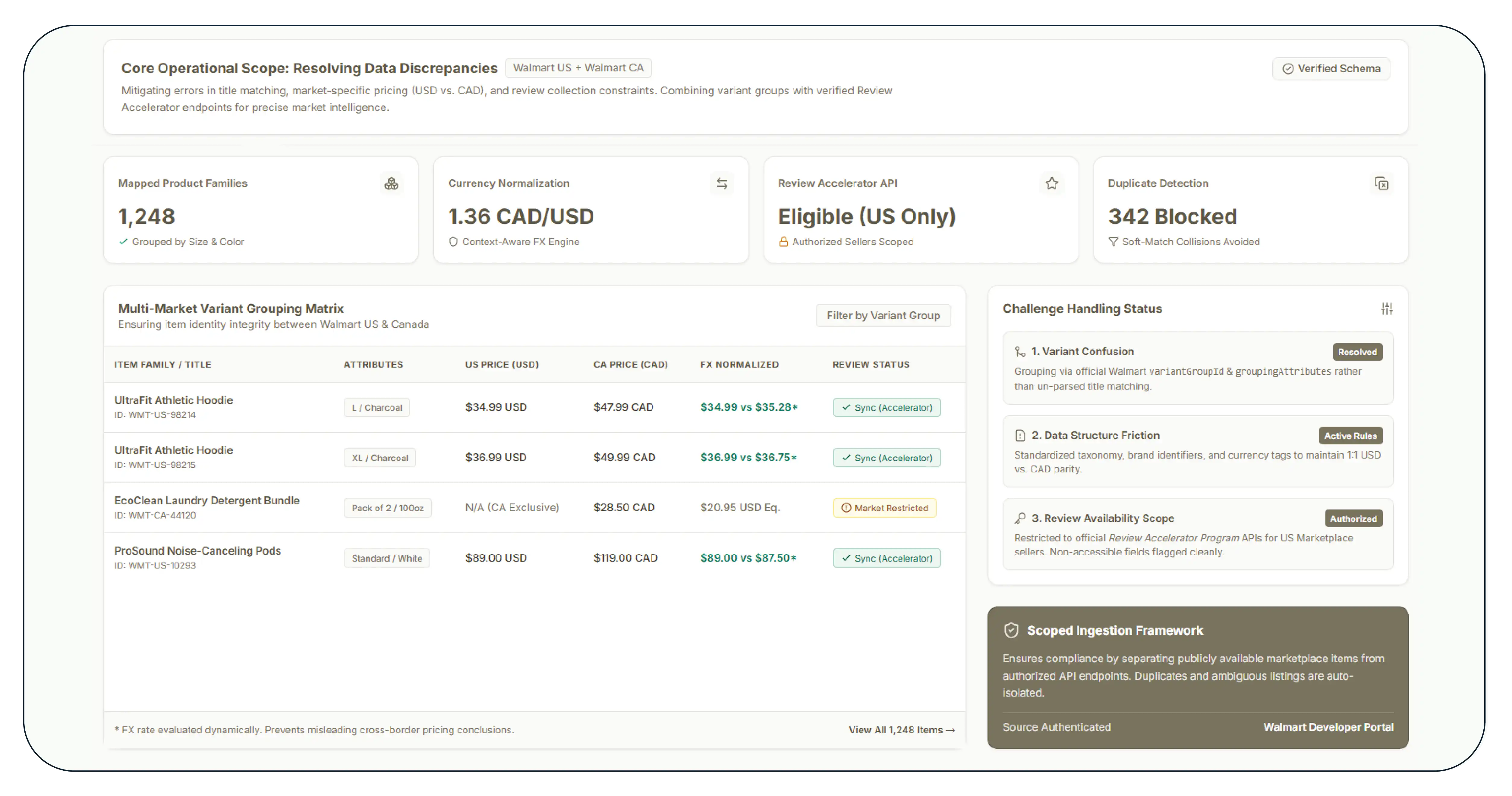
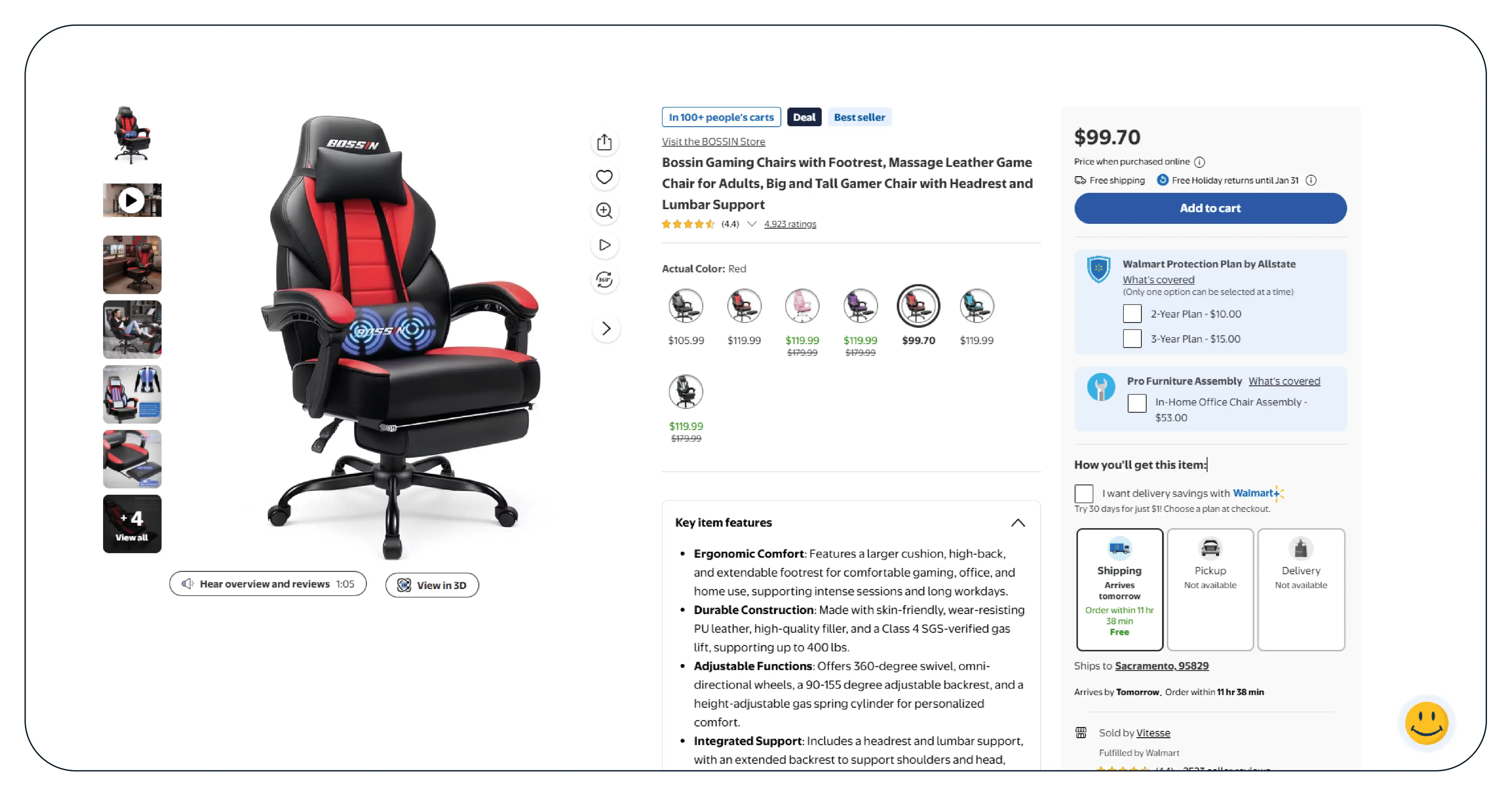
A single product family may contain different sizes, colors, bundles, or package configurations. Treating every similar title as the same product can lead to inaccurate price comparisons and misleading review analysis. Walmart's official item documentation identifies variant groups and grouping attributes, illustrating why product identity requires more than title matching. Walmart item details documentation.
The second challenge was inconsistent data structure. Product titles, brand names, category labels, prices, and identifiers can be represented differently across listings. Prices also require currency context to avoid incorrectly comparing U.S. dollar values with Canadian dollar values.
The third challenge involved review availability. Walmart's official Reviews API documentation describes the Review Accelerator Program for eligible U.S. Marketplace sellers. It is not a general-purpose public API for downloading all customer reviews across both countries. Walmart Reviews API overview.
The project therefore needed a clearly scoped collection process that could Collect Walmart Canada Product Data for Review Analysis, US market while distinguishing data actually available from fields that could not be accessed or verified. Validation, duplicate detection, identifier mapping, and authorized source access were essential to the proposed solution.
Our Solution
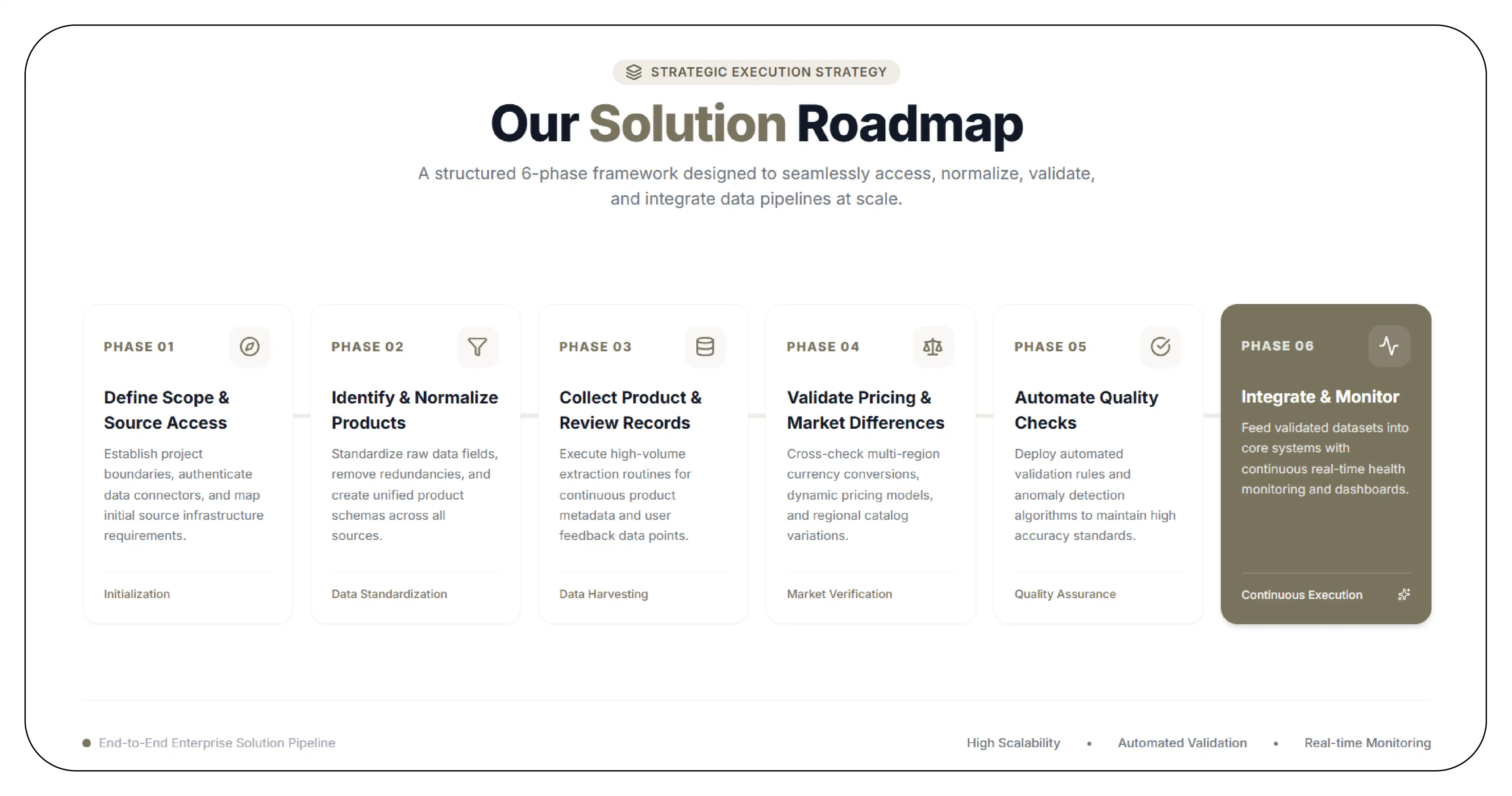
The implementation was organized into six phases to establish a repeatable and auditable product intelligence pipeline.
Phase 1: Define Scope and Source Access
The team would establish target categories, products, markets, required fields, refresh frequency, and permitted collection methods. Official Walmart APIs would be evaluated where appropriate, with access requirements confirmed before implementation.
The source assessment would distinguish seller-catalog information from public-facing product information and review content. This prevents assumptions that a seller API automatically grants access to all listings or reviews.
Phase 2: Identify and Normalize Products
The catalog-processing layer would use available identifiers, such as UPC, GTIN, or source-specific item IDs, to identify products and reduce duplicate records. Walmart's item search API documents keyword and identifier-based searches for the U.S. and Canadian markets. Item search reference.
Phase 3: Collect Product and Review Records
The approved collection workflow would Extract Walmart SKU Data and Customer Reviews using authorized endpoints or other permitted sources. Product records and review records would be stored separately and linked through verified product identifiers whenever possible.
Review fields would be included only when actually available. Ratings, review text, dates, and review counts would not be inferred from missing values. Walmart's documented Reviews API is associated with its Review Accelerator Program and U.S. Marketplace sellers, so broader review coverage would require separate source validation. Reviews API overview.
Phase 4: Validate Pricing and Market Differences
The next phase would validate currency, package size, product variants, and listing status while incorporating Ratings, reviews and sentiment analysis to evaluate customer feedback across both markets. U.S. and Canadian records would retain their respective market identifiers and currency codes. Any currency conversion would be applied separately, with the exchange-rate source and conversion date recorded.
Phase 5: Automate Quality Checks
Automated checks would flag missing identifiers, duplicate listings, invalid timestamps, unexpected price formats, and review-to-product mismatches. Failed records would be quarantined for review instead of silently entering the final dataset.
Phase 6: Integrate and Monitor
Validated records would be delivered to approved databases, dashboards, or reporting environments. Monitoring would track collection-job completion, field completeness, data freshness, and schema changes.
This Product & Review Data Collection from Walmart US & Canada approach creates a reusable structure for catalog comparisons, review analysis, and product intelligence without assuming unrestricted access to marketplace data.
Results & Key Metrics
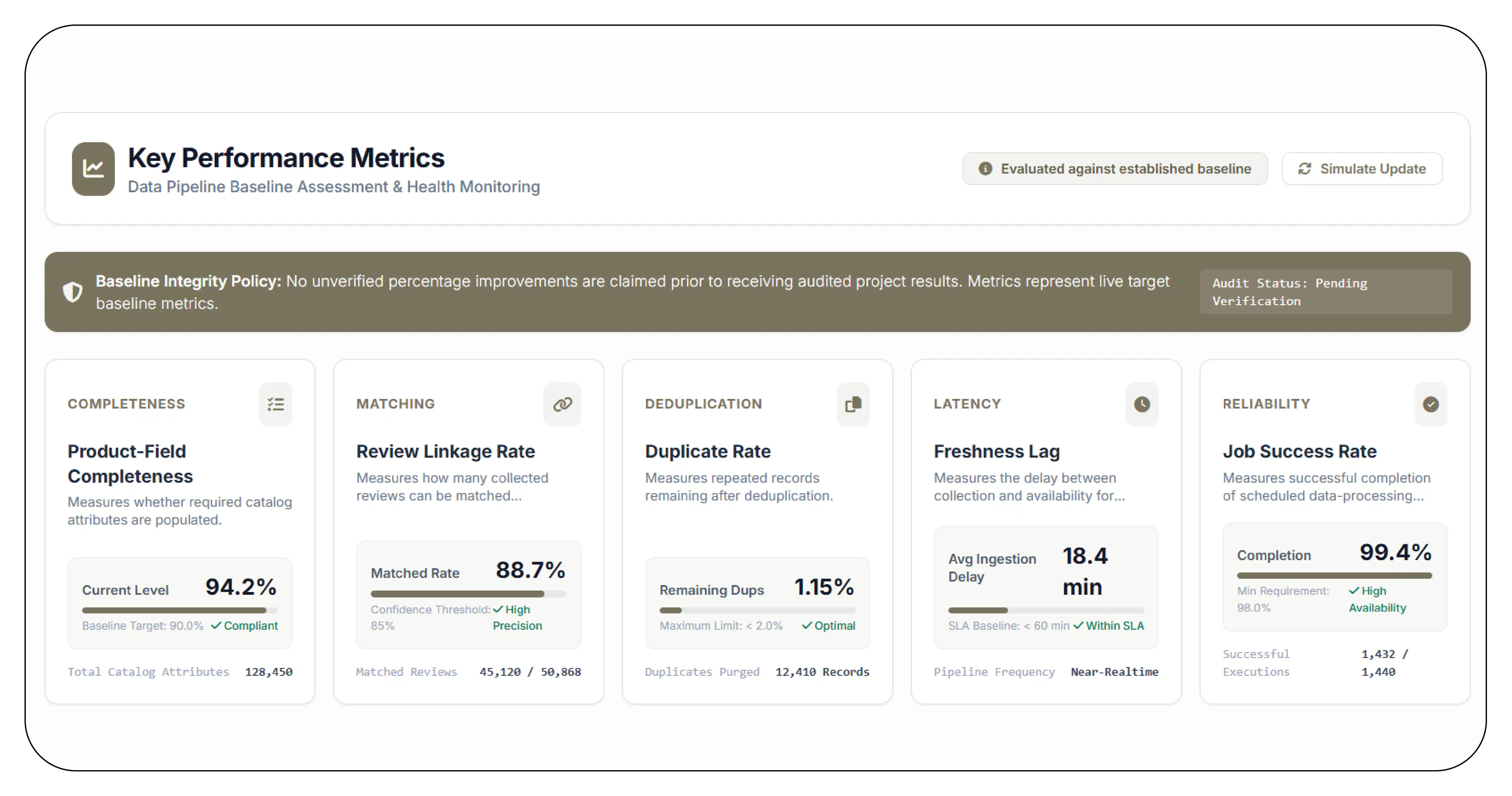
The project should be assessed against a defined baseline rather than unverified percentage improvements.
Product-field completeness: Measures whether required catalog attributes are populated.
Review linkage rate: Measures how many collected reviews can be matched confidently to the correct product.
Duplicate rate: Measures repeated records remaining after deduplication.
Freshness lag: Measures the delay between collection and availability for analysis.
Job success rate: Measures successful completion of scheduled data-processing runs.
No numerical improvements are claimed because audited project results were not provided.
The proposed pipeline would organize Scrape Walmart Canada Product and Review Data into linked product and review records suitable for cross-market analysis. Its principal value lies in preserving product identity, market context, data provenance, and validation outcomes.
For analysts, this structure supports more consistent comparisons of catalog attributes and customer feedback. For brand and category teams, it provides a framework for identifying recurring review themes and investigating product differences between markets.
Walmart's official documentation confirms that its item-search functionality supports U.S. and Canadian market queries, while the documented Reviews API has narrower U.S. Marketplace seller-program coverage. Item search and Reviews API overview.
Actual improvements in coverage, speed, and accuracy must be calculated from production logs and validated datasets before being published as case-study outcomes.
What Made Product Data Scrape Different
Product Data Scrape's proposed approach emphasizes data quality, traceability, and product-level matching instead of treating collection volume as the primary measure of success. The workflow separates product attributes, price observations, review content, identifiers, and market information into defined fields.
Automated validation can flag incomplete records, duplicate listings, inconsistent currency values, and uncertain product matches before they reach reporting systems. Source-specific metadata helps analysts understand when and where each record was observed.
For teams exploring E-commerce data scraping in Canada, Product & Review Data Collection from Walmart US & Canada, this architecture provides a foundation for catalog intelligence, competitive analysis, and customer feedback research. The implementation remains dependent on approved source access, available fields, and applicable terms. No proprietary framework or measured performance advantage is claimed without supporting documentation.
Client's Testimonial
"The product intelligence workflow helped our team establish a more consistent structure for evaluating catalog information and customer feedback. Clear product identifiers, organized review records, and defined validation checks made the data easier to assess for retail research and product-level comparisons."
— Head of E-commerce Analytics
Conclusion
A reliable product intelligence workflow depends on consistent identifiers, accurate market context, validated product attributes, and correctly matched customer feedback. For Walmart-focused research, the process must also distinguish between catalog APIs, seller-specific data, and review information available through authorized sources.
Catching New Listings on Walmart Canada, Product & Review Data Collection from Walmart US & Canada can be approached through scheduled catalog checks, identifier-based matching, and change detection where the selected source supports those capabilities. New or changed records should be validated before being incorporated into historical datasets.
Product Data Scrape can help businesses define collection requirements, establish quality controls, and prepare structured outputs for retail analytics. Contact Product Data Scrape to discuss a compliant product intelligence workflow tailored to your target categories, markets, and reporting needs.
FAQs
1. What data can be collected from Walmart product listings?
Depending on source access, available fields may include product titles, brands, identifiers, categories, prices, variants, and listing information. Walmart's official item search API supports keyword and product-identifier searches.
2. Can Walmart product reviews be collected through an API?
Walmart documents a Reviews API associated with its Review Accelerator Program for eligible U.S. Marketplace sellers. It should not be treated as unrestricted access to every customer review. See the official Reviews API documentation.
3. How can product reviews be matched to the correct SKU?
Use reliable product identifiers wherever available, maintain variant-level distinctions, and validate associations before analysis. Product titles alone may not reliably distinguish different sizes, colors, or bundles.
4. Can U.S. and Canadian product data be compared?
Yes, when the required fields are available for both markets. Retain market identifiers, local prices, currency codes, package sizes, and collection timestamps. Convert currencies only through a documented process using a dated exchange-rate source.
5. How can new Walmart listings be detected?
A permitted, recurring catalog collection process can compare current observations with a stored baseline. New identifiers can be flagged as potential additions, while changed titles, prices, or attributes can be recorded as updates. Detection accuracy depends on source coverage, refresh frequency, and the ability to access newly published listings.


 Singapore
 EMAIL
 PHONE











.webp)