Introduction
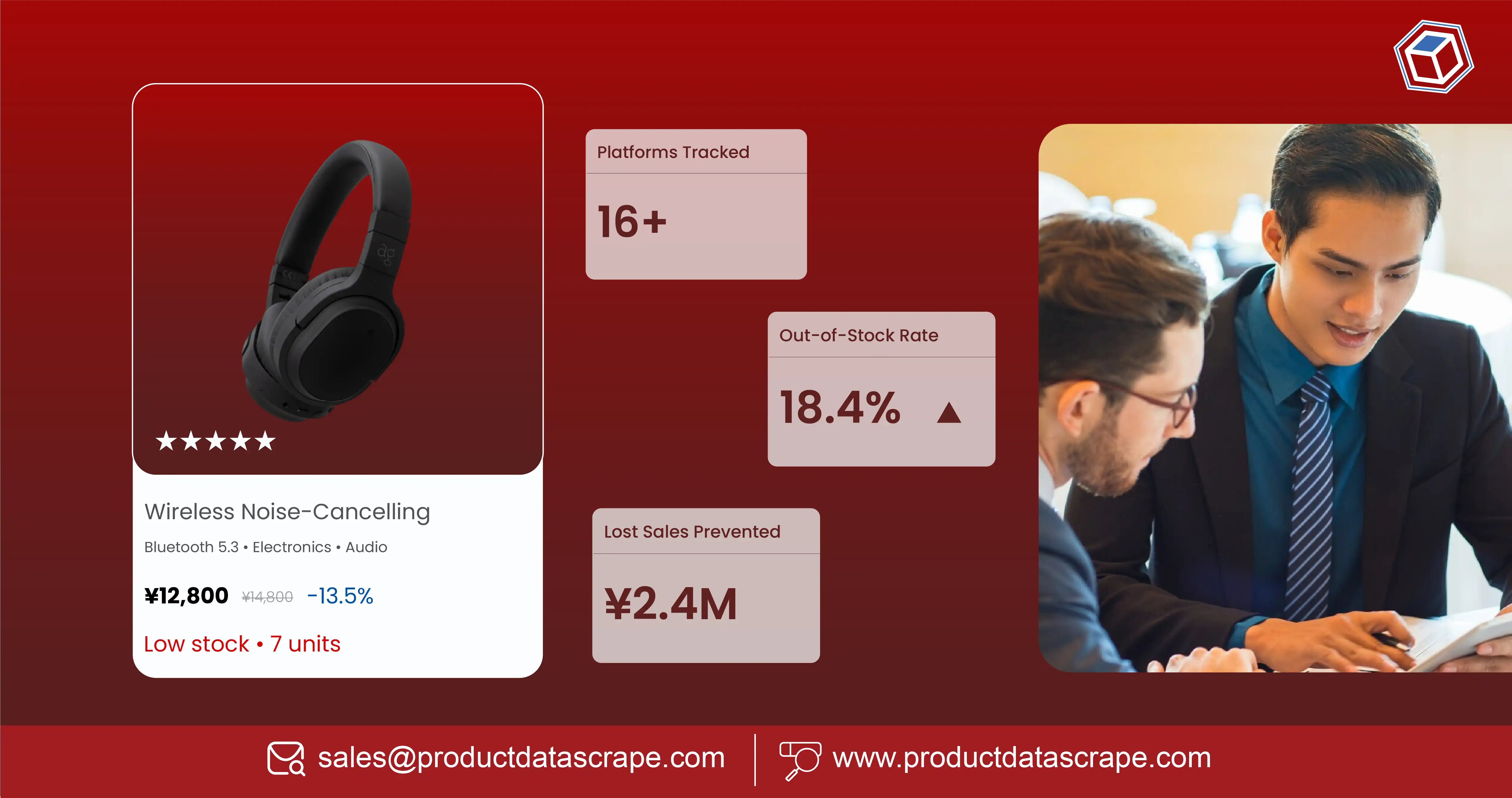
Availability monitoring on Japanese online retailers helps brands, manufacturers, distributors, and e-commerce teams identify out-of-stock products, track restocks, and detect discrepancies between advertised availability and actual purchase options. By combining authorized product data collection, historical stock observations, and automated validation, businesses can respond faster to inventory changes and make better-informed decisions across Japanese retail channels.
Availability monitoring on Japanese online retailers is particularly relevant for businesses managing large product catalogs across marketplaces and direct-to-consumer stores. A product may remain visible even when it cannot be purchased, while another retailer may replenish the same item without an obvious announcement. Without consistent monitoring, analysts can confuse missing data with genuine stockouts and overlook important changes in product availability.
Japan's Ministry of Economy, Trade and Industry (METI) reported that the domestic business-to-consumer e-commerce market reached ¥26.1 trillion in 2024, a 5.1% increase from 2023. The merchandise segment alone reached ¥15.2194 trillion. These figures demonstrate the scale of Japan's online retail market, although they do not measure stockouts or losses caused by unavailable products. Source: METI's FY2024 E-Commerce Market Survey.
For retail operations managers, marketplace sellers, pricing analysts, and inventory planners, the objective is to turn changing product availability into actionable Real-Time Market Insights. This requires reliable source access, consistent product identifiers, time-stamped observations, and clear rules for distinguishing unavailable products from collection errors.
How Can Retailers Track Product Availability and Pricing Across Japanese Stores?
Japan Retail Price Availability Tracking combines product price observations with stock-status information to help businesses understand whether comparable products are available across their target retailers. Tracking these signals together provides more context than price monitoring alone.
For example, a competitor's product page may show a price but display an out-of-stock message or disable the purchase button. Recording the price without the availability status could lead an analyst to treat the offer as an active purchasing option when it is not.
A structured monitoring workflow should collect permitted information such as product identifiers, retailer names, product URLs, displayed prices, currency, availability status, and observation timestamps. The exact fields depend on the source, applicable terms, and business requirements.
For cross-market research, Taiwan & Japan Marketplace Rakuten data scrape is a related search term for businesses interested in comparing marketplace product information in both markets. A suitable cross-market workflow should normalize currencies, product identifiers, variant attributes, and retailer-specific availability labels before making comparisons.
The core process includes:
- Product identification: Match products using reliable identifiers, model numbers, brand names, and variant attributes.
- Price normalization: Store prices in their original currency and maintain a separate normalized value when conversion is required.
- Availability classification: Distinguish in-stock, out-of-stock, preorder, discontinued, and unknown statuses where source evidence supports these categories.
- Historical tracking: Preserve dated observations to identify when availability changes.
- Validation: Check whether missing information reflects a collection failure or a genuine change in the retailer's offer.
What should the monitoring dataset contain?
| Field | Purpose | Quality check |
|---|
| Product identifier | Links observations to the correct product | Confirm identifier consistency |
| Retailer and product URL | Establishes the source | Validate source identity |
| Displayed price | Supports price comparisons | Check currency and numeric format |
| Availability status | Indicates the observed purchase state | Validate against source evidence |
| Observation timestamp | Shows when the status was checked | Use a consistent time standard |
| Collection status | Records whether the observation succeeded | Separate technical failures from stock changes |
Rakuten offers official developer resources for certain supported data access use cases. Businesses should review the current API documentation and applicable terms rather than assuming that automated extraction from every marketplace page is permitted. Source: Rakuten Web Service.
For inventory planners, this structured approach reduces ambiguity. It also provides the historical evidence needed to investigate stock changes rather than relying on isolated screenshots or manual checks.
Why Is Consistent Monitoring Important Across Japanese E-commerce Platforms?
Japanese E-commerce Availability Scraping describes the collection of product availability information from online retail sources. In practice, the appropriate method depends on whether the retailer provides an authorized API, a licensed data feed, or another permitted access method.
Availability monitoring on Japanese online retailers becomes more challenging when different platforms express stock information in different ways. One retailer may display a clear out-of-stock message, while another may show a disabled purchase button, a preorder notice, or an estimated shipping date.
These states should not automatically be treated as equivalent. A preorder may indicate that a product can still be purchased for future delivery, while a temporarily unavailable item may not accept orders at all.
A reliable monitoring system therefore needs a shared classification model supported by source-specific interpretation rules.
How can businesses standardize different availability signals?
- Define common statuses. Establish agreed categories such as available, unavailable, preorder, discontinued, and unknown.
- Map source-specific messages. Associate each retailer's documented status indicators with the shared categories.
- Retain original evidence. Store the original status text or permitted status value alongside its normalized interpretation.
- Validate transitions. Check whether changes between statuses are supported by the source.
- Escalate ambiguity. Use an unknown state when the evidence does not support a reliable classification.
Japan's e-commerce growth provides context for these operational requirements. METI reported the following B2C e-commerce market figures in its annual market surveys.
| Year | Japan's B2C e-commerce market | Annual change reported by METI |
|---|
| 2020 | ¥19.3 trillion | — |
| 2021 | ¥20.7 trillion | 7.35% |
| 2022 | ¥22.7 trillion | 9.91% |
| 2023 | ¥24.8 trillion | 9.23% |
| 2024 | ¥26.1 trillion | 5.1% |
| 2025 | Not included in the cited FY2024 survey | — |
| 2026 | Full-year figures are not yet available | — |
Source: METI e-commerce market surveys. Figures are rounded to one decimal place for the earlier years; annual changes are based on the reported market values.
The table measures overall B2C e-commerce, not inventory availability. It should not be used to infer a particular stockout rate or the financial impact of unavailable products.
For e-commerce operations teams, the practical implication is to design monitoring around the specific products, sources, and decisions that matter. Reliable classification helps distinguish genuine availability changes from differences in retailer interface design.
How Can Inventory Intelligence Help Explain Product Availability Changes?
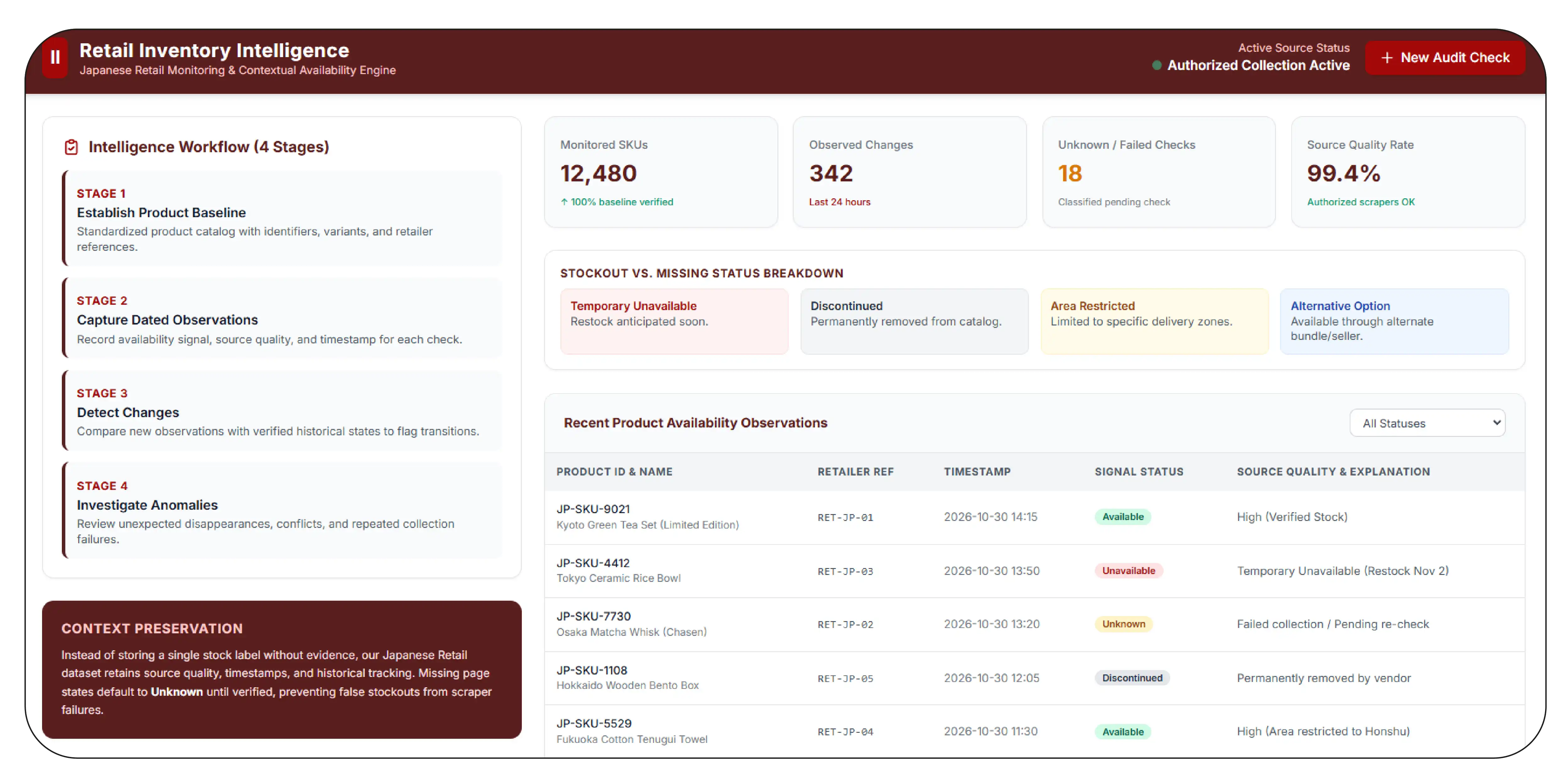
Japanese Retail Inventory Intelligence Data combines historical product observations with identifiers, timestamps, and source-quality information to help businesses understand availability patterns. Its value comes from preserving context around each observation instead of storing a single stock label without supporting evidence.
A stockout can have several possible explanations. A product may be temporarily unavailable, discontinued, restricted to a particular delivery area, or available only through a different purchase option. A failed collection can also produce a missing status that resembles an inventory problem.
The monitoring system should not assume that every missing product page indicates a stockout. It should classify the observation as unknown until the source can be checked.
E-commerce data scraping is one term used to describe automated collection of product information. For business use, the collection process should rely on authorized methods and include quality controls that prevent incomplete observations from overwriting valid historical records.
A practical inventory intelligence workflow has four stages.
Stage 1: Establish a product baseline. Create a standardized product catalog with identifiers, variants, retailer references, and relevant attributes.
Stage 2: Capture dated observations. Record the availability signal, source, and observation time for each successful check.
Stage 3: Detect changes. Compare new observations with previous verified states and identify meaningful transitions.
Stage 4: Investigate anomalies. Review unexpected disappearance, conflicting statuses, repeated collection failures, and unusually frequent changes.
These stages support better interpretation of retail data. For example, an item recorded as available in one observation and unavailable in a later successful observation represents an observed change. However, the exact time of the stockout is unknown unless the monitoring interval or retailer's own records establish it.
Which metrics should inventory teams monitor?
| Metric | What it measures | Operational use |
|---|
| Availability coverage | Share of target products with a valid status observation | Reveals monitoring gaps |
| Stockout observation rate | Share of valid observations classified as unavailable | Supports source- and category-level analysis |
| Status transition count | Number of observed changes between availability states | Identifies frequently changing products |
| Observation freshness | Time elapsed since the last successful check | Flags potentially outdated records |
| Collection failure rate | Share of attempted observations that failed | Helps separate technical problems from stock changes |
These are recommended measurement definitions, not claims about the current performance of Japanese retailers.
A further safeguard is to maintain separate fields for observed status and inferred interpretation. This helps analysts explain why a product was classified as unavailable and makes the dataset easier to audit.
For marketplace managers and inventory planners, the result is a more defensible view of product availability, backed by traceable observations rather than unsupported assumptions.
How Can Online Store Monitoring Reduce Inventory Blind Spots?
Japan Online Store Inventory Monitoring helps businesses observe product availability across selected retailers and identify changes that may require investigation. It is especially useful when teams need a consistent view of a product catalog distributed across multiple online channels.
The main challenge is that availability can change between checks. A product that appears available during a morning observation may be unavailable later. Conversely, a product marked out of stock may become purchasable after a replenishment.
Monitoring frequency should reflect the business's needs, the volatility of the product category, and the access conditions of the source. A frequently changing, high-priority item may justify more frequent permitted checks than a stable, low-priority product. No single interval is appropriate for every catalog.
An effective monitoring program should prioritize the products most relevant to business decisions.
- High-priority products: Monitor according to agreed service requirements and source limitations.
- Stable products: Use a schedule aligned with their observed change patterns.
- Products with repeated collection failures: Escalate technical investigation rather than increasing requests indiscriminately.
- Products with ambiguous availability: Require stronger evidence before triggering business alerts.
A useful alert should identify the affected product, retailer, previous observed status, current observed status, observation time, and source reference. This gives the recipient enough context to decide what action is appropriate.
How should monitoring intervals be evaluated?
| Operational question | Recommended approach |
|---|
| Is the latest data sufficiently current? | Compare observation age against the agreed freshness requirement |
| Are stockout alerts reliable? | Review false alerts and classification errors |
| Are some retailers failing more often? | Track collection failures by source |
| Does the catalog contain duplicate products? | Compare identifiers and variant attributes |
| Is the system collecting unnecessary data? | Review field requirements and permitted access methods |
The monitoring process should also preserve the last valid observation when a new check fails. A technical error is not evidence that the product has become unavailable.
For businesses using stock data in replenishment or sales planning, this distinction matters. Incorrectly treating a failed check as a stockout can create unnecessary escalation, while treating a genuine stockout as a collection failure can delay investigation.
A well-designed workflow connects monitoring alerts to defined business actions. Those actions might include checking the retailer's page, contacting an authorized supplier, reviewing alternative offers, or investigating whether the product has been discontinued.
How Can Businesses Detect Out-of-Stock Products Without Generating False Alerts?
Japanese E-commerce Out-of-Stock Detection requires clear status definitions, repeated observations where appropriate, and safeguards against confusing technical failures with genuine inventory changes.
A product should be classified as out of stock only when the available source evidence supports that conclusion. An empty price field, a page-loading error, or a missing product record is not sufficient on its own.
False alerts can occur when a retailer changes its page layout, introduces a new purchase option, or modifies the way availability is displayed. They can also occur when product variants are confused. A listing for one size or color may be unavailable while another variant remains purchasable.
A reliable detection workflow should therefore combine product matching, status interpretation, and source validation.
First, validate product identity. Ensure that the observation relates to the intended model, size, color, or package quantity.
Second, interpret the availability evidence. Use explicit source indicators where available, and distinguish them from indirect signals such as disabled controls.
Third, separate source failures. Record timeout errors, access problems, and unexpected page structures as collection issues.
Fourth, confirm material changes. For high-priority alerts, use an additional permitted check or other authoritative evidence when the first observation is ambiguous.
Fifth, retain the audit trail. Preserve the timestamp and evidence behind each classification.
What should an out-of-stock alert contain?
| Alert field | Example of the information required |
|---|
| Product identity | Confirmed product identifier and variant |
| Retailer | Name of the monitored store |
| Previous state | Last verified availability |
| Current state | Newly observed status |
| Observation time | Date and time of the check |
| Evidence | Permitted status value or source reference |
| Confidence | Confirmed, provisional, or unknown under defined rules |
The confidence labels should be documented and applied consistently. They should not be presented as statistical probabilities unless a validated model supports that interpretation.
Businesses should also measure alert quality. Reviewing false positives, missed changes, and unresolved observations helps improve the classification rules over time. The goal is not to maximize the number of alerts; it is to make alerts dependable enough for operational use.
For retail analysts, these controls reduce wasted investigation and improve confidence in inventory reports. For category managers, they provide a clearer basis for identifying persistent availability problems and evaluating alternative purchasing options.
How Can Retailers Track Restocks and Understand Availability Trends?
Japanese Retailer Restock Tracking focuses on detecting when a previously unavailable product becomes available again and recording the change with a reliable timestamp.
Restock monitoring is not simply the reverse of stockout detection. A product page may reappear without being purchasable, a preorder may open before physical inventory arrives, or only one variant may return to stock. A useful workflow must preserve these distinctions.
Availability monitoring on Japanese online retailers can support restock analysis when observations are collected at appropriate intervals through permitted sources. Historical records allow analysts to identify the last confirmed unavailable state and the first subsequent confirmed available state.
That interval establishes when the change was observed, not necessarily the exact time the retailer replenished its inventory.
Restock information can help teams investigate recurring patterns, compare retailer availability, and prioritize product checks. It should not be treated as a direct measure of warehouse stock unless the source explicitly provides that information.
What can historical market data tell us about monitoring priorities?
METI's FY2024 report provides a useful example of the growth in online merchandise sales. The cosmetics and pharmaceuticals category reached ¥1.015 trillion in Japanese B2C e-commerce sales in 2024, up 4.54% from 2023. This is a category-level sales measure, not a count of unavailable products or restocks. Source: METI FY2024 E-Commerce Market Survey.
Businesses can use market-level statistics to understand the importance of a category, then rely on their own verified product observations to measure availability.
A practical restock workflow should:
- Identify products with a previously confirmed unavailable status.
- Recheck them according to the agreed monitoring schedule.
- Confirm that the same product and variant are being observed.
- Record the first successful observation indicating renewed availability.
- Distinguish in-stock products from preorders or other purchase states.
- Calculate observed unavailable periods only where the observation history supports the calculation.
| Restock metric | Definition | Limitation |
|---|
| Restock detection count | Number of observed transitions from unavailable to available | Depends on monitoring coverage |
| Observed unavailable interval | Time between confirmed unavailable and available observations | Does not reveal the exact replenishment time |
| Repeat stockout frequency | Number of distinct observed stockout episodes | Requires consistent product matching |
| Restock alert latency | Time between first successful available observation and alert generation | Excludes any unobserved time before the check |
| Status confidence | Strength of evidence for the recorded transition | Depends on source quality |
These metrics help retail teams distinguish observed behavior from assumptions about underlying inventory.
The resulting data can support prioritization, supplier discussions, and competitor monitoring. However, replenishment decisions should also consider internal sales, lead times, warehouse records, and supplier information rather than relying on competitor availability alone.
Why Choose Product Data Scrape?
Product Data Scrape can be evaluated for projects that require structured product monitoring, historical observations, data normalization, and reporting across selected retail sources. A suitable implementation should begin by defining the target retailers, products, access permissions, monitoring frequency, and required delivery format.
Real-time price tracking can complement availability observations by showing whether an offer's price and purchase status change together. The exact freshness and coverage achievable depend on the source, permitted collection method, and monitoring requirements.
Businesses should assess the proposed workflow against measurable criteria, including status accuracy, product matching, source traceability, freshness, and collection failure handling. Clear requirements help prevent unsupported promises about complete coverage or instantaneous detection.
Conclusion
Reliable stock monitoring requires consistent product identifiers, validated status classifications, time-stamped observations, and safeguards against false alerts. Rakuten Product Data Scraping API may be relevant when an authorized Rakuten interface supports the required data and use case; teams should confirm the current documentation, permissions, and field availability before implementation.
Availability monitoring on Japanese online retailers can help businesses build a more useful view of stockouts and restocks when supported by reliable, permitted data sources.
Ready to improve product availability intelligence? Contact Product Data Scrape to discuss a tailored monitoring workflow for your target Japanese retailers, priority products, and reporting requirements!
FAQs
1. What is availability monitoring?
Availability monitoring records product purchase status over time across selected online retailers. It helps businesses identify observed stockouts, restocks, and data inconsistencies using reliable source evidence.
2. Why monitor Japanese online retailers?
Monitoring Japanese online retailers helps brands, sellers, and analysts understand product availability changes, investigate competitor stockouts, and support inventory decisions across relevant retail channels.
3. How can false stockout alerts be reduced?
Validate product identity, interpret explicit availability signals, separate technical failures from stock changes, and confirm ambiguous observations before generating high-priority alerts.
4. Can restock times be identified precisely?
Monitoring can identify the interval between observations of unavailable and available states. Exact replenishment time requires additional evidence from the retailer or inventory system.
5. Which data fields are needed?
Useful fields include product identifiers, retailer references, availability status, observation timestamps, collection status, and source evidence, subject to applicable permissions and data-access terms.


 Singapore
 EMAIL
 PHONE














.webp)