Quick Overview
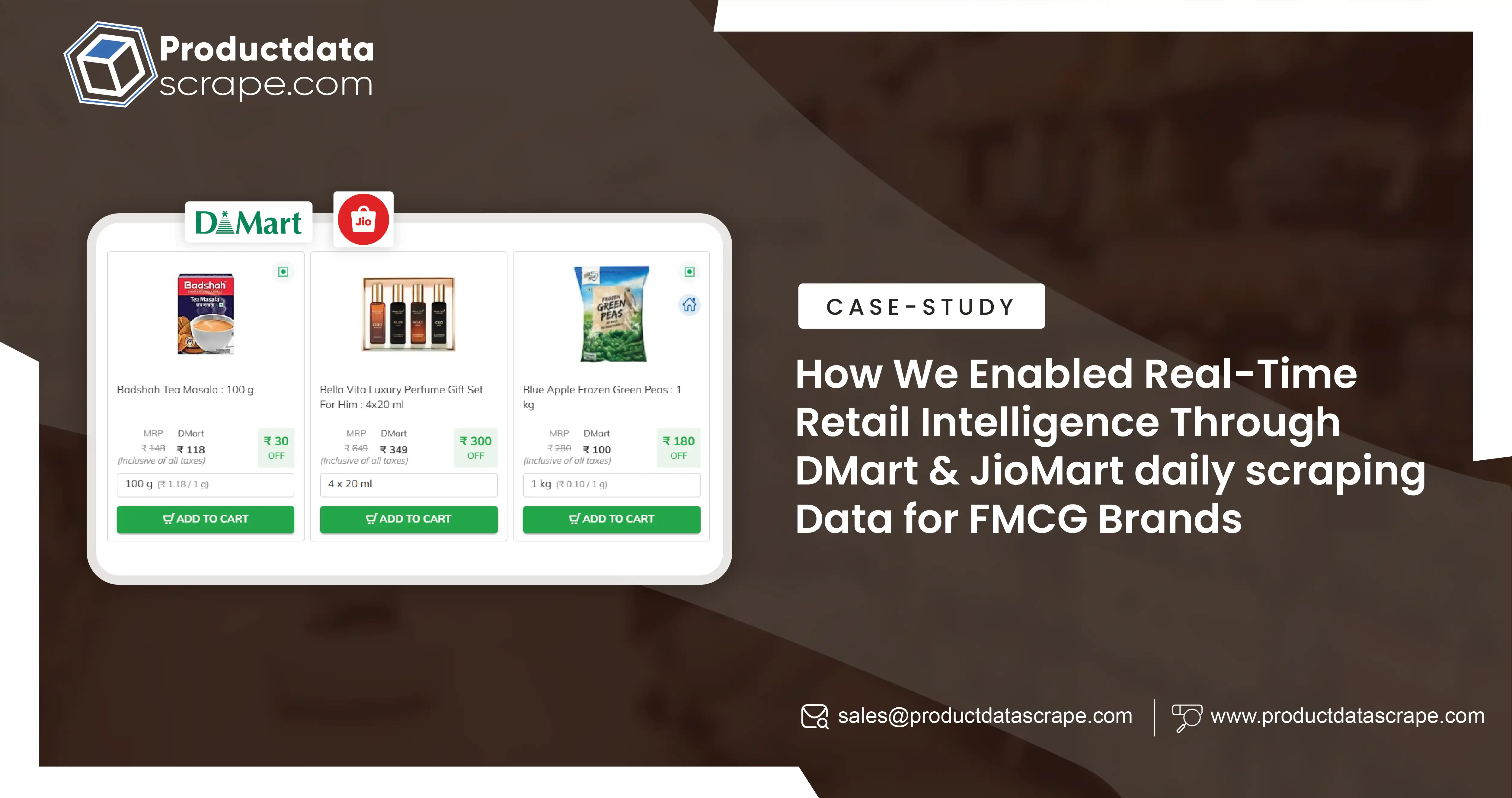
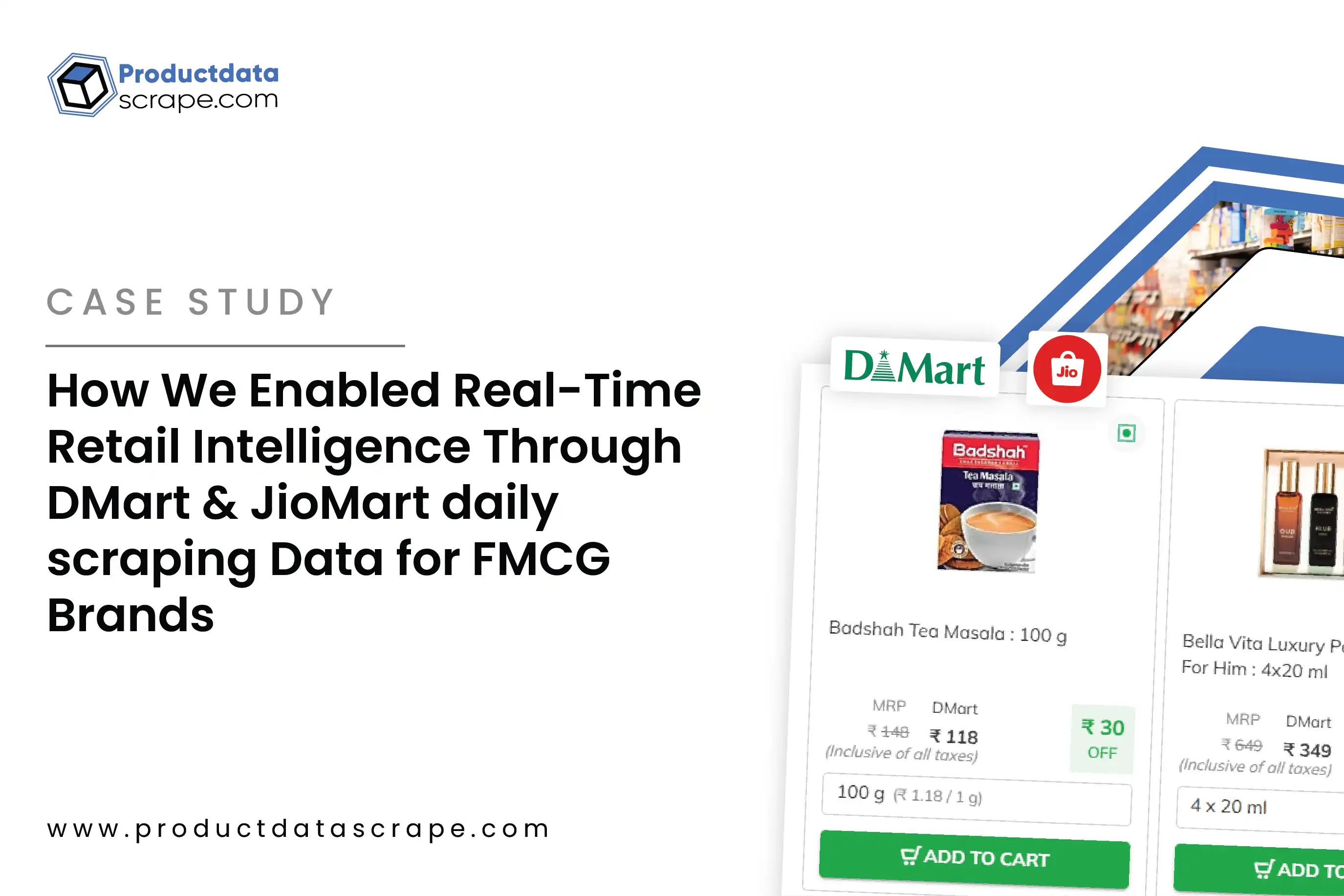
Product Data Scrape designed a retail intelligence workflow to help FMCG brands organize grocery product, price, promotion, and availability observations from DMart and JioMart. The DMart & JioMart daily scraping Data approach focuses on structured records, location-aware comparisons, and quality checks to support Real-time price tracking across selected products and service areas. The objective is to help category managers, pricing analysts, and retail strategists understand market differences without relying entirely on manual checks. Client-specific performance results and project duration were not provided, so no unverified improvements are claimed.
Client Name / Industry: Confidential FMCG brand / Grocery and consumer packaged goods.
Service / Duration: Grocery retail data collection and price intelligence / Duration not publicly disclosed.
Key Impact Metrics: Product-record completeness, price-observation freshness, and location-level coverage. Verified numerical results were not supplied.
The Client
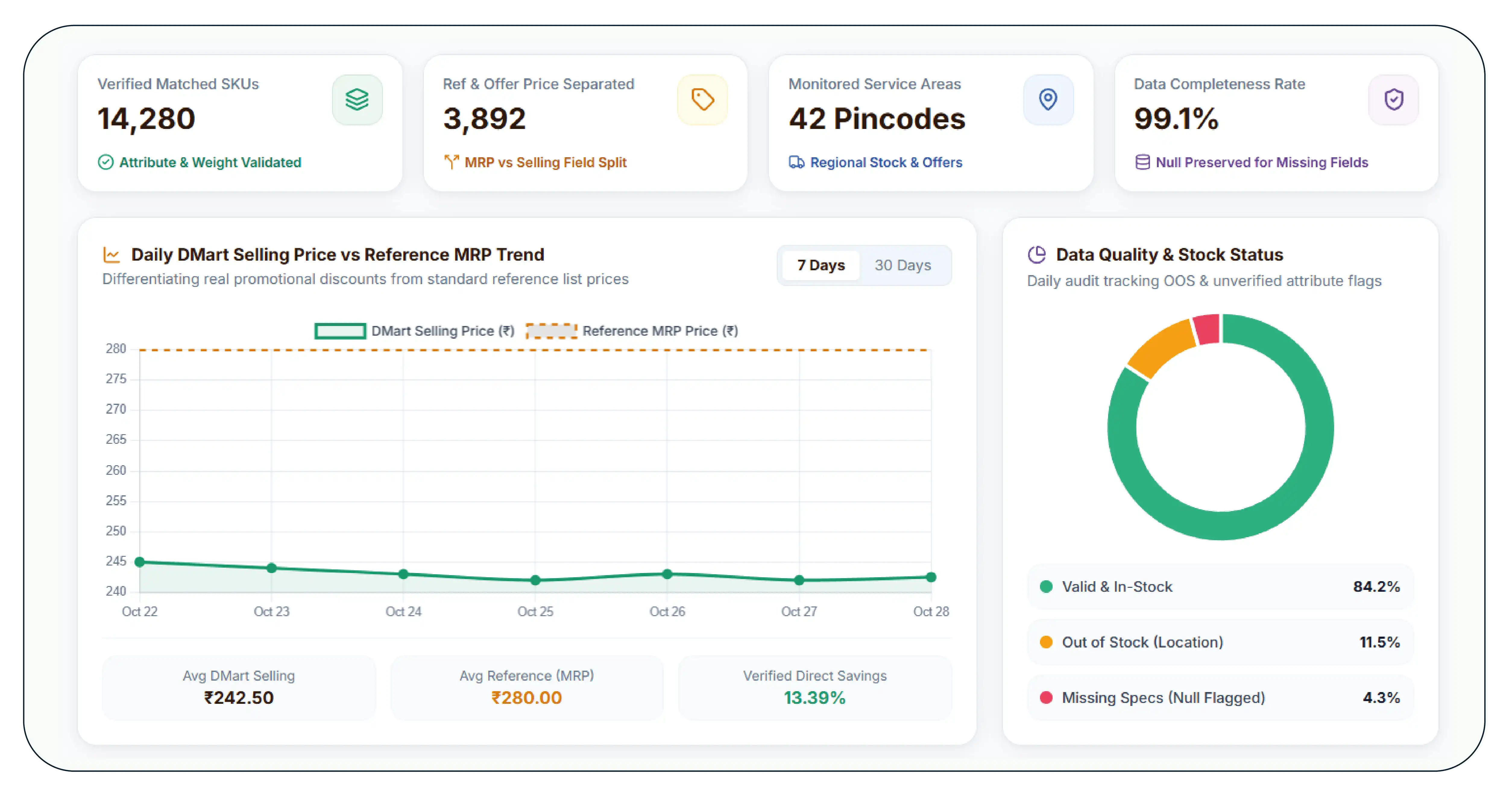
The client was an FMCG business seeking a more consistent view of grocery pricing and product availability across Indian online retail channels. Brands selling packaged foods, beverages, household essentials, and personal-care products must understand how their products are presented across retailers and locations. Product listings, discounts, package sizes, and availability signals can all affect the interpretation of a price comparison.
DMart and JioMart represent different retail businesses and shopping experiences. DMart's corporate website describes Avenue Supermarts Limited as the company operating DMart stores, while JioMart provides an online shopping platform through Reliance Retail. These official sources establish the relevant retail entities: DMart corporate website and JioMart.
Before the proposed engagement, the client needed a repeatable way to organize observations from multiple product pages and service locations. Manual comparisons could be difficult to maintain when product names, package quantities, promotional prices, and availability changed. Records collected at different times could also become misleading if timestamps and location context were missing.
The transformation aimed to establish a structured data workflow for JioMart Grocery Price Tracking, Hyperlocal pricing intelligence. The intended result was a clearer basis for comparing like-for-like products, identifying location-specific differences, and supporting category decisions with validated observations rather than unstructured screenshots or spreadsheets.
Goals & Objectives
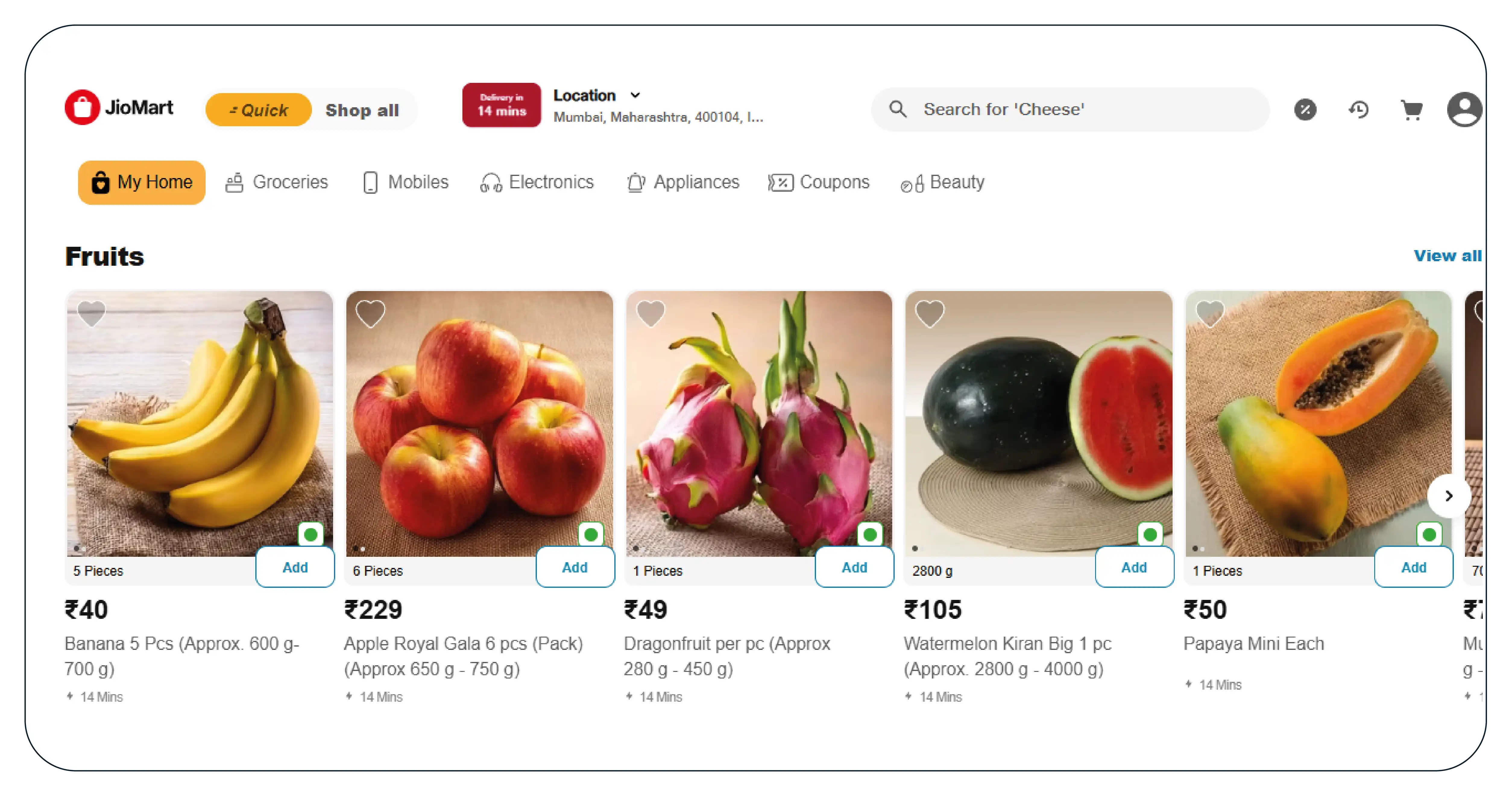
The business goal was to create a scalable retail intelligence process for monitoring selected grocery products across DMart and JioMart. The workflow needed to support FMCG pricing teams, category managers, and competitive intelligence analysts with comparable product-level observations.
The primary business priorities were repeatability, accuracy, traceability, and timely reporting. The data model also needed to preserve distinctions between regular prices, promotional prices, package quantities, and product availability.
The proposed Track Grocery Prices Across DMart and JioMart, Assortment and availability monitoring workflow would:
Collect permitted product observations from defined retail sources and service locations.
Standardize product names, brands, package sizes, units, and price fields.
Keep regular and promotional prices separate when both are available.
Retain pincode or service-area context for location-sensitive comparisons.
Flag missing values, duplicate observations, and inconsistent units.
Deliver validated records to dashboards, databases, or reporting tools.
Support scheduled collection where source access and technical conditions permit.
Product matching accuracy: Percentage of comparisons that pass product and package-size validation.
Price-data freshness: Elapsed time between observation and analytical availability.
Location coverage: Number and percentage of approved service areas represented.
Field completeness: Percentage of records containing required product and price fields.
Pipeline reliability: Percentage of scheduled jobs completed successfully.
These are proposed KPIs, not measured client outcomes. Targets should be set after an initial baseline assessment.
The Core Challenge
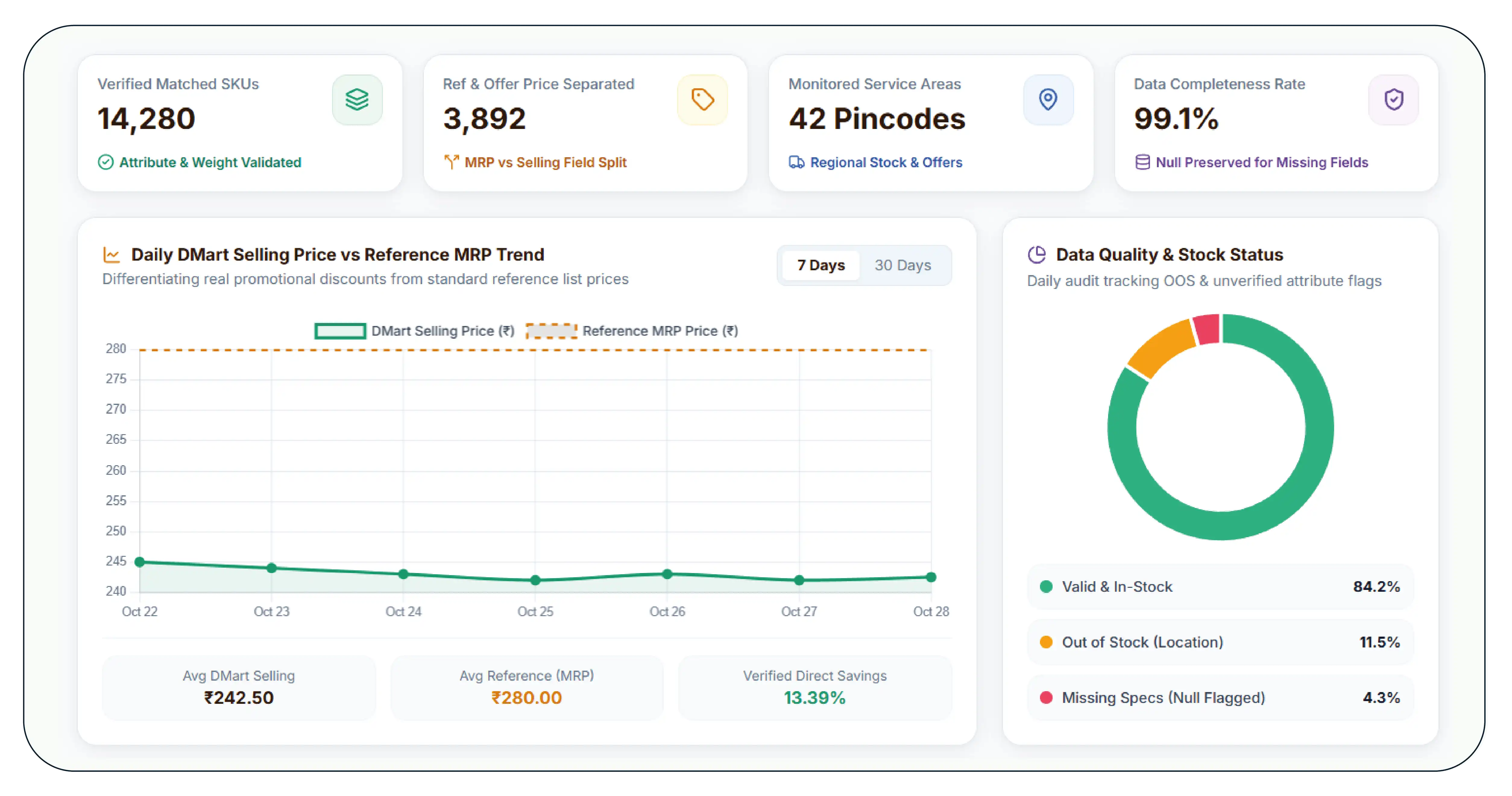
The core challenge was to make grocery price comparisons reliable across different retailers and service locations. A product with a similar name is not necessarily the same item: package weight, count, flavor, formulation, or bundle configuration may differ. Comparing these listings without validating their attributes can create misleading price gaps.
A second challenge was that online prices may be presented alongside discounts or promotional messaging. A robust dataset needs to preserve the displayed selling price and any clearly identified reference price as separate fields rather than assuming every crossed-out price is comparable across retailers.
Location was another important consideration. Online grocery assortments, delivery eligibility, and displayed offers can vary by service area. A price observation without a pincode or equivalent location identifier may not accurately represent what a customer in that area could see.
The proposed Track Dmart Prices and Availability Daily, Price scraping workflow therefore needed to preserve timestamps, product identity, package quantities, source information, and location context. Data validation also had to detect unavailable fields and avoid replacing missing information with assumptions.
Finally, collection frequency had to be balanced against technical reliability and permitted access. A daily schedule can provide a useful monitoring cadence, but it does not guarantee uninterrupted access or instant detection of every change. Source availability, platform requirements, and collection failures must be accounted for in reporting.
Our Solution
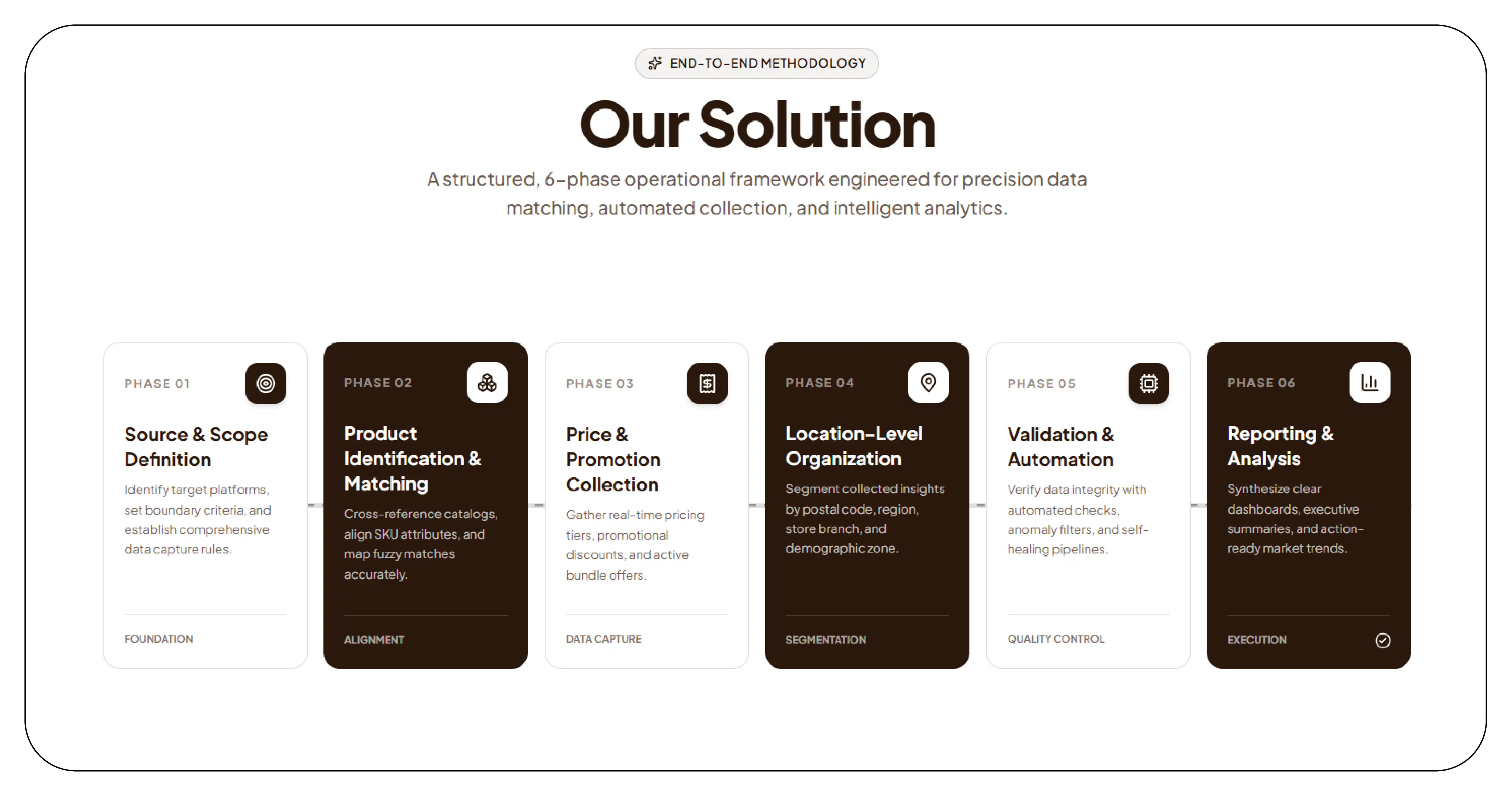
The proposed implementation used six phases to turn grocery listing observations into a structured retail intelligence dataset.
Phase 1: Source and Scope Definition
The team would identify target product categories, brands, pack sizes, retail sources, and service locations. Collection methods would be assessed against applicable platform terms, authorized access, and available data fields. The scope would distinguish public-facing observations from information requiring specific access permissions.
Phase 2: Product Identification and Matching
Product records would be standardized using available identifiers, brand names, product titles, package quantities, and measurement units. For example, a 500 g pack and a 1 kg pack of the same brand would remain distinct products. Uncertain matches would be flagged rather than automatically treated as equivalent.
Phase 3: Price and Promotion Collection
The collection layer would capture available product prices, promotional information, and observation timestamps. Regular and discounted prices would be stored separately where the source clearly identifies both. This makes DMart & JioMart Retail Price Benchmarking, DMart & JioMart daily scraping Data more meaningful because analysts can compare equivalent products without mixing pack sizes or price types.
Phase 4: Location-Level Organization
Where product observations were associated with a selected pincode or service area, the location identifier would be retained with the record. Analysts could then compare the same product across defined locations and identify differences in displayed prices or availability. Missing location context would be explicitly flagged.
Phase 5: Validation and Automation
Automated quality checks would identify duplicate records, missing prices, invalid quantities, inconsistent units, and unexpected changes in source formatting. Scheduled jobs would record successful runs and collection errors. Retry rules and exception logs would help maintain operational visibility without implying that every source change could always be captured.
Phase 6: Reporting and Analysis
Validated records would be organized for dashboards, spreadsheets, or analytical databases. Reports could show price differences, promotional observations, assortment coverage, and historical changes across selected products and locations.
This DMart & JioMart daily scraping Data workflow was designed to support repeatable grocery intelligence, with results dependent on permitted source access, available fields, and the reliability of each observation.
Results & Key Metrics
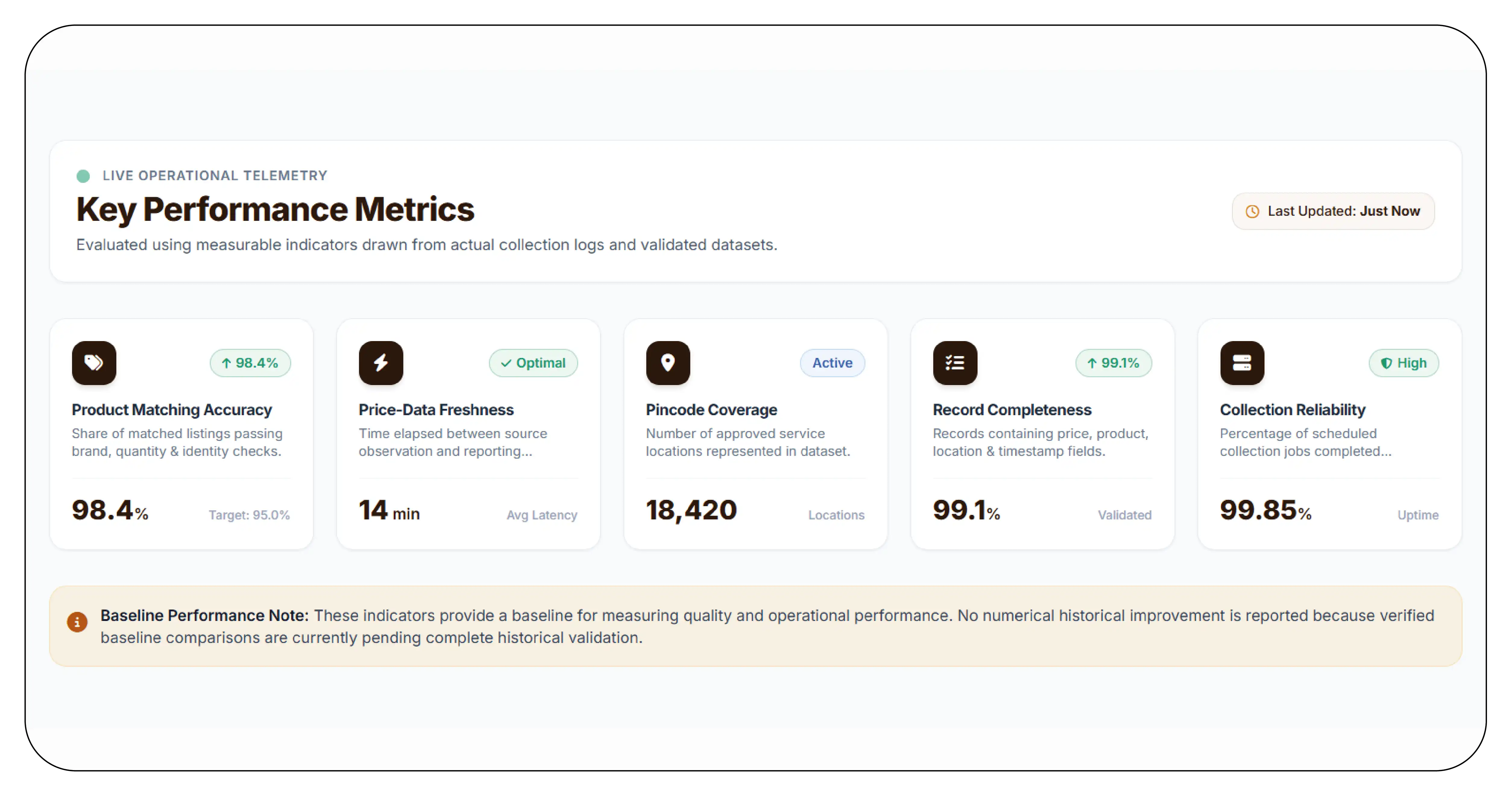
The project should be evaluated using measurable indicators drawn from actual collection logs and validated datasets.
Product matching accuracy: Share of matched listings that pass checks for brand, quantity, and product identity.
Price-data freshness: Time elapsed between the source observation and its availability in reporting.
Pincode coverage: Number of approved service locations represented in the dataset.
Record completeness: Share of records containing required price, product, location, and timestamp fields.
Collection reliability: Percentage of scheduled collection jobs completed successfully.
These indicators provide a baseline for measuring quality and operational performance. No numerical improvement is reported because verified project measurements were not provided.
The intended outcome was a structured dataset supporting DMart Pincode Wise Price Extraction, DMart & JioMart daily scraping Data for selected products and service locations. By preserving package quantities, price types, timestamps, and location identifiers, the workflow would allow analysts to investigate differences without confusing unrelated products or observations.
For FMCG teams, the resulting data model can support price benchmarking, promotional research, assortment comparisons, and availability analysis. It can also make exception handling more transparent by identifying missing or inconsistent records before they reach reports.
Actual benefits must be established through baseline and post-implementation measurements. Product Data Scrape should publish claims about improved speed, accuracy, coverage, or operational efficiency only after verifying them against project logs and approved client evidence.
What Made Product Data Scrape Different
Product Data Scrape's proposed approach emphasizes product matching, data validation, and traceability instead of treating collection volume as the only measure of success. The workflow separates product identity, package size, price type, location, and observation time so analysts can understand the basis of each comparison.
Automated checks can flag incomplete records, inconsistent units, duplicate listings, and unexpected price changes. Location-aware organization also helps analysts distinguish a genuine market difference from an observation made under different service conditions.
The framework can support JioMart Product Availability Tracking alongside price monitoring where the relevant fields are accessible. For FMCG brands, this offers a foundation for structured retail analysis without claiming unverified proprietary technology or guaranteed real-time coverage. All collection remains subject to source access and applicable platform requirements.
Client's Testimonial
"A structured retail data workflow can help our team compare product prices, package sizes, and availability observations more consistently. Clear validation rules and location-level records are valuable for investigating differences across grocery retail channels and preparing more reliable category reports."
— Head of Category Analytics, FMCG Brand.
Conclusion
Reliable grocery intelligence depends on comparable products, accurate price fields, location context, and traceable observations. For FMCG brands, a structured monitoring workflow can help organize retail data for price benchmarking, promotional analysis, assortment comparisons, and availability research.
A suitable JioMart Scraping API, DMart & JioMart daily scraping Data strategy should begin with a defined product scope, authorized data sources, appropriate collection frequency, and measurable quality checks. The term “API” should be used for an actual available and authorized interface, not as an assumption that either retailer provides unrestricted access.
Product Data Scrape can help businesses plan data structures, validation rules, and reporting workflows tailored to their retail intelligence requirements. Contact Product Data Scrape to discuss a data collection solution for your target FMCG categories, products, and service locations.
FAQs
1. What data can be collected from DMart and JioMart?
Depending on authorized source access, available fields may include product names, brands, package sizes, displayed prices, promotional information, availability signals, and observation timestamps. Field availability varies by source and product.
2. How does daily grocery price monitoring work?
A scheduled workflow collects permitted observations, validates product matches, records timestamps, and compares current records with previous observations. Daily scheduling does not guarantee that every price change will be captured immediately.
3. Can prices be compared across pincodes?
Yes, provided observations retain their service-area context and represent comparable products. Package sizes, promotional conditions, and collection times should also be checked before interpreting differences.
4. Is a DMart Scraping API available for unrestricted data collection?
An API should be used only when a documented interface and appropriate access permissions are available. The existence of a data collection requirement does not establish that a retailer offers an unrestricted public API.
5. How can FMCG brands use these insights?
FMCG teams can use validated observations for price benchmarking, promotional research, assortment analysis, and availability monitoring. DMart Scraping API integrations, where actually available and authorized, may form part of the technical architecture. Product Data Scrape can help define the required fields, validation criteria, and reporting KPIs before implementation.


 Singapore
 EMAIL
 PHONE











.webp)