Quick Overview
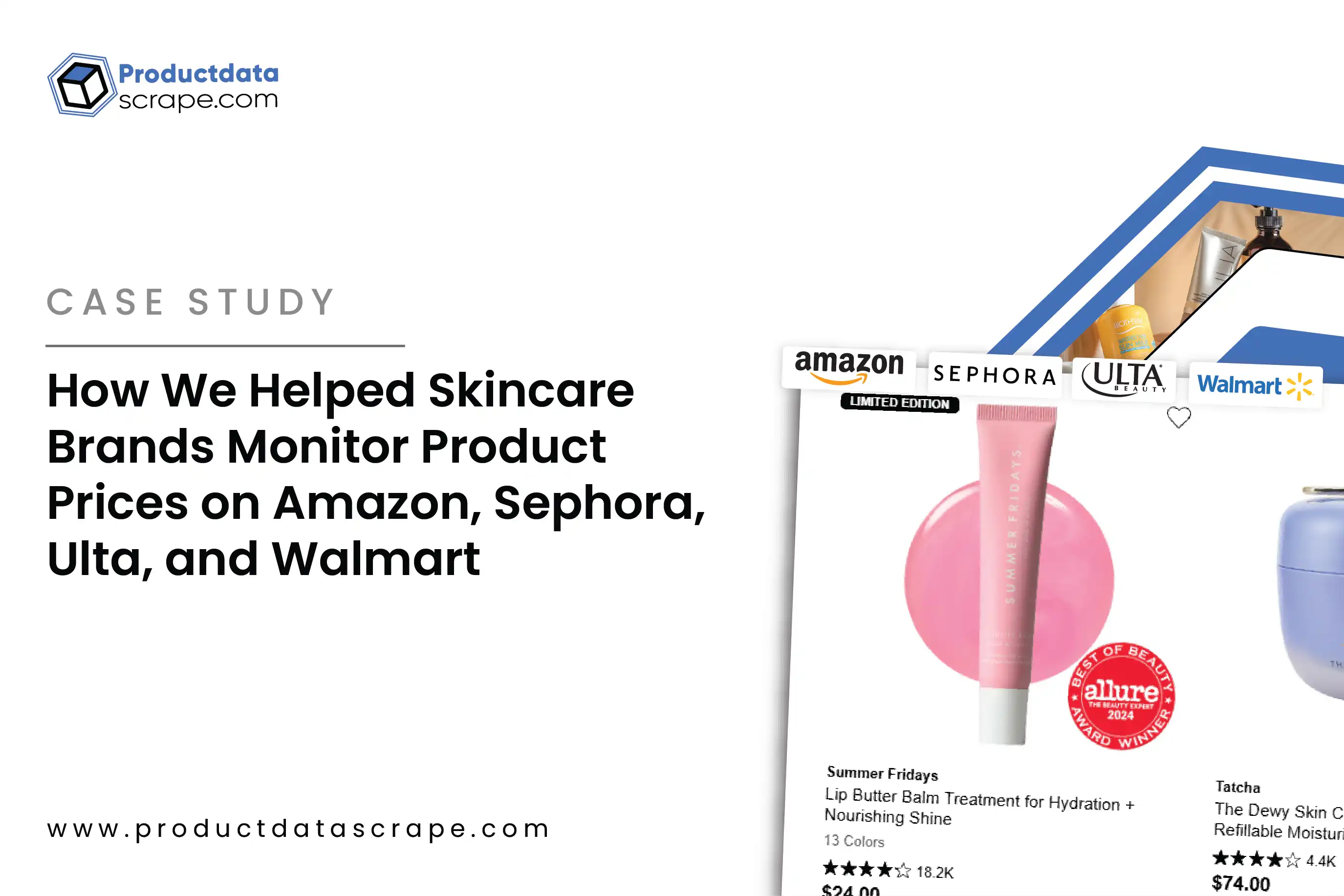
Product Data Scrape partnered with a leading skincare and beauty company to build a multi-retailer pricing intelligence solution covering Amazon, Sephora, Ulta, and Walmart. Through Skincare Brands Monitor Product Prices, the client could systematically track product prices, discounts, availability, and assortment across major online retail channels. The project also enabled Scrape Skincare Prices Across Amazon Sephora Ulta Walmart, creating a consolidated view of competitive pricing movements. Key skincare brands and products monitored included CeraVe cleansers, La Roche-Posay sunscreens, The Ordinary serums, Neutrogena moisturizers, Clinique skincare, and Estée Lauder products.
Client Name / Industry: Global Skincare & Beauty Brand
Service / Duration: Multi-Retailer Skincare Price Intelligence / 12 Weeks
Key Impact Metrics: 90% faster price monitoring, 95%+ data accuracy, 80% reduction in manual research
The Client
The client was a growing skincare company with products distributed through multiple digital retail channels. Its portfolio included cleansers, moisturizers, facial serums, sunscreens, acne treatments, masks, and anti-aging products competing alongside established brands such as CeraVe, La Roche-Posay, The Ordinary, Neutrogena, Clinique, and Estée Lauder.
The beauty market was becoming increasingly competitive as consumers compared prices, discounts, promotions, ratings, and availability across multiple websites before purchasing. A product could have different pricing or promotional positioning depending on the retailer, creating challenges for brands trying to maintain marketplace visibility.
Before partnering with Product Data Scrape, the client relied heavily on manual price checks and spreadsheets. Analysts periodically visited retail websites to record product prices and promotional information. This process was time-consuming and made it difficult to maintain a consistent historical record.
The company needed Skincare Brands Multi-Retailer Price Monitoring to establish a centralized view of pricing across different retail channels. Its team also needed structured Scraping from Ulta Beauty to monitor products and competitor activity on one of the industry's important beauty retail platforms.
The transformation was therefore essential to reduce manual work, improve data refresh speed, and provide a more reliable foundation for pricing and competitive analysis.
Goals & Objectives
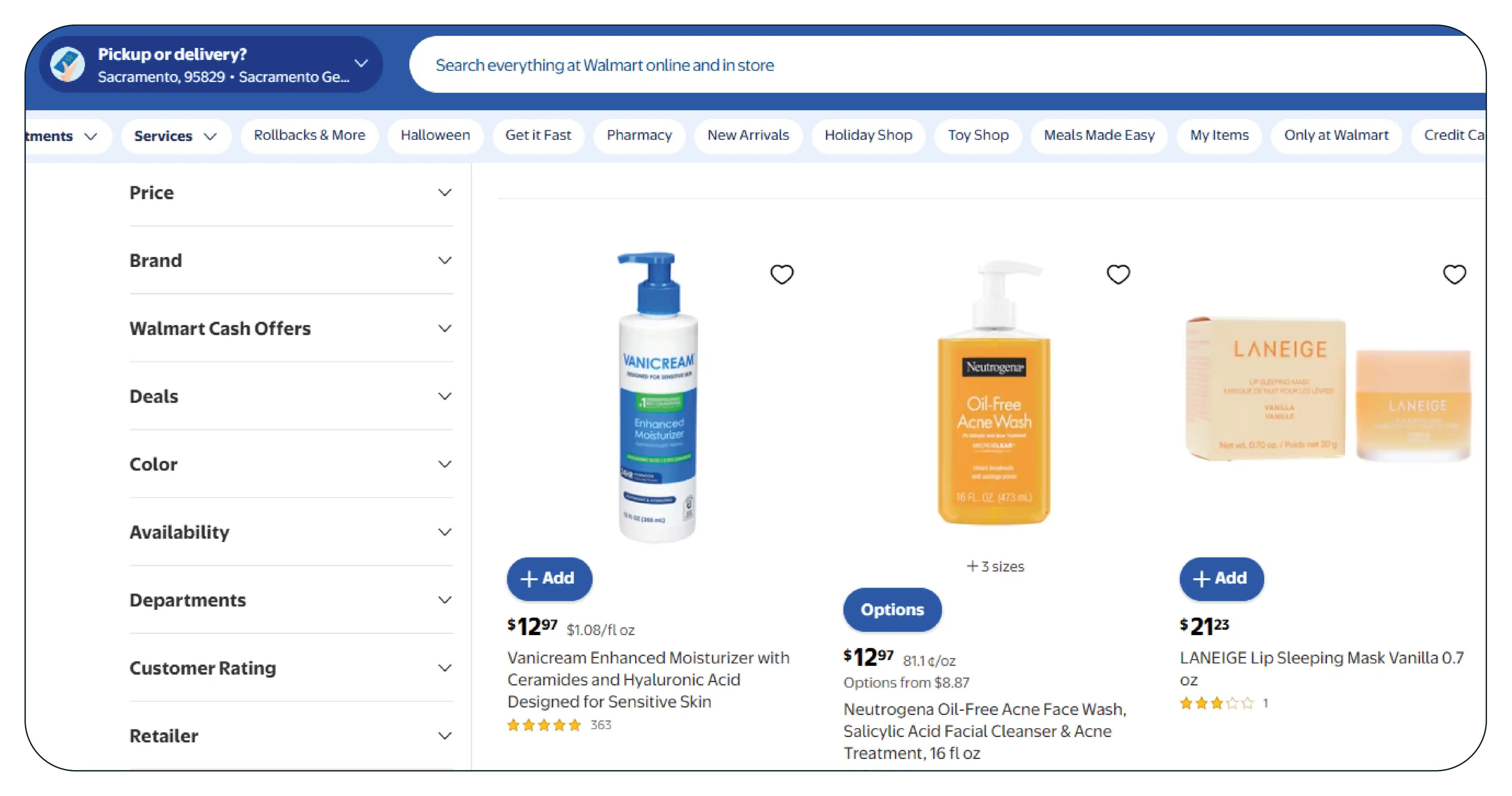
The project was designed to improve the scalability, speed, and accuracy of skincare marketplace monitoring while creating a technical framework for automated data collection and analytics.
The primary business goal was to establish automated Amazon Skincare Price Monitoring across the client's priority product categories. The solution needed to track products such as CeraVe cleansers, The Ordinary serums, La Roche-Posay sunscreens, and Neutrogena moisturizers.
A secondary goal was to understand customer feedback and marketplace positioning through Scrape Walmart Reviews Analysis, allowing the client to connect pricing observations with product ratings and review trends.
Automate recurring product price collection.
Track product names, brands, variants, prices, discounts, and availability.
Monitor pricing across Amazon, Sephora, Ulta, and Walmart.
Normalize product and brand information.
Connect collected data with analytics dashboards.
Support scheduled data refreshes.
Maintain historical pricing records.
Enable competitive product benchmarking.
90% faster price monitoring.
95%+ validated data accuracy.
80% reduction in manual research.
90% faster competitor product discovery.
Daily refresh capability for priority products.
Improved consistency across multi-retailer datasets.
The Core Challenge
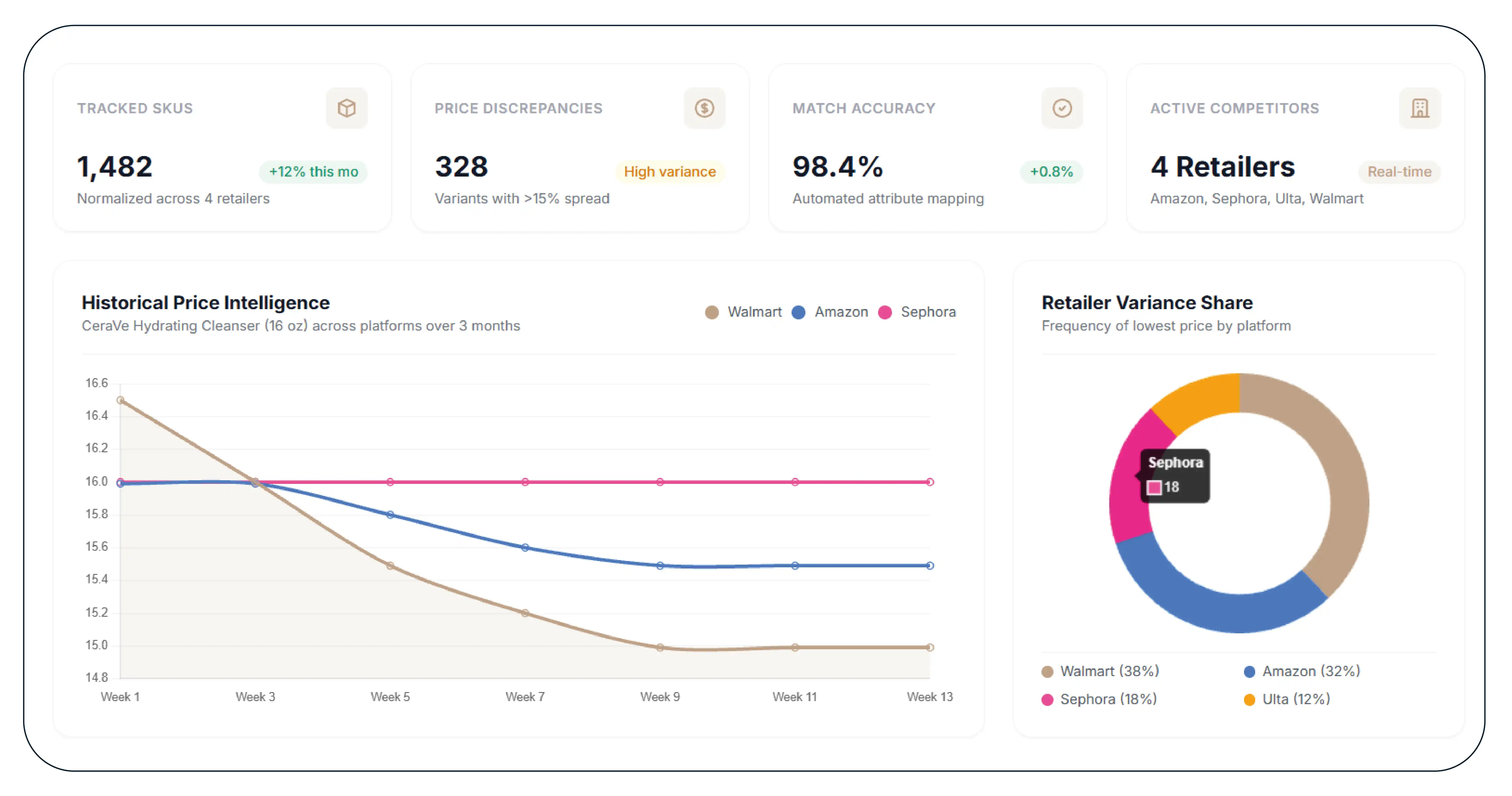
The client's biggest challenge was the fragmented nature of online skincare pricing. The same cleanser, serum, moisturizer, or sunscreen could appear across Amazon, Sephora, Ulta, and Walmart with different prices, promotions, seller information, availability, and product presentation.
For example, CeraVe products could have multiple sizes and formulations, while The Ordinary products might have different variants and pack configurations. La Roche-Posay sunscreens and Neutrogena skincare products could similarly appear in multiple formats.
The client needed reliable Walmart Skincare Price Tracking data to compare product-level pricing and identify changes across its assortment. However, manually collecting information from large product catalogs was slow and difficult to maintain.
Amazon presented a similar challenge. Product pages could include multiple variants, sellers, discounts, and availability conditions. A basic Amazon Product Data Scraper therefore needed to distinguish product variants and capture the correct pricing context.
Data consistency was another issue. Retailers often use different product naming conventions, category structures, and attribute formats. Without normalization, comparing the same product across four retailers could generate misleading results.
The company also lacked a centralized historical dataset. Analysts could see current prices but had limited ability to understand how pricing had changed over previous weeks or months.
Product Data Scrape therefore needed to build an automated framework that could collect, match, validate, and organize multi-retailer skincare information at scale.
Our Solution
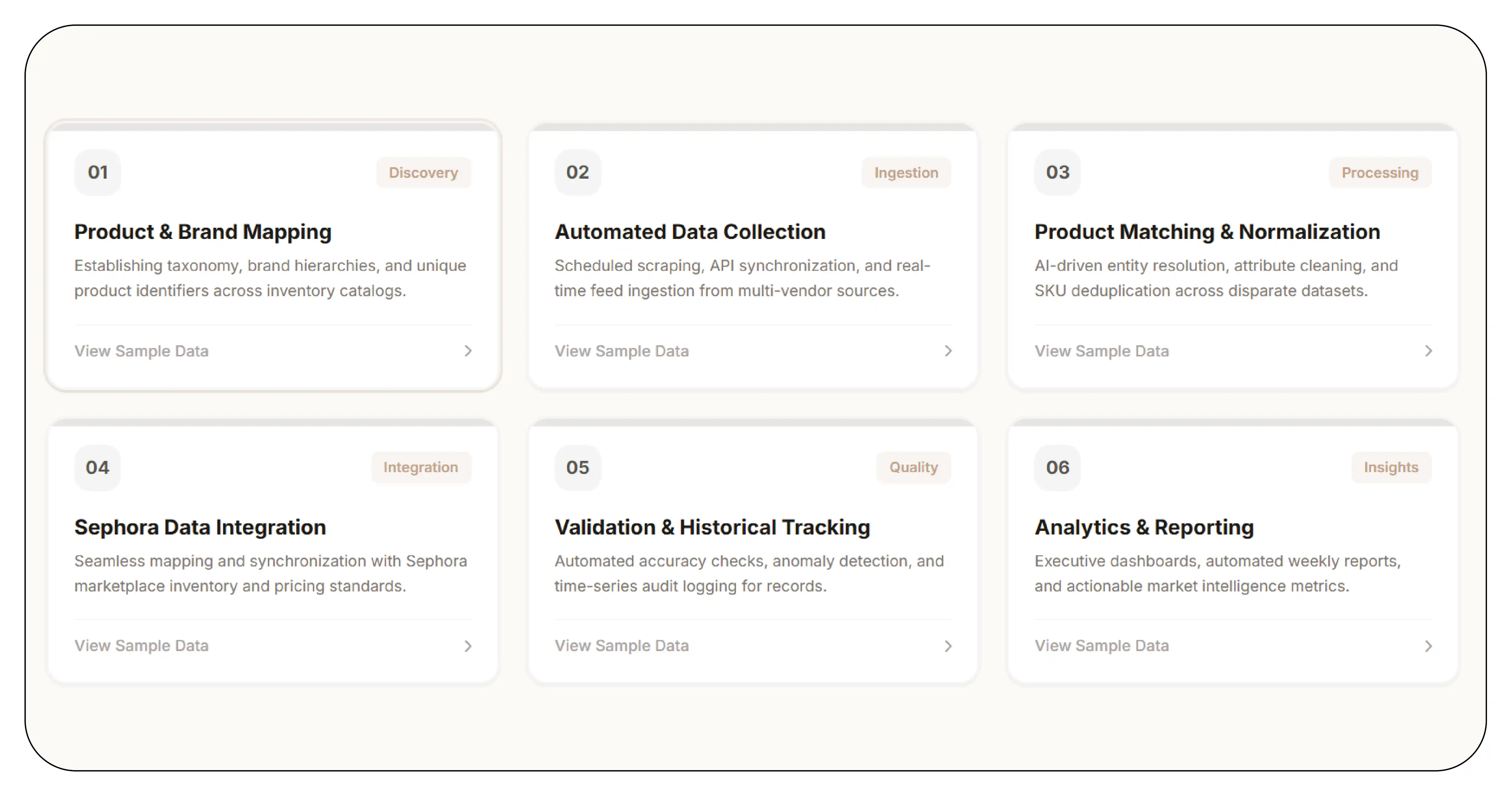
Product Data Scrape implemented a phased multi-retailer data collection and pricing intelligence framework covering Amazon, Sephora, Ulta, and Walmart.
Phase 1: Product & Brand Mapping
The first phase established the monitoring universe. Priority categories included facial cleansers, moisturizers, serums, sunscreens, acne treatments, masks, and anti-aging products. Brands such as CeraVe, The Ordinary, La Roche-Posay, Neutrogena, Clinique, Estée Lauder, Cetaphil, Olay, and Paula's Choice were mapped according to the client's requirements. Product names, variants, sizes, URLs, and category relationships were identified to create a consistent monitoring structure.
Phase 2: Automated Data Collection
The collection framework was configured around Scraping Ulta Skincare Brands Pricing data, capturing product and pricing information from relevant retailer pages. The dataset included product name, brand, category, variant, size, current price, original price, discount, availability, seller information where applicable, ratings, review counts, product URL, and product images where accessible. The same product structure was applied across Amazon, Sephora, Ulta, and Walmart to make cross-retailer comparisons easier.
Phase 3: Product Matching & Normalization
The team standardized product names, brands, sizes, variants, and categories. This was particularly important for products such as CeraVe Hydrating Cleanser, The Ordinary Niacinamide serum, and La Roche-Posay Anthelios sunscreen. Matching rules helped identify equivalent products even when retailers displayed slightly different naming formats.
Phase 4: Sephora Data Integration
A dedicated Sephora US Product Data Scraper workflow was incorporated into the collection architecture to support recurring product and price monitoring. The process captured relevant product attributes and connected them to standardized product records for cross-retailer analysis.
Phase 5: Validation & Historical Tracking
Automated validation rules checked missing prices, duplicate records, inconsistent variants, invalid product identifiers, and unusual data changes. Historical snapshots were preserved so the client could compare pricing across collection periods rather than relying only on current marketplace observations.
Phase 6: Analytics & Reporting
The final datasets were delivered in structured formats compatible with databases, dashboards, spreadsheets, and business intelligence systems. This enabled teams to analyze pricing movements, product availability, promotions, assortment changes, and retailer-level differences from a centralized data environment.
Results & Key Metrics
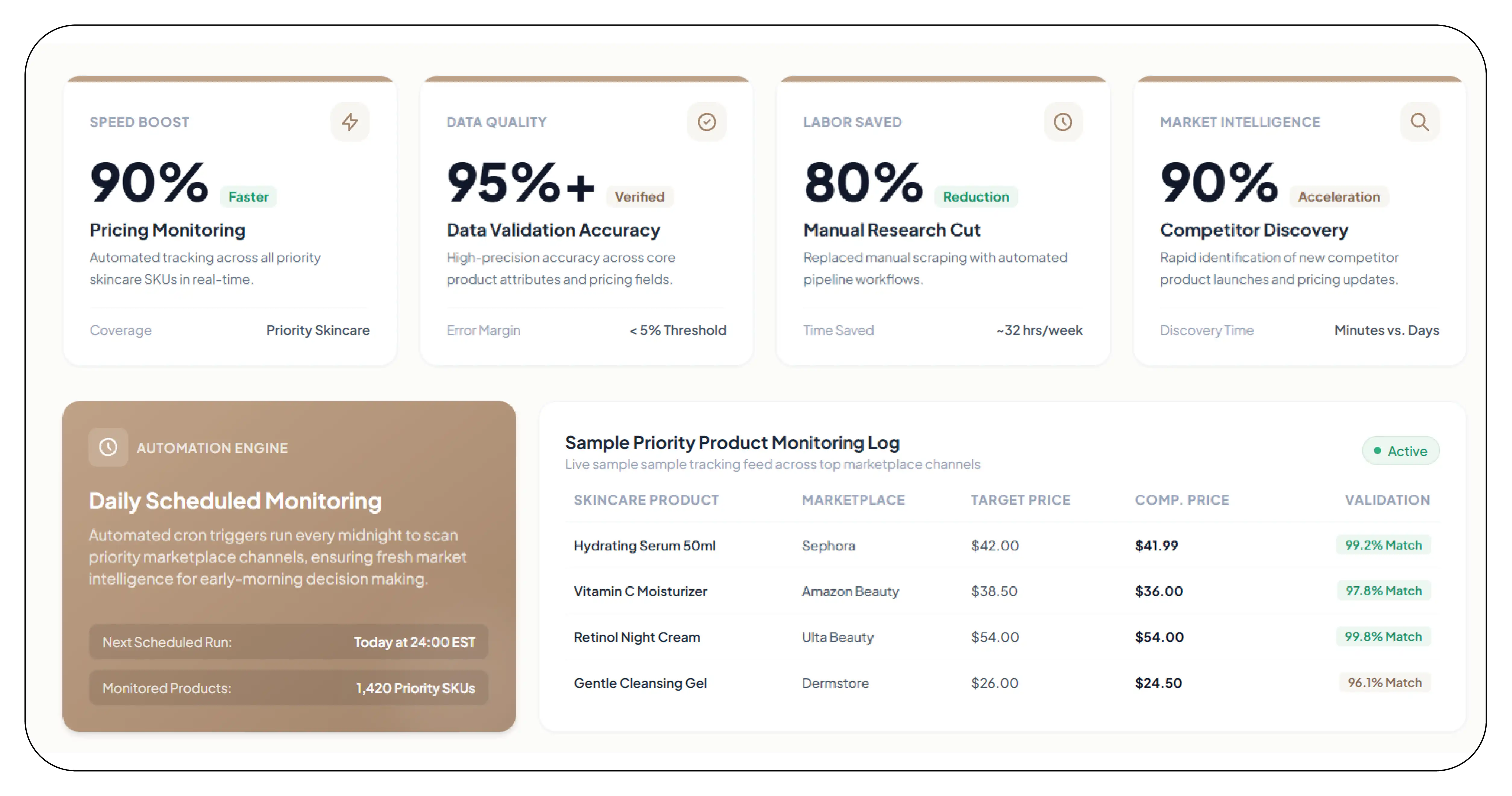
The implementation produced measurable improvements across data collection and marketplace monitoring:
90% faster pricing monitoring across priority skincare products.
95%+ data validation accuracy across core product and pricing fields.
80% reduction in manual marketplace research.
90% faster competitor product discovery.
Daily scheduled monitoring for priority products.
Improved cross-retailer product matching.
More consistent historical price records.
Faster identification of assortment and availability changes.
Results Narrative
With Sephora Skincare Price Tracking, the client gained a structured view of product pricing and assortment across Sephora alongside its Amazon, Ulta, and Walmart monitoring workflows.
The data helped analysts compare products such as CeraVe cleansers, The Ordinary serums, La Roche-Posay sunscreens, Neutrogena moisturizers, and Clinique skincare products across multiple retail channels.
The Sephora US Product Data Scraper also supported recurring collection, reducing reliance on manual checks.
By combining current and historical observations, the client could identify pricing movements, promotional changes, and availability differences more efficiently while maintaining a standardized dataset for ongoing competitive analysis.
What Made Product Data Scrape Different
Product Data Scrape approached the project as a unified beauty-marketplace intelligence framework rather than four separate scraping workflows.
The system standardized product names, brands, variants, sizes, prices, discounts, availability, ratings, and Scrape Skincare Product Reviews across Amazon, Sephora, Ulta, and Walmart.
The Amazon Sephora Ulta Walmart Price Comparison framework allowed the client to view retailer-level differences through a common data structure.
A configurable Sephora US Product Data Scraper architecture supported recurring collection and integration with downstream analytics systems. Automated validation, product matching, deduplication, and historical snapshots improved data consistency.
The framework could also expand to additional skincare brands, categories, products, and retailers without requiring the entire architecture to be rebuilt.
This approach transformed fragmented beauty-marketplace observations into a structured dataset designed for recurring pricing and competitive intelligence.
Client's Testimonial
"Before this project, our pricing research involved checking several retail websites manually and consolidating the findings into spreadsheets. The new solution gave our team a much clearer and more consistent view of our skincare products across Amazon, Sephora, Ulta, and Walmart. We can now monitor products such as CeraVe cleansers, The Ordinary serums, La Roche-Posay sunscreens, and Neutrogena moisturizers more efficiently. The historical data is particularly valuable because it allows our analysts to understand pricing changes rather than looking at isolated snapshots. Product Data Scrape delivered a scalable workflow that fits our growing marketplace intelligence requirements."
— Director of E-Commerce Analytics, Global Skincare Brand
Designer visual references: CeraVe cleanser, The Ordinary serum, La Roche-Posay sunscreen, Neutrogena moisturizer, Clinique moisturizer, Estée Lauder serum, Amazon product page, Sephora product page, Ulta product page, and Walmart product page.
Conclusion
The project helped the skincare brand establish a scalable framework for monitoring product prices and marketplace activity across Amazon, Sephora, Ulta, and Walmart. Automated collection reduced repetitive manual research while improving the consistency and timeliness of pricing information.
The structured dataset also created opportunities to connect product pricing with availability, ratings, reviews, assortment, and promotional activity.
As the client's marketplace presence grows, the framework can be expanded to additional skincare brands, product categories, retailers, and geographic markets.
By combining structured product collection with historical monitoring, businesses can build a stronger foundation for competitive pricing analysis and digital shelf intelligence.
The solution demonstrates how multi-retailer data collection can turn fragmented beauty marketplace information into an organized, analytics-ready resource.
FAQs
1. What skincare data can be collected from online retailers?
Depending on accessibility, datasets can include product names, brands, categories, variants, sizes, prices, discounts, availability, ratings, reviews, seller information, URLs, and product images.
2. Why monitor skincare prices across multiple retailers?
Multi-retailer monitoring allows brands to compare how products are positioned across Amazon, Sephora, Ulta, and Walmart and identify pricing differences, promotions, and assortment changes.
3. Which skincare brands can be monitored?
Monitoring can include brands such as CeraVe, The Ordinary, La Roche-Posay, Neutrogena, Clinique, Estée Lauder, Cetaphil, Olay, and Paula's Choice, depending on the project scope.
4. Can skincare reviews be collected along with prices?
Where accessible, product ratings and review information can be collected alongside pricing and product attributes, enabling businesses to analyze customer feedback together with marketplace performance.
5. Can the monitoring process be automated?
Yes. Product Data Scrape can structure recurring collection workflows around selected brands, products, categories, retailers, and attributes, with validation and scheduled refreshes to support ongoing marketplace intelligence.


 Singapore
 EMAIL
EMAIL
 PHONE
PHONE











.webp)