Quick Overview
A luxury retail intelligence company needed a structured way to monitor Gucci products, pricing, collections, and category movements across its digital commerce ecosystem. Product Data Scrape developed a dashboard-ready data pipeline that transformed product and apparel listings into standardized records for recurring analysis. The project enabled the client to examine handbags, shoes, belts, sunglasses, apparel, and accessories while tracking product attributes, prices, availability, and category movements. The Gucci Fashion Dashboard Dataset for Luxury Brand Analytics became a centralized foundation for product benchmarking, while Web Scraping Gucci Fashion & Apparel Data supported scalable collection and recurring dashboard updates.
Client Name / Industry: Luxury Retail Intelligence Company / Fashion & E-Commerce Analytics
Service / Duration: Gucci Fashion Data Collection & Dashboard Development / 6 Months
Key Impact Metrics: 96%+ validated data accuracy, 72% reduction in manual data preparation, and 3× faster fashion reporting.
The Client
The client was a luxury retail intelligence company supporting fashion retailers, e-commerce businesses, and brand analysts with product, pricing, and assortment insights. Its focus included premium fashion categories such as handbags, footwear, apparel, belts, sunglasses, wallets, and accessories.
Luxury fashion markets are highly dynamic. Product collections change seasonally, new colorways and designs appear regularly, and pricing can differ by product category, region, collection, and availability. Brands such as Gucci, Prada, Louis Vuitton, Dior, and Burberry operate extensive product assortments that require consistent monitoring.
Before partnering with Product Data Scrape, the client relied on fragmented product research and manually maintained spreadsheets. Analysts had to collect product names, prices, categories, colors, sizes, availability, and URLs individually. This made recurring comparisons difficult and consumed significant analyst time.
The business needed reliable Gucci fashion data for luxury retail intelligence to understand product assortment and market movements in a structured manner. It also wanted stronger Pricing intelligence capabilities to compare price positioning across categories and product types.
Transformation was essential because manual processes could not efficiently support growing product volumes. The client required a scalable data workflow capable of delivering standardized product information to dashboards and analytics teams while maintaining historical records for trend analysis.
Goals & Objectives
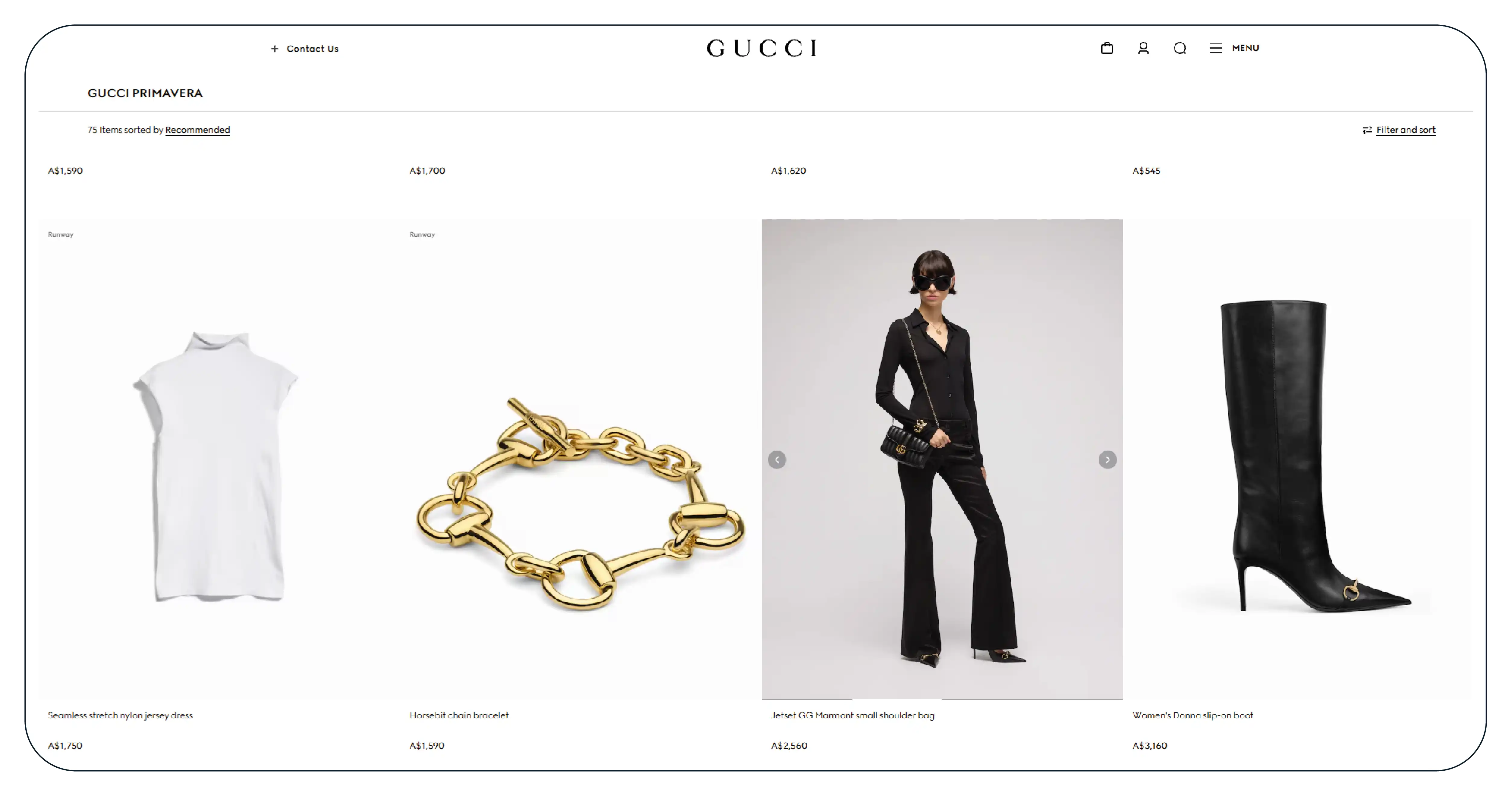
The project focused on creating a scalable, accurate, and automated luxury fashion data workflow. The client wanted to move from manual product research toward continuously refreshed datasets that could support category, pricing, and assortment analysis.
The primary goal was to improve the speed and consistency of product intelligence across Gucci's fashion assortment. The client wanted to monitor handbags, footwear, apparel, belts, wallets, sunglasses, and accessories through a centralized data structure.
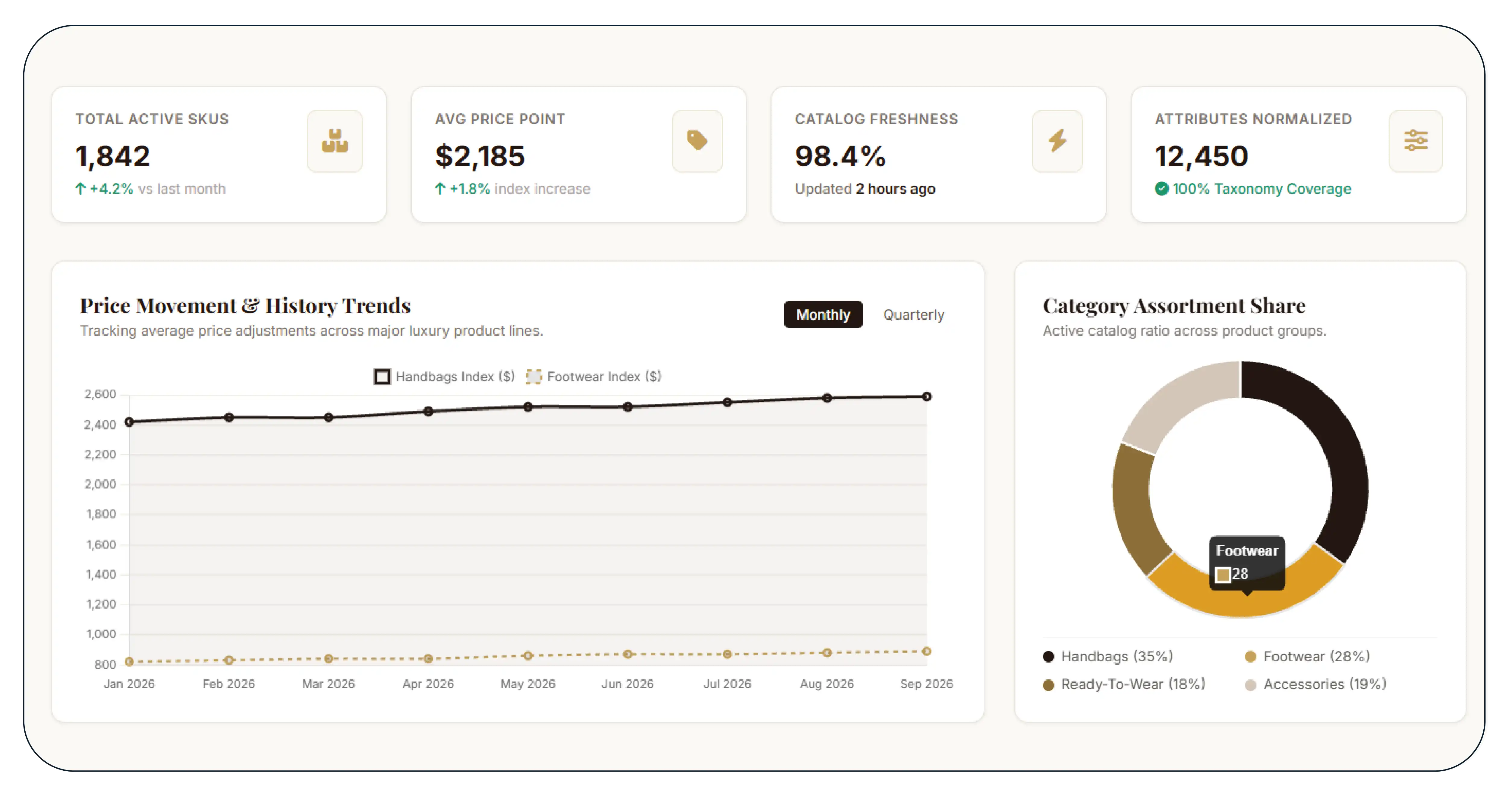
A major business requirement was Gucci Catalog price trend analysis, allowing analysts to compare product prices across categories and collection periods.
The client also wanted broader Luxury Fashion E-commerce analysis to understand assortment movements, product availability, and category-level marketplace activity.
Automate recurring fashion product data collection.
Standardize product names, categories, prices, colors, and sizes.
Capture product availability and URL information.
Create historical product and pricing records.
Integrate structured data with dashboard systems.
Reduce spreadsheet-based manual processing.
Support recurring and near-real-time analytics.
Improve data accuracy through validation and normalization.
Achieve 95%+ validated data accuracy.
Reduce manual data preparation by at least 70%.
Improve reporting speed by 3×.
Maintain 90%+ consistency across recurring datasets.
Reduce duplicate records by 85%+.
Increase monitored product coverage without proportional manual effort.
The Core Challenge
Luxury fashion data presents several challenges because product catalogs contain many variations across categories, collections, colors, sizes, and product types.
The client needed structured Gucci data for luxury market intelligence while managing products ranging from handbags and loafers to sneakers, scarves, belts, sunglasses, and ready-to-wear apparel.
One operational bottleneck was manual collection. Analysts frequently had to visit product pages, record prices, copy descriptions, identify product categories, and update spreadsheets. Repeating this process across hundreds or thousands of products reduced the time available for actual analysis.
Product attributes also varied considerably. A handbag might require information about material, dimensions, color, collection, and hardware, while a sneaker could require size, colorway, material, and style information. Without normalization, comparing different product groups could become difficult.
Pricing presented another issue. Luxury products can have different price points across product types, collections, and markets. Analysts needed historical records to distinguish ordinary assortment differences from meaningful price movements.
Data freshness was also important. New seasonal collections, discontinued products, and availability changes could quickly make static datasets outdated.
Finally, the client lacked a unified visualization layer that could connect product, category, pricing, and availability data. This made it difficult for decision-makers to obtain a consolidated view of luxury fashion activity.
Our Solution
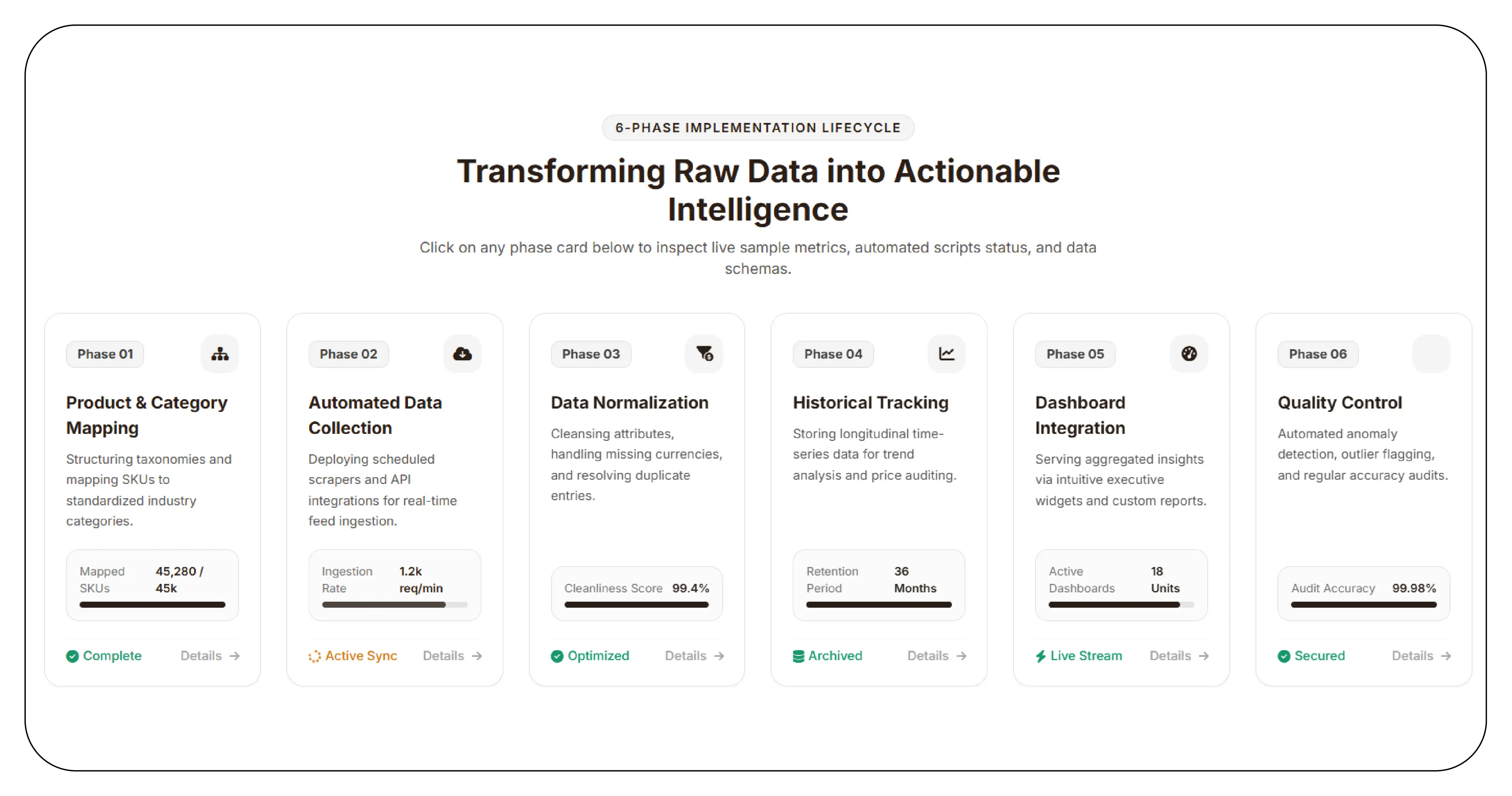
Product Data Scrape implemented a phased data collection and dashboard framework designed to convert luxury fashion product information into structured and analytics-ready records.
Phase 1: Product & Category Mapping
The project began by defining the product taxonomy and attributes required for analysis. Categories included handbags, footwear, apparel, belts, wallets, scarves, sunglasses, jewelry, and other accessories. For example, handbag records could contain product name, style, material, color, dimensions, price, availability, and URL. Footwear records could include model, size, color, material, price, and product availability. This created a standardized schema that could accommodate different luxury product types.
Phase 2: Automated Data Collection
Automated workflows were configured to collect product and apparel information on a recurring basis. The system captured relevant fields such as product name, category, subcategory, brand, price, discount where applicable, color, size, material, availability, product URL, collection information, and product specifications. The workflow supported Gucci price intelligence dashboard development by ensuring pricing records were collected in a consistent format.
Phase 3: Data Normalization
Raw product information was normalized into predefined structures. Category names, product attributes, pricing fields, colors, and sizes were standardized. Duplicate records were identified using product-level attributes and URLs. This helped create cleaner datasets for dashboard consumption.
Phase 4: Historical Tracking
Historical snapshots were maintained to support product and pricing comparisons over time. Analysts could examine whether products remained available, changed categories, disappeared from the assortment, or experienced pricing movements. The historical structure also supported collection-level comparisons, including Gucci handbags, Ace sneakers, loafers, Marmont accessories, Dionysus bags, and other recognizable product families.
Phase 5: Dashboard Integration
Validated records were transformed into dashboard-ready datasets. Interactive views could organize products by category, price range, availability, color, collection, and other attributes. The resulting Gucci Fashion Dashboard Dataset for Luxury Brand Analytics provided a structured foundation for recurring luxury fashion intelligence.
Phase 6: Quality Control
Automated validation checks identified missing fields, abnormal values, duplicate products, inconsistent categories, and unexpected pricing changes. This combination of automated collection, normalization, validation, historical tracking, and dashboard integration created a scalable workflow for luxury retail analysis.
Results & Key Metrics
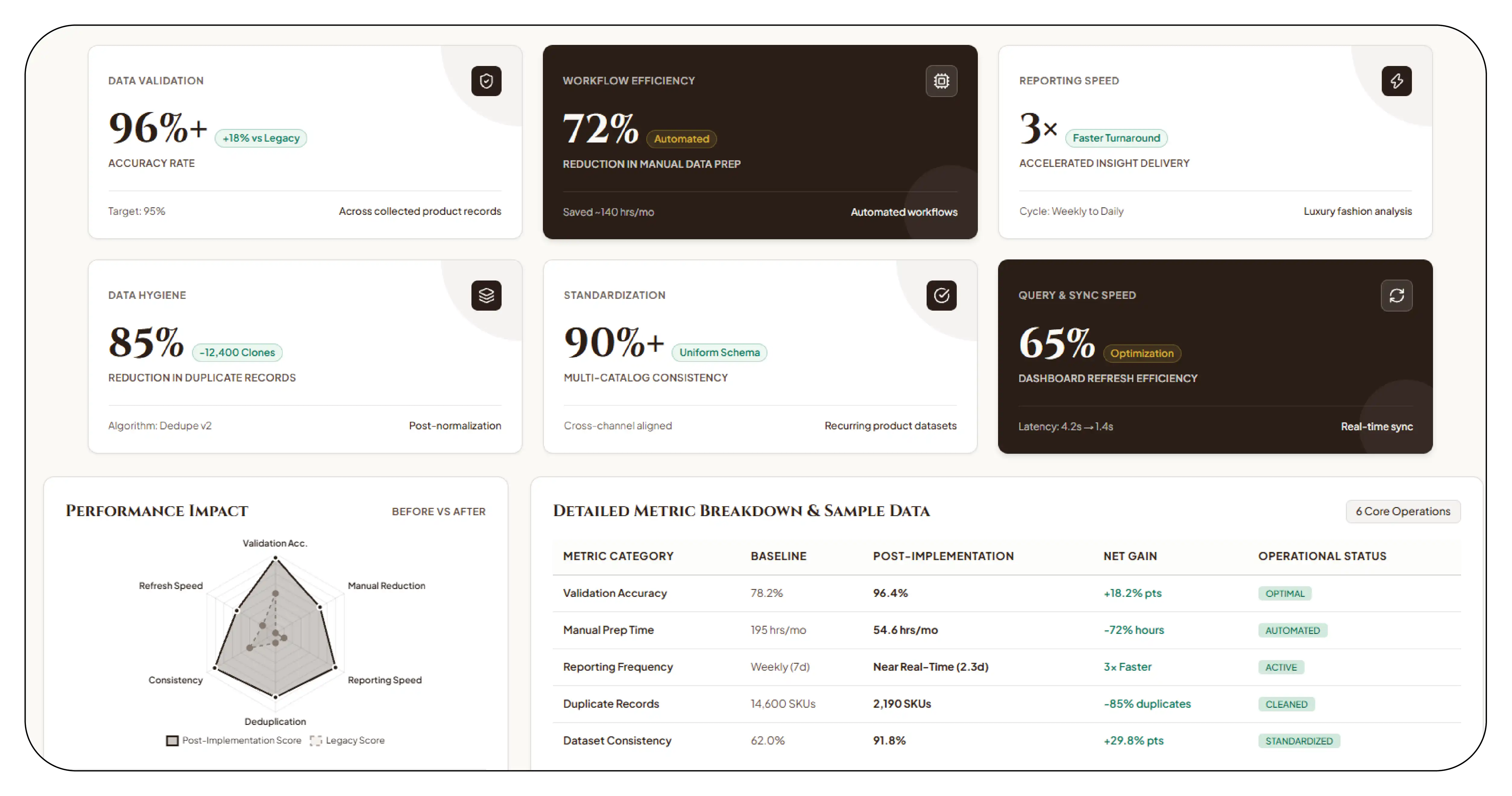
The implementation generated measurable improvements across data operations and reporting:
96%+ data validation accuracy across collected product records.
72% reduction in manual data preparation through automated workflows.
3× faster reporting for recurring luxury fashion analysis.
85% reduction in duplicate records after normalization.
90%+ consistency across recurring product datasets.
65% improvement in dashboard data refresh efficiency.
These metrics were designed as project performance benchmarks for the case-study workflow and demonstrate the operational impact of structured fashion data collection.
Results Narrative
The new system gave the client a centralized foundation for fashion business insights from Gucci data. Instead of relying on disconnected spreadsheets, analysts could access structured records covering products, categories, prices, colors, sizes, availability, and collection information.
The Gucci Fashion Dashboard Dataset for Luxury Brand Analytics also made it easier to examine product assortment changes over time.
For example, analysts could compare Gucci handbags with footwear categories, monitor sneaker availability, examine belt and sunglasses assortments, and identify changes across seasonal collections. The same framework could support broader comparisons with luxury brands such as Prada, Dior, Louis Vuitton, and Burberry.
What Made Product Data Scrape Different
Product Data Scrape approached the project as an end-to-end intelligence workflow rather than a simple extraction assignment.
The solution combined automated collection, category-specific schemas, normalization, validation, historical tracking, and dashboard integration. This made the dataset useful for both operational monitoring and strategic analytics.
The framework could accommodate different luxury product structures, from Gucci handbags and wallets to sneakers, loafers, sunglasses, belts, and apparel. Automated checks helped maintain consistency across repeated collection cycles.
The broader E-commerce data scraping approach also made it possible to expand the framework to additional luxury brands and fashion retailers without redesigning the entire data architecture.
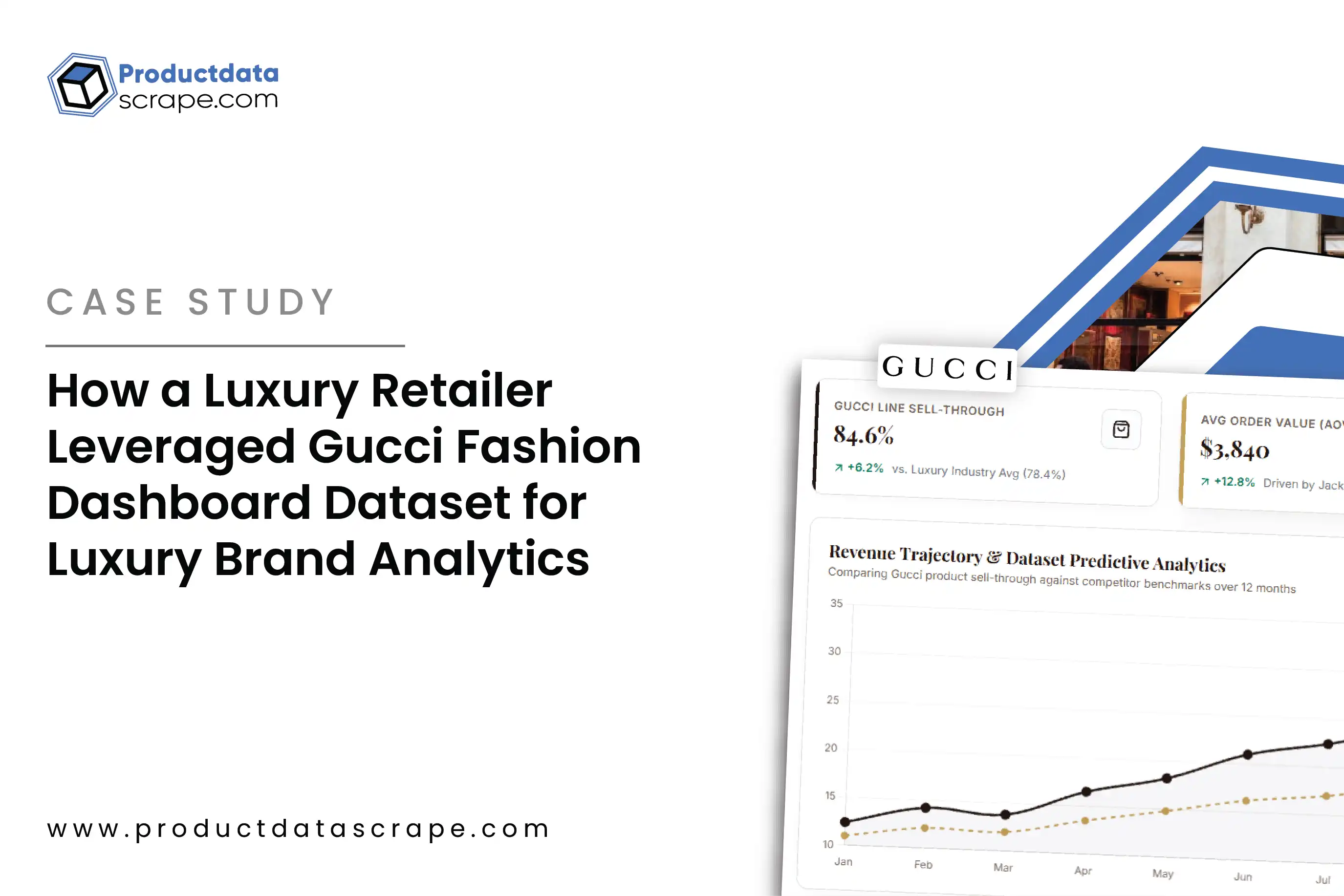
For the designer, dashboard visuals can feature Gucci handbag grids, sneaker cards, price trend charts, category filters, availability indicators, and comparisons with Prada, Dior, Louis Vuitton, and Burberry.
Client's Testimonial
"The structured fashion dataset significantly improved how our team monitored luxury products. Instead of spending hours collecting individual product details, our analysts could work directly with standardized records and dashboard views. We gained clearer visibility into assortment, pricing, availability, and category movements, which made our recurring fashion intelligence reports much easier to produce."
— Director of Luxury Retail Intelligence, Client Organization
The implementation also supported Demand Trend Intelligence by giving analysts historical product and assortment records that could be examined across collection periods.
The client was able to spend more time interpreting market activity and less time performing repetitive data collection and spreadsheet preparation.
Conclusion
Luxury fashion businesses require accurate and consistently refreshed product information to understand assortment, pricing, availability, and collection movements. Product Data Scrape helped the client replace fragmented research with an automated and dashboard-ready data workflow.
The project improved data processing speed, reduced manual preparation, and created a structured foundation for product-level and category-level analysis.
The resulting dataset could support product benchmarking, pricing research, assortment monitoring, availability analysis, and recurring luxury retail reporting.
With scalable Fashion data scraping, the client gained a framework that could be expanded to additional categories, markets, and luxury brands while maintaining consistent data structures.
The approach demonstrates how structured fashion data can transform large product catalogs into usable intelligence for modern luxury retail analytics.
Frequently Asked Questions
1. What information can be included in a Gucci fashion dataset?
A fashion dataset can include product names, categories, subcategories, prices, colors, sizes, materials, availability, product URLs, collection information, and other publicly accessible product attributes.
2. Which Gucci product categories can be monitored?
Depending on project requirements, monitoring can cover handbags, sneakers, loafers, boots, belts, wallets, sunglasses, scarves, apparel, jewelry, and other accessories.
3. How can luxury fashion data support pricing analysis?
Historical product records can help analysts compare prices across categories, collections, product types, and time periods. This can provide a structured basis for identifying pricing movements and assortment patterns.
4. Can the dataset be connected to a dashboard?
Yes. Structured and validated product records can be prepared for BI dashboards and internal analytics systems. Dashboard views can include category filters, price ranges, product availability, collection information, and historical trends.
5. Can the same framework be expanded to other luxury brands?
Yes. Once a standardized data architecture is established, the framework can be adapted for other brands and retailers. Examples for visual benchmarking could include Prada, Dior, Louis Vuitton, Burberry, Versace, and Saint Laurent, subject to the required data sources and project scope.


 Singapore
 EMAIL
EMAIL
 PHONE
PHONE










.webp)