Introduction
Online marketplaces give buyers and sellers access to a wide range of products, competing offers, and changing prices. For retailers, ecommerce analysts, and market researchers, comparing listings across platforms can help reveal differences in product positioning, availability, and pricing strategies. Scraping Facebook Marketplace Data can support this research by organising publicly accessible listing information into structured datasets, subject to platform terms, access controls, and applicable privacy laws.
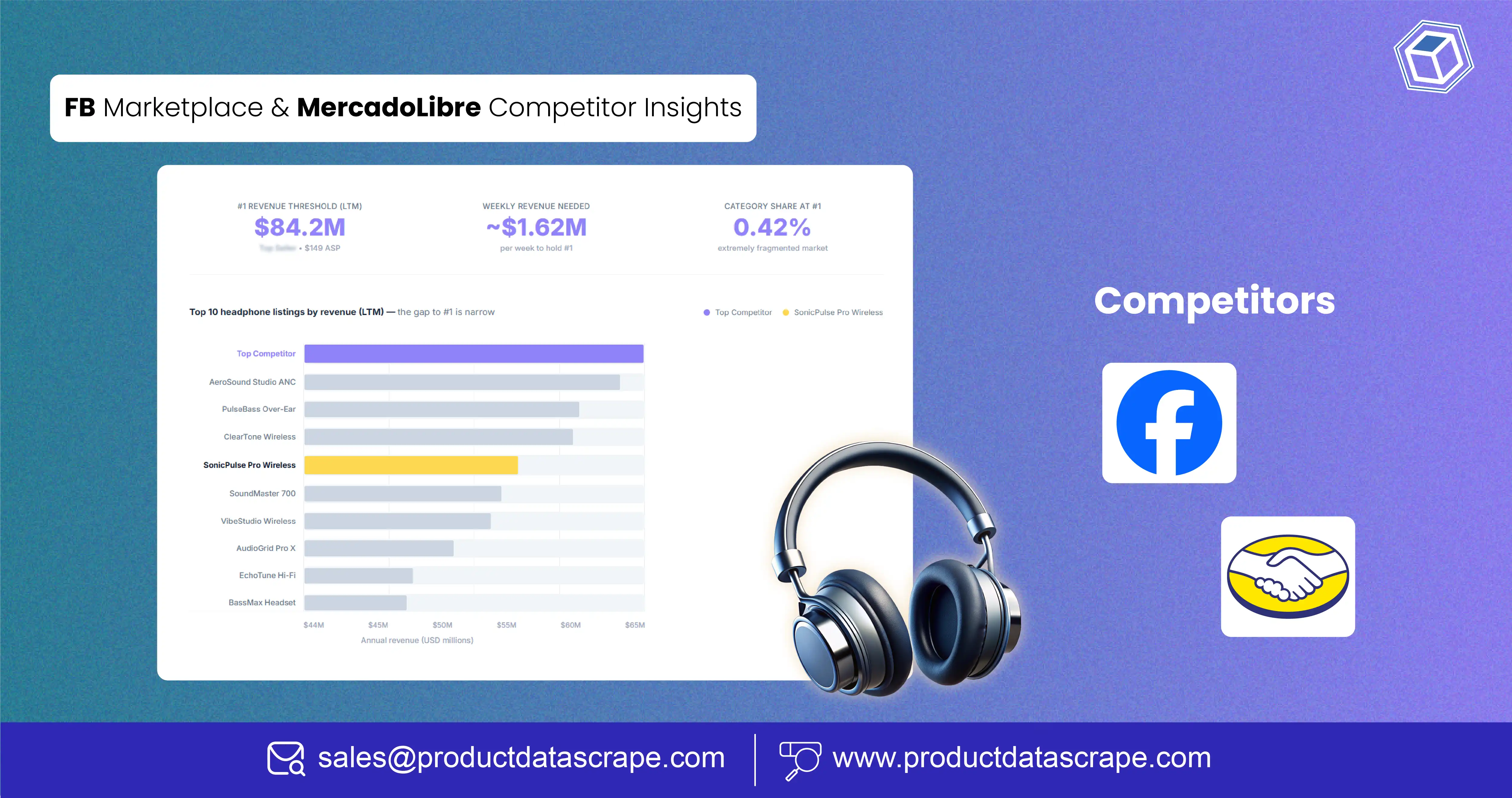
A cross-marketplace analysis can also include Mercado Libre, which operates across Latin American markets and offers product listings from a broad seller base. A Mercado Libre Product Data Scraping API can be part of a data collection workflow when its access method, coverage, and permitted use are appropriate. Combining authorised data sources allows teams to compare relevant product attributes, track observed prices over time, and build evidence-based competitor reports.
The key is to distinguish collected observations from assumptions. Prices can change, product descriptions may differ, and similar-looking listings may not represent identical items. A reliable workflow therefore needs consistent product matching, timestamps, currency and location context, and clear documentation of data sources.
Building a Consistent View of Marketplace Pricing
Facebook Marketplace Price Tracking for other sites helps businesses compare listed prices across marketplaces rather than relying on isolated observations. However, price comparisons are only meaningful when the products, conditions, locations, and currencies are comparable. A used smartphone listed by a local seller should not automatically be compared with a new, warranty-backed product on a major ecommerce platform.
A structured Scraping Facebook Marketplace Data workflow can organise authorised listing information into fields such as item title, listed price, category, condition, location at an appropriate level, listing URL, and observation timestamp. These fields help analysts group comparable listings and identify changes between observations.
The commercial importance of online retail is supported by published data. UN Trade and Development reported that online retail's share of total retail sales across the economies included in its analysis increased from 16% in 2019 to 19% in 2020, illustrating the pandemic-era shift toward online purchasing. This figure describes the wider retail market, not Facebook Marketplace alone. Source: UNCTAD, 2021.
| Year |
Verified market context |
Relevance to analysis |
| 2020 |
Online retail reached 19% of total retail sales in UNCTAD's reported economy group. |
Establishes the pandemic-era shift toward online retail. |
| 2021 |
UNCTAD reported continued growth in online sales across several measured economies. |
Supports examining marketplace activity over time. |
| 2022 |
UNCTAD estimated business ecommerce sales across 43 economies at almost US$27 trillion. |
Highlights the scale of the wider digital commerce environment. |
Sources: UNCTAD, 2021 and UNCTAD, 2024.
These figures provide context, not a forecast of marketplace prices. For practical tracking, teams should record repeated observations at defined intervals, calculate price differences only for matched products, and retain the original source and collection date for auditability.
Turning Individual Listings into Structured Records
Facebook Marketplace Listing Data Extraction focuses on converting product information into a consistent format that can be searched, filtered, and analysed. Marketplace listings can contain titles, descriptions, prices, photographs, categories, condition details, and general location information. Meta's original Marketplace announcement described product discovery through photographs, descriptions, seller details, location, and category or price filters. Source: Meta, 2016.
For business research, collecting fields is only the first step. Product titles may use abbreviations, descriptions may omit important specifications, and sellers may describe the same product in different ways. A data pipeline should therefore standardise text, normalise currencies where appropriate, separate missing values from zero values, and preserve the original listing details for verification.
A useful listing dataset can contain the following fields:
| Field |
Purpose |
| Listing identifier or URL |
Helps distinguish records and revisit the source where permitted. |
| Product title |
Supports keyword searches and initial product matching. |
| Listed price and currency |
Enables comparable price analysis. |
| Category and condition |
Helps separate unlike products. |
| Observation timestamp |
Shows when the data was recorded. |
| Image reference |
Supports permitted visual review and product matching. |
| Availability status |
Helps distinguish current observations from stale records, where verifiable. |
The dataset should also identify the source platform and the method used to obtain each record. That distinction matters when several sites have different field definitions or update schedules.
Access permission is essential. Meta's Automated Data Collection Terms state that automated collection requires Meta's express written permission and restrict the use of collected data to authorised purposes. Businesses should confirm that their collection method and intended use are permitted before gathering Marketplace information. Data quality cannot compensate for an unauthorised collection process.
Comparing Offers Across Latin American Marketplaces
Businesses researching more than one platform need to account for differences in product naming, currencies, listing structures, and seller practices. Facebook Marketplace Data Scraping for MercadoLibre data describes a cross-platform research objective: comparing relevant product information from Facebook Marketplace with information available through Mercado Libre, while keeping the two sources distinct in the underlying dataset.
Scraping Facebook Marketplace Data should not be treated as automatic access to Mercado Libre. Each platform has its own access methods, policies, and data structures. Mercado Libre provides official developer documentation for searching listings and retrieving item details through its APIs. Its documentation describes fields including item identifiers, titles, categories, pictures, prices, and seller-related details. See the official Items and Searches documentation and List Products documentation.
A cross-platform comparison workflow should match products using multiple attributes, such as brand, model, model number, capacity, condition, and relevant identifiers. Title similarity alone can produce false matches. For second-hand products, the analyst may also need to account for wear, included accessories, warranty status, and seller-provided specifications.
| Comparison requirement |
Recommended treatment |
| Currency |
Preserve the original currency and document any conversion rate and date. |
| Product identity |
Use model numbers and attributes, not just similar titles. |
| Product condition |
Separate new, refurbished, and used offers when the source supports this distinction. |
| Shipping and fees |
Record separately when reliable data is available. |
| Source and timestamp |
Keep a dated record for every observation. |
The result is a more defensible view of cross-marketplace pricing. Analysts can identify differences in advertised prices, but they should not interpret those differences as proof of actual transaction prices, sales volume, or consumer demand unless separate evidence supports those conclusions.
Understanding Price Changes and Competitive Positioning
MercadoLibre Competitor Price Monitoring can help ecommerce teams assess how listed prices differ between sellers and how advertised offers change over time. Mercado Libre's developer documentation describes endpoints for item searches, item details, and price information. It also documents price-related notifications for applications that subscribe to the relevant topic. These are official platform capabilities; the exact data available depends on the endpoint, authorisation, and use case. Source: Mercado Libre price documentation.
For a useful monitoring process, businesses need a baseline observation and subsequent records collected under a consistent methodology. Each record should include the product identifier, observed price, currency, timestamp, and any available promotion or condition information. Analysts can then calculate the absolute difference between two observations and the percentage change relative to the earlier price.
For example, the basic calculation is:
Price change (%) = (New price − Previous price) / Previous price × 100
This formula is a standard calculation, not a claim about any particular seller's pricing behaviour. Its interpretation depends on whether the two records describe the same item under comparable conditions.
| Monitoring metric |
What it tells analysts |
Important limitation |
| Current listed price |
The recorded asking price at a specific time |
Does not establish the final transaction price. |
| Absolute price change |
Difference between two observations |
Can be misleading if the item or condition changed. |
| Percentage price change |
Relative movement from the baseline |
Requires a valid, non-zero baseline price. |
| Promotion status |
Whether a source displays a promotion |
Promotions may depend on buyer or channel context. |
| Listing availability |
Whether an item appears available when checked |
A missing listing does not prove that an item sold. |
Teams should avoid treating an observed price decrease as proof of a competitor's strategy. Promotions, product variants, shipping costs, and local conditions can all affect the comparison. Reliable reporting separates confirmed observations from explanations that require further evidence.
Improving Data Quality Before Making Business Decisions
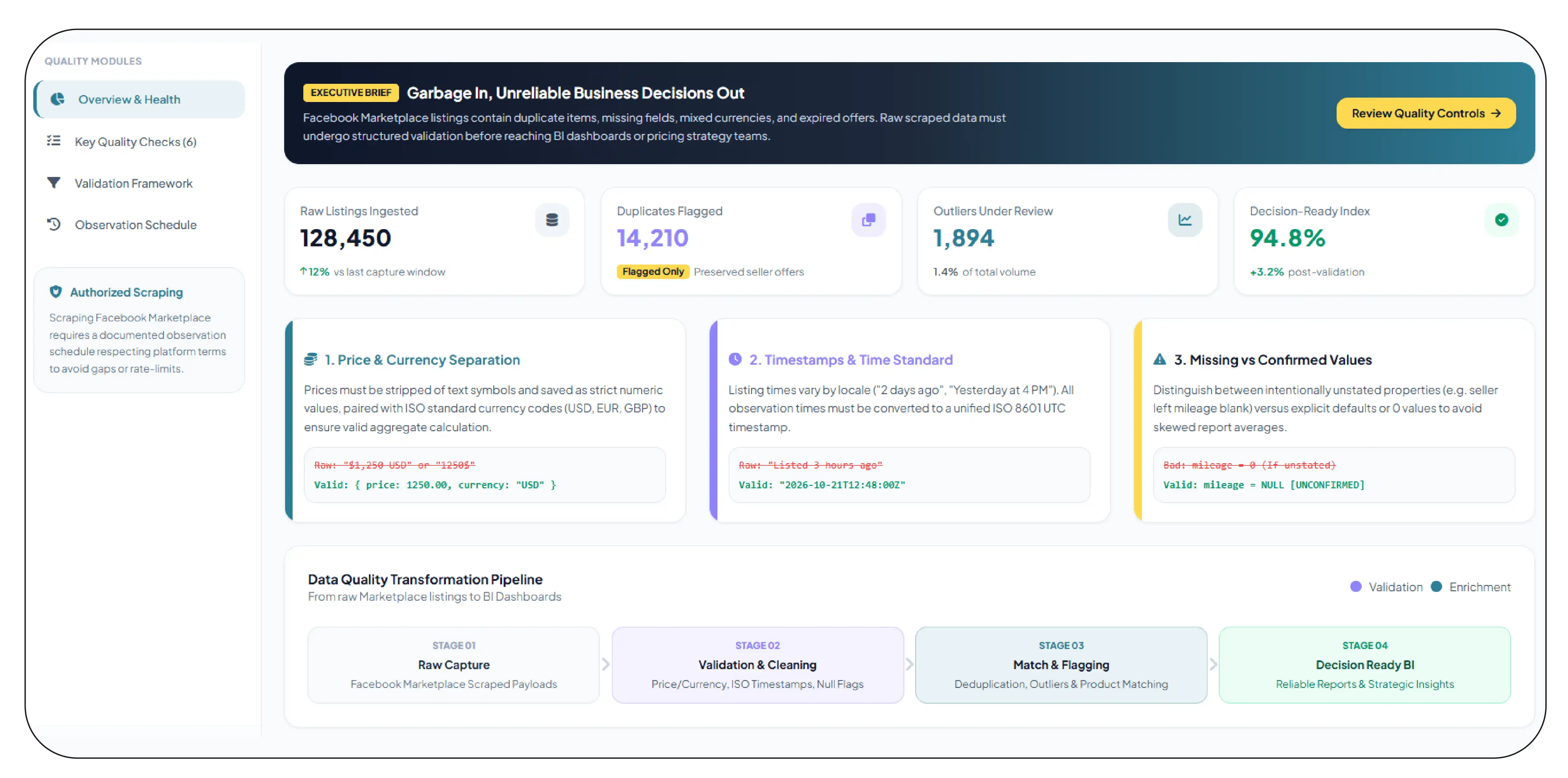
Facebook Marketplace Listing Data Extraction becomes more useful when the resulting dataset is checked for errors before it reaches dashboards or business reports. A large collection of listings may still produce unreliable conclusions if it contains duplicates, expired offers, inconsistent currencies, or multiple records for the same product.
A robust data-quality workflow begins with validation rules. Prices should be stored as numeric values with separate currency codes. Timestamps should use a consistent time standard. Missing fields should remain distinguishable from confirmed values, and duplicate listings should be flagged rather than automatically deleted when they may represent separate offers.
Repeated observations are also important. A single capture records a point in time; it cannot establish a price trend. Scraping Facebook Marketplace Data for ongoing analysis should use a documented observation schedule that respects the platform's authorised access conditions. The schedule should be selected according to the business question, not based on an assumption that every listing changes at the same rate.
Several quality checks are especially valuable:
- Product matching: Compare model numbers, brand names, specifications, condition, and other available identifiers.
- Outlier review: Flag unusually high or low values for investigation instead of deleting them without review.
- Duplicate detection: Identify repeated records while preserving genuinely separate seller offers.
- Source traceability: Retain permitted source references and observation timestamps.
- Freshness checks: Identify records that have not been revalidated within the reporting window.
- Coverage checks: Document which categories, regions, and platforms are included or missing.
These controls make findings easier to reproduce and explain. They also help analysts avoid overstating what the dataset represents: listings captured from selected sources are not necessarily a complete picture of the market.
Connecting Storefront Information with Broader Market Research
Extracting Facebook Shop & Marketplace Data may sound like one collection task, but Facebook Shops and Marketplace are distinct product experiences. Businesses should identify the specific source they are authorised to access and avoid assuming that data fields or collection permissions are interchangeable. Meta's automated data collection terms should be reviewed before designing an automated workflow.
For market research, the objective is to combine compatible information from approved sources into a consistent reporting model. That may involve listing titles, categories, prices, product attributes, and image references where access and usage rights permit. Personal data should be minimised, and the collection process should comply with applicable privacy and data-protection requirements.
The broader ecommerce context helps explain why structured analysis matters. DataReportal's Digital 2025 report, drawing on Statista estimates, reported global online consumer-goods spending of more than US$4.12 trillion in 2024, up 14.6% from 2023. It also reported that online channels represented 17.3% of consumer-goods revenue globally in 2024. These are broad ecommerce estimates, not measurements of Facebook Marketplace or Mercado Libre individually. Source: DataReportal, 2025.
Verified ecommerce data points, 2020–2026
The figures below are published reference points, not a continuous annual dataset. Where the cited sources do not provide a comparable value, the table says so rather than filling the gap with an estimate.
| Year |
Published data point |
Source and scope |
| 2020 |
Online retail reached 19% of total retail sales in the economies reported by UNCTAD. |
UNCTAD |
| 2021 |
UNCTAD reported that online retail sales remained elevated and online shopping activity continued across 66 countries with available statistics. |
UNCTAD |
| 2022 |
Business ecommerce sales across 43 economies were estimated at almost US$27 trillion. |
UNCTAD |
| 2023 |
No directly comparable annual figure is cited in this table. |
Not reported here as a separate data point. |
| 2024 |
Global online consumer-goods spending was estimated at more than US$4.12 trillion. |
DataReportal, 2025 |
| 2025 |
No directly comparable full-year figure is cited here. |
The referenced report covers 2024 spending. |
| 2026 |
No full-year figure is available in the sources cited here. |
The year is still in progress as of October 2026. |
For companies comparing marketplaces, these figures offer context about the wider digital economy, while the actual competitor analysis must come from appropriately sourced listing-level data. A structured workflow can help teams assess price differences, category coverage, and observed changes without confusing macroeconomic trends with individual seller behaviour.
Why Choose Product Data Scrape?
A dependable data workflow requires more than collecting product listings. It needs clear field definitions, consistent formatting, product-matching rules, timestamped records, and transparent reporting limitations. Product Data Scrape can support businesses seeking structured marketplace datasets for research and analysis, with the scope determined by the source, authorised access method, and project requirements.
A well-designed approach to Competitor Price Monitoring can help teams organise comparable observations and investigate changes without treating unverified assumptions as facts. Any Scraping Facebook Marketplace Data project should also account for platform permission, privacy obligations, and permitted data use. These controls help businesses build a more traceable foundation for product research, pricing analysis, and competitive reporting.
Conclusion
Cross-marketplace research can help businesses understand how products are presented, how advertised prices differ, and how listings change over time. The value of Marketplace & Seller Intelligence depends on accurate matching, consistent observations, and careful interpretation of the results.
With Real-time price tracking, teams can aim to capture timely observations from authorised sources, while recognising that actual collection frequency depends on access and platform capabilities. Product Data Scrape can help businesses plan structured data collection and analysis around their research objectives.
Ready to organise marketplace data for smarter competitor research? Contact Product Data Scrape to discuss a suitable data collection solution and project requirements!
Frequently Asked Questions
1. What is marketplace data scraping?
It is the structured collection of listing information from permitted sources. Scraping Facebook Marketplace Data requires appropriate authorisation and compliance with applicable platform terms and privacy requirements.
2. What information can marketplace datasets contain?
Depending on authorised access, datasets may include product titles, categories, displayed prices, condition, image references, listing URLs, and timestamps. Available fields vary by platform and source.
3. Can Mercado Libre data be collected through an API?
Mercado Libre provides official developer APIs for supported listing and price operations. A Mercado Libre Product Data Scraping API should not be assumed to be an official Mercado Libre product.
4. Why are timestamps important?
Timestamps show when each observation was captured, helping analysts compare records over time. Without them, it is difficult to distinguish a genuine change from differences in collection timing.
5. How can Product Data Scrape support this work?
Product Data Scrape can discuss structured data collection for marketplace research. The feasible scope depends on authorised access, requested fields, data quality needs, and applicable platform restrictions.


 Singapore
 EMAIL
 PHONE











.webp)