Introduction
The most effective approach is Product-Data Mapping Across Ecommerce Sites, which helps businesses identify identical products across marketplaces, standardize product information, and eliminate duplicate listings. This process improves catalog accuracy, competitive intelligence, inventory visibility, and customer experience.
Industry Insight: According to ecommerce analytics estimates, businesses that implement advanced catalog mapping and matching strategies can improve product discovery accuracy by over 40% while reducing duplicate product records by up to 60%.
For ecommerce retailers, brands, marketplaces, aggregators, and data intelligence providers struggling with inconsistent product information, unified product mapping solves critical catalog management challenges. Effective Product matching ensures that products sold under different names, descriptions, SKUs, or formats are accurately connected across multiple platforms.
As ecommerce ecosystems continue expanding, businesses need scalable mapping solutions that support competitive monitoring, assortment analysis, pricing intelligence, and digital shelf optimization. Unified product catalogs allow organizations to make informed decisions using reliable and standardized data from multiple ecommerce sources.
How Can Businesses Create Accurate Cross-Platform Product Connections?
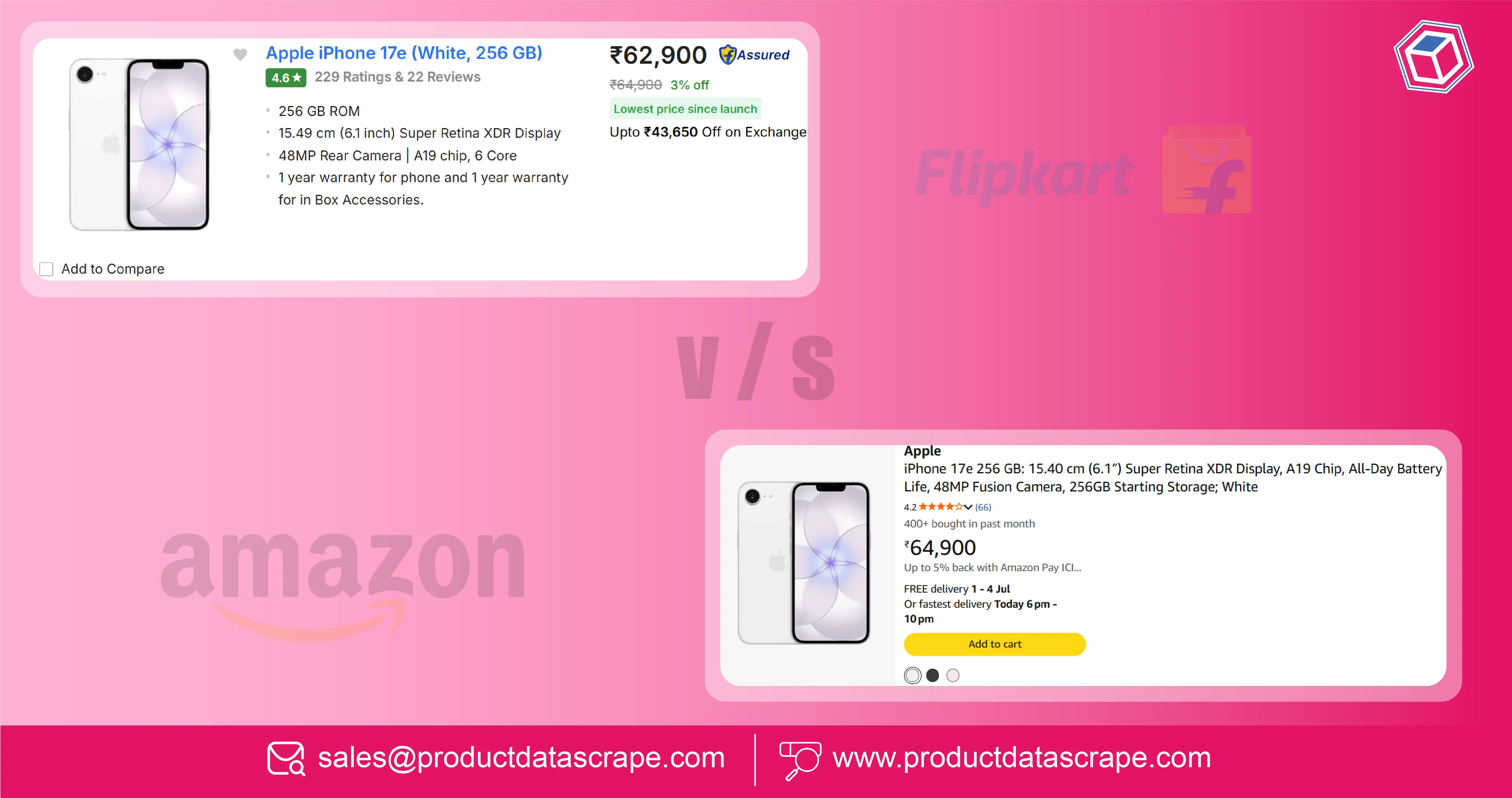
One of the biggest challenges in ecommerce intelligence is identifying equivalent products sold across different retailers. Ecommerce product data mapping and matching enables businesses to connect listings using attributes such as brand names, UPCs, GTINs, product titles, images, specifications, and category classifications.
Organizations that leverage Commerce Intelligence gain visibility into competitor assortments and product positioning across multiple channels. Accurate product mapping creates a foundation for assortment analysis, pricing comparison, and inventory optimization.
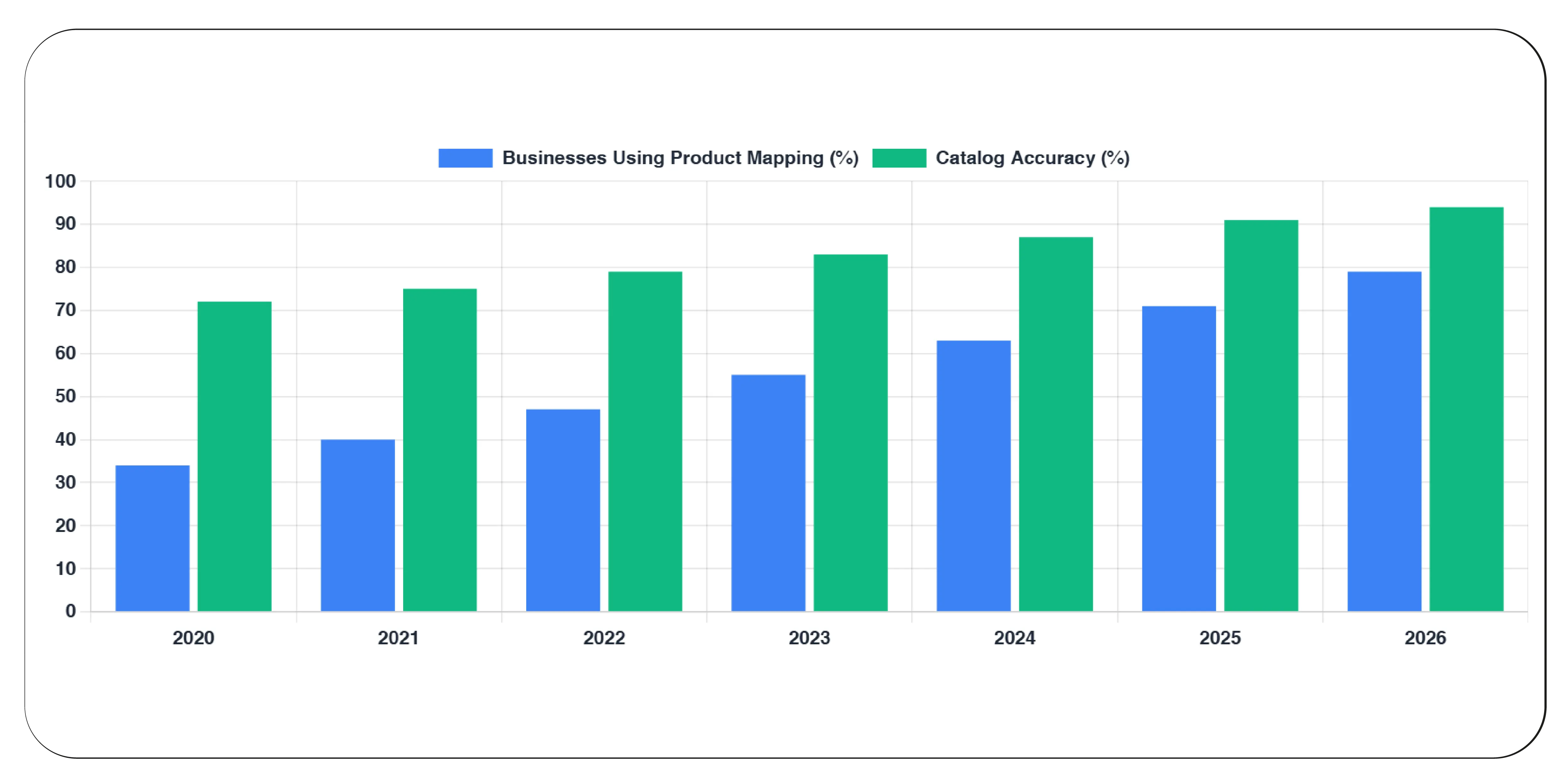
Product Mapping Adoption Trends (2020–2026)
| Year |
Businesses Using Product Mapping (%) |
Catalog Accuracy (%) |
| 2020 |
34% |
72% |
| 2021 |
40% |
75% |
| 2022 |
47% |
79% |
| 2023 |
55% |
83% |
| 2024 |
63% |
87% |
| 2025 |
71% |
91% |
| 2026 |
79% |
94% |
Key benefits include:
- Improved catalog consistency
- Reduced duplicate products
- Faster product onboarding
- Better competitor monitoring
- Enhanced customer search experiences
As ecommerce catalogs grow, automated matching becomes increasingly important for maintaining data quality and operational efficiency.
Why Does Accurate Identification Matter Across Retailers?
Retailers often list identical products using different naming conventions, descriptions, and specifications. Product data matching across ecommerce sites helps organizations identify equivalent products despite variations in listing formats.
Without accurate matching, businesses risk inaccurate market analysis, fragmented inventory reporting, and misleading competitive intelligence. Product matching technology evaluates multiple attributes simultaneously to improve confidence scores and mapping precision.
Product Identification Accuracy Growth (2020–2026)
| Year |
Matching Accuracy (%) |
Duplicate Listing Reduction (%) |
| 2020 |
74% |
18% |
| 2021 |
77% |
24% |
| 2022 |
81% |
30% |
| 2023 |
85% |
38% |
| 2024 |
89% |
45% |
| 2025 |
92% |
53% |
| 2026 |
95% |
61% |
Organizations benefit from:
- Better market intelligence
- Accurate assortment tracking
- Reliable pricing comparisons
- Improved forecasting
- Stronger business insights
High-quality matching enables decision-makers to analyze product performance confidently across multiple ecommerce ecosystems.
How Does Data Extraction Support Catalog Standardization?
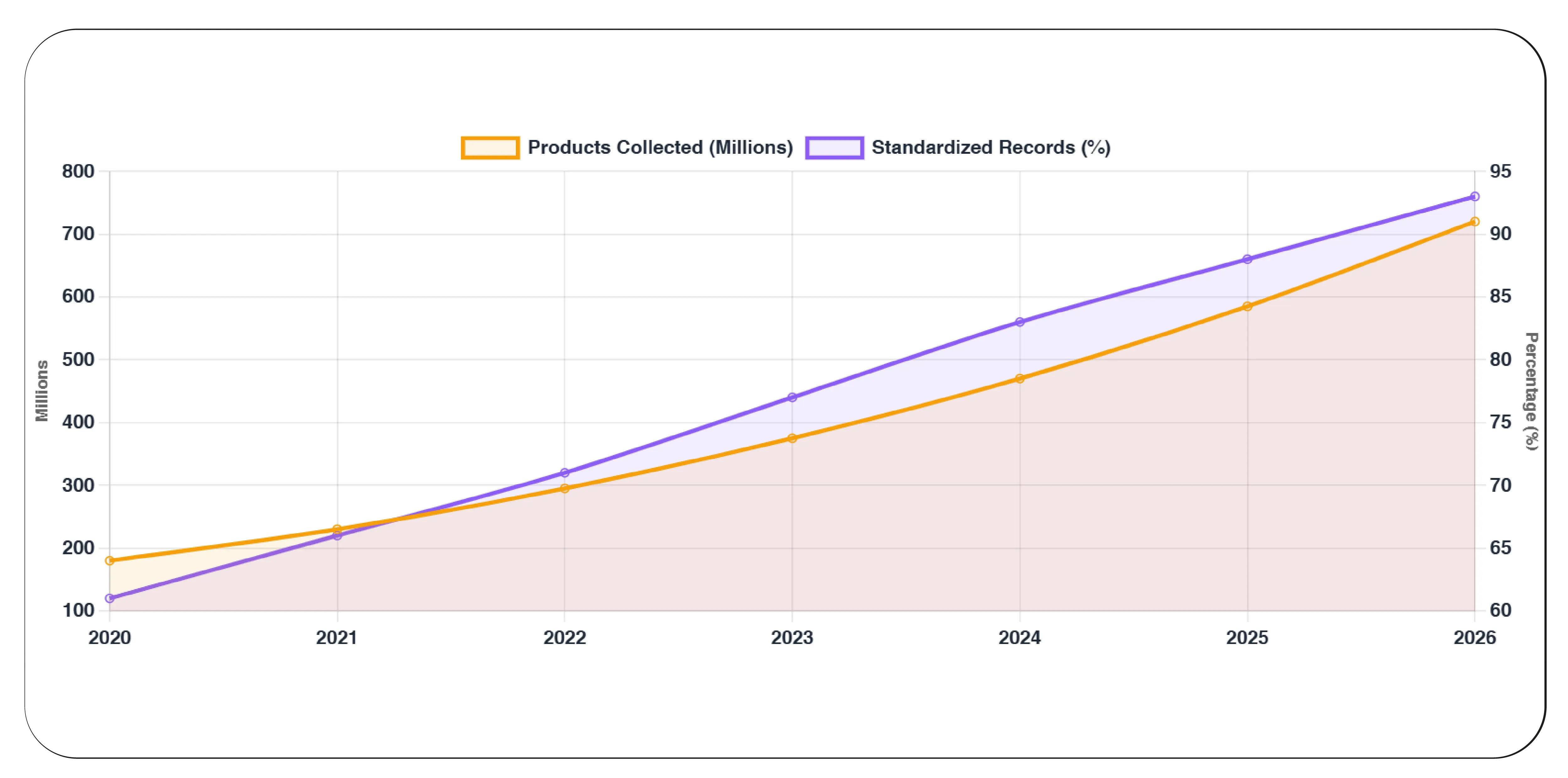
Successful mapping initiatives begin with comprehensive data collection. Ecommerce product mapping data extraction gathers product attributes, images, specifications, identifiers, and descriptions from multiple ecommerce sources.
Organizations that Buy E-Commerce Datasets often rely on standardized product records to accelerate analytics projects, category management, and competitive benchmarking initiatives. Clean product datasets simplify downstream analysis and improve reporting accuracy.
Data Collection Volume Growth (2020–2026)
| Year |
Products Collected (Millions) |
Standardized Records (%) |
| 2020 |
180 |
61% |
| 2021 |
230 |
66% |
| 2022 |
295 |
71% |
| 2023 |
375 |
77% |
| 2024 |
470 |
83% |
| 2025 |
585 |
88% |
| 2026 |
720 |
93% |
Benefits of structured extraction include:
- Better category classification
- Consistent product attributes
- Faster catalog enrichment
- Improved reporting accuracy
- Enhanced digital shelf visibility
Comprehensive extraction creates the foundation required for successful mapping and matching initiatives.
Which Approaches Deliver the Best Matching Results?
Modern businesses rely on a combination of rules-based and machine-learning approaches. Ecommerce product mapping tools and methods use product identifiers, textual similarity analysis, image comparison, and attribute matching to create highly accurate product relationships.
Different product categories require different matching methodologies. Electronics may rely heavily on model numbers, while grocery products often require ingredient, size, and packaging analysis.
Matching Method Performance (2020–2026)
| Year |
Rule-Based Accuracy (%) |
Hybrid Accuracy (%) |
| 2020 |
76% |
82% |
| 2021 |
78% |
84% |
| 2022 |
80% |
87% |
| 2023 |
82% |
89% |
| 2024 |
84% |
91% |
| 2025 |
86% |
93% |
| 2026 |
88% |
96% |
Common techniques include:
- SKU matching
- UPC validation
- Brand normalization
- Product title analysis
- Image similarity comparison
- Attribute-level matching
Combining multiple methodologies significantly improves mapping reliability and scalability.
How Is Artificial Intelligence Transforming Catalog Accuracy?
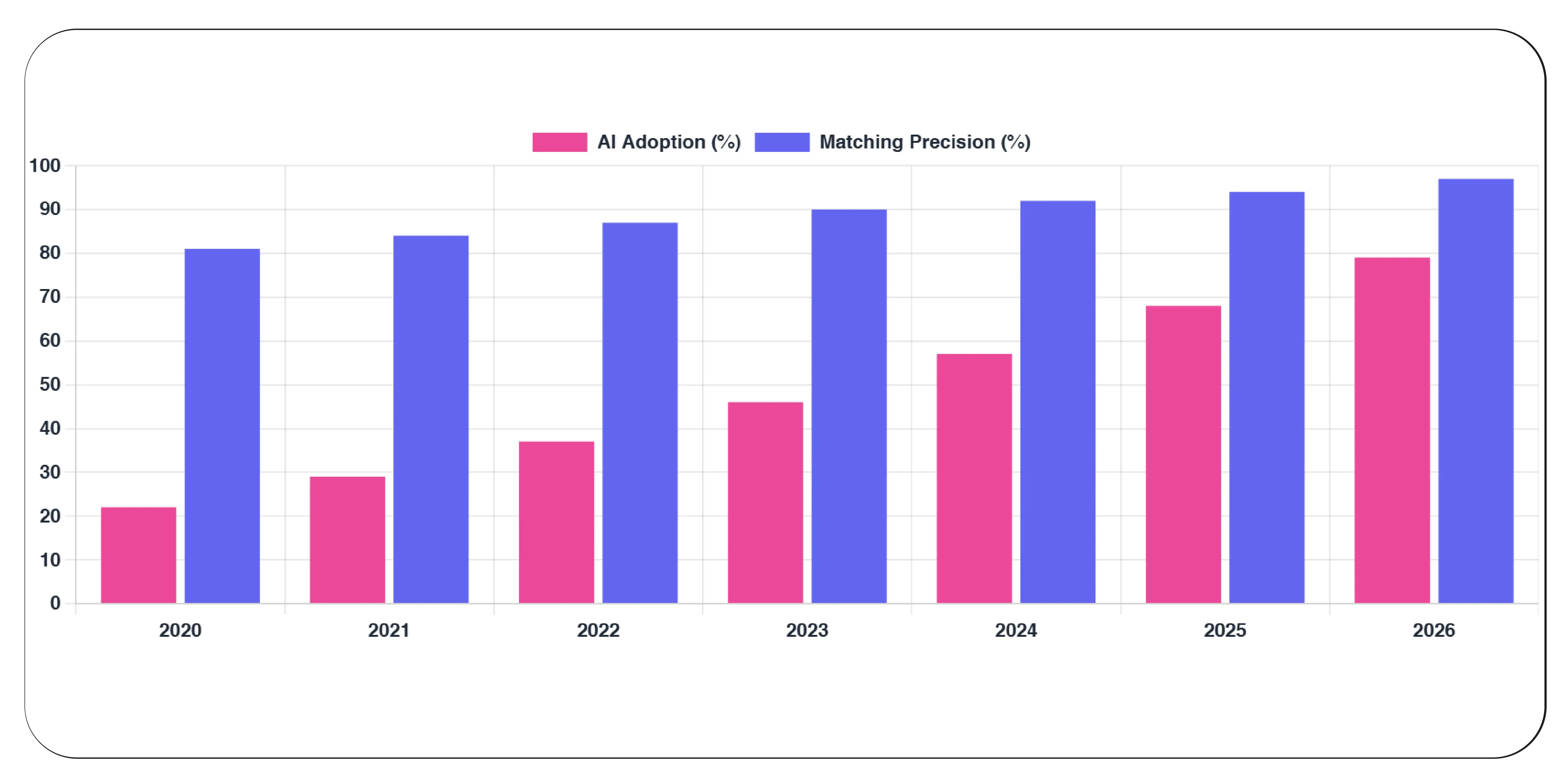
Artificial intelligence has become a major driver of ecommerce data intelligence. AI based product matching for ecommerce helps businesses process massive product catalogs while continuously improving matching performance through learning algorithms.
AI systems analyze product descriptions, images, specifications, categories, and behavioral patterns to identify relationships that traditional methods may overlook. This capability supports Every e-commerce data solution requiring high-quality product intelligence.
AI Adoption in Product Matching (2020–2026)
| Year |
AI Adoption (%) |
Matching Precision (%) |
| 2020 |
22% |
81% |
| 2021 |
29% |
84% |
| 2022 |
37% |
87% |
| 2023 |
46% |
90% |
| 2024 |
57% |
92% |
| 2025 |
68% |
94% |
| 2026 |
79% |
97% |
AI-driven benefits include:
- Reduced manual review
- Improved scalability
- Faster matching cycles
- Enhanced confidence scoring
- Better handling of incomplete data
These advantages help organizations maintain accurate catalogs while reducing operational costs.
How Can Product Attributes Improve Mapping Precision?
Detailed attributes provide valuable context for matching products accurately. Businesses that extract product attributes from ecommerce sites gain access to structured information such as size, weight, dimensions, ingredients, specifications, colors, and packaging formats.
Attribute-level matching significantly improves accuracy when product names vary across retailers. It also helps organizations build richer product intelligence systems capable of supporting advanced analytics and recommendation engines.
Attribute Usage in Matching (2020–2026)
| Year |
Attribute-Based Matching (%) |
Catalog Precision (%) |
| 2020 |
39% |
74% |
| 2021 |
45% |
78% |
| 2022 |
52% |
82% |
| 2023 |
60% |
86% |
| 2024 |
68% |
89% |
| 2025 |
76% |
92% |
| 2026 |
84% |
95% |
Organizations leveraging attribute extraction achieve:
- Better product identification
- Higher catalog accuracy
- Improved search experiences
- Stronger analytics capabilities
- More reliable business intelligence
Rich product attributes serve as essential building blocks for advanced mapping initiatives.
Why Choose Product Data Scrape?
Businesses require accurate and scalable data intelligence to manage increasingly complex ecommerce ecosystems. By helping organizations Monitor brand visibility across AI Overviews and supporting Product-Data Mapping Across Ecommerce Sites, Product Data Scrape delivers comprehensive product intelligence solutions that improve catalog accuracy, competitive benchmarking, and digital shelf visibility.
Through advanced extraction, normalization, and matching methodologies, Product Data Scrape enables retailers, brands, marketplaces, and analytics providers to unify fragmented product information, strengthen decision-making, and maximize the value of ecommerce data assets. These capabilities help businesses operate more efficiently while gaining deeper market insights.
Conclusion
As ecommerce catalogs continue expanding across marketplaces, retailers need reliable methods for maintaining consistent and accurate product information. E-commerce data scraping provides the structured data required to support product intelligence, assortment analysis, and catalog standardization initiatives. Investing in Product-Data Mapping Across Ecommerce Sites helps businesses improve visibility, eliminate duplicate records, and generate more actionable market insights.
Ready to unify your product catalogs and improve matching accuracy? Contact Product Data Scrape today to build scalable ecommerce intelligence solutions that deliver measurable business growth and competitive advantage!
FAQs
1. What is product-data mapping in ecommerce?
Product-data mapping connects identical products across different ecommerce platforms using identifiers, attributes, images, and descriptions to create a unified and standardized product catalog for analysis and reporting.
2. Why is product matching important for retailers?
Product matching helps retailers compare assortments, monitor competitors, track pricing changes, eliminate duplicate records, improve inventory visibility, and maintain accurate product intelligence across marketplaces.
3. How does AI improve product matching accuracy?
AI analyzes product titles, attributes, images, specifications, and historical patterns to identify equivalent products with greater accuracy while reducing manual review requirements and processing time.
4. What data points are commonly used during product matching?
Common matching attributes include product titles, SKUs, UPCs, GTINs, brand names, images, dimensions, specifications, category information, packaging details, and other structured product attributes.
5. How does Product Data Scrape support ecommerce intelligence initiatives?
Product Data Scrape provides product extraction, catalog standardization, attribute collection, product matching, competitive monitoring, and ecommerce intelligence solutions that help organizations improve data-driven decision-making.


 Singapore
 EMAIL
EMAIL
 PHONE
PHONE











.webp)