Quick Overview
A leading food-tech analytics company specializing in restaurant intelligence partnered with Product Data Scrape to build advanced pricing models using large-scale restaurant datasets. The project focused on helping restaurant chains improve revenue forecasting accuracy and understand dynamic pricing trends across multiple locations. Over a six-month engagement, our team collected, processed, and analyzed extensive restaurant menus & food delivery datasets to support machine learning initiatives. Through this initiative, Scrape ML Team Trained Pricing Models on Zomato Menu Data to improve forecasting precision, accelerate pricing decisions, and strengthen market responsiveness. Key outcomes included a 38% improvement in forecast accuracy, a 52% reduction in manual data processing time, and a 47% increase in pricing intelligence coverage across monitored markets.
The Client
The client was a rapidly growing restaurant analytics and revenue management company serving multi-location restaurant brands. The organization operated in a highly competitive environment where menu pricing, promotional strategies, and consumer demand changed frequently across regions.
The food delivery ecosystem experienced significant transformation between 2020 and 2026. Restaurants increasingly relied on digital platforms to attract customers, creating a growing need for accurate pricing intelligence and forecasting capabilities. Businesses sought better ways to anticipate consumer behavior, optimize menu pricing, and respond quickly to market fluctuations.
The client wanted to Extract Zomato menu data for price prediction at scale while integrating pricing insights into machine learning workflows. However, manually collecting and maintaining restaurant pricing datasets was becoming increasingly difficult. Inconsistent data structures, frequent menu updates, and regional pricing differences limited the effectiveness of existing forecasting models.
Additionally, leadership wanted enhanced visibility into pricing changes and competitive positioning through solutions that could effectively Track AI shelf dynamics and market movements. Without a scalable data collection framework, forecasting accuracy remained inconsistent, impacting strategic decision-making and growth initiatives.
The client recognized that digital transformation was essential to remain competitive. They needed a robust data pipeline capable of supporting advanced analytics and machine learning applications while delivering reliable, real-time market intelligence.
Goals & Objectives
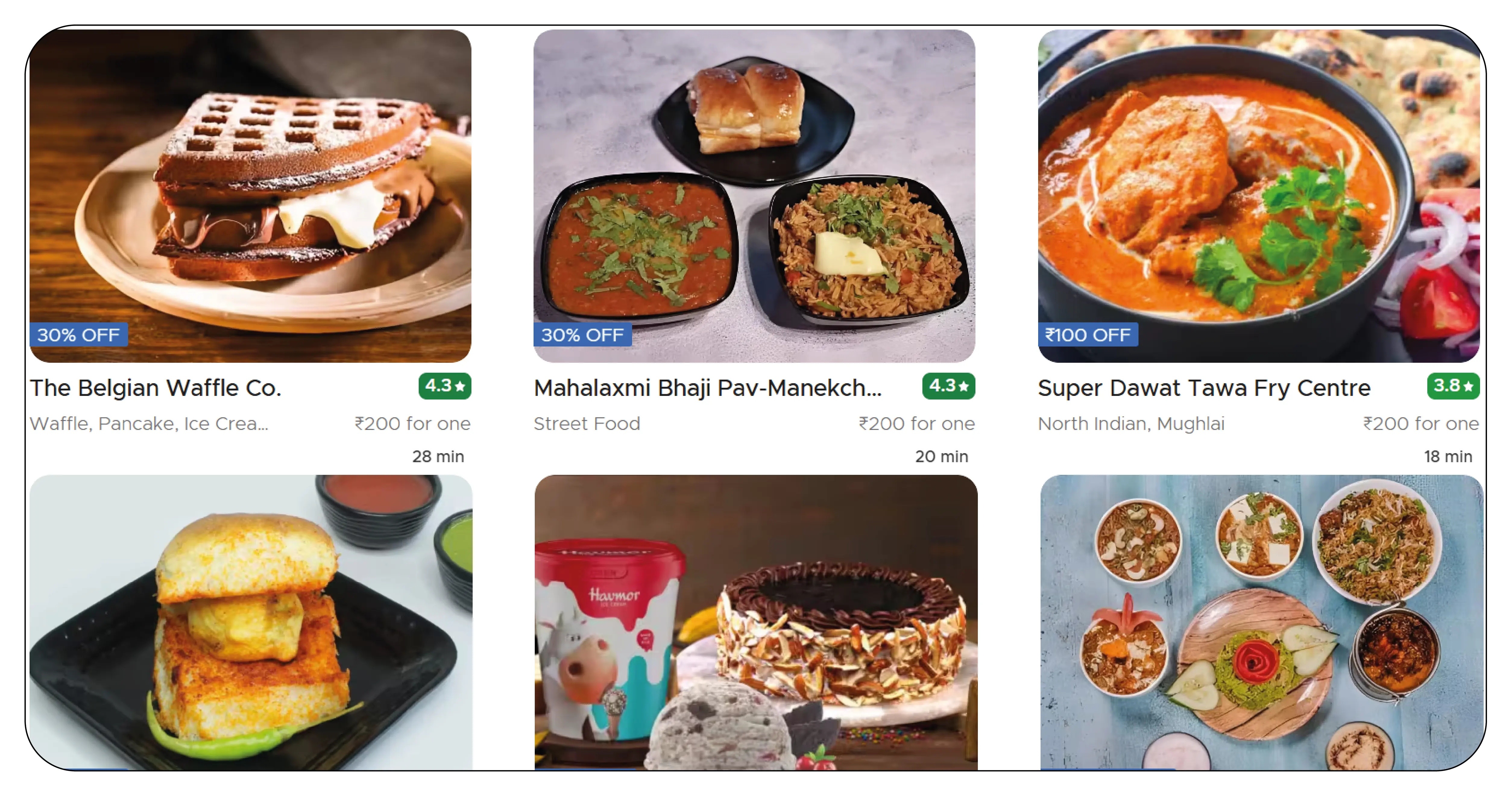
The primary goal was to build a scalable infrastructure capable of continuously collecting restaurant pricing information from multiple markets. The client wanted to Scrape machine learning pricing models using Zomato data to improve forecasting capabilities and support revenue optimization initiatives.
The project focused on creating automated workflows that would deliver high-quality structured data into machine learning environments. The solution needed to support real-time analytics, seamless integration with forecasting systems, and competitive intelligence initiatives designed to help the client Win the digital shelf through smarter pricing decisions.
Increase forecast accuracy by at least 30%
Reduce manual data collection efforts by 50%
Improve data freshness across monitored markets
Expand restaurant coverage across target locations
Enable automated machine learning model updates
Increase pricing visibility across categories
Support real-time analytics implementation
Improve data quality consistency
These objectives aligned business priorities with technical requirements, ensuring measurable outcomes throughout implementation.
The Core Challenge
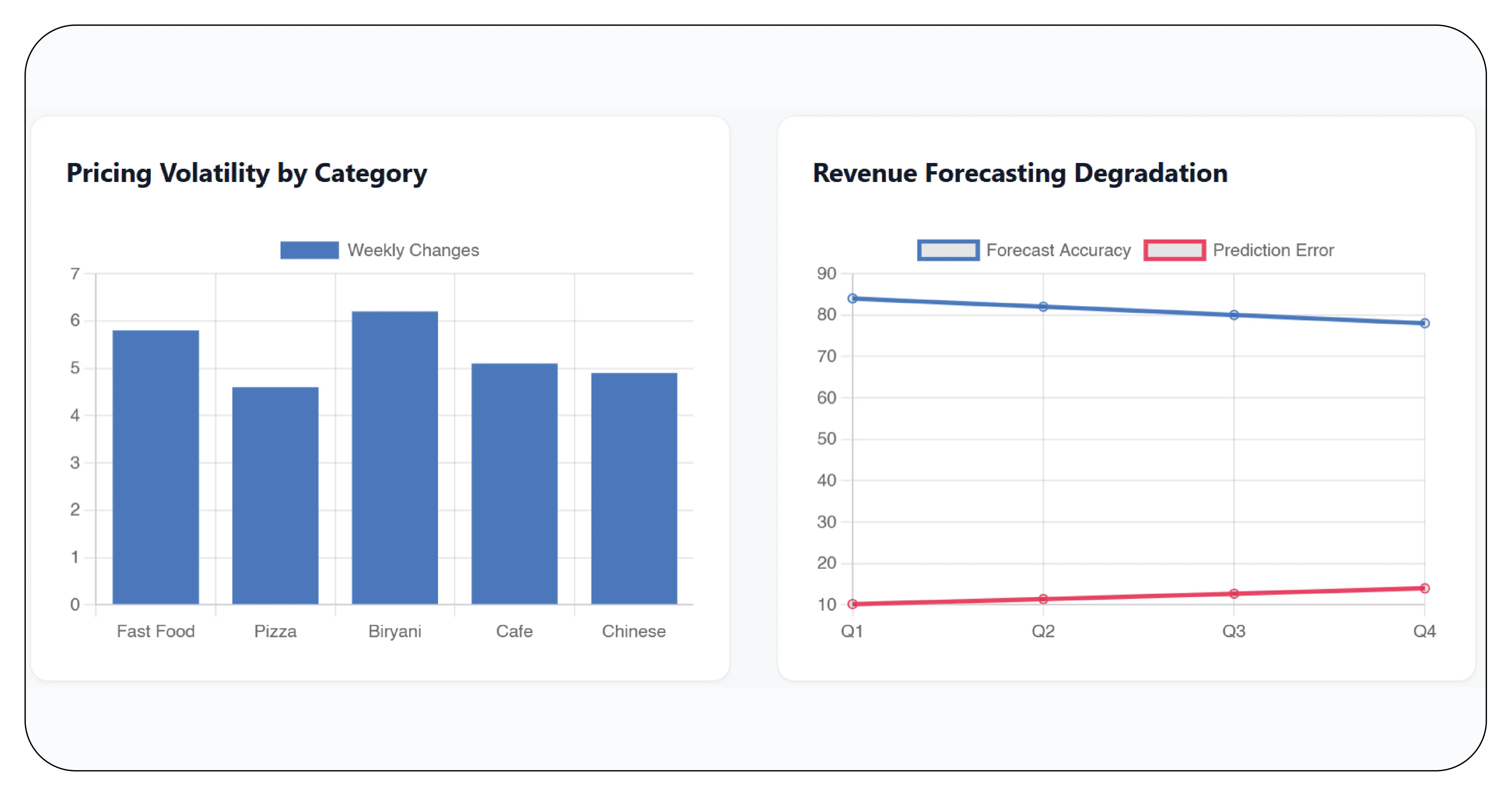
The client faced several operational and technical challenges that limited forecasting effectiveness. Restaurant menus changed frequently, often multiple times per week, making manual collection unsustainable.
Existing workflows lacked automation and required significant analyst involvement to update datasets. Data inconsistencies created challenges for machine learning models and reduced forecasting reliability. Without centralized pricing intelligence, the organization struggled to identify meaningful market trends quickly.
The client also wanted to implement AI powered Zomato menu pricing optimization capabilities but lacked the data infrastructure required to support advanced analytical models. Historical datasets contained missing values, duplicated entries, and inconsistent formatting that reduced model performance.
Another challenge involved maintaining accurate Pricing intelligence across hundreds of restaurant brands and thousands of menu items. The growing volume of restaurant pricing data created processing bottlenecks that delayed reporting and strategic decision-making.
As menu prices shifted in response to inflation, competition, and regional demand, the organization required a more agile solution. Without automation, analysts spent excessive time gathering data instead of generating business insights.
These limitations directly impacted revenue forecasting accuracy and prevented the client from fully leveraging machine learning to drive strategic growth and operational efficiency.
Our Solution
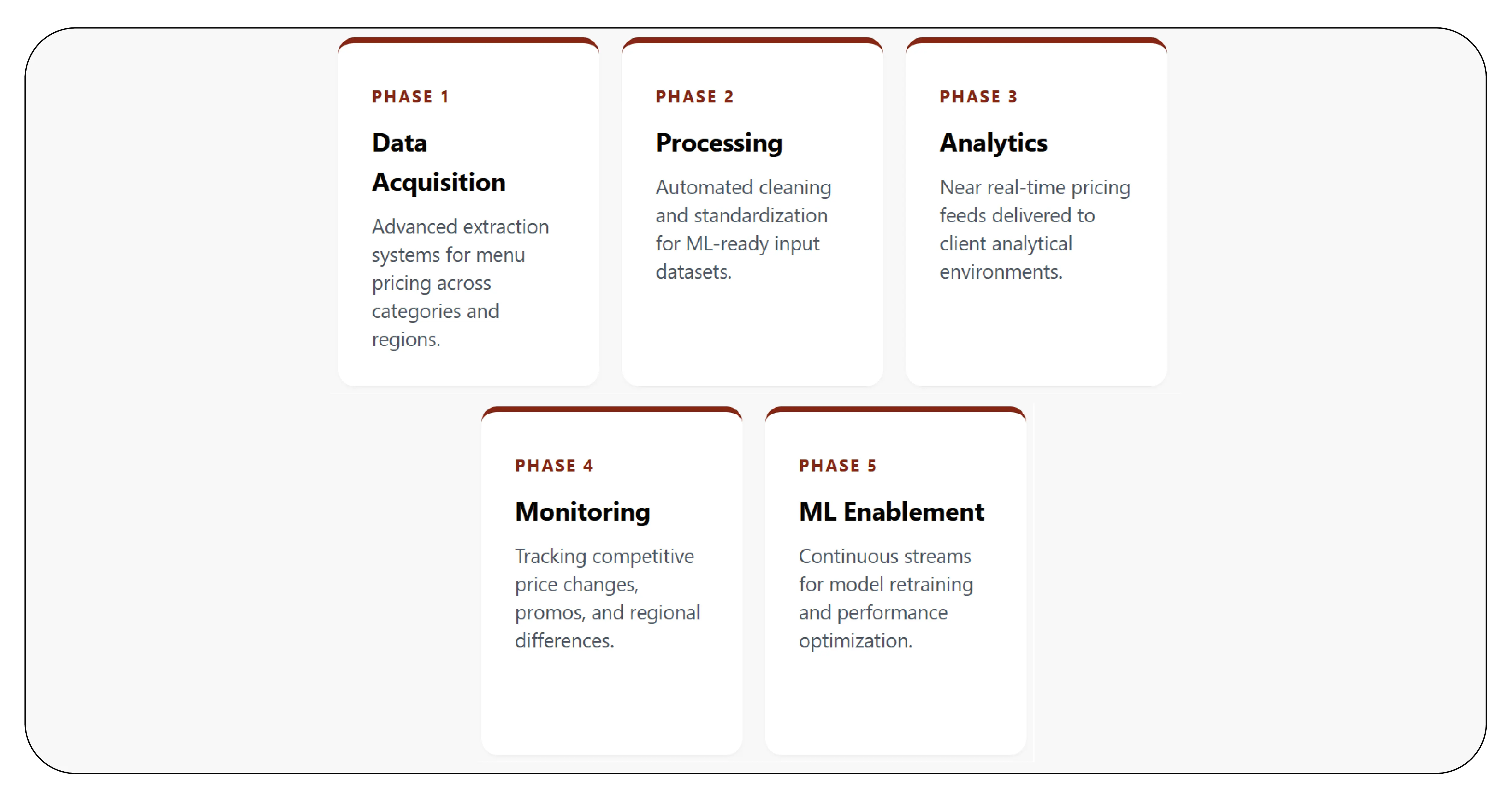
Product Data Scrape designed and implemented a phased data intelligence framework focused on automation, scalability, and machine learning readiness.
Phase 1: Data Acquisition Infrastructure
We deployed advanced extraction systems capable of collecting menu pricing information across multiple restaurant categories and geographic regions. This foundation enabled continuous collection of structured datasets while maintaining high data quality standards.
Phase 2: Data Processing & Standardization
Raw datasets were transformed into machine-learning-ready formats using automated validation and cleansing workflows. This process eliminated duplicate records, standardized menu classifications, and improved dataset consistency.
The resulting framework supported ML based restaurant pricing intelligence initiatives by ensuring reliable inputs for forecasting models.
Phase 3: Analytics Integration
Our team integrated pricing feeds directly into the client's analytical environment. Automated pipelines delivered near real-time updates that improved forecasting responsiveness and operational agility.
Phase 4: Competitive Monitoring
We established comprehensive monitoring systems to track menu price changes, promotional activities, and regional pricing differences. These insights supported strategic planning and revenue optimization initiatives.
Phase 5: Machine Learning Enablement
The final phase focused on supporting advanced predictive analytics workflows. Continuous data streams enabled more frequent model retraining and performance optimization.
To further strengthen market visibility, the solution incorporated Quick commerce intelligence capabilities that provided additional context regarding consumer demand patterns and pricing behavior across digital ordering ecosystems.
Technologies & Frameworks
Automated web data extraction systems
Data normalization pipelines
API integrations
Cloud-based storage architecture
Real-time analytics frameworks
Machine learning support environments
Automated monitoring dashboards
This phased approach ensured scalability while significantly improving data availability and forecasting performance.
Results & Key Metrics
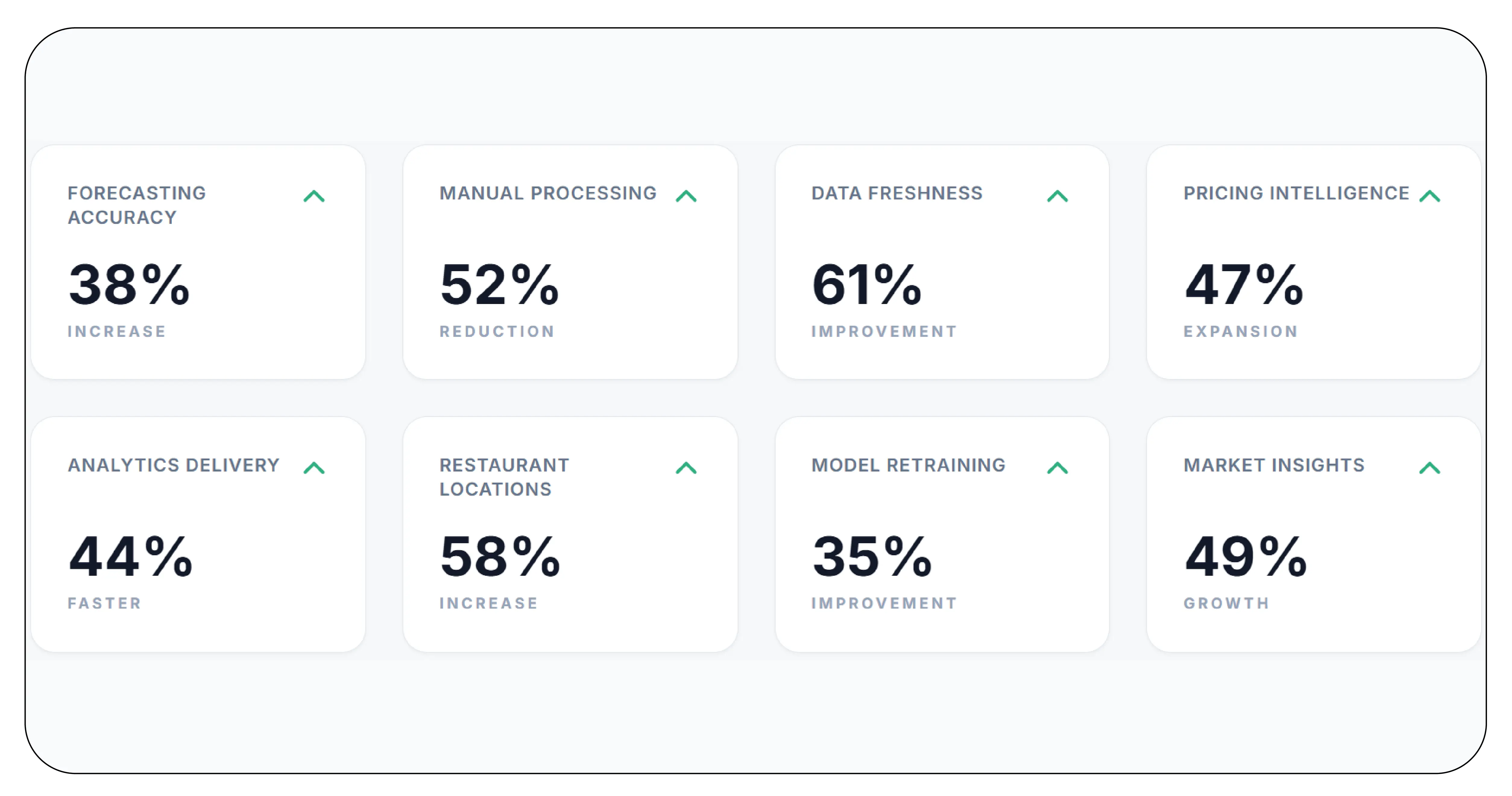
38% increase in forecasting accuracy
52% reduction in manual processing efforts
61% improvement in data freshness
47% expansion in pricing intelligence coverage
44% faster analytics delivery
58% increase in monitored restaurant locations
35% improvement in model retraining efficiency
49% growth in actionable market insights
The project also enhanced Zomato food pricing trends analysis capabilities and strengthened broader market intelligence initiatives supported by Grocery data scraping methodologies.
Results Narrative
The client achieved significant improvements across both business and technical performance metrics. Enhanced pricing visibility enabled more accurate forecasting and faster strategic responses to market changes. Automated workflows eliminated major operational bottlenecks while improving data consistency.
Machine learning teams gained access to richer datasets, enabling more reliable predictive models and better revenue planning. The solution transformed pricing intelligence into a strategic asset, helping the client improve operational efficiency and strengthen competitive positioning within the food delivery ecosystem.
What Made Product Data Scrape Different
Product Data Scrape combined advanced automation, scalable data architecture, and machine learning readiness into a unified solution. Our proprietary frameworks accelerated deployment while maintaining exceptional data quality standards.
Unlike conventional data collection approaches, our systems continuously adapt to changing digital environments and menu structures. This flexibility allowed the client to maintain uninterrupted access to high-quality pricing intelligence.
Our expertise in Machine learning for restaurant menu price optimization ensured that every dataset was designed specifically for predictive analytics applications. Through intelligent automation, scalable infrastructure, and industry expertise, we delivered a future-ready solution capable of supporting long-term growth and innovation.
Client Testimonial
"Working with Product Data Scrape transformed our forecasting capabilities. Their team delivered a highly scalable data infrastructure that significantly improved pricing visibility and model performance. The quality, consistency, and timeliness of the datasets exceeded expectations. Through the initiative where Scrape ML Team Trained Pricing Models on Zomato Menu Data, we achieved measurable gains in forecasting accuracy and operational efficiency. The partnership enabled us to move from reactive decision-making to proactive pricing strategy management. Their technical expertise and commitment to innovation made a substantial impact on our business outcomes."
— Director of Revenue Analytics
Conclusion
As restaurant pricing becomes increasingly dynamic, access to high-quality data is essential for competitive success. This project demonstrated how scalable data collection and machine learning integration can significantly improve forecasting accuracy and pricing intelligence.
By leveraging advanced analytics and Quick commerce & FMCG data, organizations can gain deeper market visibility, optimize pricing strategies, and improve business performance. Product Data Scrape helped the client transform fragmented pricing information into actionable intelligence, creating a foundation for future innovation, smarter forecasting, and sustained competitive advantage in the evolving food delivery marketplace.
FAQs
1. Why is restaurant pricing data important for machine learning models?
Restaurant pricing data helps machine learning systems identify trends, forecast demand, optimize pricing strategies, and improve revenue planning through data-driven decision-making and predictive analytics.
2. How often should restaurant menu pricing data be updated?
Ideally, pricing datasets should be refreshed daily or in near real time because menu prices, promotions, and availability frequently change across food delivery platforms.
3. What challenges exist when collecting restaurant menu data?
Common challenges include inconsistent formats, duplicate records, menu updates, regional pricing variations, missing information, and maintaining scalable data collection processes.
4. How does pricing intelligence improve forecasting accuracy?
Pricing intelligence provides historical and real-time market insights that help forecasting models better understand pricing behavior, consumer demand, and competitive market dynamics.
5. What business benefits result from automated restaurant data collection?
Automated collection improves efficiency, increases data accuracy, reduces manual workload, accelerates analytics delivery, and enables organizations to make faster, more informed strategic decisions.


 Singapore
 EMAIL
EMAIL
 PHONE
PHONE










.webp)