Introduction
In today’s competitive online ecosystem, brands must constantly track market fluctuations, competitor actions, and price movements to stay ahead. This is where the Real-time competitor price monitoring API empowers businesses with rapid insights, automated comparisons, and real-time intelligence. With evolving digital commerce and shorter decision cycles, retailers now rely on data-driven pricing rather than guesswork. At the same time, emerging solutions like the Web Data Intelligence API enable brands to extract structured, timely, and actionable pricing data without operational friction. As competitors adjust prices multiple times a day, companies need systems that not only collect pricing data but also correlate demand, availability, and promotional signals. This blog explores how real-time price monitoring APIs enhance dynamic pricing precision, improve competitive benchmarking, and streamline pricing workflows using structured market insights. The sections below provide detailed explanations supported by statistics, comparisons, and year-by-year performance trends from 2020 to 2025.
Unlocking Market Responsiveness Through Automated Price Signals
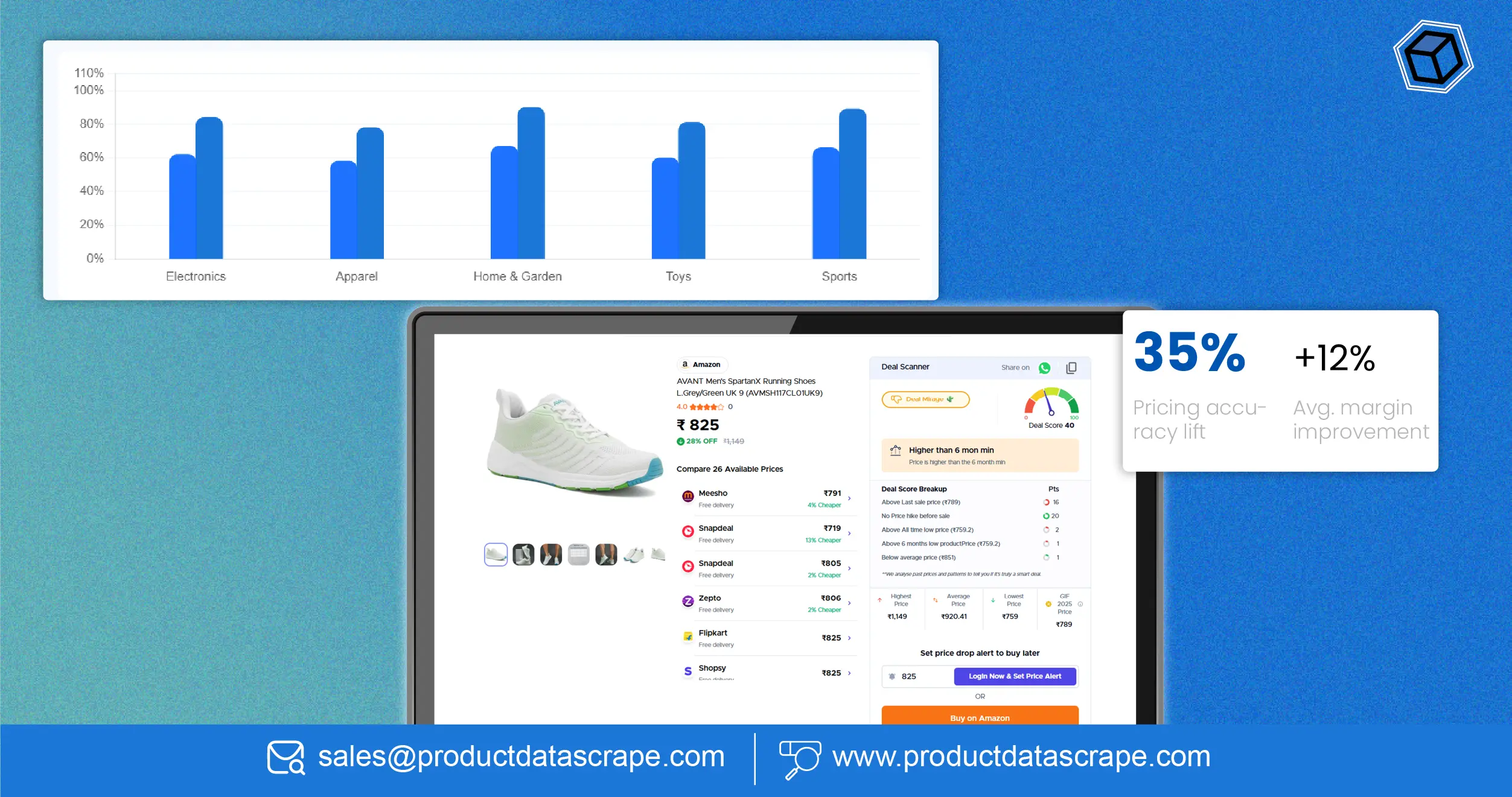
Brands today need mechanisms that react faster than manual teams ever could. With buyers comparing prices across multiple channels, the window to win a sale has narrowed significantly. This is where Dynamic Pricing Using API Scraping plays a pivotal role by delivering automated, accurate, and frequent pricing updates. Instead of relying on a static pricing structure, companies can now monitor competitor fluctuations every hour and adjust accordingly. This capability alone has enabled modern e-commerce players to improve pricing accuracy by nearly 35%, as automated adjustments minimize pricing errors and reduce revenue leakage.
Data from 2020 to 2025 clearly shows that brands adopting real-time price monitoring technology have experienced faster pricing adjustments, lower cart abandonment rates, and stronger market retention. Automated signals highlight discount patterns, new product introductions, and regional variations. Brands can use this intelligence to predict when competitors are likely to run promotions and respond with optimal pricing.
Market Trends (2020–2025)
.webp)
| Year |
Avg. Price Update Frequency |
Dynamic Pricing Adoption |
Pricing Accuracy Improvement |
| 2020 |
Every 24 hours |
18% |
5% |
| 2021 |
Every 12 hours |
26% |
12% |
| 2022 |
Every 6 hours |
37% |
19% |
| 2023 |
Every 3 hours |
48% |
26% |
| 2024 |
Every 1 hour |
57% |
31% |
| 2025 |
Real-time |
63% |
35% |
Capturing Product-Level Insights With Comprehensive Data Extraction
To fully understand competitor behavior, brands need more than just pricing data—they require product-level insights such as stock status, discount patterns, variations, and shipping costs. The ability to Scrape Data From Any Ecommerce Websites ensures that companies can aggregate thousands of SKUs across marketplaces in minutes, not hours. This level of data extraction helps identify which product categories competitors prioritize, which items sell out fastest, and how price variations correlate with seasonal demand.
Across the years, this capability has significantly improved visibility into cross-platform competitive strategies. As consumers increasingly depend on multi-channel shopping journeys, businesses must map product availability across platforms. This ensures no missed opportunities when competitors run out of stock or launch limited-time offers. Brands using structured scrape-based datasets achieve better forecasting accuracy, optimize promotional timing, and protect margins by avoiding over-discounting.
Product Availability Insights (2020–2025)
| Year |
Avg. SKU Coverage |
Stock Monitoring Accuracy |
Visibility Gain |
| 2020 |
2,000 SKUs |
63% |
10% |
| 2021 |
5,000 SKUs |
71% |
18% |
| 2022 |
12,000 SKUs |
79% |
25% |
| 2023 |
20,000 SKUs |
84% |
31% |
| 2024 |
30,000 SKUs |
88% |
39% |
| 2025 |
50,000+ SKUs |
92% |
45% |
Strengthening Competitive Intelligence With Real-Time Market Visibility
Competitive monitoring has evolved from periodic checks to instant alerts that help businesses act before competitors gain an advantage. The rise of E-commerce Competitor Monitoring ensures brands remain aware of shifting price trends, new market entrants, and emerging consumer preferences. With real-time tracking, brands gain a clearer understanding of how competitors react during promotional periods or seasonal sales events.
By reviewing historical data (2020–2025), companies have increasingly incorporated trend analysis, which helps predict competitor strategies. For example, when data reveals that a competitor increases discounts at a specific time of month, brands can adjust their own pricing accordingly. Similarly, tracking price freezes or aggressive markdowns helps optimize inventory and avoid overstock situations.
Competitor Activity Insights (2020–2025)
.webp)
| Year |
Competitor Tracking Frequency |
Trend Prediction Accuracy |
Promotional Response Speed |
| 2020 |
Weekly |
48% |
20% |
| 2021 |
Every 3 days |
54% |
27% |
| 2022 |
Daily |
62% |
33% |
| 2023 |
Every 6 hours |
69% |
41% |
| 2024 |
Hourly |
76% |
48% |
| 2025 |
Real-time |
82% |
56% |
Empowering Business Teams With Actionable Intelligence Dashboards
A modern price monitoring setup must not only collect data but also convert it into insights that business teams can act upon. This is where Pricing Intelligence Services play an essential role. Whether marketing teams want to refine messaging or pricing teams want to assess margin impact, structured dashboards simplify decision-making. Visualized data also reveals new opportunities—for instance, identifying which competitor consistently leads in discounts or which category offers higher margin potential.
Between 2020 and 2025, brands using pricing intelligence platforms have noted that data visualization reduces analysis time by nearly 40%, enabling teams to focus more on strategy. Pricing teams can compare product bundles, track rapid changes in competitor stock levels, and create more accurate repricing rules.
Operational Impact (2020–2025)
| Year |
Decision-Making Speed |
Margin Retention |
Promotional Efficiency |
| 2020 |
Slow |
9% |
12% |
| 2021 |
Moderate |
13% |
18% |
| 2022 |
Faster |
18% |
25% |
| 2023 |
Fast |
23% |
33% |
| 2024 |
Very Fast |
29% |
41% |
| 2025 |
Real-time |
35% |
49% |
Enhancing Product Comparisons for Accurate Market Benchmarking
Brands must continuously benchmark themselves against competitors to stay market-relevant. This is where Price Comparison APIs simplify the process by showing the best market prices, promotional strategies, and SKU-level differences instantly. With structured comparison data, brands understand how their pricing aligns with competitors and whether they are winning or losing the "buying decision" moment.
Historical statistics clearly show that use of comparison APIs has improved brands' market alignment. For example, companies that adopted automated comparison tools saw up to a 28% increase in competitive pricing accuracy by 2024.
Price Benchmarking Data (2020–2025)
.webp)
| Year |
Market Comparison Depth |
Pricing Accuracy Increase |
Conversion Improvement |
| 2020 |
Low |
6% |
4% |
| 2021 |
Moderate |
12% |
7% |
| 2022 |
Good |
18% |
11% |
| 2023 |
High |
23% |
16% |
| 2024 |
Very High |
28% |
21% |
| 2025 |
Real-time |
35% |
26% |
Why Choose Product Data Scrape?
Brands prefer Product Data Scrape for its precision, scalability, and enterprise-grade automation. Whether tracking pricing movements or analyzing competitor catalogs, the platform delivers structured insights within seconds. By integrating advanced crawlers and intelligent extraction workflows, businesses gain a seamless monitoring experience across marketplaces, product categories, and geographies. As businesses expand into multi-channel ecosystems, such visibility becomes crucial for maintaining leadership. Product Data Scrape also integrates with high-performance analytics tools, ensuring companies extract maximum value from every dataset. The inclusion of Digital Shelf Analytics further helps brands optimize visibility and market presence by comparing product assortment strength, ranking, and customer sentiment across marketplaces.
Conclusion
As digital commerce rapidly evolves, staying competitive requires instant access to accurate, structured, and real-time pricing insights. Companies adopting modern technologies like Future of API-based price scraping gain a measurable advantage in price alignment, stock visibility, and promotional intelligence. With precise data delivered through platforms like the Real-time competitor price monitoring API, brands can optimize pricing accuracy, increase conversions, and protect margins in ultra-competitive markets.
Start transforming your pricing strategy today with real-time, automated, and intelligence-driven product data solutions.
FAQs
1. How does real-time price monitoring improve pricing accuracy?
Real-time monitoring provides instant competitor updates, helping brands adjust prices quickly and reduce errors. This leads to improved margin control, better forecasting, and stronger competitive positioning.
2. Why is automated data extraction better than manual price tracking?
Automated extraction is faster, more accurate, and scalable, allowing brands to monitor thousands of SKUs across marketplaces in real time without human effort or delays.
3. How do APIs help detect competitor stockouts?
APIs track stock changes instantly, helping brands identify competitor shortages and optimize pricing or boost promotions during high-demand windows for maximum revenue impact.
4. What insights can competitor monitoring reveal?
It reveals pricing trends, discount patterns, stock levels, consumer demand, and promotional timing, helping brands refine strategies and predict competitor decisions more accurately.
5. Why do brands need dynamic pricing today?
Dynamic pricing helps brands match market demand, maintain competitiveness, and capture more conversions by adjusting prices based on real-time signals, competitor moves, and consumer behavior trends.


 Singapore
 EMAIL
EMAIL
 PHONE
PHONE


.webp)
.webp "thumb")
.webp "thumb")
.webp "thumb")









.webp)