Quick Overview
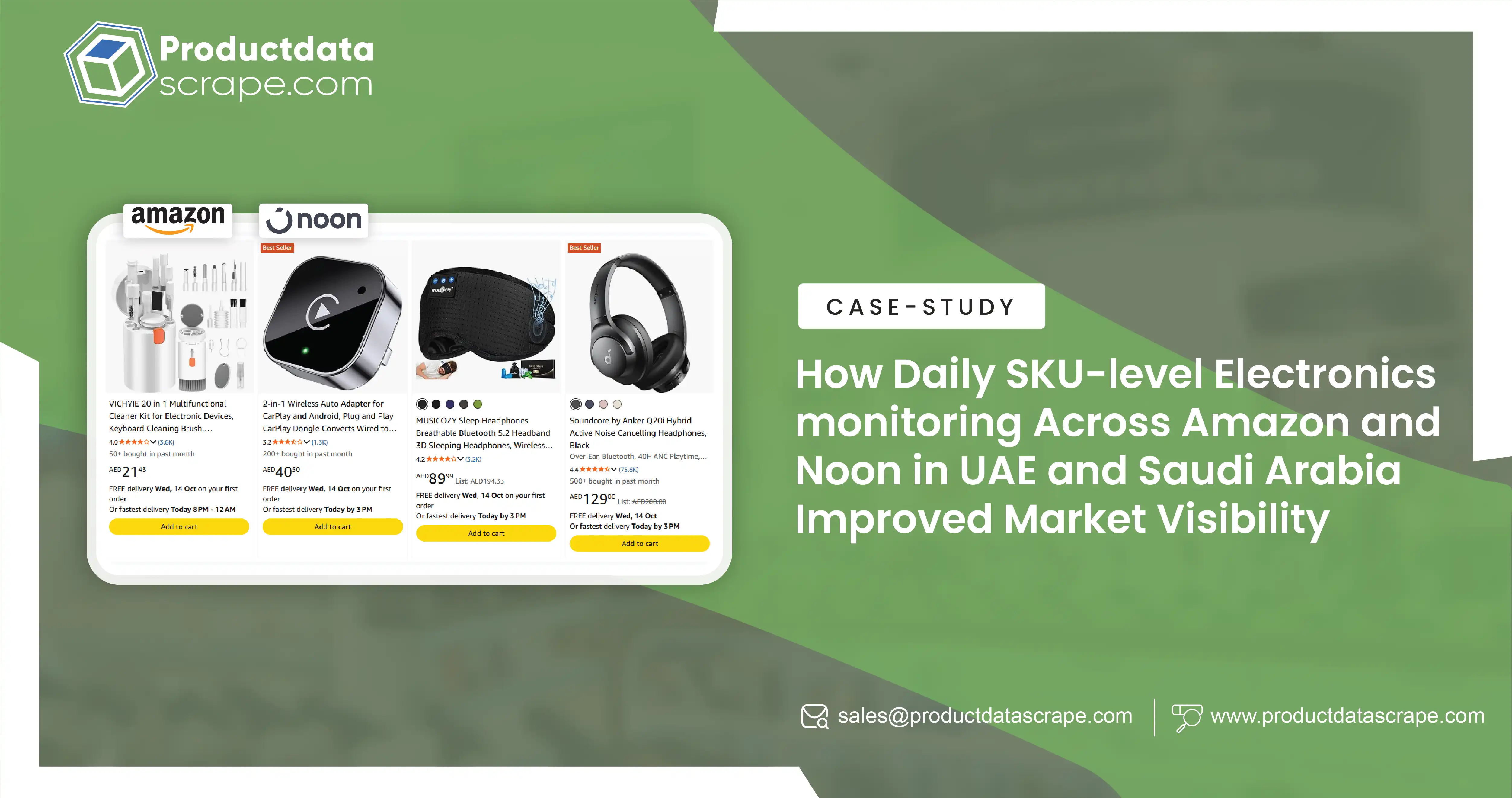
Product Data Scrape partnered with a regional electronics retailer to establish automated marketplace monitoring across Amazon UAE, Amazon Saudi Arabia, Noon UAE, and Noon Saudi Arabia. The project focused on Daily SKU-level Electronics monitoring for smartphones, laptops, tablets, gaming devices, headphones, televisions, and accessories from brands such as Apple, Samsung, Xiaomi, Lenovo, ASUS, Sony, and Huawei. The solution also incorporated Scraping Refurbished-Electronics Marketplaces Data to give the client broader visibility into new and refurbished product segments. Automated collection, product matching, validation, and historical tracking helped the retailer monitor changing prices, seller activity, product availability, and assortment at SKU level.
Client Name / Industry: Regional Electronics Retailer & Distributor
Service / Duration: UAE & Saudi Arabia Marketplace Monitoring / 14 Weeks
Key Impact Metrics: 90% faster SKU monitoring, 95%+ data accuracy, 85% reduction in manual research
The Client
The client was a regional electronics retailer and distributor operating across the UAE and Saudi Arabia. Its product portfolio included smartphones, laptops, tablets, televisions, gaming consoles, headphones, smartwatches, cameras, and computer accessories.
The electronics marketplace was highly dynamic, with prices, seller participation, inventory status, promotions, and product assortment changing frequently. Products from brands such as Apple, Samsung, Xiaomi, Lenovo, ASUS, Sony, and Huawei could appear across multiple marketplace listings and configurations.
Before partnering with Product Data Scrape, the client relied on manual product checks and spreadsheets to monitor marketplace changes. Analysts had to search individual listings, record prices, compare sellers, and update product information manually. This process became difficult as the number of monitored SKUs expanded.
The company wanted to Scrape Amazon UAE vs Noon UAE Electronics data to establish a more consistent cross-marketplace view. It also required scalable Amazon product data scraping to collect product, pricing, seller, and availability information from priority categories.
The transformation was important because manual monitoring provided only periodic snapshots rather than a continuously refreshed dataset. The retailer needed an automated system capable of capturing SKU-level changes and preserving historical records for pricing and competitive analysis.
The new framework would allow the business to spend less time gathering marketplace information and more time analyzing product and market movements.
Goals & Objectives
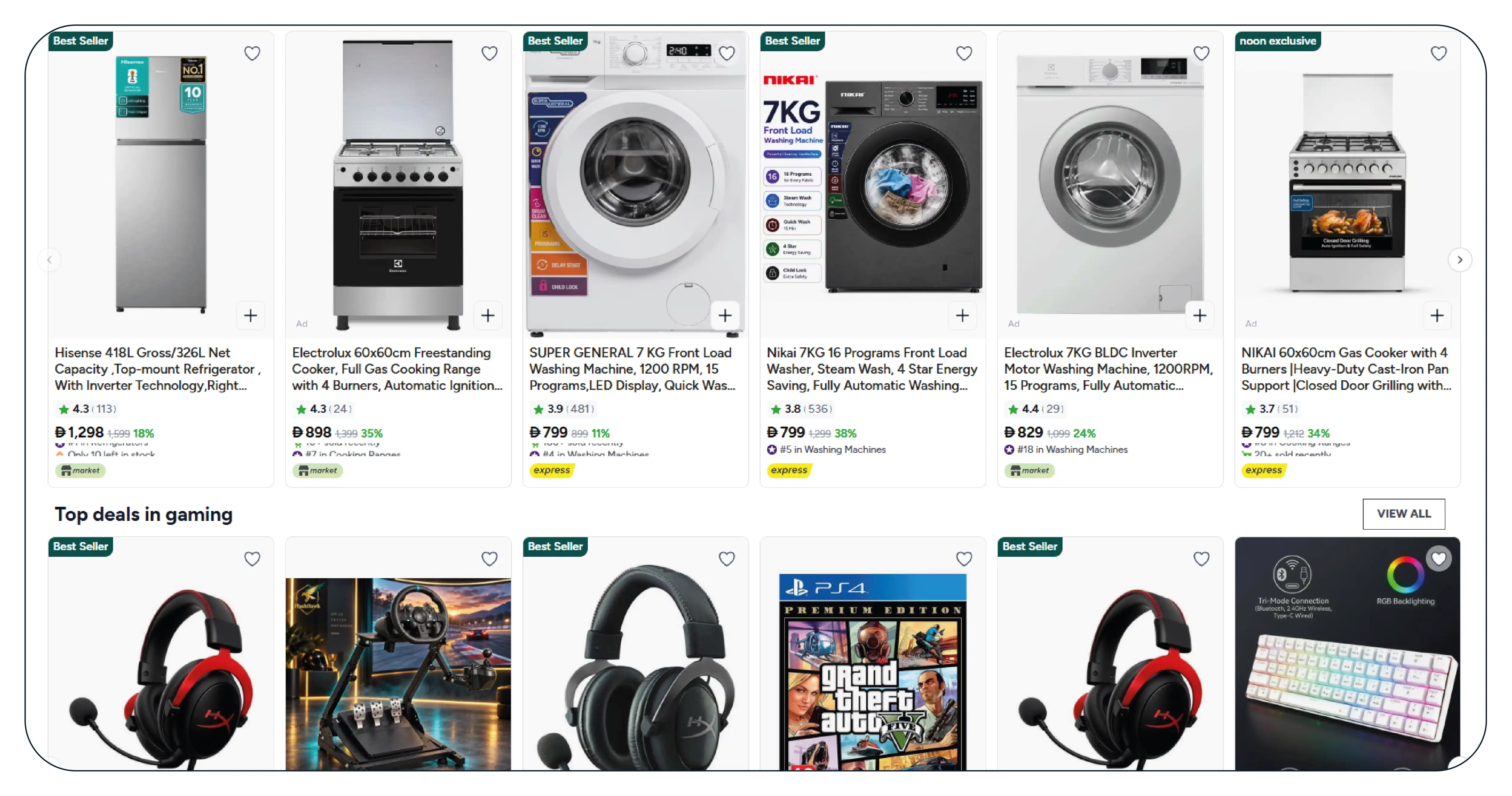
The project focused on improving monitoring scalability, collection speed, data accuracy, automation, integration, and analytics capabilities across UAE and Saudi Arabian electronics marketplaces.
The primary goal was to create a centralized monitoring framework covering Amazon and Noon across both markets. The client wanted consistent information for smartphones, laptops, tablets, gaming products, televisions, headphones, and accessories.
A major requirement was Amazon.sa Noon Saudi Electronics Monitoring, which would provide SKU-level visibility into products, sellers, prices, and availability across Saudi Arabia.
The client also wanted a scalable Noon Scraping API for UAE workflow capable of supporting recurring data collection and downstream analytics.
Automate daily SKU-level product collection.
Track product names, brands, models, SKUs, prices, discounts, and availability.
Monitor seller information and marketplace listings.
Compare product pricing between Amazon and Noon.
Normalize product and model information.
Preserve historical marketplace observations.
Integrate datasets with analytics systems and dashboards.
Support near-real-time business intelligence workflows.
90% faster SKU monitoring.
95%+ data validation accuracy.
85% reduction in manual marketplace research.
90% faster product discovery.
Daily automated refreshes across priority SKUs.
Improved product matching across marketplaces.
The Core Challenge
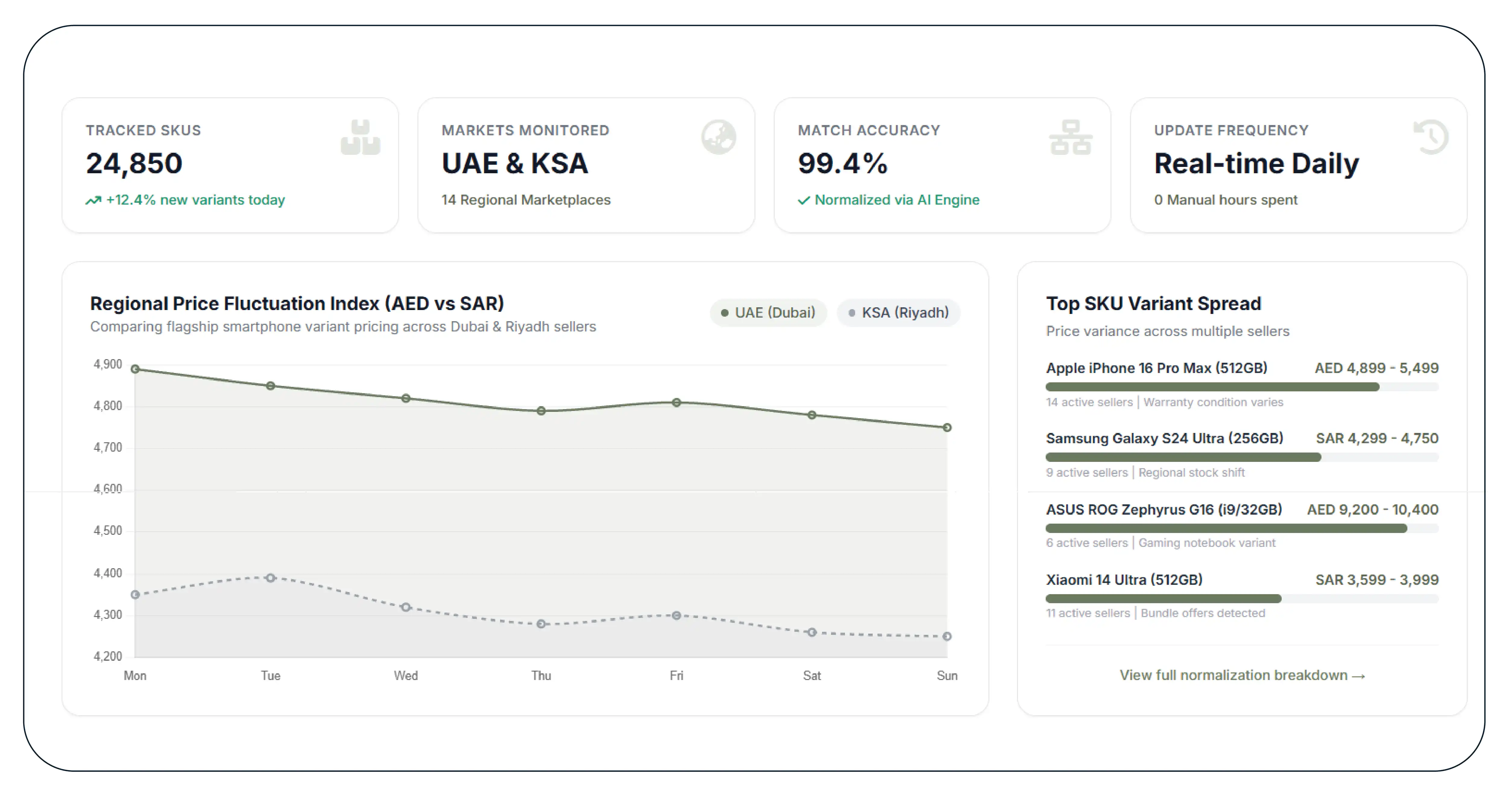
The client faced a complex monitoring environment because electronics marketplaces contain thousands of products, variants, sellers, and changing prices. A single smartphone could have different storage configurations, colors, sellers, warranty conditions, and prices.
For example, Apple iPhones, Samsung Galaxy devices, Xiaomi smartphones, Lenovo laptops, and ASUS gaming notebooks could appear through multiple listings. Comparing these records manually made it difficult to identify true product-level changes.
The retailer required reliable UAE Saudi Electronics Price Tracking to monitor price movements across both countries. However, manually collecting marketplace data could not provide the frequency required for daily analysis.
The client also wanted to compare regional marketplace behavior with broader competitive pricing information. Its existing workflow included Scrape Amazon and Walmart USA Daily Prices, but the UAE and Saudi marketplaces required a dedicated regional monitoring framework.
Data quality presented another challenge. Product names, model numbers, seller information, and specifications could vary between marketplaces. Without product matching and normalization, the same device could be treated as multiple products.
Operationally, analysts spent considerable time checking product pages, recording prices, identifying sellers, and updating spreadsheets. This slowed reporting and created a risk of inconsistent or outdated information.
The solution therefore needed to automate collection while maintaining SKU-level accuracy, product matching, historical tracking, and consistent delivery across multiple markets.
Our Solution
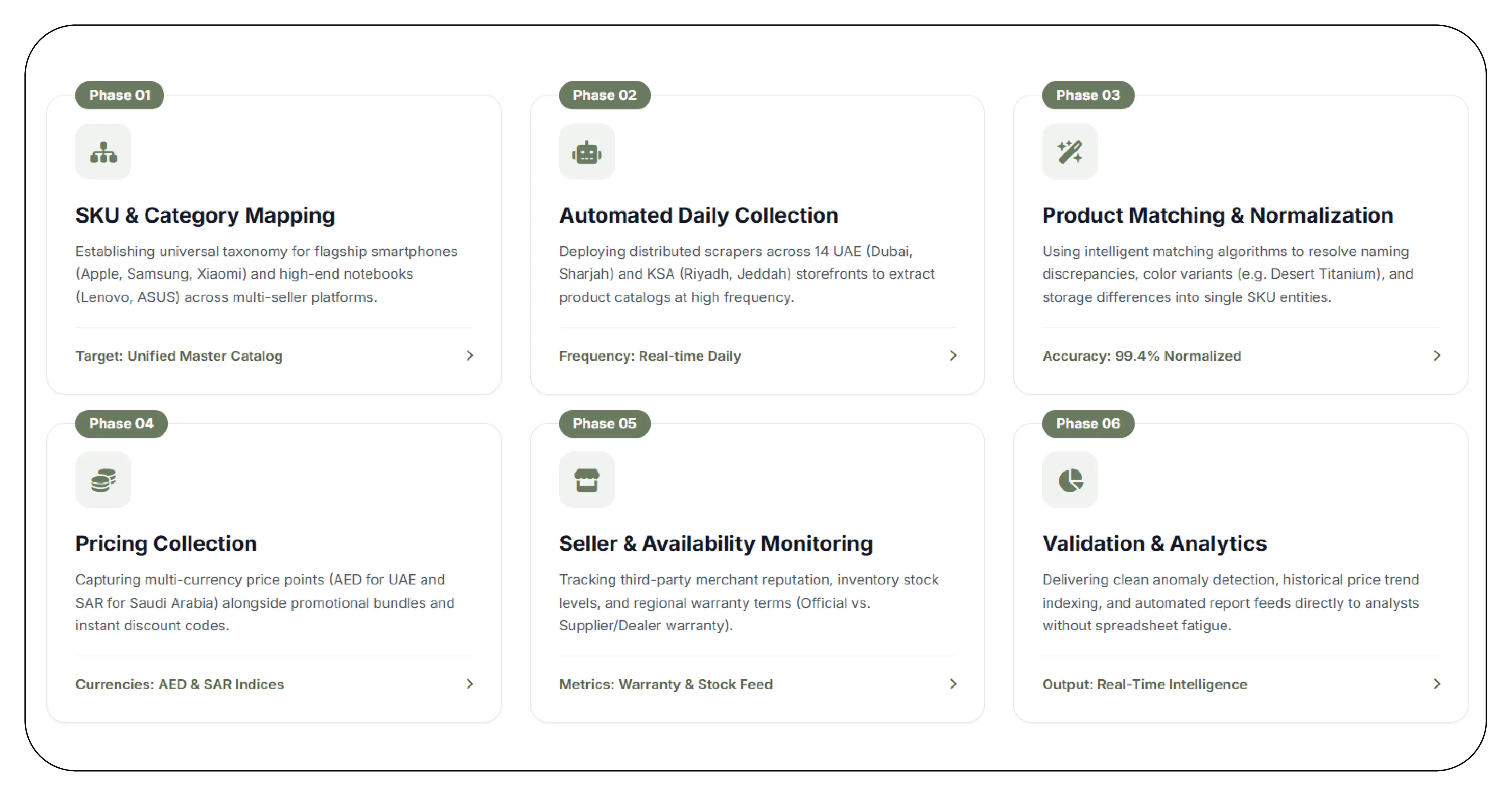
Product Data Scrape implemented a phased marketplace intelligence architecture covering Amazon UAE, Amazon Saudi Arabia, Noon UAE, and Noon Saudi Arabia.
Phase 1: SKU & Category Mapping
The first phase defined the client's monitoring universe. Categories included smartphones, laptops, tablets, televisions, gaming consoles, monitors, headphones, smartwatches, cameras, and computer accessories. Priority brands included Apple, Samsung, Xiaomi, Lenovo, ASUS, Sony, Huawei, HP, JBL, and Logitech. SKU identifiers, product URLs, model information, category structures, and accessible product attributes were mapped to establish the monitoring framework.
Phase 2: Automated Daily Collection
The system was configured around UAE Saudi Electronics daily SKU-level Intelligence requirements. The dataset included product name, brand, SKU, model number, category, current price, original price, discount, seller name, availability, rating, review count, product URL, product images where accessible, and product specifications. Automated scheduling enabled recurring collection across defined SKU groups.
Phase 3: Product Matching & Normalization
Product records from Amazon and Noon were standardized to ensure comparable fields. Model numbers, storage capacities, colors, sizes, and product variants were mapped where available. For example, different Samsung Galaxy configurations could be separated by storage and model, while Apple iPhone listings could be matched using model and variant information.
Phase 4: Pricing Collection
The system supported Scraping Electronics Product Prices across priority categories and markets. Price observations were connected to product, SKU, seller, marketplace, country, and collection timestamp fields. This created historical records rather than isolated price snapshots.
Phase 5: Seller & Availability Monitoring
Seller information and stock indicators were collected alongside pricing data. This allowed the client to understand whether marketplace changes were associated with different sellers, stock conditions, or product listings.
Phase 6: Validation & Analytics
Automated validation checked duplicate products, missing fields, inconsistent prices, invalid SKU information, and abnormal records. Validated data was delivered in structured formats suitable for databases, spreadsheets, dashboards, and business intelligence platforms. The architecture was designed to expand as the retailer added new brands, categories, SKUs, and marketplace requirements.
Results & Key Metrics
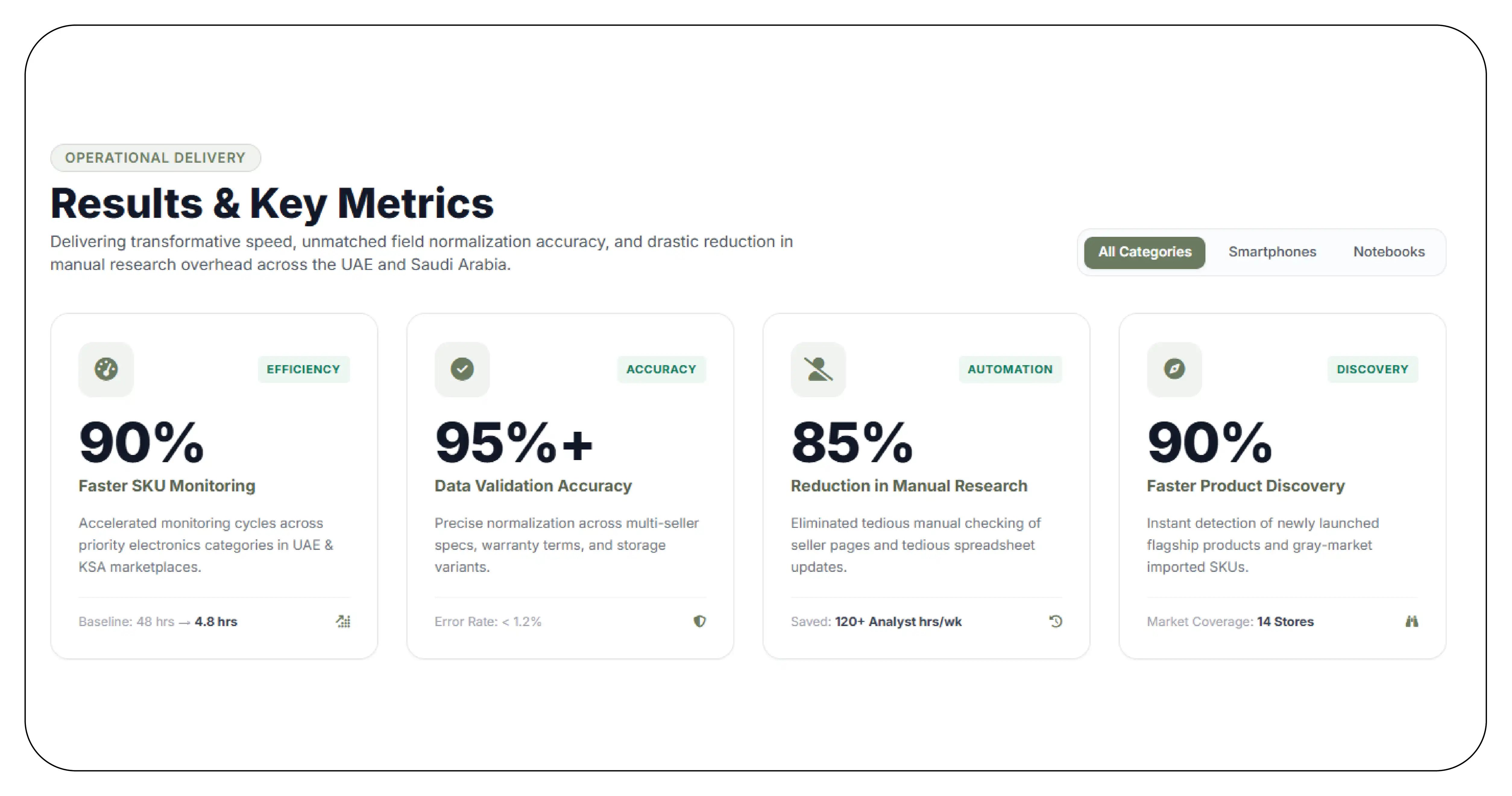
The project delivered measurable improvements in marketplace monitoring and operational efficiency:
90% faster SKU-level monitoring across priority electronics categories.
95%+ data validation accuracy across core product fields.
85% reduction in manual research.
90% faster product discovery across monitored marketplaces.
Daily automated collection across priority SKU groups.
Improved product matching between Amazon and Noon.
More consistent seller and availability records.
Historical price datasets for trend analysis.
Results Narrative
The client used Noon electronics seller tracking in Saudi Arabia to monitor seller participation, pricing, and availability across important electronics categories.
The solution also made Daily SKU-level Electronics monitoring part of a repeatable marketplace intelligence process rather than a manual research activity.
Products such as Apple iPhones, Samsung Galaxy smartphones, Lenovo laptops, ASUS gaming laptops, Sony headphones, and Xiaomi devices could be monitored through structured SKU-level records.
Historical snapshots helped the retailer identify pricing movements, assortment changes, seller activity, and stock conditions across UAE and Saudi Arabia.
The resulting data environment provided a more consistent foundation for competitive pricing analysis, product intelligence, and marketplace reporting.
What Made Product Data Scrape Different
Product Data Scrape developed a unified framework capable of monitoring multiple marketplaces and countries while maintaining SKU-level product relationships.
The system connected product, SKU, model, seller, price, availability, marketplace, and timestamp information into standardized records.
A configurable Daily Electronics price tracking API Saudi Arabia architecture enabled structured data to be integrated with dashboards, databases, and internal analytics platforms.
Automated scheduling, product matching, normalization, validation, and historical snapshots reduced repetitive manual work while improving data consistency.
The framework was also designed to scale across additional electronics categories and brands. This meant the retailer could expand monitoring from smartphones and laptops to televisions, gaming consoles, headphones, smartwatches, cameras, and accessories without redesigning the complete data architecture.
Client's Testimonial
"Our marketplace teams previously spent significant time checking individual electronics listings across UAE and Saudi Arabia. The new monitoring framework gave us a structured view of SKUs, prices, sellers, and availability across Amazon and Noon. Products such as Apple iPhones, Samsung Galaxy devices, Lenovo laptops, ASUS gaming products, and Sony headphones could be monitored systematically instead of through disconnected spreadsheets. The daily refresh capability was especially useful for identifying marketplace changes quickly. Product Data Scrape provided a scalable data workflow that reduced repetitive research and gave our analysts a stronger foundation for regional marketplace intelligence."
— Head of Marketplace Analytics, Regional Electronics Retailer
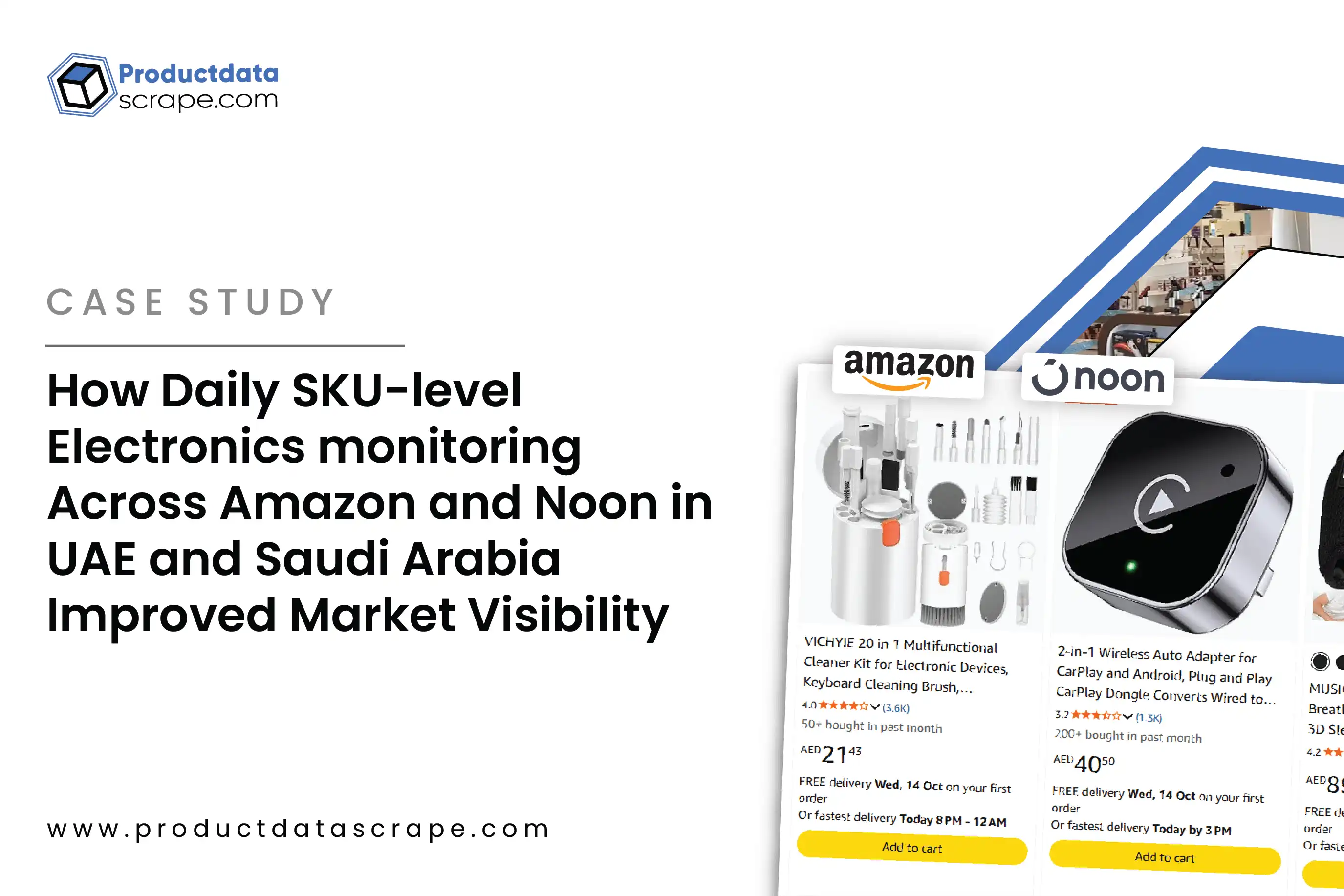
Designer visual references: Apple iPhone, Samsung Galaxy, Xiaomi smartphone, Lenovo laptop, ASUS ROG laptop, Sony headphones, Huawei tablet, Amazon UAE, Amazon Saudi Arabia, Noon UAE, and Noon Saudi Arabia marketplace screens.
Saudi Arabia Data
Saudi Arabia represented an important component of the monitoring framework, with the solution capturing structured marketplace observations for electronics products across priority categories.
Representative product examples included:
| Category |
Example Brands / Products |
| Smartphones |
Apple iPhone, Samsung Galaxy, Xiaomi |
| Laptops |
Lenovo, ASUS, HP |
| Gaming |
ASUS ROG, Lenovo Legion, PlayStation |
| Headphones |
Sony, JBL, Apple AirPods |
| Smartwatches |
Apple Watch, Samsung Galaxy Watch |
| TVs |
Samsung, Sony, LG |
| Tablets |
Apple iPad, Samsung Galaxy Tab |
These examples can support visual storytelling while demonstrating the breadth of electronics products included in the monitoring framework.
Conclusion
The project established a scalable framework for monitoring electronics products across Amazon and Noon in the UAE and Saudi Arabia. By organizing marketplace information at SKU level, the retailer gained a more consistent view of product prices, sellers, availability, and assortment.
Automated collection reduced manual research and improved the speed at which marketplace changes could be identified. Historical datasets also provided a foundation for analyzing pricing movements and product trends over time.
As the retailer expands its marketplace presence, the framework can be extended to additional categories, brands, SKUs, and regional marketplaces.
The implementation demonstrates how structured Electronics data scraping can transform fragmented marketplace listings into analytics-ready intelligence for pricing, product monitoring, seller analysis, and digital shelf management.
FAQs
1. What electronics data can be monitored?
Depending on accessibility, datasets can include product names, brands, SKUs, model numbers, prices, discounts, sellers, availability, ratings, reviews, specifications, product URLs, and images.
2. Can Amazon and Noon be monitored across both UAE and Saudi Arabia?
Yes. The monitoring architecture can be configured for Amazon UAE, Amazon Saudi Arabia, Noon UAE, and Noon Saudi Arabia, with country and marketplace information maintained separately.
3. Why is SKU-level monitoring useful for electronics?
SKU-level monitoring helps distinguish individual products and variants. This is particularly important for smartphones, laptops, tablets, televisions, and other electronics with multiple models, storage capacities, colors, or configurations.
4. Can seller and availability information be included?
Where accessible, seller names, stock indicators, ratings, and other marketplace attributes can be collected alongside product and pricing information.
5. Can the data be refreshed daily?
Yes. Automated scheduling can support daily or other defined refresh cycles for selected products, categories, brands, or SKU groups, depending on project requirements and data accessibility.


 Singapore
 EMAIL
EMAIL
 PHONE
PHONE













.webp)