Introduction
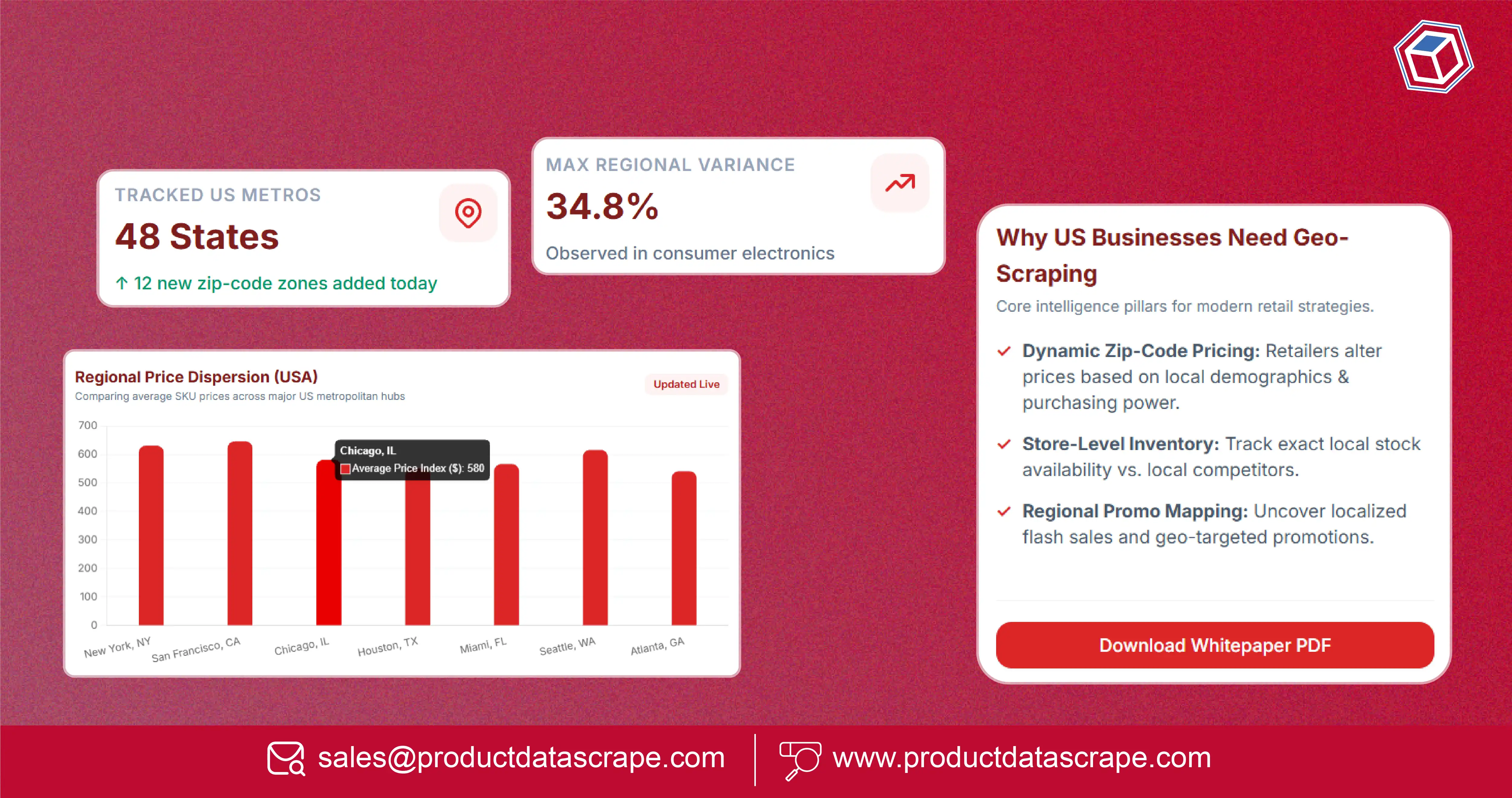
Retail pricing in the United States varies significantly across cities, states, ZIP codes, and even individual store locations. Factors such as local demand, competition, inventory levels, seasonal trends, and regional purchasing power influence product prices. For retailers, brands, manufacturers, and market research firms, monitoring these localized price differences is essential for maintaining competitiveness and maximizing profitability. However, manually collecting pricing information across thousands of retail stores and eCommerce platforms is both inefficient and difficult to scale.
Businesses increasingly use Geo-Level Retail Price Scraping in the USA to automate the collection of location-specific pricing information from leading retailers, supermarkets, marketplaces, and brand websites. Automated web scraping provides accurate, real-time visibility into regional price fluctuations, promotions, discounts, stock availability, and competitor strategies.
By leveraging Geo and store-level pricing data, organizations can optimize dynamic pricing, improve promotional planning, benchmark competitors, identify regional demand patterns, and enhance assortment strategies. Whether expanding into new markets or refining local pricing decisions, geo-level retail intelligence enables businesses to respond quickly to changing market conditions and make data-driven decisions that support sustainable growth.
Understanding Regional Pricing Differences for Smarter Decisions
Retail prices often differ from one ZIP code to another due to local competition, operating costs, customer demand, taxes, and inventory availability. Businesses that continuously monitor these regional variations gain valuable insights that support pricing optimization, localized promotions, and market expansion strategies. Automated web scraping enables retailers to capture location-specific pricing information efficiently and at scale.
Using ZIP Code-Level Retail Price Monitoring in the USA, organizations can automatically collect product prices, promotional offers, stock availability, and assortment information from retailers operating across multiple ZIP codes. This structured data helps businesses compare regional pricing strategies, identify price inconsistencies, and evaluate competitor behavior in specific markets.
Retailers use these insights to implement dynamic pricing models tailored to local demand. Brands monitor reseller pricing across different regions to ensure consistency, while manufacturers evaluate market penetration by analyzing regional price trends. Grocery chains and supermarkets also use ZIP code-level monitoring to benchmark promotional effectiveness and adjust inventory planning based on neighborhood purchasing behavior.
Historical datasets reveal seasonal pricing fluctuations, geographic demand shifts, and long-term market trends. Combined with AI-powered analytics, this information supports predictive pricing strategies, improved profitability, and faster responses to competitive market changes.
Automated regional monitoring significantly reduces manual research while providing decision-makers with timely, reliable intelligence that strengthens localized retail strategies.
Key Benefits
- Monitor ZIP-specific pricing
- Compare regional promotions
- Analyze competitor pricing
- Detect pricing inconsistencies
- Improve localized strategies
- Support dynamic pricing
- Enhance inventory planning
- Increase market responsiveness
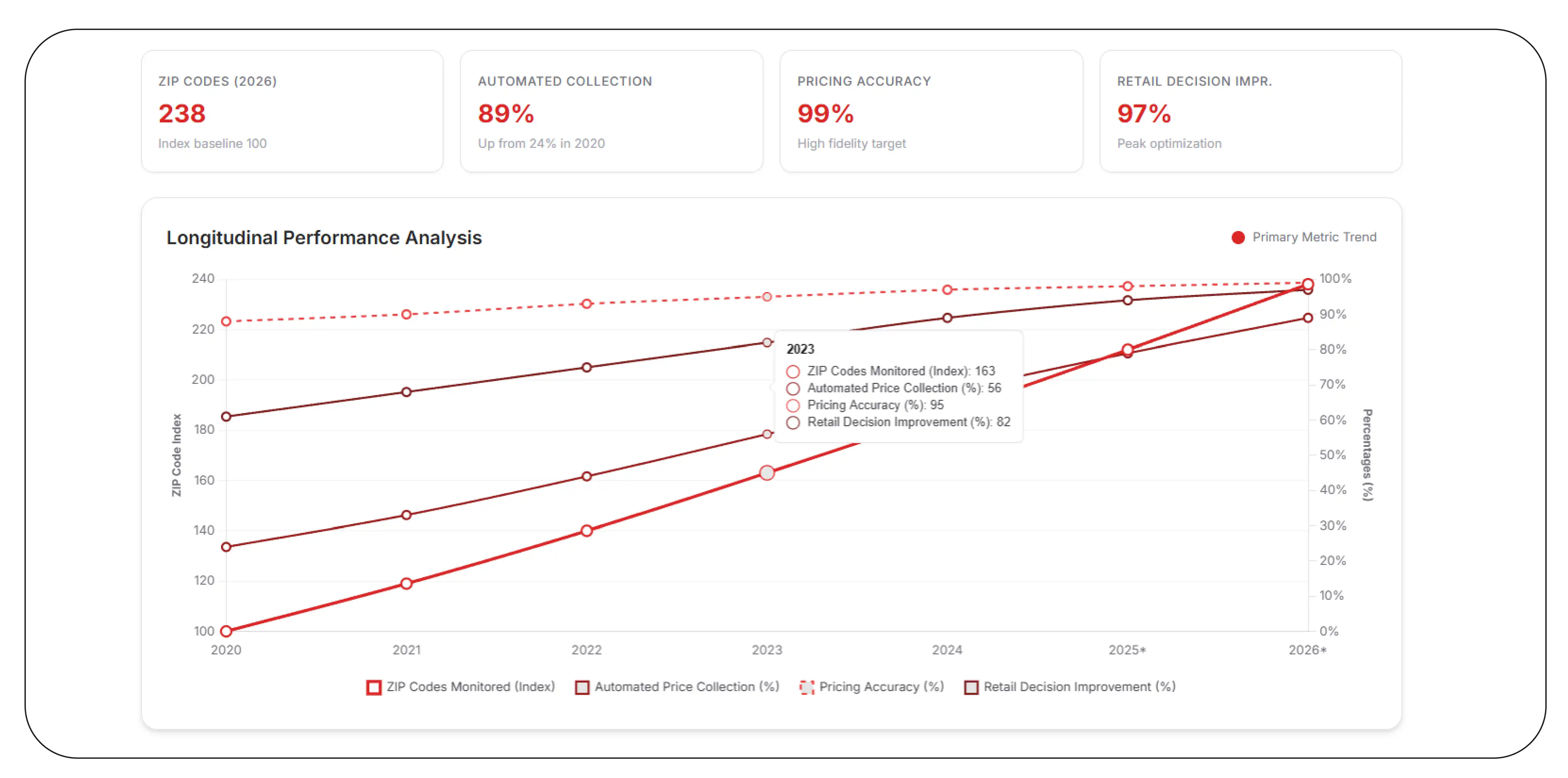
ZIP-Level Retail Pricing Trends (2020–2026)
| Year |
ZIP Codes Monitored (Index) |
Automated Price Collection (%) |
Pricing Accuracy (%) |
Retail Decision Improvement (%) |
| 2020 |
100 |
24% |
88% |
61% |
| 2021 |
119 |
33% |
90% |
68% |
| 2022 |
140 |
44% |
93% |
75% |
| 2023 |
163 |
56% |
95% |
82% |
| 2024 |
187 |
68% |
97% |
89% |
| 2025* |
212 |
79% |
98% |
94% |
| 2026* |
238 |
89% |
99% |
97% |
Projected industry estimates.
Turning Local Market Signals into Competitive Advantage
Regional retail performance depends on understanding how pricing varies across locations and how competitors respond to changing market conditions. Businesses that monitor pricing intelligence at the geographic level gain deeper insights into consumer demand, promotional effectiveness, and competitive positioning. Automated data collection makes it possible to analyze thousands of products across multiple retailers without manual effort.
Through Geo-level Retail pricing intelligence, retailers can continuously monitor location-specific prices, discounts, inventory availability, product assortment, and promotional campaigns. This intelligence enables organizations to identify regional pricing trends, benchmark competitor strategies, and evaluate how pricing decisions influence customer purchasing behavior.
Retail chains use geographic pricing insights to customize offers for individual markets, while manufacturers analyze regional demand to improve product distribution. Marketing teams evaluate localized promotional campaigns, and pricing analysts optimize margins by identifying areas where price adjustments can increase competitiveness without sacrificing profitability.
Historical pricing data also supports strategic planning by highlighting long-term regional trends, seasonal buying patterns, and competitor expansion activities. AI-powered analytics transform these datasets into predictive insights that help businesses forecast demand and proactively respond to market changes.
By integrating geographic pricing intelligence into enterprise dashboards, retailers gain a comprehensive view of market performance across cities, states, and regions, enabling faster and more informed business decisions.
Business Advantages
- Compare regional pricing trends
- Monitor localized promotions
- Evaluate competitor strategies
- Improve pricing optimization
- Support regional expansion
- Forecast market demand
- Enable AI-powered analytics
- Strengthen competitive intelligence
Geographic Pricing Intelligence Statistics (2020–2026)
| Year |
Businesses Using Geo Pricing (%) |
Automated Regional Monitoring (%) |
Market Insight Accuracy (%) |
Profitability Improvement (%) |
| 2020 |
23% |
21% |
87% |
25% |
| 2021 |
31% |
29% |
90% |
33% |
| 2022 |
41% |
40% |
92% |
43% |
| 2023 |
53% |
52% |
95% |
54% |
| 2024 |
65% |
64% |
97% |
65% |
| 2025* |
77% |
76% |
98% |
76% |
| 2026* |
88% |
87% |
99% |
86% |
Projected industry estimates.
Adapting Faster to Local Market Changes
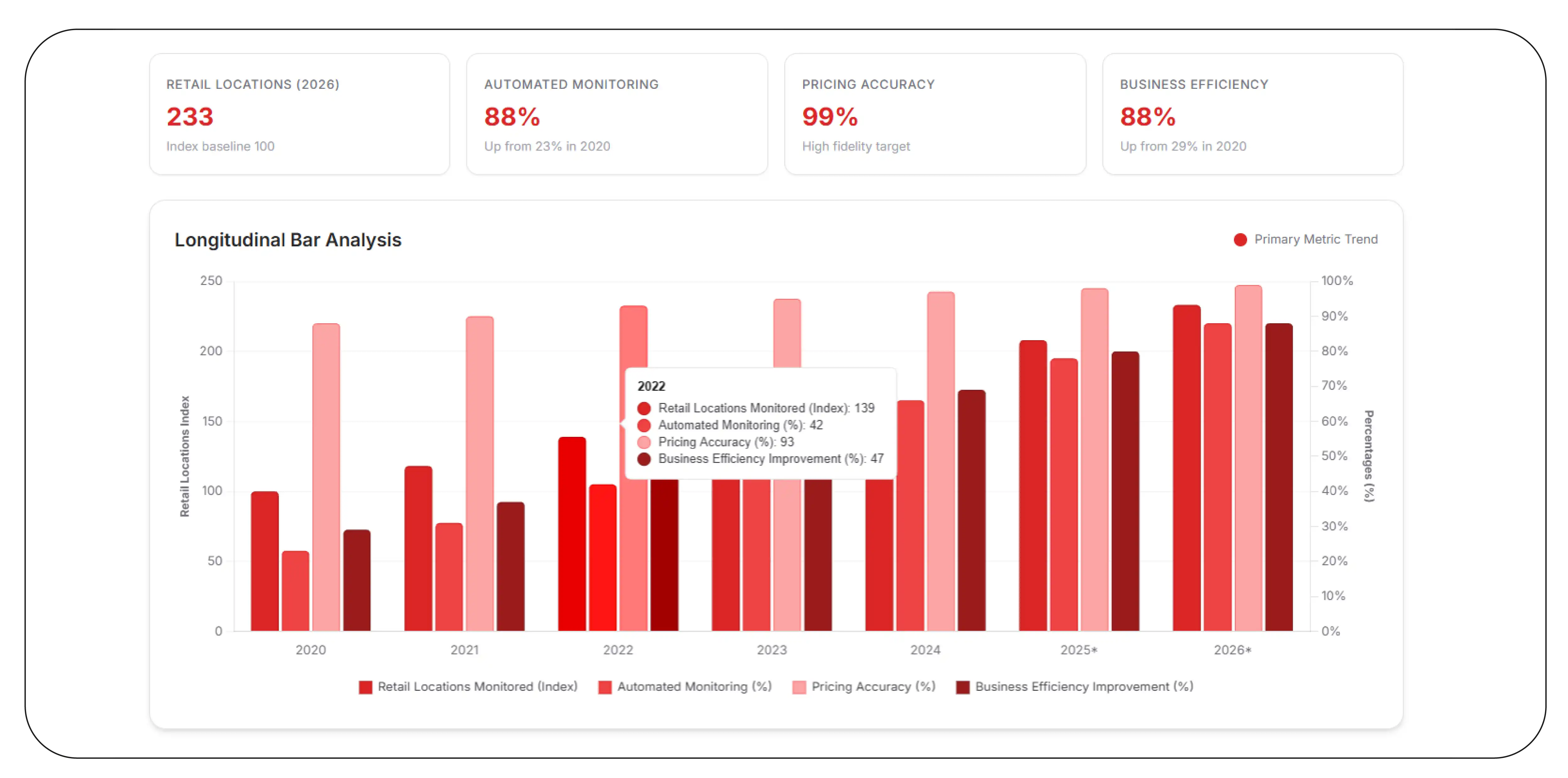
Retail pricing is influenced by neighborhood demand, local competition, inventory availability, seasonal promotions, and customer purchasing behavior. Businesses that can monitor these variables in real time are better equipped to optimize pricing strategies, maintain competitiveness, and improve customer satisfaction. Automated web scraping enables organizations to continuously track regional pricing activity across thousands of retail stores and online platforms.
Using Location-based retail price monitoring, retailers can collect product prices, promotional offers, stock availability, and assortment changes from specific cities, ZIP codes, or store locations. This localized intelligence helps businesses identify pricing discrepancies between regions, evaluate competitor strategies, and respond quickly to changing market conditions.
Retail chains use location-based monitoring to implement dynamic pricing models that reflect regional demand and competitive activity. Consumer brands compare pricing across multiple retailers to maintain brand consistency and identify unauthorized price reductions. Market researchers analyze localized pricing behavior to understand consumer purchasing patterns and uncover emerging retail trends.
Historical location-based datasets also support forecasting by revealing seasonal demand fluctuations, geographic sales patterns, and regional pricing behavior over time. Combined with AI-powered analytics, businesses gain predictive insights that improve pricing accuracy, promotional planning, and inventory optimization.
Automated monitoring reduces manual effort while ensuring decision-makers receive accurate, real-time retail intelligence that strengthens localized business strategies.
Key Benefits
- Track city and store-level prices
- Monitor regional promotions
- Detect pricing inconsistencies
- Compare competitor pricing
- Improve localized pricing
- Optimize inventory planning
- Forecast regional demand
- Enable faster decision-making
Location-Based Pricing Trends (2020–2026)
| Year |
Retail Locations Monitored (Index) |
Automated Monitoring (%) |
Pricing Accuracy (%) |
Business Efficiency Improvement (%) |
| 2020 |
100 |
23% |
88% |
29% |
| 2021 |
118 |
31% |
90% |
37% |
| 2022 |
139 |
42% |
93% |
47% |
| 2023 |
161 |
54% |
95% |
58% |
| 2024 |
184 |
66% |
97% |
69% |
| 2025* |
208 |
78% |
98% |
80% |
| 2026* |
233 |
88% |
99% |
88% |
Projected industry estimates.
Transforming Local Pricing Data into Actionable Intelligence
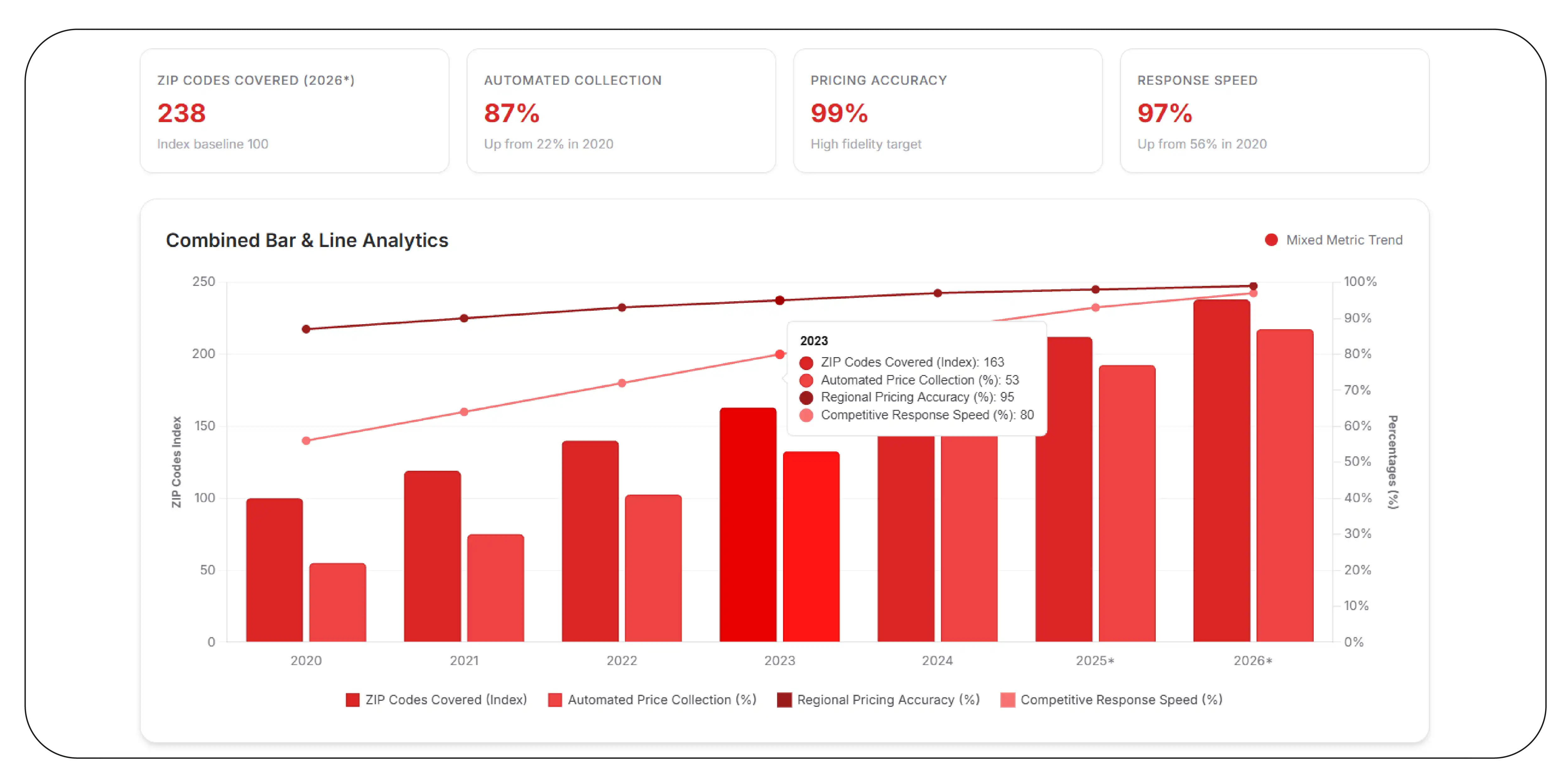
Modern retailers require more than national pricing averages to stay competitive. Understanding how prices vary across neighborhoods, cities, and regions enables businesses to develop highly targeted pricing and promotional strategies. Automated web scraping provides an efficient way to capture large volumes of localized pricing data from multiple retailers and marketplaces.
Through Web scraping retail prices by ZIP code, organizations automatically collect product prices, promotional discounts, inventory status, and assortment information for specific geographic regions. This enables retailers to compare pricing across nearby stores, evaluate regional promotional campaigns, and identify opportunities for improving local competitiveness.
Pricing teams use ZIP code-based intelligence to optimize markdowns and promotional calendars, while category managers evaluate assortment performance across different markets. Manufacturers analyze regional pricing consistency to protect brand value and monitor reseller compliance. Grocery retailers also leverage localized pricing insights to improve inventory allocation and maximize sales during seasonal demand peaks.
Historical ZIP code pricing data reveals long-term trends in consumer behavior, regional purchasing power, and competitive pricing strategies. When combined with AI-driven analytics, these datasets support predictive pricing models, helping organizations anticipate market changes before competitors react.
By automating localized price collection, businesses improve decision accuracy while reducing manual research costs and operational complexity.
Business Advantages
- Compare prices by ZIP code
- Monitor localized promotions
- Analyze regional competition
- Improve pricing consistency
- Support promotional planning
- Optimize inventory allocation
- Enable predictive pricing
- Strengthen market intelligence
ZIP Code Pricing Analytics (2020–2026)
| Year |
ZIP Codes Covered (Index) |
Automated Price Collection (%) |
Regional Pricing Accuracy (%) |
Competitive Response Speed (%) |
| 2020 |
100 |
22% |
87% |
56% |
| 2021 |
119 |
30% |
90% |
64% |
| 2022 |
140 |
41% |
93% |
72% |
| 2023 |
163 |
53% |
95% |
80% |
| 2024 |
187 |
65% |
97% |
87% |
| 2025* |
212 |
77% |
98% |
93% |
| 2026* |
238 |
87% |
99% |
97% |
Projected industry estimates.
Enhancing Regional Pricing Strategies Through Accurate Data
Retail organizations must understand how pricing differs across geographic markets to maximize profitability and improve customer engagement. Regional price variations often result from local competition, consumer demand, logistics costs, and promotional strategies. Businesses that continuously analyze localized pricing data can make smarter decisions regarding expansion, assortment planning, and pricing optimization.
Using ZIP code-based product price extraction, companies collect structured pricing information from thousands of retail stores and online marketplaces organized by geographic region. This allows decision-makers to compare product pricing between ZIP codes, evaluate regional purchasing trends, and identify high-performing markets.
Retailers leverage these insights to personalize promotional campaigns, optimize dynamic pricing, and strengthen customer loyalty through competitive local pricing. Consumer brands monitor reseller pricing across multiple locations to ensure consistency, while distributors use regional price intelligence to optimize inventory movement and supply chain efficiency.
Historical pricing datasets also provide valuable insights into seasonal fluctuations, economic influences, and long-term market evolution. AI-powered analytics transform these datasets into predictive business intelligence that helps organizations anticipate future pricing trends and identify profitable growth opportunities.
Automated geographic price extraction creates a reliable foundation for localized retail strategies while reducing operational costs associated with manual market research.
Key Outcomes
- Extract localized pricing data
- Compare regional product prices
- Improve pricing decisions
- Monitor reseller consistency
- Support regional expansion
- Enhance supply chain planning
- Forecast pricing trends
- Increase competitive visibility
Regional Product Pricing Statistics (2020–2026)
| Year |
Regional Product Records (Index) |
Automated Extraction (%) |
Decision Accuracy (%) |
Revenue Optimization (%) |
| 2020 |
100 |
21% |
68% |
24% |
| 2021 |
118 |
30% |
74% |
32% |
| 2022 |
138 |
41% |
80% |
42% |
| 2023 |
160 |
53% |
86% |
53% |
| 2024 |
183 |
65% |
91% |
64% |
| 2025* |
207 |
77% |
95% |
75% |
| 2026* |
232 |
87% |
98% |
85% |
Projected industry estimates.
Driving Smarter Retail Decisions with Hyperlocal Intelligence
As retail competition becomes increasingly localized, businesses need more than national or state-level pricing insights to remain competitive. Consumers compare prices across nearby stores and online platforms, making hyperlocal intelligence essential for pricing optimization, assortment planning, and promotional effectiveness. Automated data extraction enables retailers to monitor localized market conditions with speed and accuracy.
Using Hyperlocal pricing intelligence, businesses can analyze product prices, discounts, stock availability, promotional campaigns, and competitor activity at the neighborhood, city, and store level. These granular insights allow retailers to respond quickly to local demand, adjust pricing dynamically, and improve customer engagement through region-specific strategies.
Organizations also benefit from E-commerce Data by Country, enabling them to compare domestic pricing trends with international marketplaces, evaluate cross-border competition, and identify opportunities for global retail expansion. Combining hyperlocal and country-level intelligence creates a comprehensive view of market dynamics that supports both regional and international business strategies.
AI-powered dashboards consolidate pricing data into interactive reports, helping executives monitor market fluctuations, benchmark competitors, and forecast demand using historical and real-time datasets. Retailers can also automate alerts for significant pricing changes, ensuring rapid responses to competitor activity.
By leveraging hyperlocal pricing intelligence and country-level eCommerce data, organizations strengthen pricing strategies, improve operational efficiency, and create sustainable competitive advantages across diverse retail markets.
Key Benefits
- Monitor neighborhood pricing
- Compare local competitors
- Analyze city-level demand
- Benchmark global marketplaces
- Improve dynamic pricing
- Optimize regional promotions
- Forecast market trends
- Support international expansion
Hyperlocal Retail Intelligence Trends (2020–2026)
| Year |
Businesses Using Hyperlocal Analytics (%) |
Automated Local Monitoring (%) |
Pricing Accuracy (%) |
Competitive Advantage Improvement (%) |
| 2020 |
22% |
20% |
87% |
27% |
| 2021 |
30% |
29% |
90% |
35% |
| 2022 |
40% |
39% |
93% |
45% |
| 2023 |
52% |
51% |
95% |
56% |
| 2024 |
64% |
63% |
97% |
67% |
| 2025* |
76% |
75% |
98% |
78% |
| 2026* |
87% |
86% |
99% |
88% |
Projected industry estimates.
Why Choose Product Data Scrape?
Retail businesses need accurate, scalable, and real-time pricing intelligence to outperform competitors and respond quickly to market changes. Product Data Scrape delivers enterprise-grade web scraping solutions that collect geo-specific pricing, promotions, inventory, product availability, and competitor insights from leading retailers and marketplaces across the USA. Our advanced Price Monitoring capabilities provide structured datasets and API-ready outputs that integrate seamlessly with analytics platforms, pricing engines, and business intelligence tools. With Geo-Level Retail Price Scraping in the USA, businesses gain reliable market intelligence to optimize pricing strategies, improve promotional planning, monitor competitors, and support smarter expansion decisions through accurate location-based retail data.
Conclusion
Retail pricing is no longer uniform across markets, making localized intelligence essential for sustainable business growth. Organizations that leverage automated geo-level pricing insights can monitor regional trends, benchmark competitors, optimize promotions, and improve profitability with greater precision. By combining real-time market monitoring with advanced analytics, businesses gain the agility needed to respond to changing consumer demand and competitive dynamics.
Leverage a powerful Web Scraping API with Geo-Level Retail Price Scraping in the USA to access accurate, location-specific retail intelligence that drives smarter pricing and expansion strategies. Product Data Scrape helps transform geo-level retail data into actionable business intelligence. Contact us today to build a customized retail pricing solution that accelerates growth and strengthens your competitive advantage!
FAQs
1. Why is geo-level retail price monitoring important?
Geo-level retail monitoring helps businesses understand regional pricing differences, optimize local promotions, benchmark competitors, and improve pricing strategies based on city, ZIP code, and store-level market dynamics.
2. Which industries benefit from geo-level retail price scraping?
Retailers, brands, manufacturers, grocery chains, eCommerce companies, pricing consultants, market research firms, and consumer goods businesses benefit from localized pricing intelligence and competitive market monitoring.
3. How frequently can retail pricing data be updated?
Automated web scraping enables businesses to collect pricing data hourly, daily, or at custom intervals depending on business needs, ensuring accurate and timely market intelligence for decision-making.
4. Can pricing data be integrated into business intelligence platforms?
Yes. Structured datasets and APIs can integrate with CRM systems, ERP platforms, pricing engines, dashboards, and analytics software, helping organizations automate reporting and improve pricing decisions.
5. Why choose Product Data Scrape for retail price intelligence?
Product Data Scrape provides scalable web scraping, geo-level pricing intelligence, structured datasets, API integration, and reliable retail analytics solutions that support competitive pricing, expansion planning, and data-driven business growth.


 Singapore
 EMAIL
EMAIL
 PHONE
PHONE










.webp)