The Client
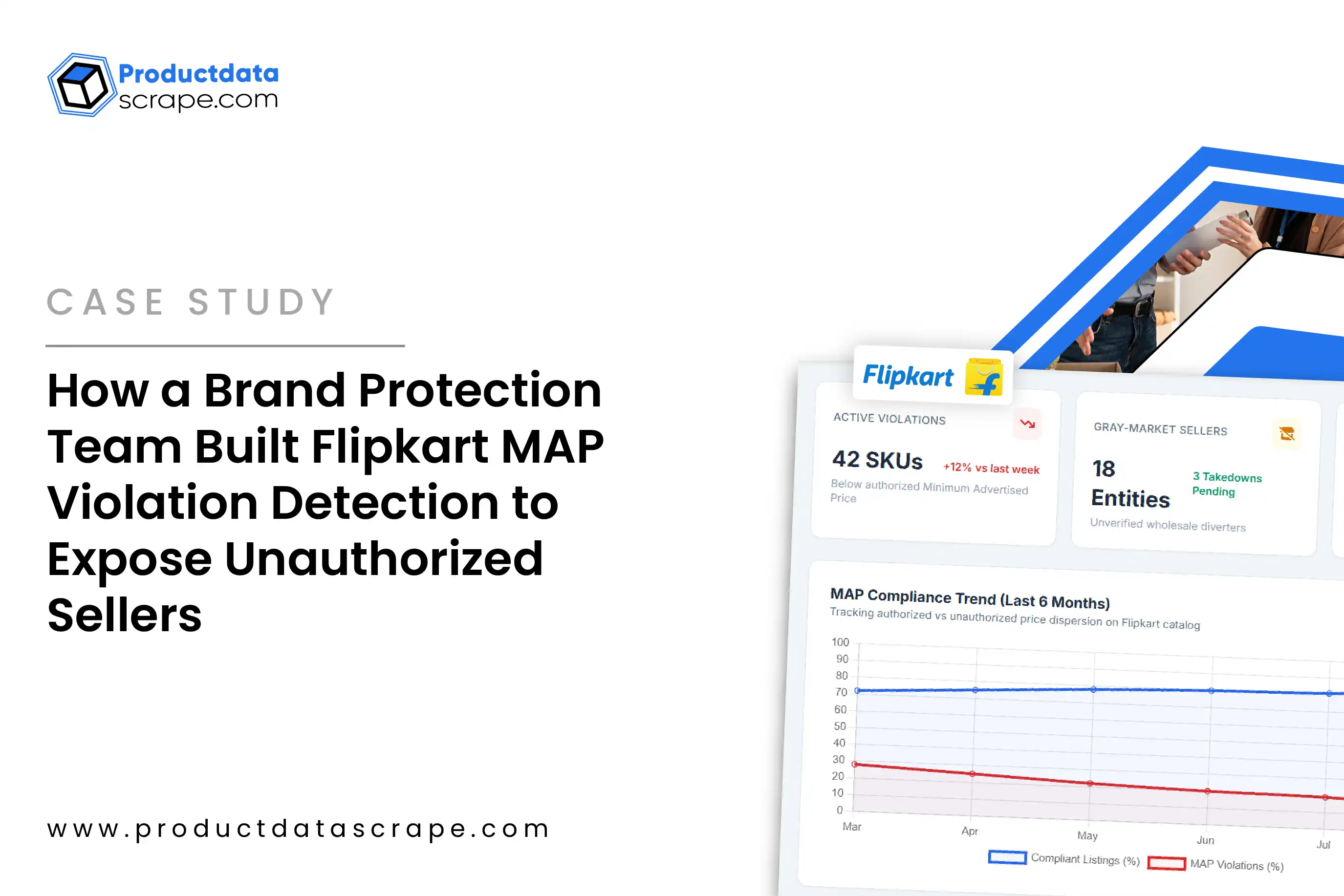
A mid-sized consumer brand — personal care and small appliances — selling on Flipkart through a network of authorised distributors and a single brand-operated seller account. The brand set a minimum advertised price (MAP) for its catalogue and expected its authorised channel to hold it.
Client details are anonymised. Figures are representative of the engagement.
The Problem: A Price Floor Nobody Was Holding
The brand had a MAP policy. What it did not have was any way of knowing whether the policy was being followed.
The symptoms arrived through the distributor network first, as complaints. Authorised distributors — the ones holding the line on price — were losing the Buy Box to sellers offering the same products several hundred rupees cheaper. Those sellers were not in the authorised network. Nobody at the brand knew who they were, where the stock had come from, or how many listings were affected.
The brand's initial attempt at a response was manual. A junior team member was asked to check listings by hand, once a week, and record any seller pricing below MAP in a spreadsheet. Within a month the exercise had collapsed under its own weight. The catalogue was large, sellers rotated on and off listings faster than a weekly check could track, and by the time a violation was recorded, the seller had often changed the price, making the record useless as evidence.
The channel manager's summary: we know we're being undercut by people we didn't authorise. We can't prove it, we can't measure it, and we can't act on it.
Why Manual Monitoring Could Not Work
Three structural reasons, each of which independently defeats a manual approach.
Scale. A catalogue of several hundred SKUs, each potentially carrying multiple sellers, produces thousands of seller-listing combinations. A person checking by hand covers a fraction, inconsistently.
Velocity. Sellers appear and disappear from listings, and change prices, on a timescale of hours. A weekly snapshot misses most of what happens between snapshots — and a violation that is not captured at the moment it occurs cannot be evidenced later.
Evidence quality. A screenshot pasted into a spreadsheet is not defensible evidence. It has no verifiable timestamp, no structured record of the seller identity, and no continuity showing how long the violation persisted. For a brand that might eventually want to act on a breach — whether through the marketplace's own channels or through its distributor agreements — the manual record was close to worthless.
The Solution: Structured MAP Violation Detection
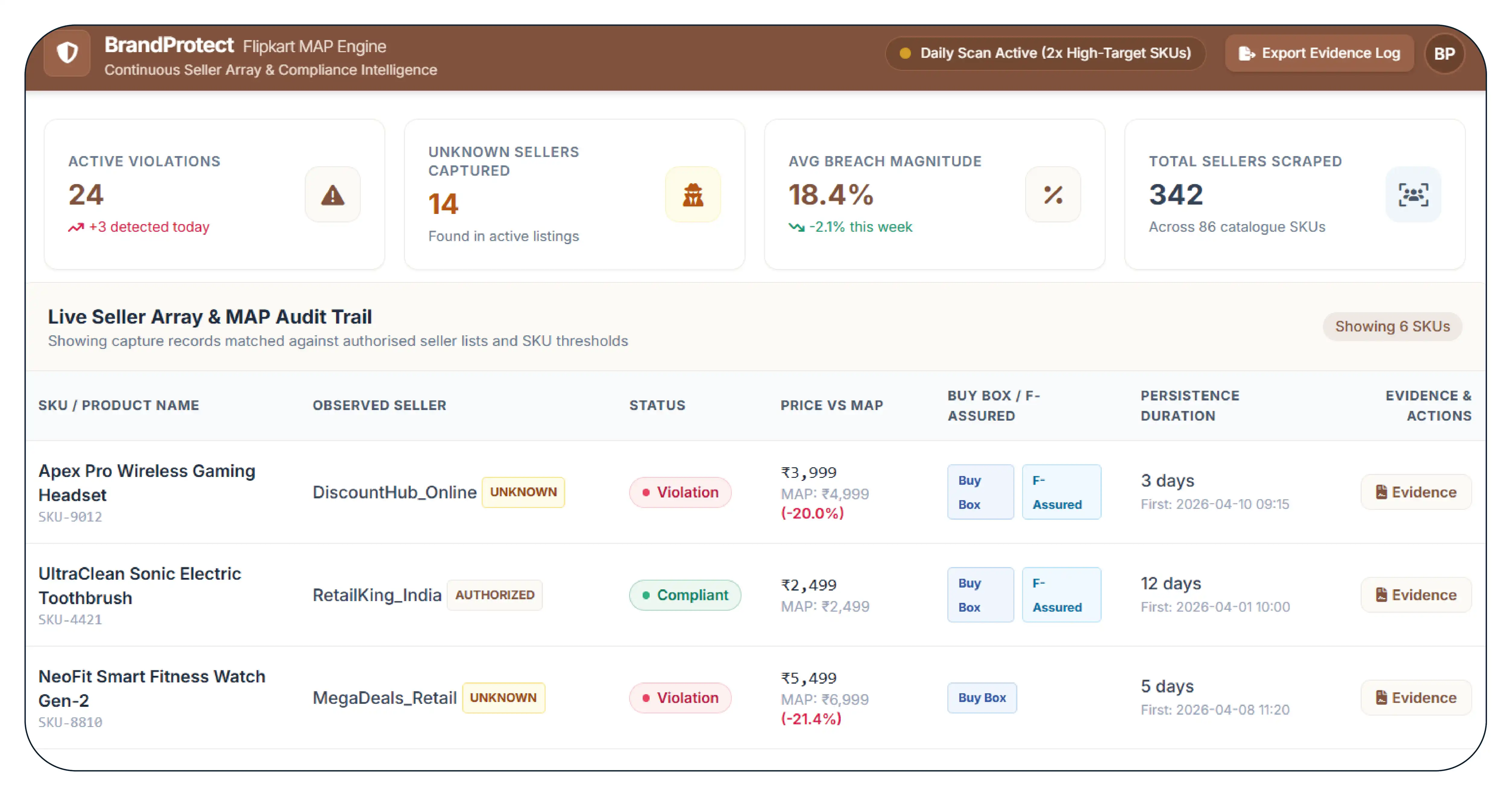
Product Data Scrape deployed continuous Flipkart MAP violation detection across the brand's full catalogue, built around the seller array on each listing rather than the headline price.
- Full seller capture. On every listing, every seller was captured — name, price, F-Assured status, rating, and whether they held the default (Buy Box) position — not just the winning seller.
- Authorised-list matching. The brand supplied its authorised seller list. Every captured seller was matched against it and classified: authorised, or unknown. Unknown sellers on a brand's own listings are the population a brand protection team most needs to see, and the population a headline-price monitor never surfaces.
- MAP threshold comparison. The brand supplied its MAP per SKU. Every seller's price was compared against the applicable MAP and flagged as compliant or in violation, with the magnitude and the timestamp recorded.
- Persistence tracking. Rather than a snapshot, each violation was tracked as a duration — first observed, last observed, and whether it was still live. A violation that persists for a week is a different problem from one that lasts an hour, and the difference matters both for prioritisation and for evidence.
- Structured, timestamped evidence. Each flagged violation produced a structured record with a verifiable capture time, the seller identity, the observed price, the applicable MAP, and the breach magnitude — an evidence trail, not a screenshot.
- Capture frequency: daily across the full catalogue, with twice-daily capture on the SKUs most frequently targeted.
Sample Data: The Seller Array, Classified
An illustrative captured record for a single SKU with its full seller array classified against the authorised list and MAP.
{
  "product_id": "PCARE7734ZQ",
  "title": "BrandY Grooming Kit (Premium)",
  "captured_at": "2026-07-14T09:22:11+05:30",
  "map_price": 2499,
  "listed_price_default_seller": 2149,

  "sellers": [
    {
      "seller_name": "BrandY Official",
      "price": 2499,
      "is_authorised": true,
      "is_default_seller": false,
      "map_status": "compliant"
    },
    {
      "seller_name": "MegaDeals Retail",
      "price": 2149,
      "is_authorised": false,
      "is_default_seller": true,
      "map_status": "violation",
      "breach_amount": 350,
      "first_observed": "2026-07-02T00:00:00+05:30",
      "still_live": true,
      "days_live": 12
    },
    {
      "seller_name": "ValueBazaar",
      "price": 2299,
      "is_authorised": false,
      "is_default_seller": false,
      "map_status": "violation",
      "breach_amount": 200,
      "first_observed": "2026-07-09T00:00:00+05:30",
      "still_live": true,
      "days_live": 5
    }
  ],

  "unauthorised_seller_count": 2,
  "map_violations_live": 2,
  "authorised_seller_holds_buybox": false
}
The two lines that made the brand sit up: the default seller position was held by an unauthorised seller pricing 350 rupees below MAP, and that violation had been live for twelve days before the structured system first surfaced it as a persistent breach rather than a one-off.
What the Data Revealed
The first full-catalogue pass produced a picture materially worse than the brand had assumed from the distributor complaints.
| Finding |
Observed (illustrative) |
| SKUs with at least one unauthorised seller |
~34% of catalogue |
| SKUs where an unauthorised seller held the Buy Box |
~19% of catalogue |
| Distinct unauthorised sellers identified |
40+ |
| Median MAP breach depth |
~11% below MAP |
| Longest continuously live violation |
Several weeks |
Illustrative figures.
Two patterns emerged from the seller-level data that the brand could not have seen any other way.
A small number of sellers caused most of the damage. Of the forty-plus unauthorised sellers identified, a handful accounted for the large majority of Buy Box captures and the deepest breaches. This changed the enforcement approach entirely — instead of an impossible campaign against forty parties, the brand could concentrate on the small number doing most of the harm.
The breaches clustered on the highest-value SKUs. Unauthorised sellers were not randomly distributed across the catalogue. They concentrated on the premium, high-margin SKUs — exactly where a MAP breach does the most damage to both margin and brand positioning.
What the Brand Did
The structured evidence changed what was possible.
Prioritised enforcement. The brand focused first on the handful of sellers responsible for most of the Buy Box captures, using the timestamped, persistent-violation records as the evidence base. The specific enforcement route — marketplace seller-policy channels, distributor agreement action, or otherwise — was determined by the brand's own legal counsel and MAP policy; the data supplied the evidence, not the legal strategy.
Traced the leak. Because several unauthorised sellers were offering identical stock, the brand was able to work backwards through its distribution to identify likely sources of channel leakage — a diagnosis the seller-level data enabled but the headline price never would have.
Continuous monitoring. Detection became an always-on feed rather than a periodic project. New unauthorised sellers were surfaced within a day of appearing, and violation persistence was tracked from the first observation.
The Results (One Quarter)
| Metric |
Before |
After One Quarter |
| SKUs with an unauthorised seller in the Buy Box |
~19% |
~6% |
| Median MAP breach depth on affected SKUs |
~11% |
~4% |
| Time to detect a new unauthorised seller |
Up to a week (if caught at all) |
Within a day |
| Authorised distributors holding the Buy Box, premium SKUs |
Minority |
Majority |
| Evidence quality for enforcement |
Screenshots |
Structured, timestamped records |
Figures are representative of the engagement outcome.
The channel manager's follow-up: for the first time we're arguing from evidence instead of from complaints.
The Lesson
A MAP policy is only as real as your ability to measure compliance with it. Without measurement, it is a document — and every party in the channel that benefits from ignoring it eventually works that out.
The critical shift was not from "no monitoring" to "monitoring." It was from the headline price to the seller array. A brand watching only the winning price sees a number. A brand watching every seller on the listing, classified against its authorised list and its MAP, sees who is breaking the floor, by how much, and for how long — which is the difference between knowing you have a problem and being able to do something about it.
Work With Product Data Scrape
Product Data Scrape builds Flipkart MAP violation detection for brand protection teams: full seller-array capture on every listing, authorised-list matching, per-SKU MAP comparison, Buy Box tracking, and structured, timestamped violation records with persistence tracking — delivered as JSON, CSV, API, or into your warehouse.
We capture publicly available seller and price information only. Enforcement decisions remain yours and your counsel's; our role is to make sure that when you act, you are acting on evidence.
Ask us for a diagnostic pass on your catalogue — we will show you who is on your listings that should not be.
Product Data Scrape — turning marketplace complexity into decision-ready data.


 Singapore
 EMAIL
EMAIL
 PHONE
PHONE


.webp "thumb")
.webp "thumb")












.webp)