Introduction
Luxury retail businesses face constant pricing challenges, including changing product prices, promotional discounts, inventory fluctuations, and regional price differences. These changes can affect profit margins, competitive positioning, and purchasing decisions. Extract luxury/accessories Coach Product Data helps retailers collect structured information about product prices, descriptions, categories, materials, and availability to identify market changes and make informed pricing decisions.
Coach, a global fashion and accessories brand founded in New York in 1941, offers products across handbags, accessories, footwear, and other lifestyle categories. Its extensive product assortment makes consistent market monitoring important for retailers, distributors, and e-commerce businesses.
Businesses can also Scrape India Luxury Apparel information to understand regional product assortments, pricing differences, and luxury fashion positioning. By organizing product information into comparable datasets, retailers can identify unusual price movements, monitor promotional activity, evaluate competitor offerings, and reduce pricing-related revenue risks.
How Can Retailers Build a Reliable Product-Level Pricing Database?
Luxury retailers need accurate product information before they can identify pricing fluctuations. Product names, model numbers, colors, materials, dimensions, product categories, and listed prices provide the foundation for reliable comparisons. Without consistent product identification, businesses may compare different product variants and make incorrect pricing decisions.
Coach Accessories Product Scraping helps collect structured information across relevant product categories. Retailers can organize handbags, wallets, card cases, belts, footwear, and other accessories into standardized records. Each product should have a unique identifier wherever available, allowing businesses to distinguish between similar designs, sizes, and color variations.
A structured Coach Product Data Scraping API can support automated data delivery into pricing dashboards, business intelligence platforms, and internal databases. Useful fields include product title, SKU, listed price, discounted price, currency, availability, product URL, and collection name.
For example, Coach India's official women's handbag listing displays different products at different price points, including the Brooklyn Shoulder Bag 26 at ₹27,999 and the Chain Tabby Shoulder Bag With Quilting at ₹89,999. These are actual listed prices observed on the official website, not historical price movements.
Retailers can use this information as a reference for product-level comparisons while ensuring that equivalent variants are matched correctly.
The most important benefit is consistency. When product records follow the same structure, businesses can detect price changes more confidently, identify missing information, and avoid decisions based on mismatched products.
Why Should Businesses Monitor Product Categories and Promotional Changes?
Different luxury accessory categories can experience different pricing patterns. Handbags, wallets, footwear, and small leather goods may have different price positioning, customer demand, and promotional activity. Monitoring them separately helps retailers understand where pricing pressure is developing.
Coach Accessories Category Intelligence enables businesses to organize products according to their category, collection, material, design, and price range. This classification helps identify which product groups have higher listed prices, which collections offer more affordable options, and where competitors are introducing new products.
Monitoring Product Pricing and Promotions is equally important. A listed price reduction does not necessarily indicate a permanent change in product value. It may reflect a seasonal promotion, limited-time campaign, clearance activity, or regional offer.
Retailers should capture the original price, current selling price, discount percentage, promotion dates, and product availability whenever these fields are publicly displayed. Comparing these values over time helps businesses understand whether a discount is temporary or part of a longer pricing pattern.
Tapestry's fiscal 2025 annual report provides useful evidence of the commercial importance of product categories. Coach generated approximately $3.22 billion from handbags and $1.54 billion from accessories during that fiscal year. Handbags represented 57.6% of Coach segment sales, while accessories accounted for 27.5%.
These figures demonstrate why category-level analysis matters. Retailers can prioritize monitoring based on category significance instead of treating every product as equally important.
How Does Pricing Intelligence Help Retailers Protect Profit Margins?
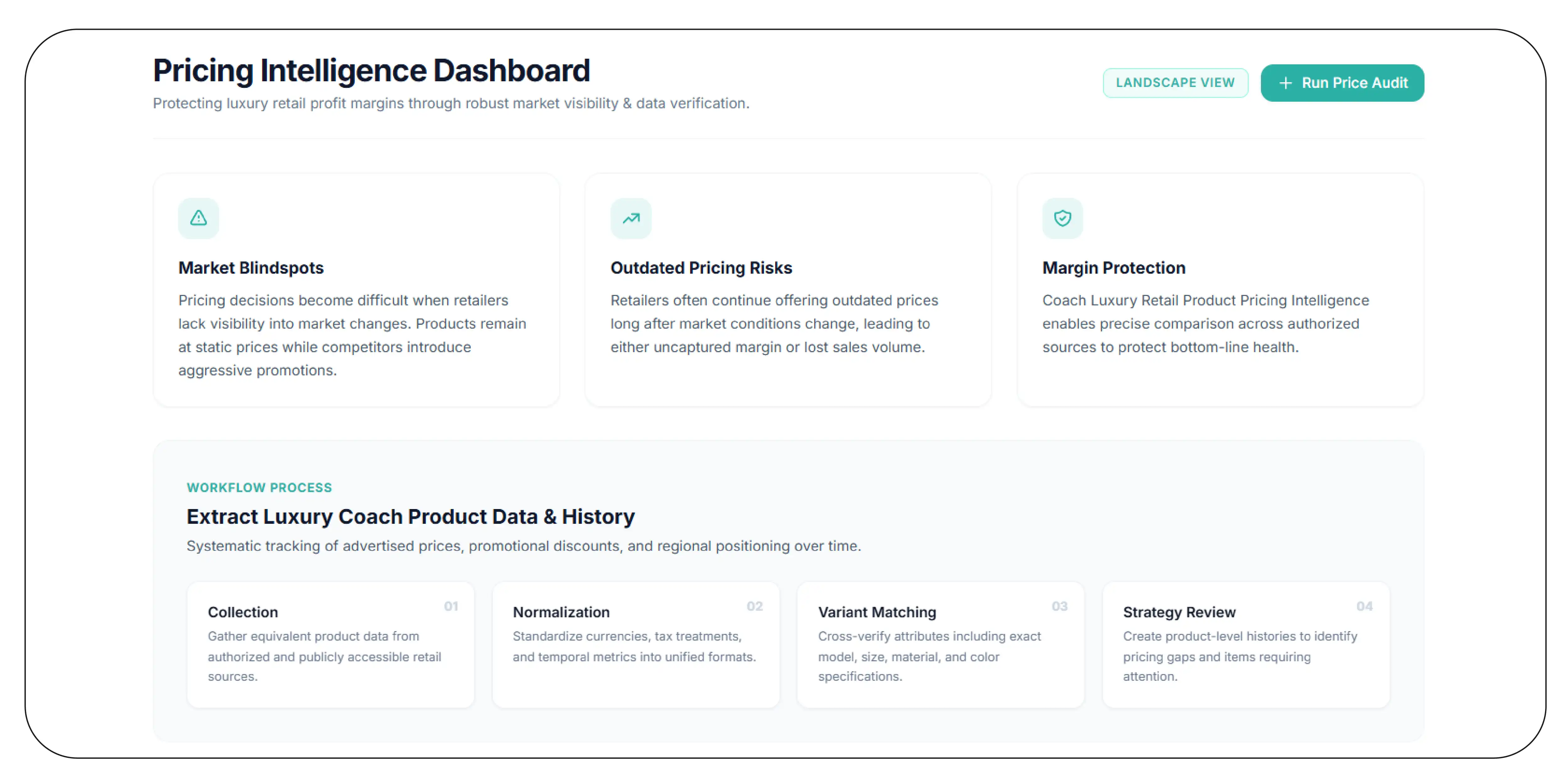
Pricing decisions become difficult when retailers lack visibility into market changes. A product may remain at the same listed price while competitors introduce promotions, or a retailer may continue offering an outdated price after market conditions change.
Coach Luxury Retail Product Pricing Intelligence helps businesses compare product prices across authorized and publicly accessible retail sources. The process involves collecting equivalent product information, normalizing currencies, matching variants, and tracking price differences over time.
With Extract luxury/accessories Coach Product Data, businesses can create product-level pricing histories that reveal changes in advertised prices, promotional discounts, and regional positioning. Retailers can use these insights to review their own pricing strategies and identify products that require attention.
For example, if an equivalent handbag is listed at different prices across two retail channels, the business should first verify the model, size, material, color, currency, tax treatment, and promotion conditions. Only after confirming these details should the difference be treated as a meaningful pricing gap.
This approach prevents incorrect comparisons and supports better margin management.
The commercial relevance is supported by Tapestry's fiscal 2025 reporting. Coach recorded net sales of approximately $5.60 billion, representing a 9.9% increase from fiscal 2024. Its reported gross profit increased from $3.88 billion to $4.37 billion over the same period.
Retailers should not interpret these company-wide figures as proof that scraping directly increases profitability. Instead, they demonstrate the scale of the business environment in which accurate product and pricing intelligence can support commercial decisions.
What Can Historical Price Tracking Reveal About Market Changes?
A single price observation provides limited information. Historical tracking offers a more useful understanding of how prices change, when promotions occur, and whether products maintain consistent market positioning.
Coach Luxury Price Trend Monitoring involves recording product prices at regular intervals and comparing them against previously collected records. This creates a timeline that can help retailers identify increases, reductions, repeated promotions, and price differences across sales channels.
Businesses using Extract luxury/accessories Coach Product Data can organize historical information by product identifier, collection, category, region, and observation date. They can then calculate percentage changes and identify products that require manual review.
The wider luxury market also provides important context. Bain & Company's 2025 luxury study reported that the global personal luxury goods market reached approximately €369 billion in 2023 before slowing to around €364 billion in 2024. The decline highlights the importance of monitoring changing consumer demand and pricing conditions.
The following table presents published market estimates rather than Coach-specific product prices.
| Year | Global personal luxury goods market |
|---|
| 2020 | €223 billion |
| 2021 | €293 billion |
| 2022 | €354 billion |
| 2023 | €369 billion |
| 2024 | €364 billion |
| 2025 | No directly comparable final annual value used here |
| 2026 | No verified full-year value available as of November 2026 |
Source: Bain & Company's global luxury market study. Values are rounded.
Retailers should use historical product-level records alongside broader market indicators. This combination helps distinguish an individual product's pricing movement from wider industry conditions.
How Can Retailers Compare Collection Prices Without Losing Accuracy?
Luxury collections often contain products with similar designs but different materials, sizes, finishes, and construction details. Comparing their prices without accounting for these differences can lead to inaccurate conclusions.
Coach Collection Price Benchmarking helps retailers compare products within relevant groups. Businesses can segment collections by product type, design family, material, size, and other available attributes before calculating price differences.
Using Extract luxury/accessories Coach Product Data, retailers can create comparable product groups and evaluate how prices vary between standard designs, premium materials, and different product configurations.
A useful benchmarking dataset should include:
- Product name and unique identifier.
- Collection and category.
- Material and color.
- Product dimensions or size.
- Original and current listed prices.
- Discount percentage, where available.
- Currency and market.
- Product availability and observation date.
For regional benchmarking, currency conversion and tax treatment must be handled separately. A price in India should not be directly compared with a US price without considering exchange rates, applicable taxes, shipping costs, and regional pricing policies.
The official Coach India website, for example, displays handbag listings in Indian rupees, while the US Coach website displays prices in US dollars. These separate storefronts provide a practical reason to maintain market-specific pricing records.
Retailers should also avoid assuming that similarly named products are identical. Product identifiers, specifications, and images can help validate matching records.
Accurate benchmarking makes it easier to identify genuine pricing differences, evaluate collection positioning, and avoid unnecessary price reductions that could weaken margins.
How Does Automated Collection Monitoring Improve Inventory Decisions?
Pricing and inventory information are closely connected. A product that becomes unavailable may require a different monitoring approach from an item that remains consistently in stock. Retailers need to understand both conditions before making purchasing or promotional decisions.
Coach Luxury Collection Data Scraping can help businesses collect publicly displayed product availability, listed prices, collection information, and product specifications at scheduled intervals.
With Extract luxury/accessories Coach Product Data, retailers can connect product-level price observations with availability records. This allows them to identify products that have experienced repeated stock changes, monitor items that remain listed during promotions, and distinguish unavailable products from discontinued listings.
A practical monitoring workflow includes:
- Collect product information from permitted public sources.
- Match records using product identifiers and verified attributes.
- Record prices, availability, and observation timestamps.
- Compare current information with previous records.
- Flag unusual price movements and missing product details.
- Review important changes before updating business pricing decisions.
The system should also maintain source URLs and collection timestamps so teams can verify where each observation originated.
Data validation is particularly important when product pages change their layout, rename collections, or remove discontinued items. Automated checks can identify missing fields and unexpected price formats before records enter business dashboards.
For retailers, this creates a more dependable foundation for inventory planning, promotional evaluation, and pricing reviews. It also reduces the risk of acting on outdated or incorrectly matched product information.
Why Choose Product Data Scrape?
Luxury retailers need organized, consistent, and actionable product intelligence to make better commercial decisions. Product Data Scrape supports businesses with Fashion data scraping solutions that collect relevant product attributes, prices, category details, and publicly displayed availability information. Its approach can help retailers organize large product catalogs, compare market offerings, monitor price movements, and identify data inconsistencies. Structured datasets also support reporting, competitor analysis, and inventory monitoring. Businesses can define the required fields, collection frequency, and delivery format according to their operational needs. Reliable validation and product matching help transform scattered retail information into useful business intelligence for better-informed decisions.
Conclusion
Pricing fluctuations can affect luxury retail competitiveness, product positioning, and revenue opportunities. With structured Apparel & Accessories Data, retailers can monitor product prices, compare collections, evaluate promotions, and identify changes that deserve attention.
Extract luxury/accessories Coach Product Data provides a practical foundation for building organized product intelligence and supporting more informed pricing decisions. Accurate product matching, historical records, and regular validation are essential for reliable results.
Ready to improve your luxury retail intelligence? Contact Product Data Scrape today to discuss a customized product data collection solution that supports smarter pricing analysis, stronger competitor visibility, and more confident retail decisions!
FAQs
1. What is luxury accessories product data extraction?
It is the collection of publicly available product details, including names, prices, categories, materials, descriptions, images, and availability, organized into structured datasets for retail analysis.
2. How does product pricing monitoring prevent revenue loss?
It helps retailers identify price changes, promotional differences, and outdated listings, enabling timely pricing reviews and reducing the risk of decisions based on inaccurate market information.
3. Which Coach product attributes should retailers monitor?
Retailers should monitor product identifiers, names, categories, materials, colors, sizes, listed prices, discounts, availability, currencies, product URLs, and observation timestamps for accurate comparisons.
4. Can retailers compare Coach prices across countries?
Yes. Retailers can compare publicly listed prices across regional storefronts after accounting for currency conversion, taxes, shipping costs, product variations, and regional promotional conditions.
5. How can Product Data Scrape support luxury retailers?
Product Data Scrape can provide structured product datasets, pricing intelligence, category monitoring, and historical records to support competitor analysis, catalog management, and informed retail decisions.


 Singapore
 EMAIL
 PHONE










.webp)