Introduction
Product listing errors, missing shoe sizes, inaccurate color variations, and inconsistent inventory information can create significant challenges for footwear retailers. Crocs Shoe Catalog and Variant Monitoring helps businesses collect, organize, and monitor product-level information to improve catalog accuracy, identify high-demand variants, and make better inventory decisions.
Crocs offers a diverse footwear portfolio with multiple styles, colors, sizes, and product variations. Managing these details across different online marketplaces requires continuous monitoring and structured product information. Retailers need visibility into product titles, SKU identifiers, size options, prices, descriptions, and stock availability to maintain accurate listings.
Businesses can also use Sports data and retail intelligence to understand broader consumer and product trends, although footwear catalog monitoring requires its own product-specific datasets. By collecting publicly available information from relevant retail sources, businesses can identify missing variants, detect inconsistent product descriptions, compare prices, and monitor changing availability.
For footwear retailers, distributors, marketplace operators, and e-commerce businesses, accurate catalog information supports better product discovery, inventory planning, and customer experiences.
Why Is Accurate Footwear Catalog Information Important for Retailers?
A footwear catalog contains more than product names and prices. Each shoe may have several sizes, colors, designs, and product identifiers. When these attributes are incorrectly recorded, retailers can display misleading information or lose visibility into important product variations.
A structured Crocs Footwear Dataset helps businesses organize product information into consistent records. Important attributes include product title, style name, SKU, color, size, material, category, price, availability, and product URL. This structure allows retailers to identify duplicate listings, compare equivalent products, and detect missing product attributes.
Retailers can also use Competitive pricing data to understand how equivalent footwear products are positioned across different sales channels. Comparing prices requires matching the same model, size, color, and product configuration rather than comparing products simply because they belong to the same footwear category.
Crocs, Inc. reported consolidated revenue of approximately $4.04 billion for fiscal 2025, compared with $4.10 billion in fiscal 2024. Its Crocs Brand generated approximately $3.33 billion in 2025 revenue. These figures demonstrate the commercial scale of the business and the importance of accurate product information across its retail ecosystem.
A reliable catalog also helps retailers maintain consistent information across their websites, marketplaces, and internal inventory systems. Product matching and validation should happen before records are used for pricing or stock decisions.
How Can Retailers Detect Product Feed Errors Before They Affect Sales?
Product feeds connect product information from inventory systems, suppliers, and e-commerce platforms. When these feeds contain outdated prices, incorrect descriptions, missing images, or incomplete size information, the same errors can spread across multiple sales channels.
Crocs Product Feed Monitoring helps retailers review product information regularly and identify inconsistencies before they affect customer-facing listings. Businesses can compare incoming product records against previously collected information to detect missing fields, unexpected changes, duplicate SKUs, and incorrect variant relationships.
A structured E-commerce data scraping process can collect publicly available product information from authorized sources and organize it into a standardized format. Retailers can then compare source information with their own product feeds.
For example, a product feed validation workflow can check whether:
- Every product has a recognizable product identifier.
- Available sizes are associated with the correct shoe model.
- Color names match the corresponding product images.
- Prices follow the expected currency and numerical format.
- Discontinued listings are not incorrectly presented as available.
- Product descriptions contain the required specifications.
- Duplicate product URLs or SKUs are identified for review.
The importance of inventory accuracy is also visible in Crocs' financial reporting. Its reported inventory was approximately $368.7 million at December 31, 2025, compared with approximately $397 million at September 30, 2026. These figures represent company-wide inventory, not individual shoe variants.
For retailers, the practical lesson is that product feed monitoring should connect catalog quality with inventory information. Regular validation helps teams identify discrepancies, correct inaccurate listings, and maintain more dependable product records.
How Can Promotional Monitoring Help Retailers Identify Better Pricing Opportunities?
Footwear retailers frequently need to understand how promotional offers affect product positioning. Discounts, seasonal campaigns, limited-time offers, and marketplace promotions can change the displayed price of a shoe without changing its underlying product specifications.
Crocs Discount and Offer Data Scraping helps businesses collect publicly displayed promotional information and organize it for comparison. Useful attributes include original price, current selling price, discount percentage, promotion description, product identifier, observation date, and product URL.
Combining these details with Crocs Shoe Catalog and Variant Monitoring enables retailers to connect promotional activity with individual product variations.
For example, retailers can distinguish between a discount applied to an entire shoe model and an offer available only for selected sizes or colors. This distinction is important because a product may appear discounted while certain variants remain at their regular listed price.
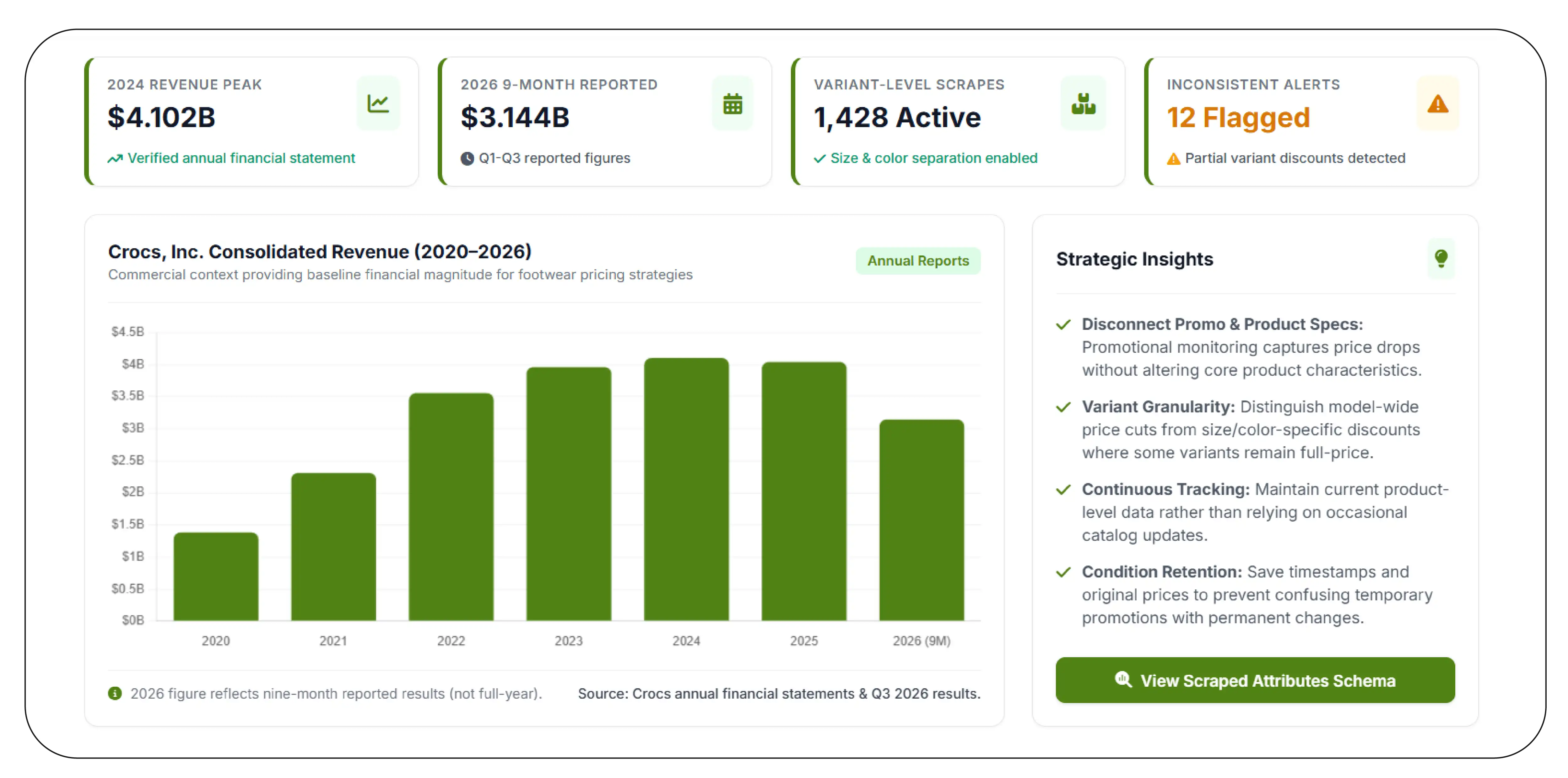
The following table presents verified company-wide revenue figures that provide commercial context for footwear retailers. It does not represent Crocs discount or promotional prices.
| Year | Crocs, Inc. consolidated revenue |
|---|
| 2020 | $1.386 billion |
| 2021 | $2.313 billion |
| 2022 | $3.555 billion |
| 2023 | $3.962 billion |
| 2024 | $4.102 billion |
| 2025 | $4.041 billion |
| 2026 | $3.144 billion (first nine months) |
Sources: Crocs annual financial statements and Q3 2026 results. 2026 is a nine-month reported figure, not a full-year result.
This historical context shows why retailers should maintain current product-level information rather than rely on occasional catalog updates. A promotional monitoring system can flag unusual price changes, identify inconsistent discounts, and support more informed pricing reviews.
Businesses should also retain the original price, observation timestamp, and promotional conditions to avoid confusing temporary offers with permanent price changes.
Why Is Size-Level Inventory Visibility Important for Footwear Businesses?
Size availability is one of the most important attributes in footwear catalog management. A shoe model may remain listed on an online store even when particular sizes are unavailable. Without variant-level monitoring, retailers may incorrectly interpret an active product listing as evidence that every size is in stock.
Crocs Size-Wise Stock Availability Tracking helps businesses monitor individual size options rather than relying only on the overall product availability status.
For example, a footwear product may offer multiple size selections, but the availability of each selection can differ. Retailers need to distinguish between available, unavailable, temporarily out-of-stock, and discontinued variants whenever the source provides enough information to support these classifications.
Combining size-level information with Crocs Shoe Catalog and Variant Monitoring helps businesses understand which variants require inventory attention.
A useful monitoring dataset should contain:
- Product name and SKU.
- Available size options.
- Size-specific availability status.
- Color and product configuration.
- Product URL and source marketplace.
- Last observed availability date.
- Historical availability changes.
- Collection timestamp.
Crocs reported inventory of $413.0 million as of September 30, 2026, compared with $397 million on September 30, 2025. This represents company-wide inventory, not a breakdown of available shoe sizes.
This distinction matters because financial inventory figures cannot establish which specific shoe sizes are available to customers.
Retailers should use product-level availability observations to identify recurring stock changes. They can then review replenishment requirements, improve product availability communication, and reduce the possibility of advertising unavailable variants.
How Can Variant-Level Price Comparisons Improve Footwear Decisions?
Different sizes and colors of the same shoe may appear within one product listing, but retailers should not automatically assume that every variant has identical pricing or availability.
Crocs Footwear Variant Price Tracking helps businesses record and compare prices at the product-variant level. The dataset can include product identifiers, size, color, listed price, discount, currency, stock status, and observation date.
Using Crocs Shoe Catalog and Variant Monitoring, retailers can identify whether a displayed price applies to all variants or only to a selected option. This is especially useful when online stores display a starting price before customers select a particular size or configuration.
Consider these practical comparison requirements:
- Product identification: Match the exact model and product identifier before comparing prices.
- Size verification: Check whether the listed price changes after selecting a particular size.
- Color comparison: Confirm that the selected color belongs to the same product family.
- Discount validation: Record both the original and displayed selling price.
- Marketplace comparison: Normalize currency and account for applicable taxes and shipping.
- Historical tracking: Compare current observations against earlier records to identify genuine price movements.
Crocs' fiscal 2025 annual report provides another useful commercial indicator. The Crocs Brand generated approximately $3.326 billion in revenue in 2025, up 1.5% from approximately $3.278 billion in 2024. However, its reported Crocs Brand operating income declined by 6% over the same period.
These figures highlight why retailers should evaluate pricing, product mix, and business performance separately. Revenue growth alone does not establish that every product variant is performing well.
Variant-level price monitoring gives merchandising teams more detailed information for reviewing pricing consistency, identifying unusual changes, and making better-informed promotional decisions.
How Does Marketplace Data Collection Improve Product Listing Accuracy?
Footwear businesses often distribute products through brand websites, online marketplaces, and authorized retail partners. Each platform may present product information differently, making it difficult to maintain consistent listings across sales channels.
Crocs Marketplace Product Data Scraping helps businesses collect publicly available product information from relevant marketplace listings and organize it into comparable datasets.
When combined with Crocs Shoe Catalog and Variant Monitoring, this approach supports the identification of duplicate listings, incorrect product titles, mismatched images, missing sizes, and inconsistent product descriptions.
A useful marketplace dataset can include:
| Data field | Business purpose |
|---|
| Product title | Identifies the listed footwear model |
| SKU or product ID | Supports accurate product matching |
| Size and color | Identifies individual variants |
| Listed price | Supports price comparisons |
| Discount information | Records promotional activity |
| Stock status | Supports availability monitoring |
| Seller information | Helps identify listing sources |
| Product URL | Enables source verification |
| Observation timestamp | Establishes when data was collected |
Crocs' Q3 2026 results provide a current example of the company's multichannel business environment. In that quarter, Crocs Brand direct-to-consumer revenue increased 8.2% year over year to $510 million, while wholesale revenue decreased 0.5% to $362 million. These are reported brand-level channel figures, not marketplace-specific sales.
For retailers, this demonstrates why monitoring information across different sales channels can be useful. Online listings, wholesale product information, and direct-to-consumer catalogs may require separate validation procedures.
Businesses should also distinguish between authorized sellers and other marketplace sellers, verify product identity, and avoid treating similar-looking listings as identical products.
An effective marketplace monitoring workflow includes collecting permitted public information, matching products, validating variant details, checking availability, and delivering structured records to internal reporting systems. This gives merchandising and e-commerce teams a clearer view of listing quality and competitive positioning.
Why Choose Product Data Scrape?
Footwear businesses need accurate product information to manage changing catalogs and inventory efficiently. Product Data Scrape provides customized data collection solutions for monitoring product listings, size variations, prices, and availability across relevant retail sources. Its services support Stockout Monitoring, product catalog validation, competitor analysis, and structured dataset delivery. Businesses can define their preferred product attributes, collection frequency, and output formats according to their operational requirements. Consistent data validation and product matching help reduce catalog inconsistencies and improve reporting quality. These insights enable footwear retailers to make informed merchandising, pricing, and inventory decisions while maintaining better visibility across multiple sales channels.
Conclusion
Accurate footwear listings and variant-level inventory information are essential for successful e-commerce operations. Marketplace & Seller Intelligence helps retailers understand product positioning, identify listing inconsistencies, compare prices, and monitor changing availability across different sales channels.
Crocs Shoe Catalog and Variant Monitoring provides a structured approach to improving product catalog accuracy and identifying high-demand shoe variations.
Ready to strengthen your footwear data strategy? Contact Product Data Scrape today to discuss customized product data extraction solutions that improve catalog management, inventory visibility, and marketplace intelligence!
FAQs
1. What is footwear catalog monitoring?
Footwear catalog monitoring collects and validates product names, SKUs, sizes, colors, prices, descriptions, and availability to maintain accurate and consistent online product listings.
2. Why is size-wise inventory tracking important?
Size-wise tracking identifies unavailable shoe variants, monitors inventory changes, improves product availability visibility, and helps retailers make informed replenishment decisions.
3. How does variant monitoring identify listing errors?
It compares product identifiers, sizes, colors, images, and specifications to detect duplicate listings, missing attributes, incorrect variations, and inconsistent product information.
4. Can retailers monitor Crocs prices across marketplaces?
Yes. Retailers can collect publicly available prices from relevant marketplaces, match equivalent shoe variants, and compare discounts while accounting for currency and regional differences.
5. How can Product Data Scrape help footwear retailers?
Product Data Scrape provides structured footwear datasets, catalog monitoring, pricing intelligence, and availability tracking to support better inventory planning and competitive retail analysis.


 Singapore
 EMAIL
 PHONE











.webp)