Introduction
Why is ESG data scraping important for compliance and reporting? Businesses can simplify ESG reporting, strengthen regulatory compliance, and improve sustainability decision-making by implementing ESG & Sustainability Data Scraping. Automated data collection delivers accurate, timely, and structured ESG information that reduces manual effort while helping organizations meet evolving disclosure requirements and stakeholder expectations.
Industry Insight (2026): Industry estimates suggest that over 78% of global enterprises now integrate ESG metrics into strategic planning, while nearly 70% of institutional investors consider sustainability disclosures before making investment decisions. Organizations adopting automated ESG intelligence report significantly faster reporting cycles and improved compliance accuracy.
Investors, regulators, customers, and business partners increasingly expect transparent sustainability reporting. Organizations must monitor environmental impact, social responsibility initiatives, governance practices, climate commitments, supplier disclosures, and compliance updates across numerous public sources. Manual collection of this information is time-consuming, inconsistent, and prone to errors.
For sustainability managers, ESG consultants, compliance officers, procurement teams, investors, and corporate governance professionals, automated intelligence has become essential. Leveraging Digital Shelf Analytics alongside ESG monitoring provides businesses with broader visibility into supplier transparency, sustainability commitments, responsible sourcing practices, and marketplace performance.
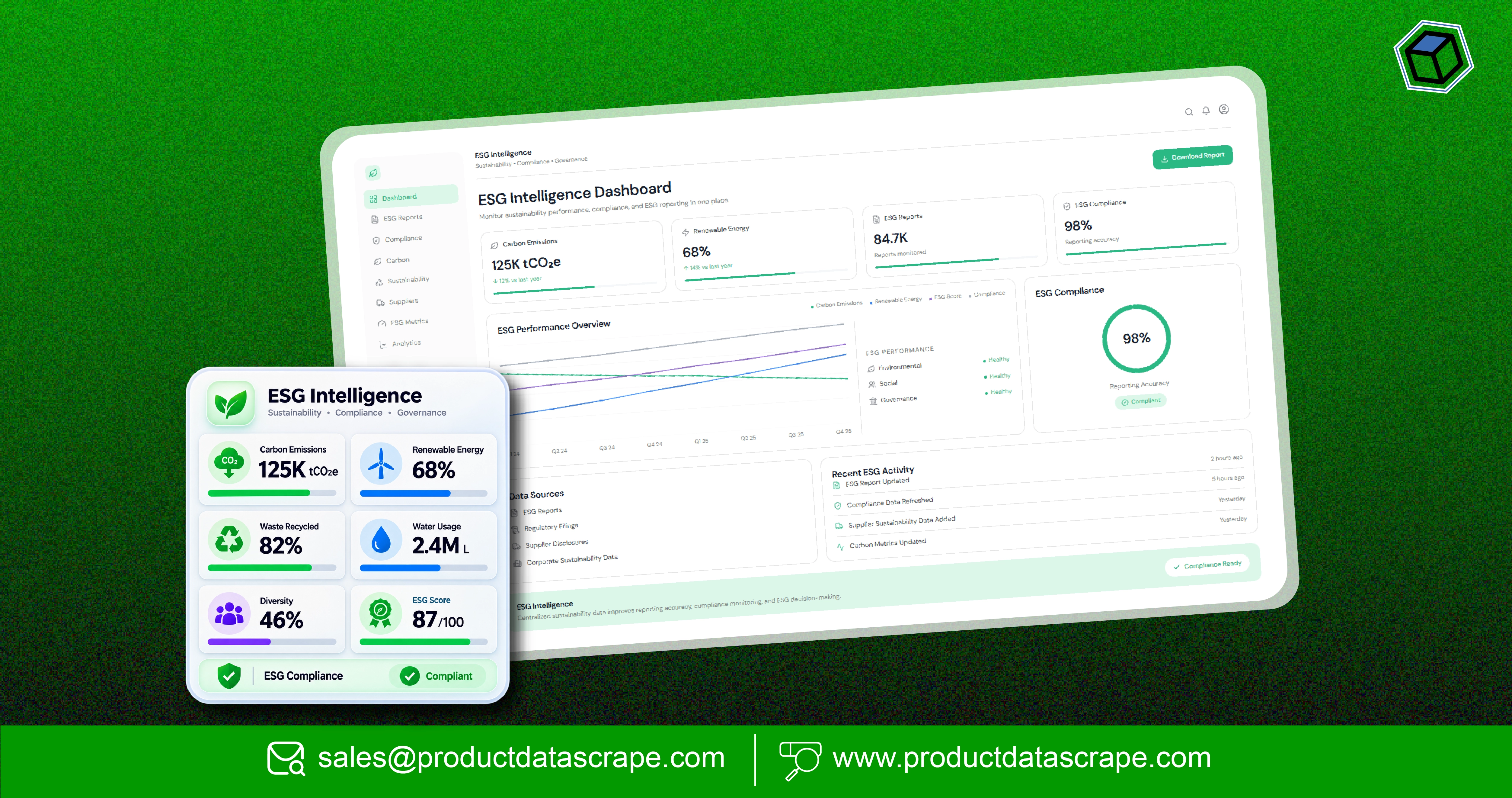
Using ESG & Sustainability Data Scraping, organizations can continuously monitor ESG disclosures, identify reporting gaps, benchmark sustainability performance, strengthen governance practices, and improve stakeholder confidence. Automated ESG intelligence supports accurate reporting, reduces compliance risks, and enables businesses to make informed sustainability decisions that contribute to long-term growth.
How Can Businesses Collect Reliable Sustainability Information Efficiently?
Organizations publish sustainability reports across websites, investor portals, annual reports, supplier platforms, and regulatory databases. Gathering this information manually often delays reporting and introduces inconsistencies. Automated data collection provides structured datasets that improve reporting accuracy and reduce operational effort.
By implementing Scrape Sustainability Reporting Data, businesses can automatically collect environmental commitments, carbon emissions disclosures, renewable energy initiatives, diversity metrics, governance policies, climate targets, supply chain transparency, and corporate sustainability goals from multiple trusted sources.
Beyond sustainability disclosures, many organizations also combine ESG monitoring with Competitive pricing data to evaluate how responsible sourcing, ethical manufacturing, and sustainability initiatives influence pricing strategies and market competitiveness. This integrated intelligence enables companies to balance profitability with sustainability objectives.
Automated sustainability intelligence supports organizations by helping them:
- Monitor sustainability disclosures continuously.
- Track climate commitments.
- Compare supplier sustainability initiatives.
- Benchmark industry reporting practices.
- Evaluate renewable energy adoption.
- Analyze carbon reduction programs.
- Identify reporting gaps.
- Improve ESG transparency.
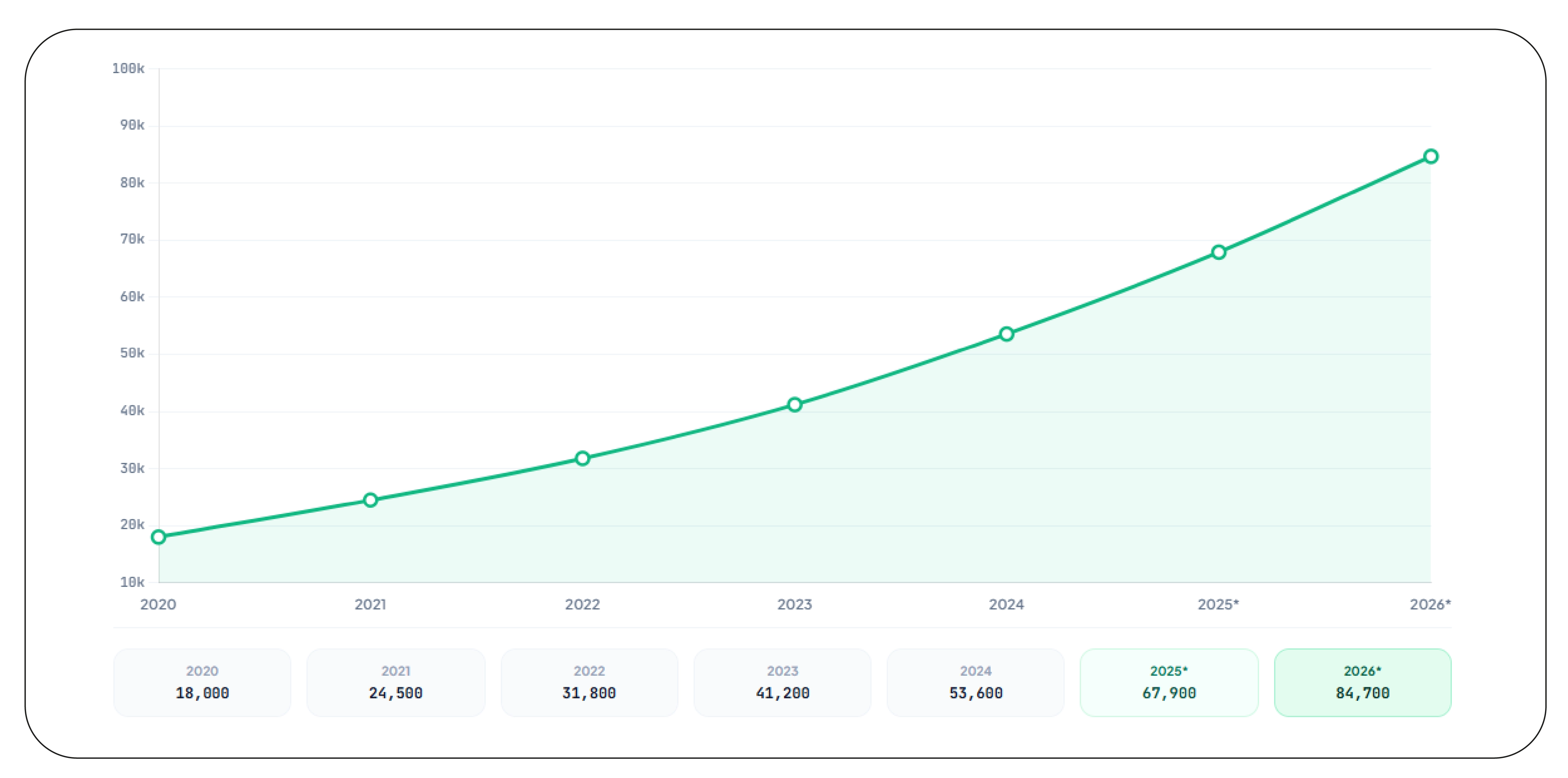
Sustainability Reporting Intelligence (2020–2026)
| Year |
ESG Reports Monitored |
Companies Using Automated ESG Data |
Reporting Accuracy |
| 2020 |
18,000 |
29% |
82% |
| 2021 |
24,500 |
36% |
85% |
| 2022 |
31,800 |
45% |
88% |
| 2023 |
41,200 |
55% |
91% |
| 2024 |
53,600 |
64% |
94% |
| 2025* |
67,900 |
72% |
96% |
| 2026* |
84,700 |
80% |
98% |
Projected industry estimates.
Organizations that automate sustainability intelligence gain faster access to reliable ESG information, enabling better compliance management, stronger stakeholder communication, improved supplier assessments, and more effective sustainability planning across global operations.
How Can Companies Stay Ahead of Changing ESG Regulations?
ESG regulations continue to evolve across industries and regions. Governments, financial regulators, and stock exchanges frequently introduce new disclosure requirements that demand timely, accurate, and transparent reporting. Businesses relying on manual monitoring often struggle to keep pace with these changing obligations.
Using Scrape ESG Reports for Compliance, organizations can continuously monitor published ESG disclosures, annual sustainability reports, governance statements, climate-risk reports, and regulatory filings from competitors, suppliers, and industry leaders. Automated intelligence enables compliance teams to detect reporting changes quickly and identify emerging regulatory expectations before reporting deadlines arrive.
Continuous ESG monitoring helps organizations:
- Track regulatory disclosure updates.
- Compare reporting standards.
- Monitor sustainability frameworks.
- Identify compliance gaps.
- Benchmark governance practices.
- Evaluate climate-related disclosures.
- Improve audit preparedness.
- Strengthen investor confidence.
Automated ESG intelligence also supports cross-functional collaboration between sustainability teams, legal departments, investor relations, procurement, and executive leadership. Having centralized ESG datasets reduces reporting inconsistencies while improving the quality and completeness of sustainability disclosures.
ESG Compliance Monitoring Trends (2020–2026)
| Year |
Compliance Reports Tracked |
Regulatory Updates Monitored |
Businesses Automating ESG Compliance |
| 2020 |
12,600 |
1,200 |
27% |
| 2021 |
16,400 |
1,650 |
35% |
| 2022 |
21,300 |
2,150 |
44% |
| 2023 |
27,800 |
2,850 |
54% |
| 2024 |
35,900 |
3,700 |
63% |
| 2025* |
45,600 |
4,750 |
72% |
| 2026* |
57,800 |
6,000 |
81% |
Projected industry estimates.
Businesses that proactively monitor ESG reporting requirements are better equipped to meet regulatory expectations, reduce compliance risks, improve disclosure quality, and strengthen long-term sustainability governance. Continuous compliance intelligence transforms ESG reporting from a reactive process into a strategic business advantage.
How Can Continuous Compliance Monitoring Reduce Business Risk?
Organizations operate in an environment where regulations, sustainability standards, and governance requirements evolve rapidly. Waiting until annual reporting cycles to review compliance information can expose businesses to regulatory penalties, reputational damage, and operational risks. Continuous monitoring enables companies to identify issues early and respond proactively.
By implementing Scrape Compliance Monitoring Data, organizations can automatically collect information from regulatory agencies, industry associations, corporate disclosures, supplier portals, and sustainability databases. This provides compliance teams with up-to-date insights that improve governance and strengthen risk management.
Automated compliance monitoring helps businesses:
- Track regulatory updates in real time.
- Identify policy changes quickly.
- Monitor supplier compliance.
- Detect reporting inconsistencies.
- Benchmark industry standards.
- Reduce audit preparation time.
- Improve governance transparency.
- Strengthen enterprise risk management.
Instead of relying on fragmented manual processes, businesses gain a centralized repository of compliance intelligence. Historical data also enables organizations to identify recurring compliance trends, evaluate policy effectiveness, and prepare for future regulatory requirements with greater confidence.
Compliance Monitoring Growth (2020–2026)
| Year |
Compliance Records Monitored |
Regulatory Sources Tracked |
Automated Compliance Adoption |
| 2020 |
14,800 |
240 |
31% |
| 2021 |
19,600 |
310 |
39% |
| 2022 |
25,700 |
390 |
48% |
| 2023 |
33,900 |
490 |
58% |
| 2024 |
43,500 |
610 |
67% |
| 2025* |
55,800 |
760 |
75% |
| 2026* |
70,900 |
920 |
84% |
Projected industry estimates.
Organizations using automated compliance intelligence improve reporting accuracy, reduce regulatory risks, streamline internal audits, and enhance decision-making. Continuous monitoring also supports stronger stakeholder confidence by demonstrating a proactive approach to governance and compliance management.
How Can Corporate Responsibility Insights Strengthen ESG Strategies?
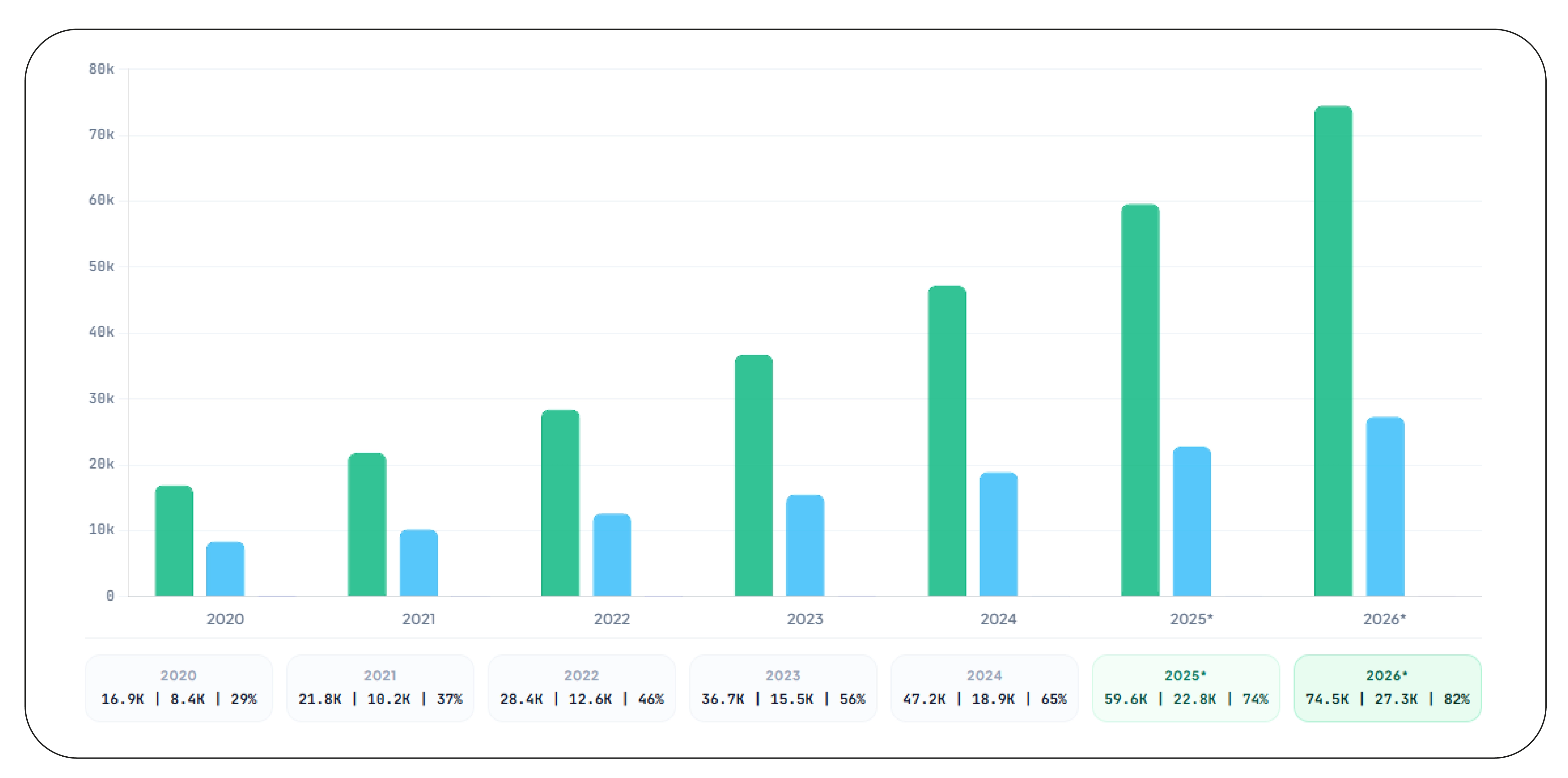
Corporate responsibility extends beyond regulatory compliance. Investors, consumers, and business partners increasingly evaluate organizations based on environmental initiatives, employee welfare, community engagement, ethical sourcing, and governance practices. Monitoring these disclosures helps businesses benchmark their sustainability performance and identify opportunities for improvement.
Using Scrape Corporate Responsibility Reports, organizations can automatically collect data from sustainability reports, CSR publications, annual reports, supplier disclosures, and public corporate communications. These structured datasets provide valuable insights into how businesses manage environmental, social, and governance commitments across global operations.
Corporate responsibility intelligence enables organizations to:
- Monitor environmental initiatives.
- Track diversity and inclusion programs.
- Evaluate community investment efforts.
- Compare ethical sourcing practices.
- Analyze governance disclosures.
- Benchmark sustainability commitments.
- Improve stakeholder reporting.
- Strengthen ESG planning.
This intelligence supports procurement teams, investors, sustainability managers, and executive leadership by providing measurable benchmarks for responsible business practices. Organizations can also identify industry leaders and adopt best practices that enhance long-term resilience and corporate reputation.
Corporate Responsibility Reporting Trends (2020–2026)
| Year |
CSR Reports Collected |
Companies Publishing ESG Reports |
Automated CSR Analysis Adoption |
| 2020 |
16,900 |
8,400 |
29% |
| 2021 |
21,800 |
10,200 |
37% |
| 2022 |
28,400 |
12,600 |
46% |
| 2023 |
36,700 |
15,500 |
56% |
| 2024 |
47,200 |
18,900 |
65% |
| 2025* |
59,600 |
22,800 |
74% |
| 2026* |
74,500 |
27,300 |
82% |
Projected industry estimates.
Businesses that continuously monitor corporate responsibility disclosures gain deeper visibility into sustainability performance across industries. These insights help strengthen ESG strategies, improve stakeholder engagement, support responsible sourcing initiatives, and build long-term trust with investors, regulators, customers, and business partners.
How Can ESG Performance Metrics Improve Strategic Decision-Making?
Organizations need measurable ESG indicators to evaluate sustainability progress and identify areas for improvement. Monitoring ESG performance across competitors, suppliers, and industry leaders enables businesses to make informed strategic decisions while demonstrating accountability to stakeholders.
By implementing Scrape ESG Performance Data, businesses can collect structured information on carbon emissions, renewable energy adoption, water usage, waste management, diversity metrics, governance indicators, supply chain sustainability, and climate commitments. Automated monitoring replaces manual data collection with continuous, accurate intelligence that supports long-term planning.
Organizations can use ESG performance intelligence to:
- Benchmark sustainability performance.
- Track carbon reduction goals.
- Monitor renewable energy initiatives.
- Evaluate governance effectiveness.
- Compare industry ESG scores.
- Improve supplier assessments.
- Support investment decisions.
- Strengthen sustainability reporting.
Historical ESG datasets also enable predictive analysis, helping businesses anticipate reporting trends, identify emerging sustainability risks, and improve corporate resilience. These insights contribute to stronger governance frameworks and better alignment with evolving stakeholder expectations.
ESG Performance Monitoring (2020–2026)
| Year |
ESG Metrics Collected |
Organizations Using ESG Analytics |
Reporting Accuracy |
| 2020 |
2.8 Million |
32% |
84% |
| 2021 |
3.9 Million |
39% |
87% |
| 2022 |
5.3 Million |
48% |
90% |
| 2023 |
7.2 Million |
58% |
93% |
| 2024 |
9.8 Million |
67% |
95% |
| 2025* |
12.9 Million |
76% |
97% |
| 2026* |
16.5 Million |
84% |
98% |
Projected industry estimates.
Organizations that continuously monitor ESG performance gain a competitive advantage through improved reporting accuracy, stronger compliance, better supplier evaluation, and enhanced sustainability planning that supports long-term business growth.
How Does Centralized ESG Intelligence Support Long-Term Sustainability?
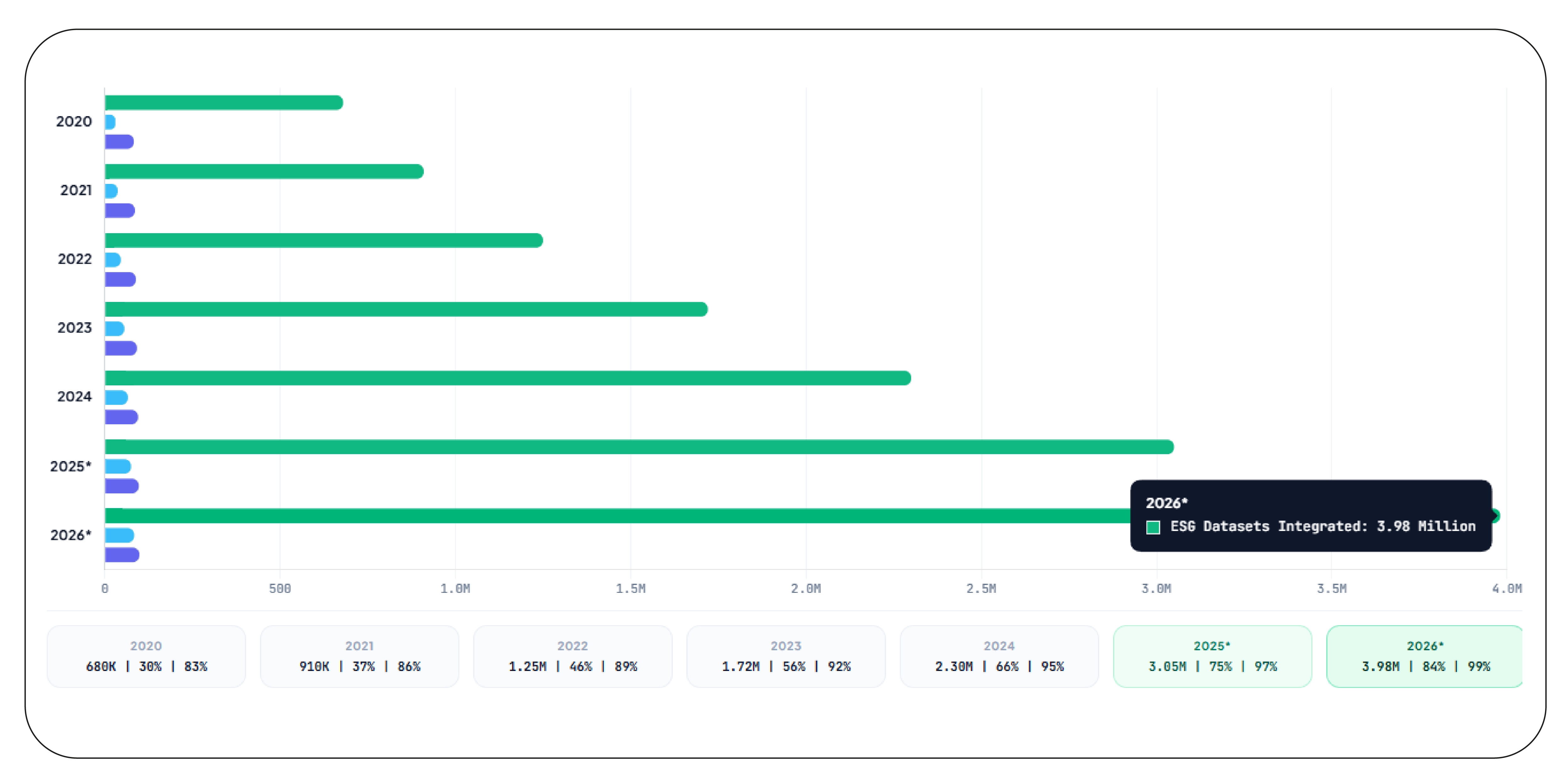
Modern organizations require a unified view of sustainability information across multiple business functions. Fragmented ESG datasets often lead to inconsistent reporting, duplicated effort, and delayed decision-making. Centralized intelligence creates a single source of truth for sustainability management.
Leveraging ESG & sustainability data, businesses can integrate information from sustainability reports, regulatory filings, supplier disclosures, governance documents, environmental databases, and corporate responsibility publications into one structured analytics platform.
Centralized ESG intelligence helps organizations:
- Standardize sustainability reporting.
- Improve data accuracy.
- Monitor supplier transparency.
- Identify reporting gaps.
- Benchmark industry performance.
- Strengthen governance frameworks.
- Support investment analysis.
- Enhance executive decision-making.
A centralized ESG ecosystem also enables collaboration across compliance teams, procurement, finance, sustainability, investor relations, and executive leadership. This improves operational efficiency while ensuring consistent ESG disclosures throughout the organization.
ESG Intelligence Adoption (2020–2026)
| Year |
ESG Datasets Integrated |
Enterprises Using Centralized ESG Platforms |
Data Consistency |
| 2020 |
680,000 |
30% |
83% |
| 2021 |
910,000 |
37% |
86% |
| 2022 |
1.25 Million |
46% |
89% |
| 2023 |
1.72 Million |
56% |
92% |
| 2024 |
2.30 Million |
66% |
95% |
| 2025* |
3.05 Million |
75% |
97% |
| 2026* |
3.98 Million |
84% |
99% |
Projected industry estimates.
Businesses that centralize ESG intelligence improve reporting consistency, accelerate compliance processes, enhance sustainability governance, and make data-driven decisions that create long-term value for investors, regulators, customers, and stakeholders.
Why Choose Product Data Scrape?
Product Data Scrape delivers enterprise-grade data extraction solutions that help organizations automate sustainability intelligence, regulatory monitoring, and market analysis. Our expertise in ESG & Sustainability Data Scraping enables businesses to collect structured ESG disclosures, compliance updates, supplier sustainability information, and governance metrics from trusted public sources. We also support MAP and RRP compliance monitoring, helping brands monitor pricing integrity while maintaining regulatory compliance. With scalable data collection, customized dashboards, API integration, and real-time analytics, our solutions empower organizations to improve reporting accuracy, strengthen compliance strategies, reduce manual effort, and make faster, data-driven sustainability decisions.
Conclusion
Organizations that invest in ESG & Sustainability Data Scraping gain a strategic advantage through automated reporting, stronger compliance, improved governance, and better sustainability planning. Combining ESG intelligence with Real-time price tracking provides deeper visibility into supplier performance, responsible sourcing, and market dynamics, enabling smarter business decisions. As reporting standards continue to evolve, automated intelligence becomes essential for maintaining transparency and stakeholder trust.
Partner with Product Data Scrape to implement ESG & Sustainability Data Scraping solutions that deliver actionable sustainability intelligence, regulatory compliance support, and Real-time price tracking for smarter, future-ready business growth!
FAQs
1. Why is ESG data scraping important?
Automated ESG data scraping helps organizations collect accurate sustainability information, improve reporting efficiency, reduce manual work, identify compliance risks, and strengthen decision-making using reliable environmental, social, and governance data.
2. What information can ESG data scraping collect?
It can collect sustainability reports, ESG disclosures, governance policies, climate commitments, carbon emissions, supplier transparency, compliance updates, CSR initiatives, diversity metrics, and environmental performance indicators from public sources.
3. Which industries benefit the most from ESG intelligence?
Manufacturing, retail, finance, healthcare, energy, logistics, consumer goods, investment firms, and procurement organizations benefit from ESG intelligence to improve compliance, supplier evaluation, and sustainability reporting.
4. How does Product Data Scrape support ESG reporting?
Product Data Scrape provides automated data extraction, structured ESG datasets, regulatory monitoring, supplier intelligence, customizable dashboards, and scalable analytics that improve reporting accuracy and sustainability decision-making.
5. How often should organizations update ESG data?
Organizations should monitor ESG data continuously or at scheduled intervals to capture regulatory changes, sustainability disclosures, supplier updates, governance developments, and emerging compliance requirements before reporting deadlines.


 Singapore
 EMAIL
EMAIL
 PHONE
PHONE


.webp)
.webp)

.webp "thumb")
.webp "thumb")









.webp)