Introduction
Web Scraping Costs in 2026 depend on data volume, website complexity, scraping frequency, infrastructure, maintenance, and delivery requirements. Businesses can reduce costs by choosing the right collection model before development begins. The goal is not simply to find the cheapest scraper. The goal is to achieve reliable data at the lowest sustainable total cost.
A useful 2026 planning benchmark is that scraping costs can range from low-cost self-managed tools for small projects to significantly higher monthly budgets for enterprise-scale data operations. Actual costs vary by website, volume, frequency, and technical requirements.
Illustrative Cost Pressure Trends (2020–2026)
| Year |
Typical Data Need |
Cost Pressure |
Main Cost Driver |
| 2020 |
Small datasets |
Low |
Development |
| 2021 |
Regular collection |
Low-Medium |
Infrastructure |
| 2022 |
Larger datasets |
Medium |
Proxies and maintenance |
| 2023 |
Multi-site scraping |
Medium-High |
Scale and reliability |
| 2024 |
High-volume extraction |
High |
Infrastructure and monitoring |
| 2025 |
Real-time datasets |
High |
Frequency and complexity |
| 2026 |
AI and live-data workflows |
Very High |
Scale, reliability, and freshness |
These figures are planning benchmarks, not universal market prices.
Live Web Data has also become more important for pricing, product intelligence, competitive research, and AI-driven applications. Companies need current information instead of outdated static datasets.
For buyers, the main cost question is simple: how much should you spend to collect, maintain, process, and deliver the data your business actually needs?
How Much Should a Web Scraping Project Cost in 2026?
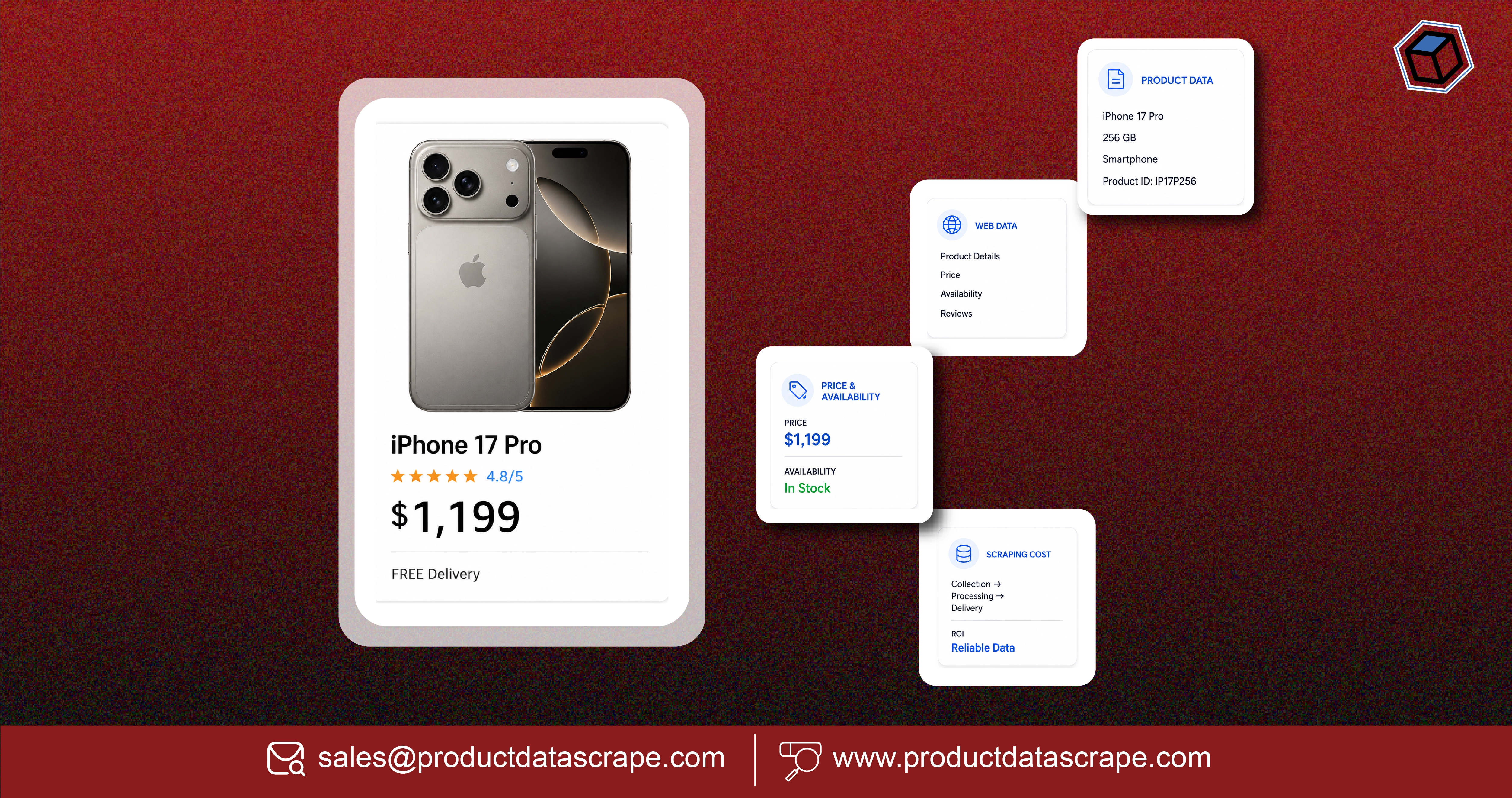
A web scraping cost benchmark report 2026 should consider more than development fees. The complete cost includes setup, infrastructure, proxies, data storage, maintenance, monitoring, extraction logic, and data delivery.
A simple scraper that collects a few hundred pages once a month has very different requirements from a system that monitors millions of pages every day.
Several factors influence the final budget.
First, website complexity matters. Static pages are usually easier to process. JavaScript-heavy websites may require browser automation and additional resources.
Second, scraping frequency affects infrastructure use. Daily collection requires fewer resources than hourly or near-real-time collection.
Third, the number of target websites matters. Each website may have different structures and technical behavior.
Fourth, data quality adds cost. Businesses may need validation, deduplication, normalization, and historical storage.
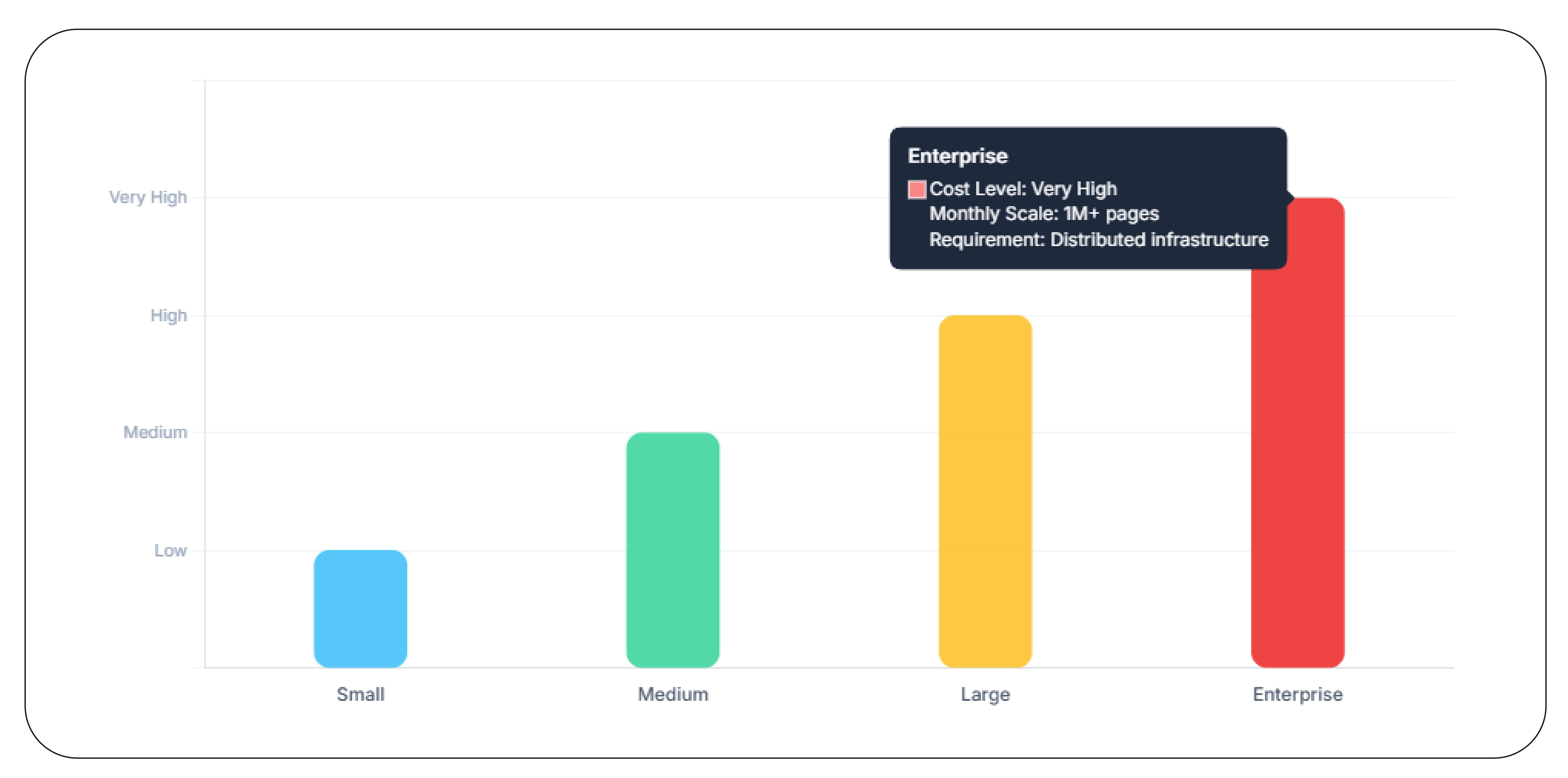
Illustrative Project Cost Levels
| Project Type |
Illustrative Monthly Scale |
Relative Cost Level |
Typical Requirement |
| Small |
Up to 10K pages |
Low |
Basic extraction |
| Medium |
10K–100K pages |
Medium |
Automation and monitoring |
| Large |
100K–1M pages |
High |
Scaling and validation |
| Enterprise |
1M+ pages |
Very High |
Distributed infrastructure |
These are illustrative ranges designed for planning.
The cheapest option is not always the most economical. A low-cost scraper that frequently fails can create expensive manual work.
Businesses should therefore calculate total operating cost rather than looking only at the initial development quote.
The best approach balances data freshness, coverage, reliability, scalability, and cost.
What Factors Increase the Total Project Budget?
A web scraping project cost analysis should separate one-time costs from recurring costs.
One-time expenses may include architecture, scraper development, data schema design, testing, and integration. Recurring expenses can include infrastructure, proxies, monitoring, maintenance, storage, and data processing.
The target website can have a major impact on both categories.
If a website has a simple structure, extraction may require fewer resources. If it uses complex JavaScript rendering, frequent layout changes, authentication, or multiple page types, development becomes more demanding.
Scraping frequency is another major factor.
A business collecting data once per week may need a simple scheduled workflow. A pricing team monitoring products every hour requires a much more robust system.
Illustrative Cost Pressure by Component (2020–2026)
| Cost Component |
2020 |
2021 |
2022 |
2023 |
2024 |
2025 |
2026 |
| Development |
Medium |
Medium |
Medium |
High |
High |
High |
High |
| Infrastructure |
Low |
Low |
Medium |
Medium |
High |
High |
High |
| Maintenance |
Low |
Medium |
Medium |
High |
High |
High |
Very High |
| Data Processing |
Low |
Low |
Medium |
Medium |
High |
High |
Very High |
| Monitoring |
Low |
Low |
Medium |
Medium |
High |
High |
Very High |
The table shows relative cost pressure, not actual currency values.
Businesses should also consider data delivery.
Some teams only need CSV files. Others need APIs, databases, dashboards, cloud storage, or direct integration with internal applications.
A useful budgeting formula is:
Total scraping cost = development + infrastructure + data access + maintenance + processing + storage + monitoring + delivery.
This formula prevents teams from focusing on one expense while ignoring the others.
For long-term projects, recurring costs often become more important than the initial development investment.
Why Does Large-Scale Collection Cost More?
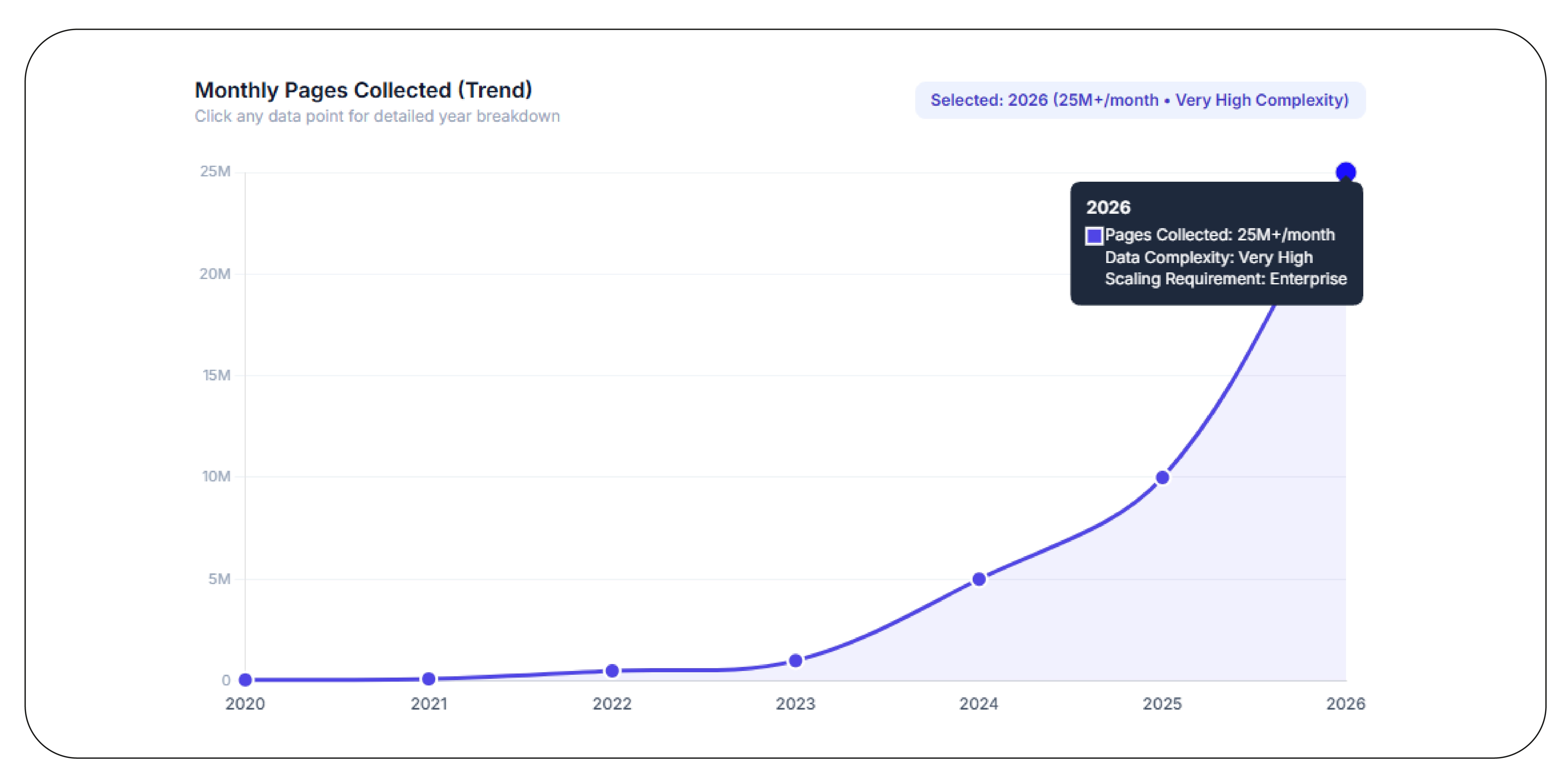
The cost of large-scale web scraping increases as businesses expand product coverage, websites, frequency, and geographic scope.
A system collecting 10,000 pages per month may work with a modest infrastructure setup. A system collecting millions of pages may need distributed processing, stronger monitoring, advanced scheduling, and automated recovery.
Large-scale projects also generate more data.
Web Scraping data may include product information, prices, availability, reviews, ratings, seller details, property listings, job postings, or competitor information.
The data must then be processed and stored.
Illustrative Large-Scale Requirements (2020–2026)
| Year |
Illustrative Pages Collected |
Data Complexity |
Scaling Requirement |
| 2020 |
50K/month |
Low |
Basic |
| 2021 |
100K/month |
Low |
Basic |
| 2022 |
500K/month |
Medium |
Moderate |
| 2023 |
1M/month |
Medium |
High |
| 2024 |
5M/month |
High |
High |
| 2025 |
10M/month |
High |
Very High |
| 2026 |
25M+/month |
Very High |
Enterprise |
These volumes are hypothetical examples to illustrate scaling pressure.
Large-scale systems also need strong quality controls.
A failed collection run can create missing records. A website redesign can break extraction fields. Duplicate records can distort analytics.
Monitoring helps detect these problems quickly.
Businesses should track metrics such as:
- Successful page collection rate.
- Missing-field rate.
- Duplicate rate.
- Data freshness.
- Processing time.
- Error frequency.
- Delivery success.
The cost of scaling should therefore include quality assurance.
Reliable data is more valuable than simply collecting a large volume of pages.
For companies using web data for pricing or market intelligence, poor-quality information can lead to incorrect business decisions. This can make data quality a financial issue rather than only a technical issue.
How Can Businesses Compare Different Pricing Models?
A web scraping pricing comparison 2026 should evaluate the three common approaches: building internally, buying software, and using a managed service.
Building internally provides control. The company owns the architecture and can customize the system.
Buying a commercial solution can reduce development time. The business receives predefined features and a ready-to-use interface.
A managed service can reduce the operational workload. The provider manages much of the collection infrastructure while the customer focuses on using the data.
Illustrative Model Comparison
| Model |
Setup Cost |
Ongoing Work |
Customization |
Scalability |
| Build |
High |
High |
Very High |
High with investment |
| Buy |
Medium |
Medium |
Medium |
Medium-High |
| Managed |
Low-Medium |
Low |
High |
High |
These ratings are general decision-making guidelines.
Businesses should also compare pricing structures.
Some solutions charge based on requests. Others use pages, records, credits, products, API calls, or monthly plans.
For example, a project collecting 50,000 records may have a very different cost from one collecting 5 million records.
Frequency also changes the economics.
A daily workflow can cost much less than hourly monitoring across the same product catalog.
The best pricing model is therefore tied to business requirements.
Before selecting a provider or technology, buyers should estimate:
- Number of websites.
- Number of pages.
- Number of products.
- Collection frequency.
- Required data fields.
- Historical data needs.
- Delivery format.
- Expected growth.
This creates a more accurate budget than comparing headline subscription prices.
How Can Scraping Costs Be Controlled for Competitive Intelligence?
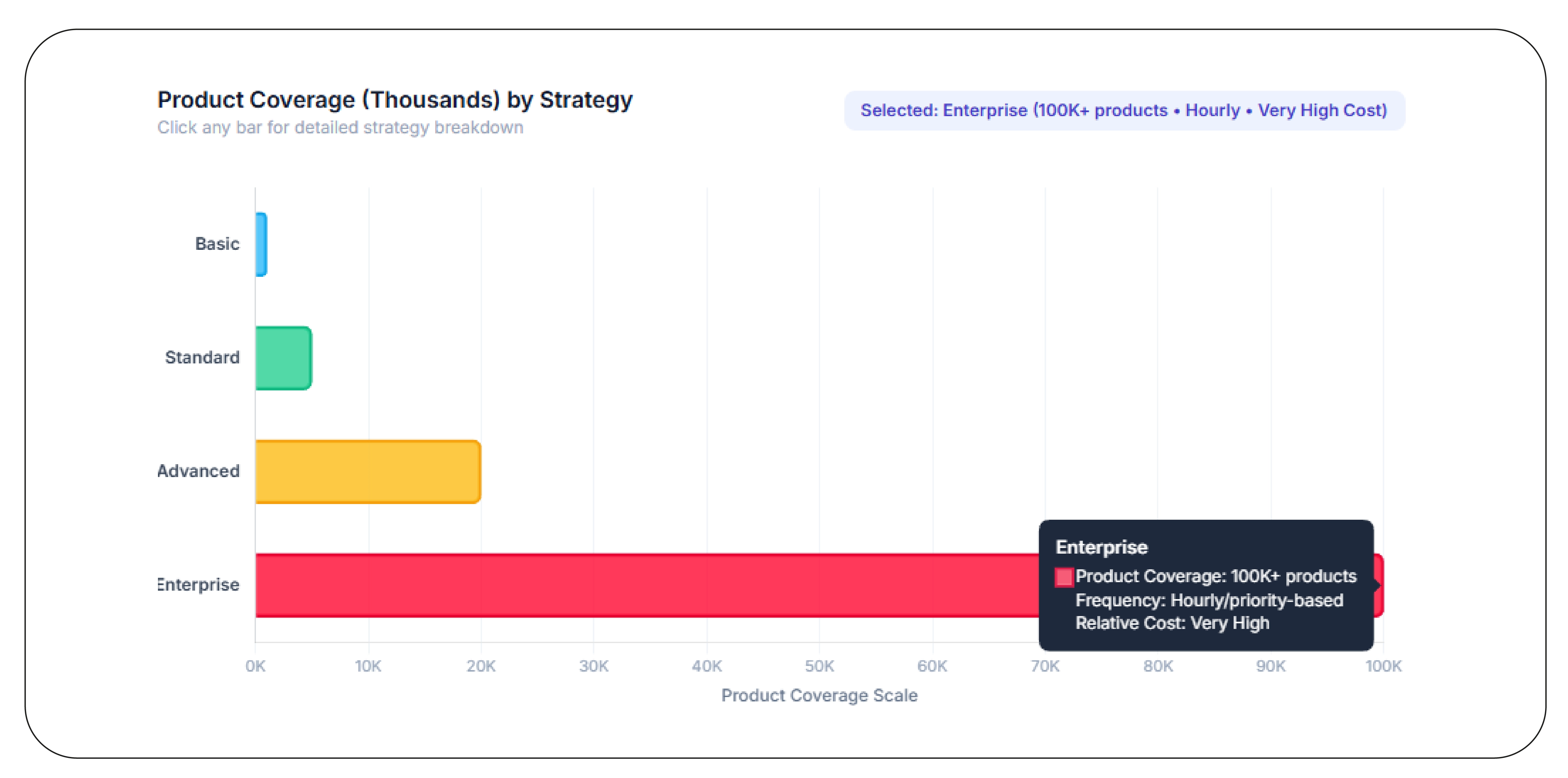
The web scraping cost for competitive intelligence can increase quickly when businesses monitor many competitors, products, locations, or marketplaces.
However, companies do not always need to collect everything.
The first cost-control strategy is to define the exact business question.
If the goal is competitor price tracking, collecting every available page may be unnecessary. A focused product list can reduce data volume and processing requirements.
The second strategy is to prioritize important products.
High-value or high-competition products can be monitored more frequently. Low-priority products can be checked less often.
The third strategy is to avoid unnecessary fields.
If the business only needs price and availability, collecting dozens of additional attributes can increase processing and storage requirements.
Illustrative Monitoring Scenarios
| Monitoring Strategy |
Product Coverage |
Frequency |
Relative Cost |
| Basic |
1K products |
Weekly |
Low |
| Standard |
5K products |
Daily |
Medium |
| Advanced |
20K products |
Several times daily |
High |
| Enterprise |
100K+ products |
Hourly/priority-based |
Very High |
These are illustrative scenarios.
Another cost-saving strategy is historical change detection.
Instead of storing unnecessary duplicate records, businesses can focus on meaningful changes.
For example, if a product price remains unchanged, the system may only need to record the latest observation while preserving important historical snapshots according to the reporting requirement.
Businesses can also automate alerts.
Instead of manually reviewing thousands of products, pricing teams can receive notifications when prices move beyond a defined threshold.
This turns scraping from a data collection activity into a focused intelligence workflow.
The best cost strategy is therefore selective monitoring, not simply reducing the amount spent on infrastructure.
Can AI Applications Use Live Data Without Creating Unnecessary Costs?
AI Agents Use Live Product Data to answer questions, compare products, monitor competitors, and support automated decision-making. This creates a growing need for fresh information.
However, collecting live information for every product at every moment can become expensive.
A better model uses data freshness based on business importance.
For example, a high-demand product may require frequent updates. A low-priority product may only need daily or weekly updates.
The same principle can apply to AI agents.
An agent does not necessarily need the entire internet continuously refreshed. It needs relevant data when a specific task requires it.
Illustrative AI Data Freshness Scenarios (2020–2026)
| Year |
AI/Data Workflow |
Data Freshness Need |
Cost Pressure |
| 2020 |
Basic automation |
Daily |
Low |
| 2021 |
Data-assisted analytics |
Daily |
Low-Medium |
| 2022 |
Automated recommendations |
Several times daily |
Medium |
| 2023 |
AI-assisted research |
Frequent |
High |
| 2024 |
AI shopping workflows |
Near-real-time |
High |
| 2025 |
Agentic workflows |
Live for priority data |
Very High |
| 2026 |
AI Agents Use Live Product Data |
Task-based live access |
Very High |
These are illustrative technology planning scenarios.
The key is to connect freshness with value.
If an AI agent compares prices, stale data can reduce answer quality. If an agent summarizes a product category, hourly updates may not be necessary.
This creates an opportunity for adaptive scraping.
A business can assign different refresh levels:
- Critical data: near-real-time.
- High-priority data: hourly.
- Standard data: daily.
- Historical data: weekly or on demand.
This approach can reduce unnecessary collection.
It also makes infrastructure easier to scale.
Businesses should design the scraping workflow around actual AI use cases instead of assuming every data point needs continuous updates.
Why Choose Product Data Scrape?
Technology guides on web scraping often focus on tools and code. Business teams also need to understand scalability, maintenance, data quality, and total ownership cost.
Product Data Scrape helps businesses approach data collection as a practical business workflow. The focus should remain on collecting the right information at the right frequency and delivering it in a usable structure.
For teams evaluating Web Scraping Costs in 2026, this approach can help reduce unnecessary infrastructure investment and avoid building systems that are larger than the actual business requirement.
Key considerations include:
- Data scope.
- Collection frequency.
- Website coverage.
- Historical requirements.
- Data validation.
- Scalability.
- Delivery format.
- Maintenance needs.
A well-designed data strategy can reduce hidden expenses while improving the value of collected information.
Conclusion
The best way to control scraping expenses is to plan around business value. Start with the exact data required. Define the collection frequency. Estimate future volume. Then compare internal development, software, and managed options.
Competitive pricing data is valuable only when it is timely, accurate, and usable. Businesses should avoid paying for unnecessary volume or excessive infrastructure.
Web Scraping Costs in 2026 will increasingly depend on data freshness, automation, AI requirements, scale, and reliability. A focused strategy can keep these costs under control while supporting long-term growth.
Contact Product Data Scrape today to discuss your data requirements and build a scalable, cost-efficient web scraping strategy for your business!
FAQs
What affects web scraping costs most?
Website complexity, scraping frequency, data volume, infrastructure, proxies, maintenance, storage, processing, and delivery requirements usually have the biggest impact on overall project costs.
Is managed scraping cheaper than building internally?
It can be when maintenance, infrastructure, engineering time, monitoring, and scaling are included. The best option depends on project volume, complexity, customization, and internal resources.
How can scraping costs be reduced?
Prioritize important pages, adjust collection frequency, collect only required fields, automate monitoring, reuse validated workflows, and choose infrastructure that matches actual data volume.
Does real-time scraping cost more?
Usually, yes. Frequent collection creates higher infrastructure and processing requirements. Businesses can control costs by applying real-time monitoring only to high-priority products or data.
Can Product Data Scrape support scalable projects?
Yes. Product Data Scrape can support businesses that need structured web data for competitive intelligence, product monitoring, pricing analysis, market research, and other scalable use cases.


 Singapore
 EMAIL
EMAIL
 PHONE
PHONE


.webp)
.webp)
.webp "thumb")
.webp "thumb")








.webp)