Quick Overview
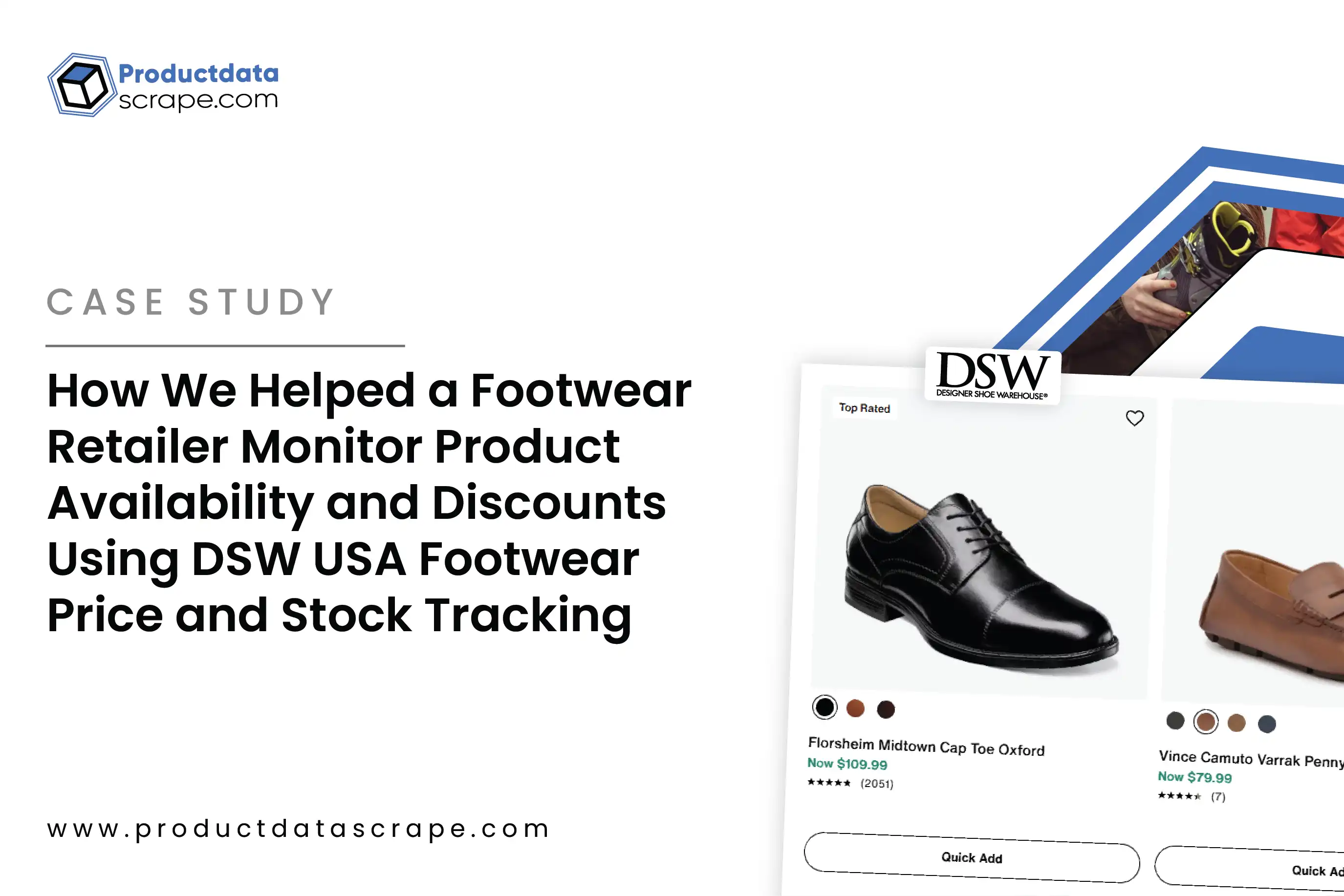
A US footwear retailer wanted better visibility into competitor pricing, product discounts, and stock availability across DSW Designer Shoe Warehouse. Product Data Scrape developed a structured data collection approach to organize product-level information and support competitive retail analysis. The project focused on footwear prices, size-level availability, promotional changes, and inventory observations. DSW USA Footwear Price and Stock Tracking was designed to strengthen Competitor price monitoring and provide a consistent foundation for retail intelligence.
Client Name / Industry: Confidential US Footwear Retailer | Footwear and E-commerce
Service / Duration: Footwear Price and Inventory Data Collection | Project duration to be confirmed.
Key Impact Metrics: Product price coverage, stock-status data completeness, and monitoring update reliability.
The Client
The client was a US-based footwear retailer operating in the competitive fashion and e-commerce industry. Its business focused on offering branded footwear across different customer segments, including men, women, and children. The company wanted to strengthen its understanding of competitor pricing, product availability, and promotional activity to make more informed merchandising decisions.
The US footwear retail market presents ongoing challenges for businesses because product prices, discounts, sizes, and availability can change across online retail channels. DSW Designer Shoe Warehouse, operated by Designer Brands Inc., is an established footwear retailer offering brand-name and designer dress, casual, and athletic footwear alongside accessories. Its official company information describes a broad retail presence and a direct-to-consumer e-commerce business.
The client wanted to understand how competing footwear products were positioned across the DSW marketplace. Before partnering with Product Data Scrape, its research process relied on fragmented product observations and manual comparisons. This limited the consistency of competitor analysis and made it difficult to maintain historical product-level records.
The client therefore explored US Footwear Brand Competitor Pricing Intelligence to improve product benchmarking, monitor promotional changes, and strengthen its merchandising decisions. With customized Pricing strategy services, Product Data Scrape designed a data collection framework focused on publicly accessible footwear listings, product prices, discounts, and stock indicators.
Company reference: Designer Brands – Our Company.
Goals & Objectives
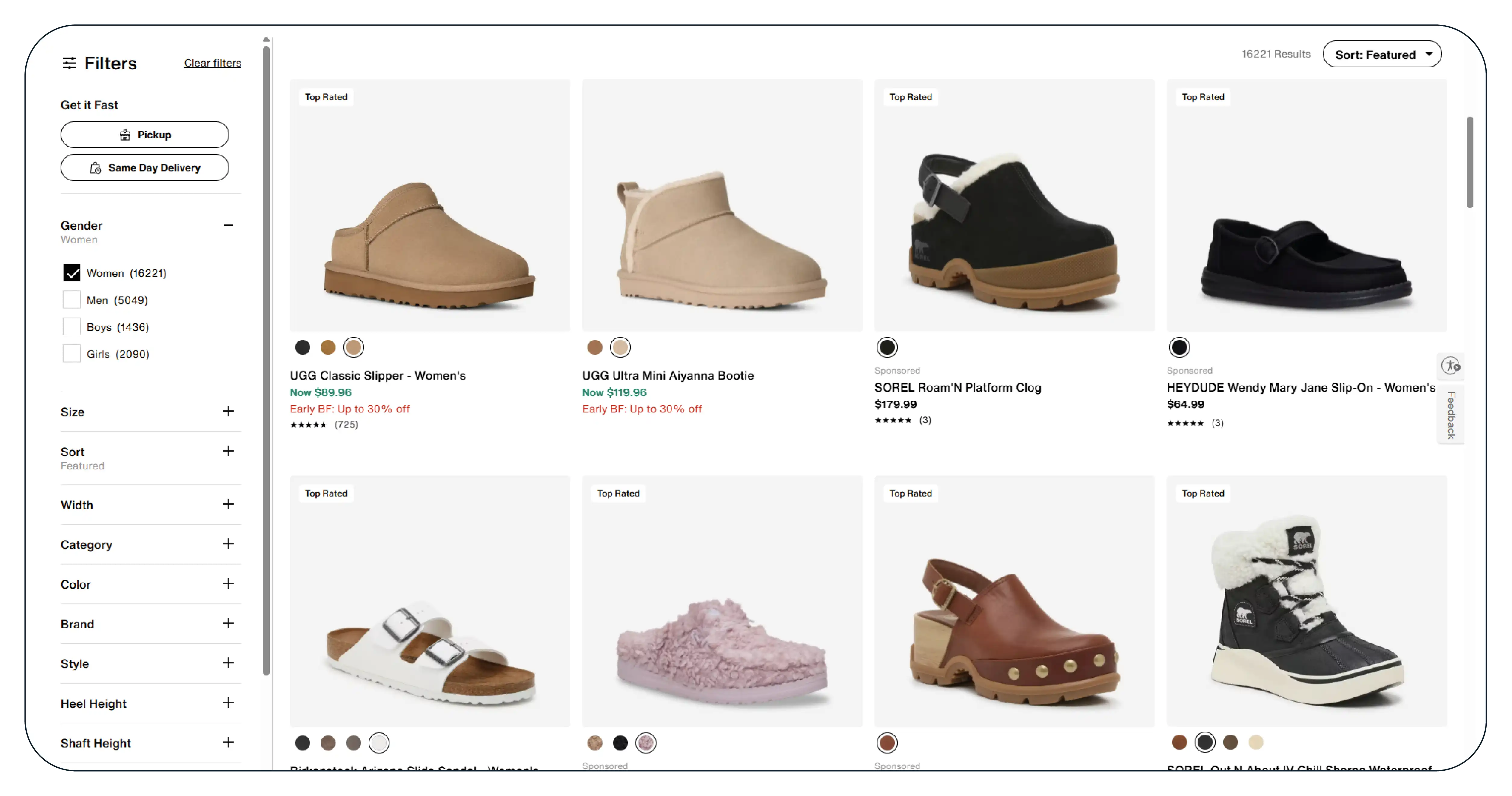
The primary business goal was to improve competitive visibility across footwear products listed on DSW. The client wanted a centralized source of product information that could support pricing comparisons, inventory research, and promotional analysis. Another priority was scalability, allowing the retailer to monitor a broader footwear assortment without depending entirely on manual research.
The solution was designed to improve product identification, simplify competitor comparisons, and support merchandising decisions across footwear categories. Consistent product records would also help analysts understand how competitor pricing and availability changed over time.
The technical objectives focused on building an automated and repeatable data collection workflow.
Automated Extraction: Collect publicly accessible product information, prices, discounts, and stock indicators.
SKU-Level Identification: Organize products using brand, model, product identifiers, and available size information.
Data Integration: Structure extracted records for integration with internal reporting and analytics systems.
Availability Monitoring: Capture available stock and size indicators at scheduled intervals.
Historical Analysis: Maintain timestamped observations to support price and inventory comparisons.
Data Validation: Identify missing fields, duplicate products, and inconsistent records.
The DSW Product-Level Stock Availability Scraping framework was designed to support these objectives through structured product-level collection and validation. The broader DSW USA Footwear Price and Stock Tracking workflow focused on making competitor information easier to analyze.
The following KPIs define how project performance should be measured. Actual values require client-side project records.
Product identification and matching accuracy.
Product price field completeness.
Size-level availability coverage.
Successful scheduled collection rate.
Discount and promotional change detection.
Historical record completeness.
Duplicate listing reduction.
The Core Challenge
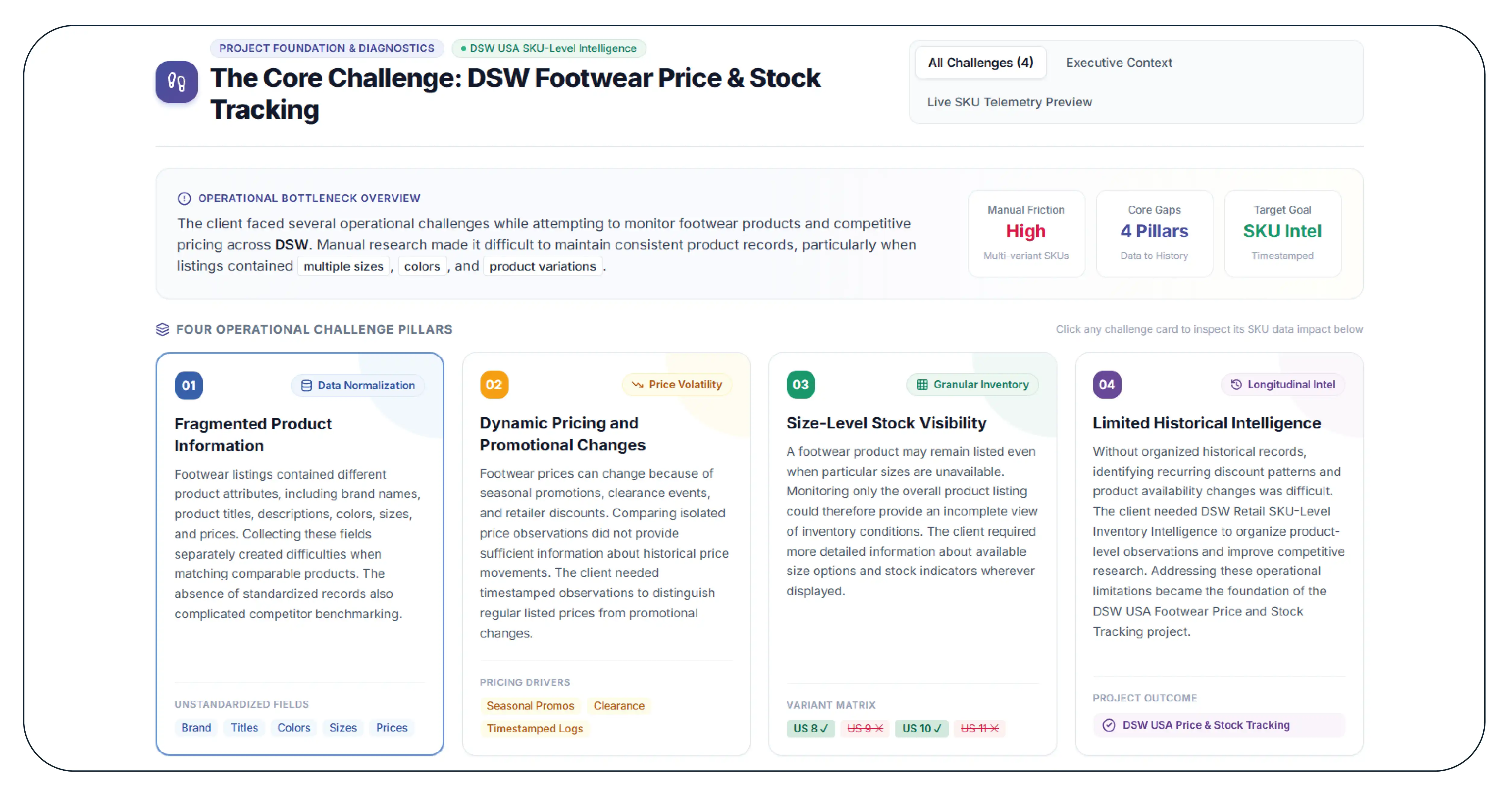
The client faced several operational challenges while attempting to monitor footwear products and competitive pricing across DSW. Manual research made it difficult to maintain consistent product records, particularly when listings contained multiple sizes, colors, and product variations.
Fragmented Product Information
Footwear listings contained different product attributes, including brand names, product titles, descriptions, colors, sizes, and prices. Collecting these fields separately created difficulties when matching comparable products. The absence of standardized records also complicated competitor benchmarking.
Dynamic Pricing and Promotional Changes
Footwear prices can change because of seasonal promotions, clearance events, and retailer discounts. Comparing isolated price observations did not provide sufficient information about historical price movements. The client needed timestamped observations to distinguish regular listed prices from promotional changes.
Size-Level Stock Visibility
A footwear product may remain listed even when particular sizes are unavailable. Monitoring only the overall product listing could therefore provide an incomplete view of inventory conditions. The client required more detailed information about available size options and stock indicators wherever displayed.
Limited Historical Intelligence
Without organized historical records, identifying recurring discount patterns and product availability changes was difficult. The client needed DSW Retail SKU-Level Inventory Intelligence to organize product-level observations and improve competitive research. Addressing these operational limitations became the foundation of the DSW USA Footwear Price and Stock Tracking project.
Our Solution
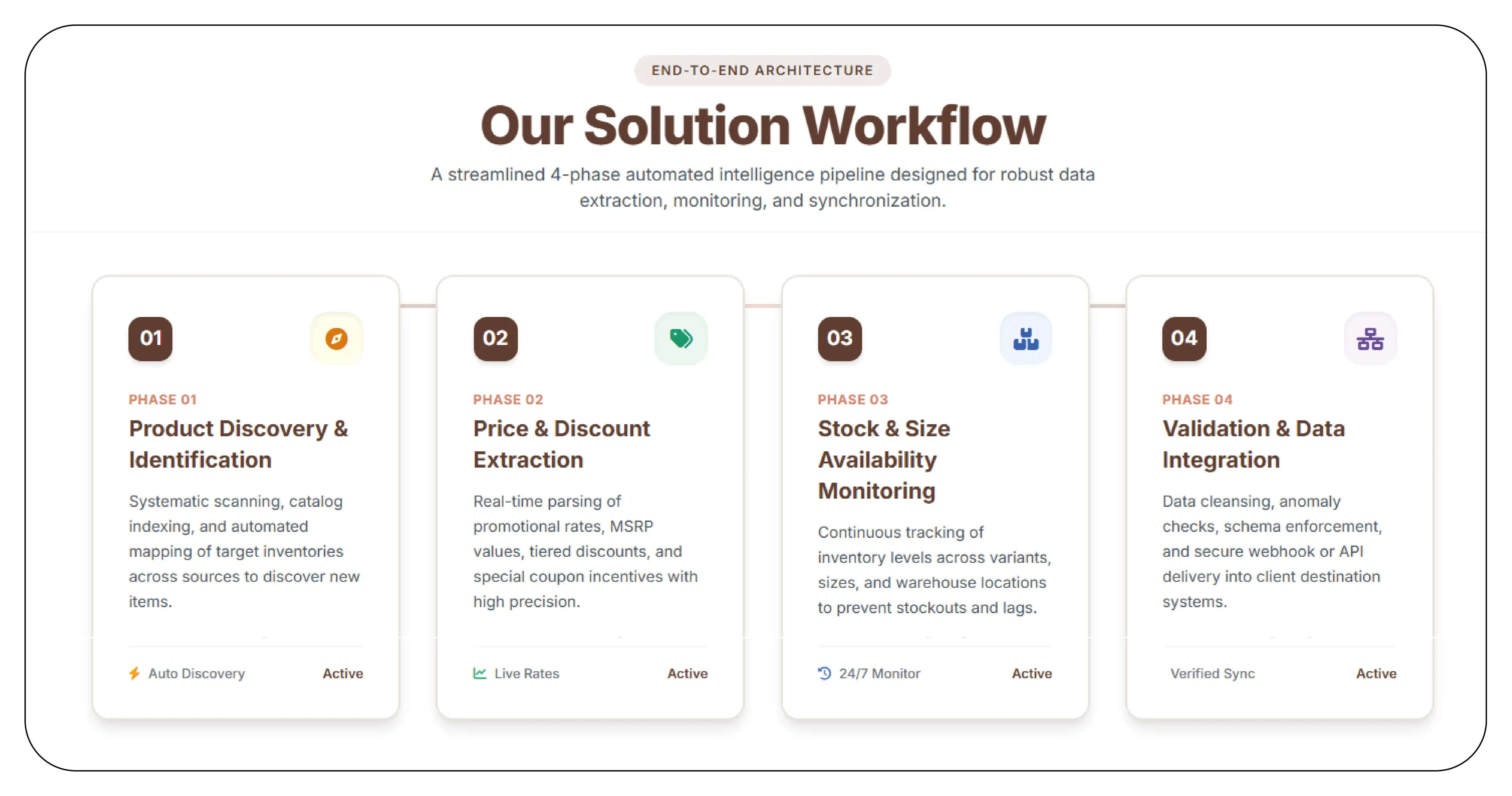
Product Data Scrape developed a structured footwear intelligence workflow focused on collecting, validating, and organizing publicly accessible product information from DSW Designer Shoe Warehouse. The implementation followed four major phases.
Phase 1: Product Discovery and Identification
Our team established product discovery rules covering relevant footwear categories, brands, product names, descriptions, identifiers, colors, and size variations. Standardized identification fields helped distinguish similar products and reduce duplicate records. This phase established a consistent foundation for product-level comparisons.
Phase 2: Price and Discount Extraction
We developed extraction rules to capture displayed product prices, available promotional information, and relevant listing attributes. Regular and promotional prices were organized into separate fields wherever the source presentation allowed. Timestamped observations supported comparisons between collection periods and helped identify recorded pricing changes.
Phase 3: Stock and Size Availability Monitoring
The next phase focused on product availability indicators. Our workflow captured accessible stock information, including available sizes and out-of-stock indicators where displayed. Product-level and size-level records were maintained separately to avoid treating an entire product as unavailable when only particular sizes were missing.
Phase 4: Validation and Data Integration
Collected information passed through validation and normalization processes. Our team checked product identifiers, price formats, duplicate records, and missing fields. The resulting dataset was organized into structured records suitable for spreadsheets, databases, and business intelligence platforms.
Through DSW Footwear Price-to-Availability Benchmarking, the client could evaluate product prices alongside recorded availability information. The complete DSW USA Footwear Price and Stock Tracking workflow was designed to support competitive analysis, historical comparisons, and more consistent footwear merchandising research.
Results & Key Metrics
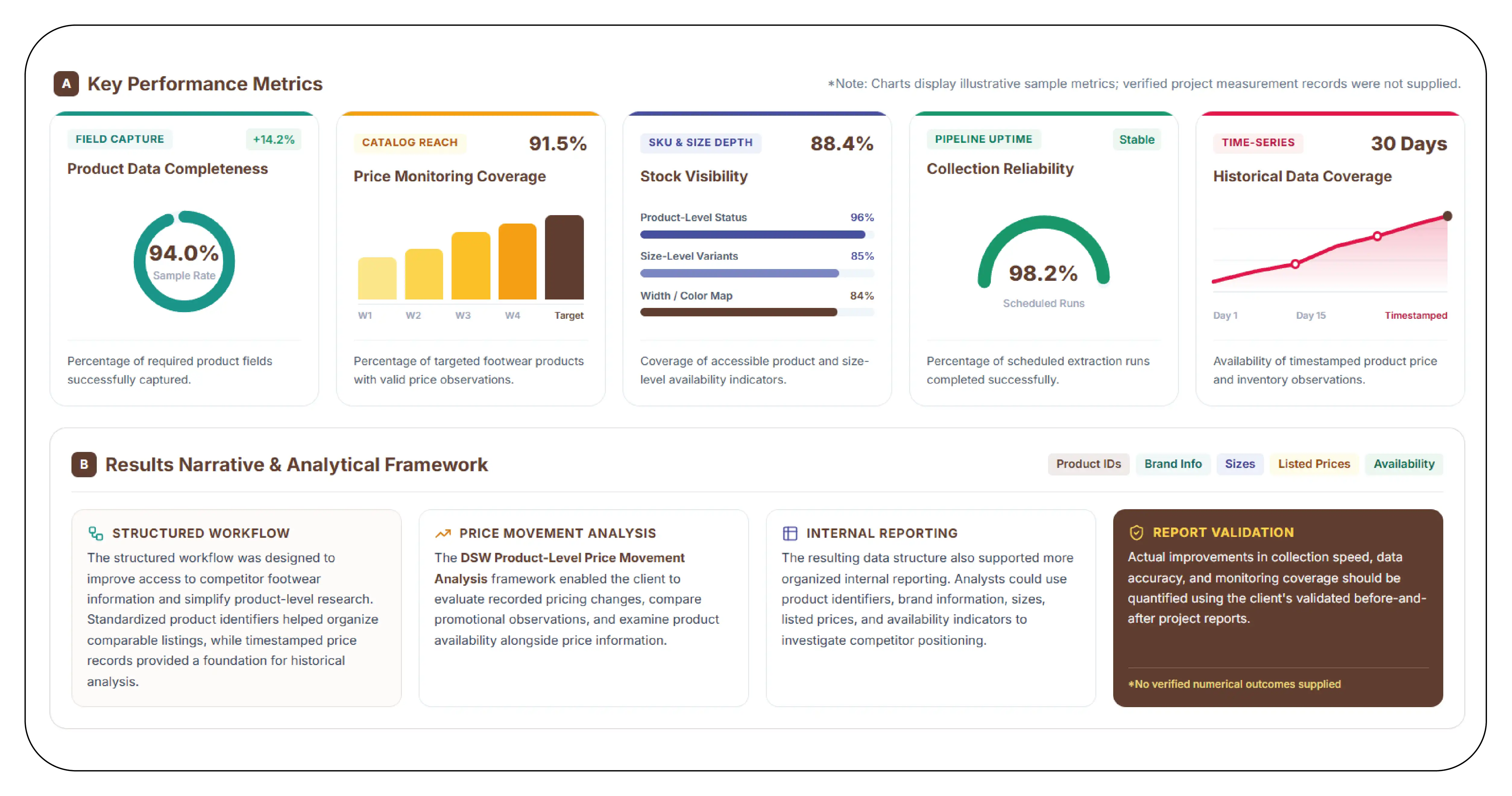
The solution established a structured foundation for evaluating footwear pricing and product availability across DSW listings. Rather than relying on isolated marketplace observations, the client could organize product-level information into comparable records.
The following measurements define the project's performance evaluation framework. No numerical outcomes are presented because verified project measurement records were not supplied.
Product Data Completeness: Percentage of required product fields successfully captured.
Price Monitoring Coverage: Percentage of targeted footwear products with valid price observations.
Stock Visibility: Coverage of accessible product and size-level availability indicators.
Collection Reliability: Percentage of scheduled extraction runs completed successfully.
Historical Data Coverage: Availability of timestamped product price and inventory observations.
The structured workflow was designed to improve access to competitor footwear information and simplify product-level research. Standardized product identifiers helped organize comparable listings, while timestamped price records provided a foundation for historical analysis.
The DSW Product-Level Price Movement Analysis framework enabled the client to evaluate recorded pricing changes, compare promotional observations, and examine product availability alongside price information.
The resulting data structure also supported more organized internal reporting. Analysts could use product identifiers, brand information, sizes, listed prices, and availability indicators to investigate competitor positioning.
Actual improvements in collection speed, data accuracy, and monitoring coverage should be quantified using the client's validated before-and-after project reports.
What Made Product Data Scrape Different
Product Data Scrape focused on building a product-level intelligence workflow rather than collecting isolated footwear prices.
Structured SKU-Level Collection
Product identifiers, brand names, sizes, colors, and prices were organized into standardized fields to support accurate comparisons.
Intelligent Availability Mapping
Our approach considered size-level availability indicators instead of relying exclusively on overall product listing status.
Automated Data Validation
Field normalization, duplicate identification, and timestamp management helped improve dataset consistency.
Flexible Monitoring Framework
The Assortment and availability monitoring workflow was designed around changing product listings and client-specific reporting requirements.
These capabilities formed the foundation of DSW USA Footwear Price and Stock Tracking, providing a scalable approach to footwear market intelligence.
Client's Testimonial
"Product Data Scrape helped us gain better visibility into DSW footwear pricing, promotional discounts, and product availability. The structured dataset made it easier to compare competitor products, monitor size-level stock changes, and understand pricing movements across footwear categories. Their organized data collection approach improved our market research workflow and provided valuable insights for merchandising and inventory planning. We appreciate their technical expertise, flexible data solutions, and commitment to delivering structured retail intelligence."
— Head of E-commerce Analytics, US Footwear Retailer
Conclusion
Footwear retailers need reliable competitor information to understand pricing movements, promotional activity, and product availability. This project demonstrates how a structured data collection framework can support more organized footwear market research and SKU-level comparisons. By leveraging Commerce Intelligence, businesses can gain actionable insights into competitor pricing strategies, product assortment trends, stock availability, and changing consumer demand, enabling smarter merchandising and data-driven retail decisions. By combining price observations with size-level availability information, Product Data Scrape designed a foundation for better Stockout Monitoring and competitive analysis. The DSW USA Footwear Price and Stock Tracking approach can support retailers seeking consistent product intelligence across changing online assortments. Partner with Product Data Scrape to build customized footwear datasets and strengthen your retail decision-making with structured market intelligence.
FAQs
1. What Is DSW USA Footwear Price and Stock Tracking?
It is a data collection approach for monitoring footwear product prices, discounts, sizes, and available stock indicators across DSW listings. Retailers use this information for competitor benchmarking, pricing research, and inventory analysis.
2. Which Product Details Can Be Collected from DSW?
Depending on publicly available listing information, the dataset can include: Brand and product name. Product URL and identifier. Listed price and discounts. Available sizes and colors. Stock availability indicators. Product images and descriptions.
3. Why Is Size-Level Stock Monitoring Important?
A shoe listing can remain active even when specific sizes are unavailable. Size-level monitoring provides more detailed availability information and helps retailers understand assortment gaps.
4. How Does Competitor Price Monitoring Help Footwear Retailers?
It helps retailers compare similar footwear products, evaluate promotional changes, identify price differences, and make informed merchandising decisions.
5. Can Product Data Scrape Deliver Customized Footwear Datasets?
Yes. Product Data Scrape develops customized data collection workflows and structured datasets based on business requirements, including product details, pricing observations, and availability indicators.


 Singapore
 EMAIL
 PHONE











.webp)