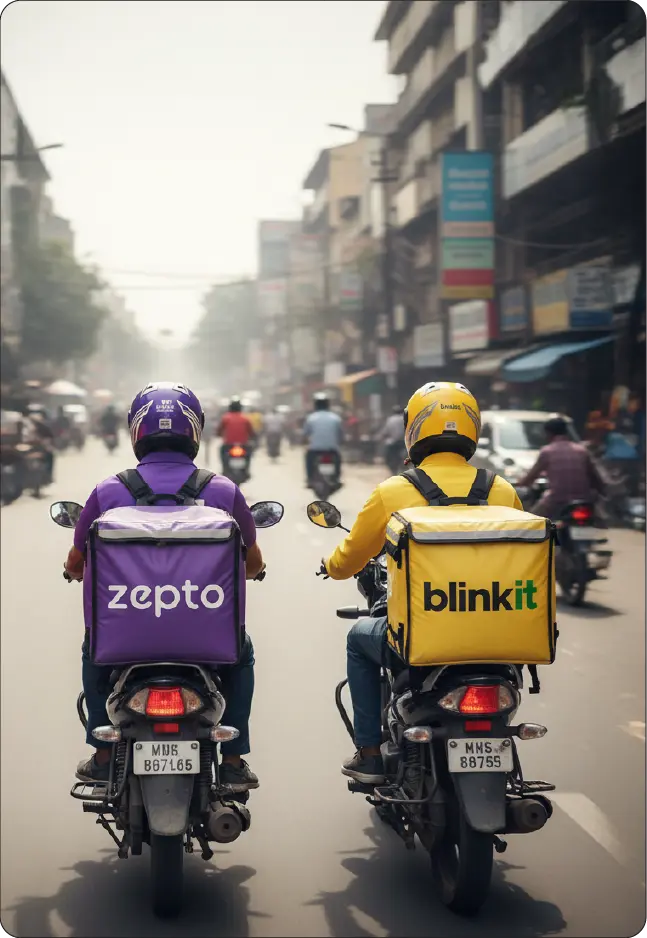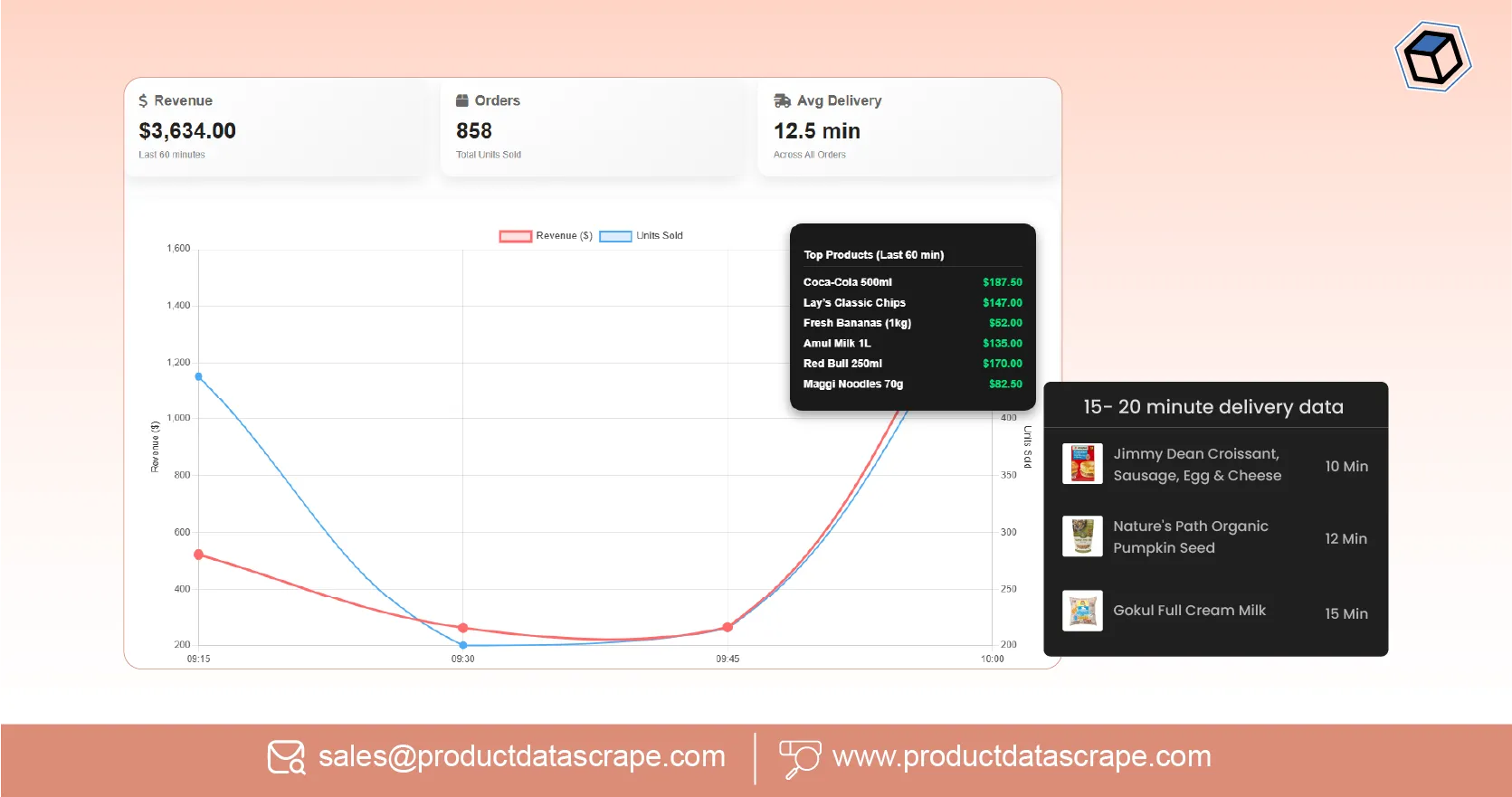
Introduction
In today’s ultra-competitive quick commerce market, timely insights can make or break a retail
business. 15-minute delivery data extraction and SQL analysis from scraped data allows retailers
to make informed decisions in real-time, ensuring they remain agile in a fast-moving
environment. With customer expectations shifting toward hyperlocal and instant delivery,
businesses must understand pricing trends, delivery efficiency, and competitor strategies to
stay ahead.
Scraping and analyzing quick commerce platforms enables retailers to capture granular details
about product availability, delivery times, and price fluctuations. For example, data from
grocery and FMCG platforms reveals which items are moving fastest and which are lagging in local
demand. Using SQL-based analysis, this data can be quickly transformed into actionable insights,
supporting strategic decisions for inventory management, pricing, and promotions.
From SQL insights from scraped quick commerce data to tracking competitive pricing, combining
scraping with ultrafast analysis creates a powerful toolkit. This blog explores practical
problem-solving techniques for capturing, storing, and analyzing delivery data efficiently,
providing actionable insights for real-time retail decision-making.
Hyperlocal Delivery Data Extraction
In today’s quick commerce market, consumers expect products delivered within minutes. Hyperlocal
delivery plays a crucial role in meeting these expectations. Businesses that implement
hyperlocal delivery data extraction can map demand geographically, optimize routes, and monitor
delivery performance for different zones.
The Problem
Without capturing location-specific data, retailers cannot identify which areas experience high
demand or delayed deliveries. Standard scraping techniques often miss hyperlocal nuances such as
delivery slots, courier efficiency, and stock availability across micro-locations. Incomplete
data leads to poor planning and customer dissatisfaction.
The Solution
Here’s how to handle it:
- Dynamic API Monitoring – Inspect the platform’s API
endpoints to capture delivery estimates and stock for each postal code. Many quick commerce
apps use location-based APIs to return delivery times dynamically.
- Automated Extraction Pipelines – Implement Python or
Node.js scrapers to continuously extract hyperlocal delivery data. Store it in a structured
SQL database for quick queries and historical comparisons.
- Data Validation – Cross-check timestamps, delivery slots,
and stock availability to ensure accuracy. Invalid data can distort decision-making.
- Visualization & Analytics – Map delivery efficiency and
stock availability by zone to identify bottlenecks or high-demand regions.
Example
A grocery retailer using hyperlocal extraction discovered that Zone A consistently had 20%
longer delivery times than average. By reallocating couriers and adjusting stock, delivery times
improved, reducing customer complaints by 15%.
Stats: Hyperlocal Delivery Trends (2020–2025)
| Year |
Avg Delivery Time (min) |
Hyperlocal Coverage (%) |
| 2020 |
35 |
25 |
| 2021 |
30 |
40 |
| 2022 |
25 |
55 |
| 2023 |
20 |
65 |
| 2024 |
18 |
75 |
| 2025 |
15 |
85 |
By leveraging 15-minute delivery data extraction and SQL analysis from scraped data, retailers
gain a competitive edge by identifying zones with the highest potential and optimizing
operations accordingly.
Scrape Delivery Time & Pricing Insights
Monitoring both delivery time and pricing is critical in fast-moving retail. Businesses that
scrape delivery time & pricing insights can understand cost dynamics and offer competitive
prices while maintaining service quality.
The Problem
Quick commerce platforms adjust fees frequently based on demand, peak hours, or location.
Without real-time monitoring, retailers risk underpricing, losing revenue, or overpricing,
causing customer churn. Additionally, fluctuating delivery times impact customer satisfaction
and fulfillment efficiency.
The Solution
Here’s how to handle it:
- Frequent Data Capture – Schedule scrapers to extract
delivery times and fees multiple times daily to capture real-time fluctuations.
- Structured SQL Analysis – Store data in tables with
columns like product_id, delivery_time, delivery_fee, zone, and timestamp. Use SQL queries
to detect trends, outliers, and patterns.
- Dashboard Visualization – Utilize SQL-powered BI tools
like Power BI or Tableau to visualize peak delivery times, fastest zones, and pricing
trends.
- Predictive Insights – Historical SQL data enables
forecasting of peak hours, helping in resource allocation and dynamic pricing.
Example
A retailer tracking delivery fees discovered surge pricing during evening hours. By
pre-positioning stock in local warehouses, delivery times decreased by 12%, and cost per
delivery reduced by 8%.
Stats: Delivery Fee Trends (2020–2025)
| Year |
Avg Delivery Fee (₹) |
Price Variance (%) |
| 2020 |
25 |
10 |
| 2021 |
28 |
12 |
| 2022 |
30 |
15 |
| 2023 |
32 |
18 |
| 2024 |
35 |
20 |
| 2025 |
38 |
22 |
Integrating ultrafast delivery data monitoring with SQL ensures that businesses can proactively
adjust pricing and delivery schedules, improving revenue and customer satisfaction.
Boost your quick commerce strategy—scrape delivery time & pricing
insights to optimize costs, speed, and customer satisfaction instantly!
Contact Us Today!
Quick Commerce Price Tracker Scraping
In a competitive landscape, monitoring competitor prices is essential. Quick commerce price
tracker scraping automates competitor monitoring to identify promotions, price drops, and
trending products.
The Problem
Manual tracking is slow, error-prone, and insufficient for rapid decision-making. Competitor
prices fluctuate multiple times per day, and missed opportunities lead to lost revenue.
The Solution
Here’s how to handle it:
- Automated Scrapers – Build scripts to extract competitor
prices for top SKUs several times per day. Capture product ID, price, discount, and
promotion details.
- SQL Database Storage – Organize historical competitor
data for comparison, trend analysis, and price elasticity calculation.
- Real-Time Alerts – Set thresholds to receive
notifications whenever competitor prices drop or promotions are launched.
- Market Strategy Integration – Feed competitor insights
into dynamic pricing engines to automatically adjust your prices.
Example
By tracking competitor discounts for grocery items, a retailer aligned prices within 5% of the
market average, increasing conversion rates by 10%.
Stats: Competitor Pricing Trends (2020–2025)
| Year |
Avg Price Change (%) |
Competitor Promotions (%) |
| 2020 |
5 |
10 |
| 2021 |
6 |
12 |
| 2022 |
7 |
15 |
| 2023 |
8 |
18 |
| 2024 |
9 |
20 |
| 2025 |
10 |
22 |
Using scrapers to track competitor product pricing and promotions, retailers can respond
instantly to market fluctuations, maintaining competitiveness.
Extract Grocery & Gourmet Food Data
In the quick commerce segment, grocery and gourmet food items account for a large portion of
orders. Efficient Extract Grocery & Gourmet Food Data pipelines allow retailers to capture
SKU-level insights, stock levels, pricing, and promotions. This ensures timely inventory
decisions and targeted marketing campaigns.
The Problem
Manual data collection or partial scraping leads to incomplete datasets. Retailers might miss
high-demand SKUs, localized shortages, or promotional offers, resulting in stockouts or missed
revenue opportunities. Additionally, data inconsistencies across stores or platforms can distort
insights if not properly handled.
The Solution
Here’s how to handle it:
- Targeted Scrapers – Focus on high-demand categories like
fresh produce, packaged foods, beverages, and gourmet items. Capture product details
including SKU, weight, price, delivery time, and promotions.
- SQL Database Structuring – Store extracted data in
structured tables for efficient querying. Include fields like product_id, category, price,
stock, promotion_flag, and timestamp.
- Historical Analysis – Compare current stock and pricing
against historical trends to predict demand surges and optimize inventory allocation.
- Real-Time Updates – Schedule scrapers at intervals (e.g.,
every 15 minutes) to ensure data reflects live availability and price changes.
Example
A retailer used scraped grocery data to identify best-selling items in urban zones. By
pre-stocking high-demand SKUs, they reduced stockouts by 20% and increased order fulfillment
efficiency by 15%.
Stats: Grocery Product Trends (2020–2025)
| Year |
Avg SKU Count |
Fast-Moving SKU % |
| 2020 |
5000 |
40 |
| 2021 |
6000 |
45 |
| 2022 |
7500 |
50 |
| 2023 |
9000 |
55 |
| 2024 |
10500 |
60 |
| 2025 |
12000 |
65 |
Integrating Quick Commerce Grocery & FMCG Data Scraping with SQL analytics allows retailers to
monitor trends, plan promotions, and optimize inventory allocation dynamically.
Competitor Price Monitoring Services
Price competitiveness is critical in quick commerce. Competitor Price Monitoring Services allow
retailers to track rival pricing, discounts, and promotions, ensuring they remain
market-relevant.
The Problem
Manual competitor tracking is slow and often inaccurate. Missed promotions or delayed pricing
adjustments can lead to lost market share. Additionally, competitors may introduce surge pricing
or localized discounts that require real-time monitoring to stay competitive.
The Solution
Here’s how to handle it:
- Real-Time Scraping – Capture competitor product pricing,
promotions, and stock levels multiple times per day. Track all variations across SKU,
location, and delivery time.
- SQL Storage & Analysis – Maintain historical tables for
competitor prices. Use SQL queries to calculate average price changes, promotional
frequency, and price elasticity.
- Alerts & Notifications – Automate notifications when
competitor prices drop or new promotions appear. This enables timely counter-strategies.
- Predictive Insights – Analyze historical trends to
forecast competitor pricing strategies, allowing proactive adjustments rather than reactive
responses.
Example
By monitoring competitor prices for grocery SKUs, a retailer adjusted their prices within
minutes of a competitor promotion. This resulted in a 12% increase in sales for the promoted
items.
Stats: Competitor Pricing Analysis (2020–2025)
| Year |
Price Monitoring Frequency |
Avg Reaction Time (hrs) |
| 2020 |
Weekly |
48 |
| 2021 |
3x Weekly |
36 |
| 2022 |
Daily |
24 |
| 2023 |
2x Daily |
12 |
| 2024 |
Hourly |
6 |
| 2025 |
Real-Time |
1 |
Combining competitor tracking with Pricing Intelligence Services ensures retailers maintain
dynamic pricing strategies, reducing revenue loss and increasing competitiveness.
Stay ahead in retail—use Competitor Price Monitoring Services to track
rival pricing, optimize strategies, and maximize revenue effortlessly!
Contact Us Today!
Ultrafast Delivery Data Monitoring with SQL
Speed and reliability are the backbone of quick commerce. Ultrafast delivery data monitoring
with SQL enables retailers to track delivery efficiency, fulfillment accuracy, and operational
performance in near real-time.
The Problem
Without continuous monitoring, delayed deliveries, stockouts, and incorrect pricing can damage
customer trust and reduce repeat orders. Manual tracking cannot keep pace with rapid changes in
delivery efficiency and demand fluctuations.
The Solution
Here’s how to handle it:
- Real-Time Extraction Pipelines – Implement automated
scrapers to capture delivery times, stock availability, and pricing updates every 15
minutes.
- SQL-Based Analysis – Aggregate and query data to identify
trends, anomalies, and performance bottlenecks. Create historical tables for predictive
analytics.
- Dashboards & Alerts – Visualize delivery times, SKU-level
stock status, and pricing changes on dashboards. Set automated alerts for delays, stock
shortages, or price fluctuations.
- Actionable Insights – Use insights to reallocate
resources, optimize courier deployment, and adjust prices dynamically.
Example
A retailer monitored delivery times across 10 urban zones. SQL dashboards revealed that Zone C
consistently had 10% longer delivery times during evening hours. By reallocating couriers and
pre-positioning stock, average delivery times reduced from 22 minutes to 15 minutes.
Stats: Delivery Monitoring Trends (2020–2025)
| Year |
Avg Data Refresh Time (min) |
Avg Delivery Accuracy (%) |
| 2020 |
120 |
85 |
| 2021 |
60 |
87 |
| 2022 |
30 |
90 |
| 2023 |
15 |
92 |
| 2024 |
10 |
94 |
| 2025 |
5 |
96 |
Why Choose Product Data Scrape?
Product Data Scrape specializes in building automated pipelines for 15-minute delivery data
extraction and SQL analysis from scraped data. We help businesses gather hyperlocal,
competitive, and grocery-specific data efficiently. Our services include Quick Commerce Grocery
& FMCG Data Scraping, competitor monitoring, and delivery performance insights.
With structured SQL storage, our solutions enable fast analytics and visualization, empowering
retailers to optimize pricing, stock, and delivery in real-time. Whether you need scrapers to
track competitor product pricing and promotions or SQL insights from scraped quick commerce
data, we provide reliable, scalable, and actionable datasets.
Conclusion
Real-time retail decision-making relies on speed and accuracy. 15-minute delivery data
extraction and SQL analysis from scraped data equips businesses with actionable insights,
enabling competitive pricing, faster deliveries, and inventory optimization.
From hyperlocal delivery monitoring to grocery-specific analytics and competitor price tracking,
scraping combined with SQL analysis empowers retailers to respond instantly to market changes.
Ready to transform your retail operations? Partner with Product Data Scrape to unlock real-time
insights, optimize pricing, and stay ahead in the quick commerce race!


 Singapore
 EMAIL
EMAIL
 PHONE
PHONE


.webp)
.webp "thumb")
.webp "thumb")
.webp "thumb")








.webp)