Quick Overview
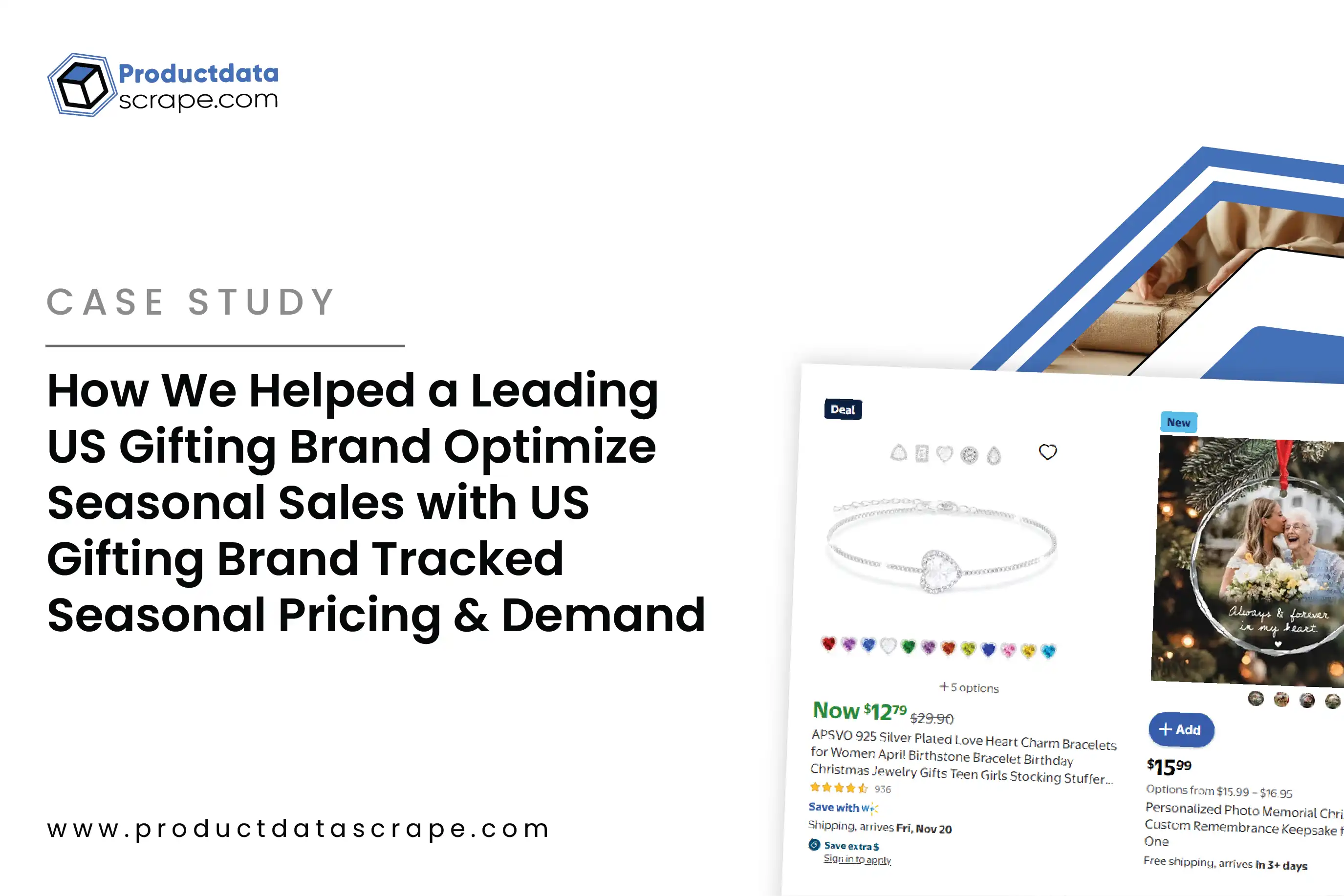
The project focused on helping a leading US gifting brand understand seasonal product demand, competitor pricing, and changing consumer preferences through structured e-commerce intelligence. US Gifting Brand Tracked Seasonal Pricing & Demand highlights the importance of accurate product-level monitoring during occasions such as Valentine's Day, Mother's Day, Thanksgiving, and Christmas. Product Data Scrape's proposed approach combines automated product collection, price comparisons, assortment monitoring, and demand signals to support better merchandising decisions. The client identity, project duration, and quantified business outcomes remain undisclosed. The initiative demonstrates how Personalized Gifting Market Intelligence can strengthen seasonal planning and competitive visibility.
Project profile
Client Name / Industry: Confidential US gifting and floral e-commerce brand.
Service: Product data extraction, competitor price monitoring, seasonal assortment intelligence, and demand analysis.
Duration: Not publicly disclosed.
Key Impact Metrics: Price coverage, product availability coverage, and seasonal assortment change detection. Verified client-specific improvement figures were not supplied.
The Client
The client operated in the competitive US gifting and floral e-commerce industry, where product demand changes around holidays, personal celebrations, and special occasions. Customers frequently compare bouquets, personalized gifts, chocolates, gift baskets, greeting cards, and delivery options before placing orders. These changing shopping patterns create pressure on retailers to maintain competitive prices, relevant assortments, and accurate product availability.
The importance of seasonal planning is visible in the operations of established gifting businesses. According to its FY2025 annual report, 1-800-FLOWERS.COM, Inc. reported that approximately 46% of its annual revenue came from its second fiscal quarter, which includes the Thanksgiving and Christmas holiday season. Its business portfolio includes 1-800-Flowers.com, Harry & David, Cheryl's Cookies, Shari's Berries, and PersonalizationMall.
This industry environment made data-led transformation important for the anonymous client. Before the proposed engagement, its monitoring requirements involved understanding product prices across competing stores, identifying changing seasonal assortments, and consolidating fragmented product information.
The project scope included evaluating publicly visible market signals associated with 1-800-Flowers Seasonal Demand Tracking and examining how E-commerce seller data scraping India capabilities could support structured data collection and analysis for US retail markets. The objective was to establish a consistent intelligence foundation rather than rely on disconnected manual observations.
Goals & Objectives
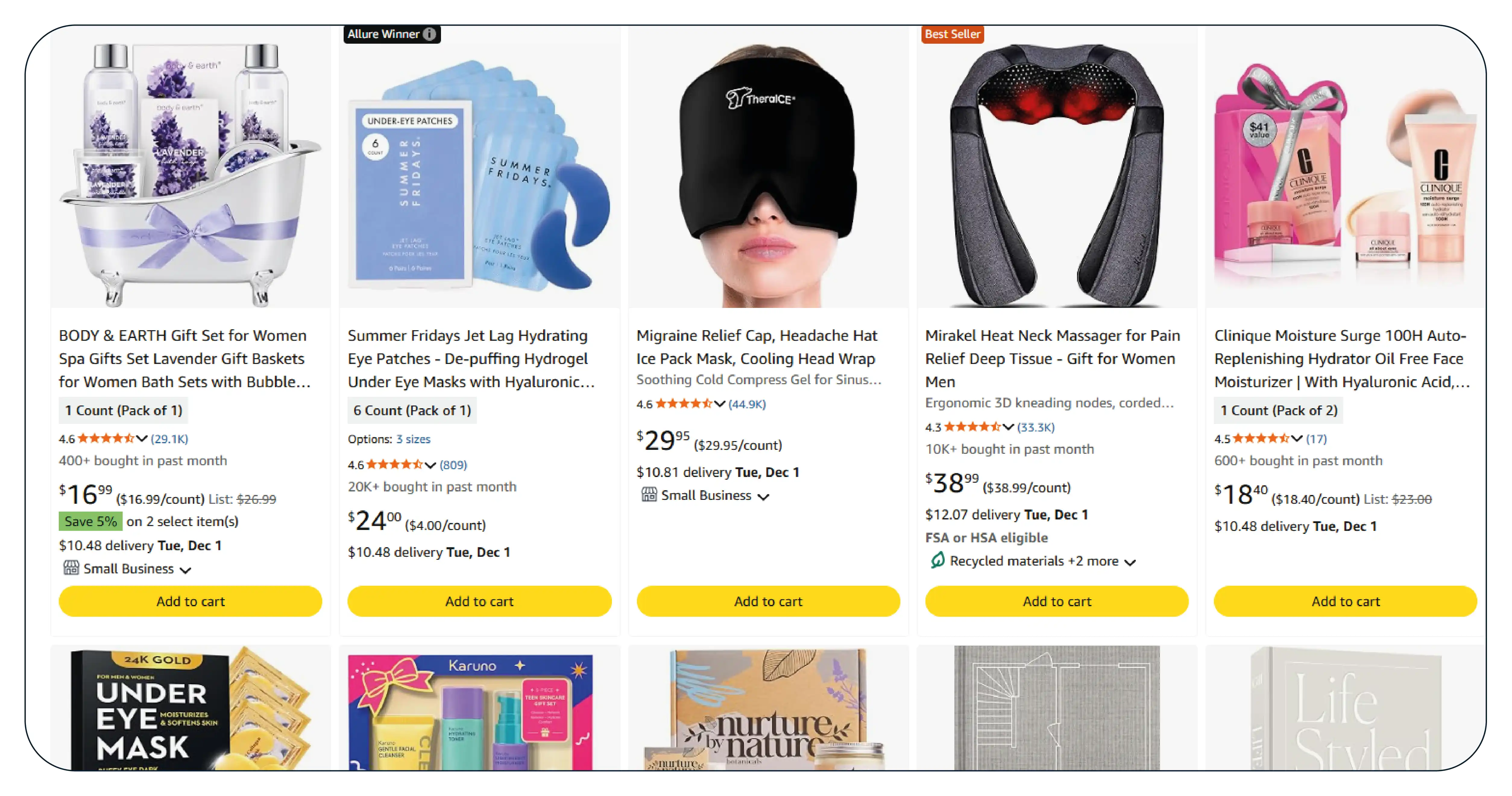
The primary goal was to establish a dependable product intelligence system that could help the gifting brand understand seasonal price movements, competitor assortment changes, and demand-related market signals. US Gifting Brand Tracked Seasonal Pricing & Demand represents the central objective of connecting product-level information with actionable retail decisions. The strategy focused on improving collection consistency, reducing manual monitoring, and making information easier to analyze across seasonal campaigns.
Improve scalability: Build a repeatable collection process for monitoring large product assortments across multiple US gifting retailers.
Increase speed: Reduce dependence on manual product research through scheduled data collection.
Strengthen accuracy: Standardize product names, prices, variants, availability, and promotional details.
Improve competitiveness: Identify differences in bouquet prices, gift basket offerings, personalized products, and seasonal promotions.
Automate product information collection from selected public retail sources.
Integrate structured datasets with reporting systems and business intelligence platforms.
Organize historical observations to identify seasonal product and pricing changes.
Develop dashboards that help merchandising teams compare products and retailers.
Establish consistent product matching and validation rules.
The project also incorporated the USA Floral Market Seasonal Demand Dataset as a key analytical requirement. This dataset category supports comparisons of floral assortment visibility, seasonal product availability, and retailer-level price changes.
The following indicators define how the project should be evaluated. They are measurement targets, not claimed client results.
Product collection coverage across selected retailers.
Price-field completeness and validation accuracy.
Product availability observation frequency.
Duplicate product record rate.
Time required to refresh and consolidate datasets.
Number of seasonal assortment changes identified.
Percentage of products successfully matched across retailers.
The Core Challenge
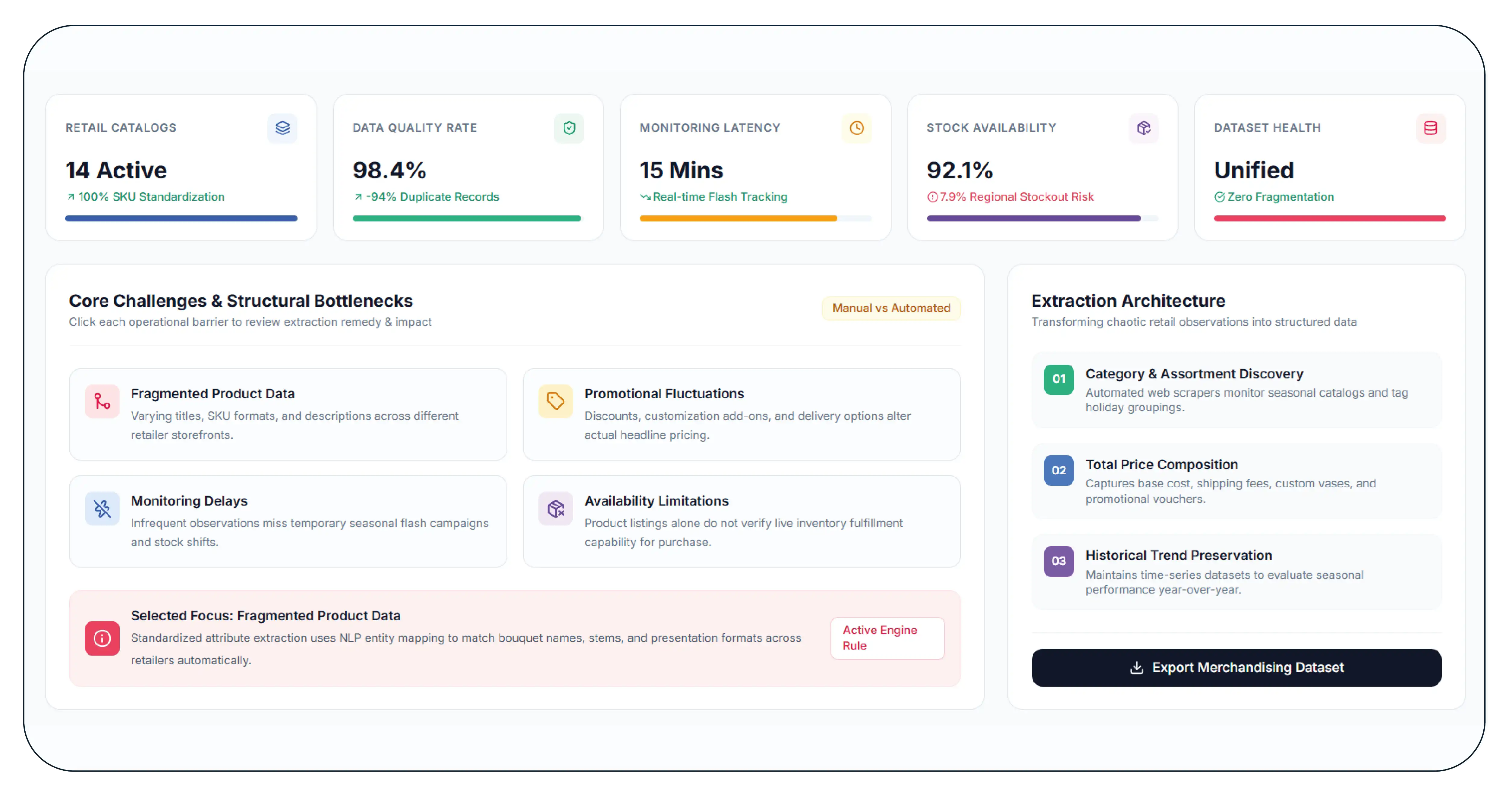
Seasonal gifting retailers face multiple operational challenges because their products, promotional campaigns, and customer preferences change throughout the year. The client needed a consistent way to understand these changes without depending entirely on manual competitor research.
One major bottleneck involved fragmented product information. Different retailers used different product titles, descriptions, SKU structures, image formats, and pricing conventions. A bouquet listed under one name could appear with a different description or presentation on another website. Without standardized matching, comparing similar products became difficult.
Another challenge involved promotional fluctuations. Prices could change because of seasonal campaigns, delivery options, product customization, or temporary discounts. Capturing only the displayed headline price would not necessarily provide a complete comparison.
The Seasonal Gifting Product Demand Extraction requirement therefore needed a structured approach to identifying relevant product categories, monitoring assortment changes, and preserving historical observations.
The brand also needed to address:
Operational bottlenecks: Manual research could not provide consistent monitoring across extensive product catalogs.
Data quality issues: Missing attributes, duplicate records, and inconsistent product descriptions affected comparisons.
Monitoring delays: Infrequent observations could overlook temporary promotional changes.
Availability limitations: Product listings alone could not establish whether every product was actually available for purchase.
Analytical fragmentation: Separate datasets made it harder to compare seasonal performance across retailers.
The central challenge was transforming disconnected retail observations into a standardized dataset suitable for merchandising and pricing analysis.
Our Solution
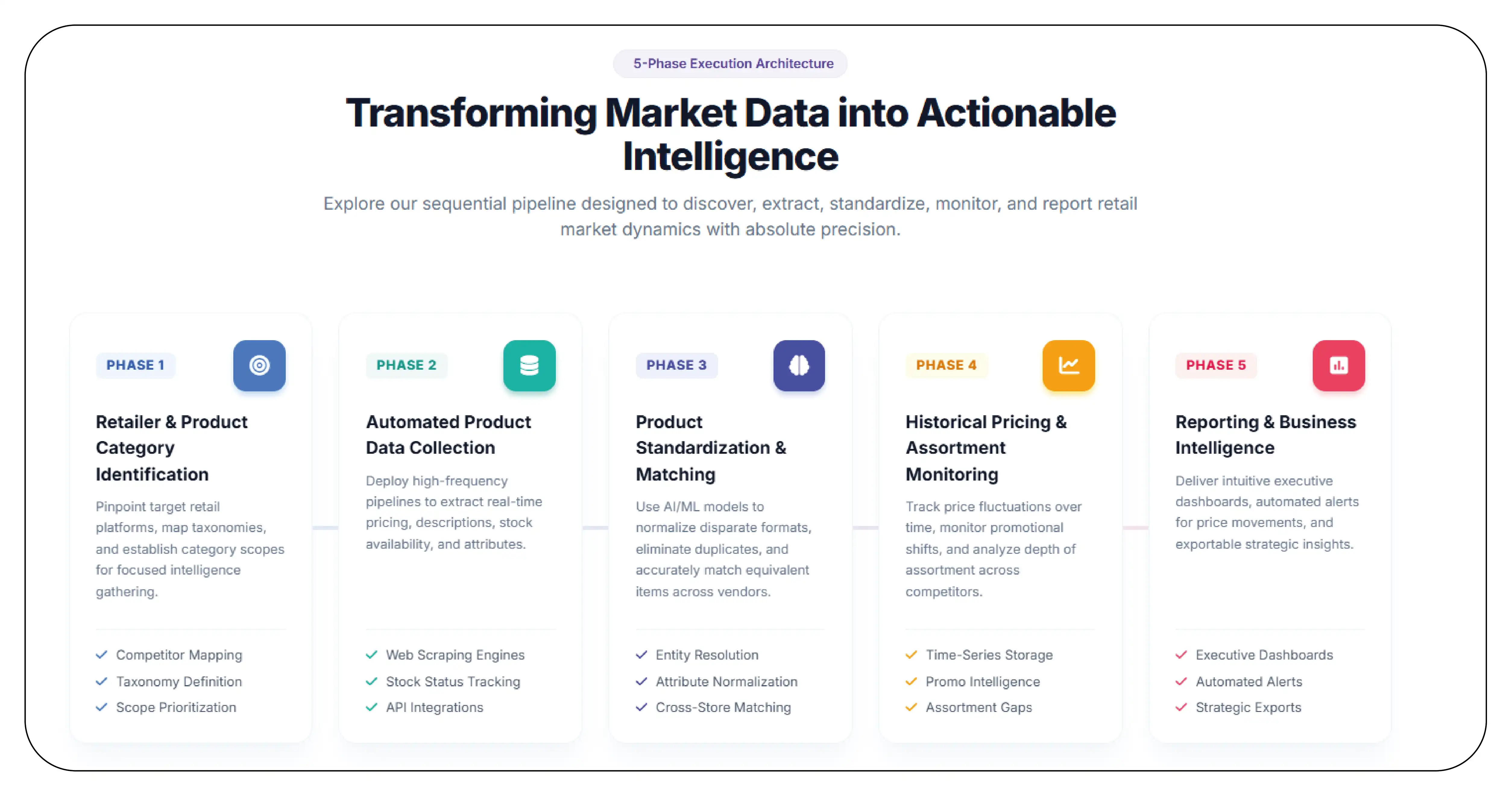
Product Data Scrape's proposed solution combines automated collection, product normalization, price monitoring, and analytical reporting. The implementation is organized into five phases, with each phase addressing a specific data challenge.
Phase 1: Retailer and Product Category Identification
The first phase defines the relevant retail sources and product categories. The scope can include floral arrangements, personalized gifts, gourmet baskets, chocolates, cookies, and celebration products.
Retailer examples used for category mapping include:
1-800-Flowers.com.
Harry & David.
Cheryl's Cookies.
Shari's Berries.
PersonalizationMall.
The Popcorn Factory.
These are real brands used as market-reference examples, not confirmed project data sources.
Phase 2: Automated Product Data Collection
The second phase focuses on collecting publicly accessible product information through configurable extraction workflows.
Relevant fields include product name, product URL, category, brand, displayed price, discount information, product description, availability status, and image URL.
The 1-800-Flowers USA Seasonal Price Tracking requirement provides a useful category-level reference for monitoring floral products and seasonal promotional changes. Collection frequency should be determined by source accessibility, business requirements, and permitted access conditions.
Phase 3: Product Standardization and Matching
Raw product information often contains inconsistent naming conventions and formatting. Product Data Scrape's workflow applies normalization rules to improve consistency.
The process includes:
Standardizing product titles and category labels.
Cleaning currency and price fields.
Identifying duplicate listings.
Mapping similar products using available attributes.
Separating product variants and customized offerings.
Recording missing or inconsistent information.
Where reliable product identifiers are unavailable, matching should use multiple attributes rather than product names alone.
Phase 4: Historical Pricing and Assortment Monitoring
The next phase organizes repeated observations into historical datasets. This helps analysts compare listed prices, discounts, and assortment visibility over different observation periods.
Seasonal events such as Valentine's Day, Mother's Day, Easter, Thanksgiving, and Christmas can be used as monitoring periods. The system can flag observed changes without automatically assuming that a price movement represents increased consumer demand.
Phase 5: Reporting and Business Intelligence
The final phase converts validated records into reporting-ready datasets.
Dashboards can organize information by retailer, category, product, promotional status, and observation date. Teams can use these reports to compare competitor positioning, review product availability, and identify assortment changes.
This five-phase framework makes US Gifting Brand Tracked Seasonal Pricing & Demand a practical data intelligence use case, connecting automated extraction with structured analysis and more informed seasonal merchandising decisions.
Results & Key Metrics
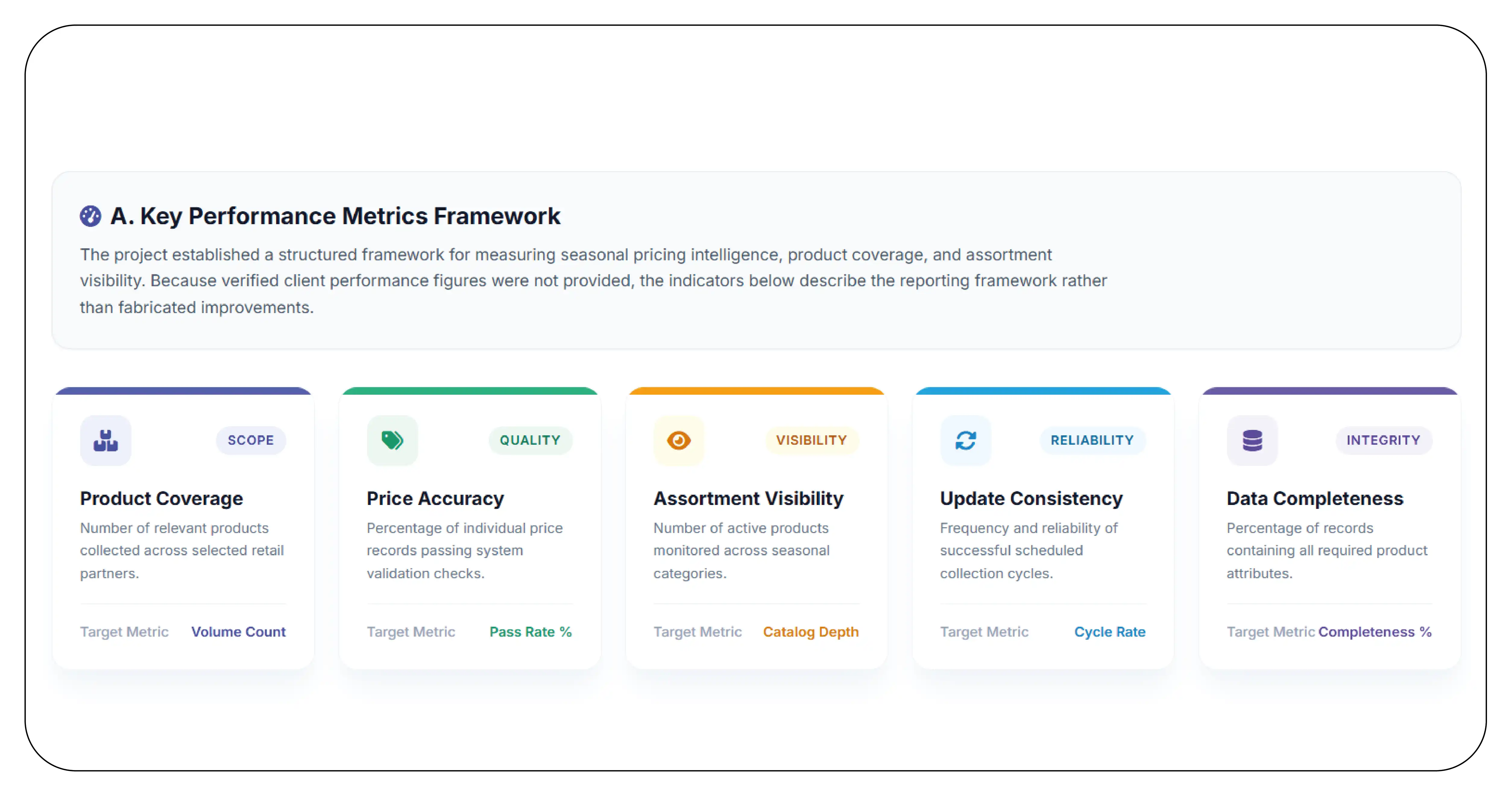
The project established a framework for measuring seasonal pricing intelligence, product coverage, and assortment visibility. Because verified client performance figures were not provided, the following metrics describe the reporting framework rather than fabricated improvements.
The following indicators can be used to evaluate the monitoring system:
Product coverage: Number of relevant products collected across selected retailers.
Price accuracy: Percentage of price records passing validation checks.
Assortment visibility: Number of products monitored across seasonal categories.
Update consistency: Frequency of successful scheduled collection cycles.
Data completeness: Percentage of records containing required product attributes.
The structured dataset provides a foundation for Seasonal Floral Assortment Tracking Across USA, helping merchandising teams examine product availability, pricing differences, and changing catalog composition.
Public market evidence reinforces the value of this approach. Adobe Analytics reported that US online holiday spending reached $257.8 billion between November 1 and December 31, 2025, representing 6.8% year-over-year growth. The analysis covered more than one trillion visits to US retail websites.
For gifting retailers, these market conditions demonstrate why consistent product monitoring and historical comparisons matter. Actual improvements in revenue, conversion, or pricing accuracy would require the client's verified before-and-after operational data.
What Made Product Data Scrape Different?
Product Data Scrape's approach emphasizes structured collection, repeatable automation, and data quality rather than simply gathering large volumes of product listings.
The Festive Gifting Demand Tracking framework can organize information around seasonal occasions, product categories, retailer differences, and promotional activity.
Its key differentiators include:
Configurable extraction: Collection workflows can accommodate different retailer structures and product attributes.
Data normalization: Standardized fields make cross-retailer comparisons easier.
Automated validation: Checks can identify missing prices, duplicate listings, and inconsistent records.
Historical intelligence: Repeated observations support analysis of price and assortment changes.
Flexible reporting: Structured datasets can be prepared for dashboards, spreadsheets, and business intelligence tools.
The approach also distinguishes observable market signals from actual sales demand, preventing unsupported conclusions from product listing data alone.
Client's Testimonial
"The product data intelligence approach provided a more structured way to monitor seasonal product pricing, competitor assortments, and promotional changes. Having organized product information helped our team evaluate market trends, understand competitor positioning, and make more informed merchandising decisions. The ability to analyze product-level information across gifting categories also strengthened our seasonal planning process. Product Data Scrape's approach gave us a clearer view of the competitive gifting landscape and the information needed to support data-driven retail strategies."
— Head of E-commerce & Digital Merchandising
Conclusion
Seasonal gifting businesses need consistent market information to understand changing product prices, competitor assortments, and promotional activity. This case study demonstrates how Product Data Scrape can support these requirements through automated extraction, standardized product datasets, historical monitoring, and analysis of Pricing Promotions to help retailers make informed seasonal merchandising and competitive pricing decisions.
The Real-time price tracking approach can help retailers observe pricing changes more systematically, identify competitive differences, and improve merchandising visibility.
As online gifting competition evolves, combining structured product information with seasonal market analysis can support better planning across floral arrangements, personalized gifts, chocolates, and gift baskets.
Looking to strengthen your seasonal retail intelligence? Partner with Product Data Scrape to build scalable product datasets, monitor competitor assortments, and turn fragmented e-commerce information into actionable business insights.
FAQs
1. Why is seasonal pricing monitoring important for US gifting brands?
Seasonal pricing monitoring helps retailers understand competitor price changes, promotional activity, and product assortment differences during occasions such as Valentine's Day, Mother's Day, and Christmas.
2. Which products can be included in gifting market datasets?
Datasets can include flowers, bouquets, chocolates, gourmet gift baskets, cookies, personalized gifts, greeting cards, and celebration products from retailers such as 1-800-Flowers.com, Harry & David, and Cheryl's Cookies.
3. How does product data scraping help monitor competitors?
Automated extraction collects publicly available product attributes, including titles, displayed prices, descriptions, categories, and availability information. Standardization makes comparisons easier across retailers.
4. Can seasonal product datasets identify actual customer demand?
Not independently. Product listings, price changes, and availability are demand-related market signals. Confirming actual demand requires additional evidence, such as verified sales, transaction, or order-volume data.
5. How can Product Data Scrape support gifting retailers?
Product Data Scrape can help businesses build structured product datasets, automate competitor monitoring, organize historical pricing observations, and prepare market intelligence for merchandising and pricing decisions.


 Singapore
 EMAIL
 PHONE











.webp)