Introduction
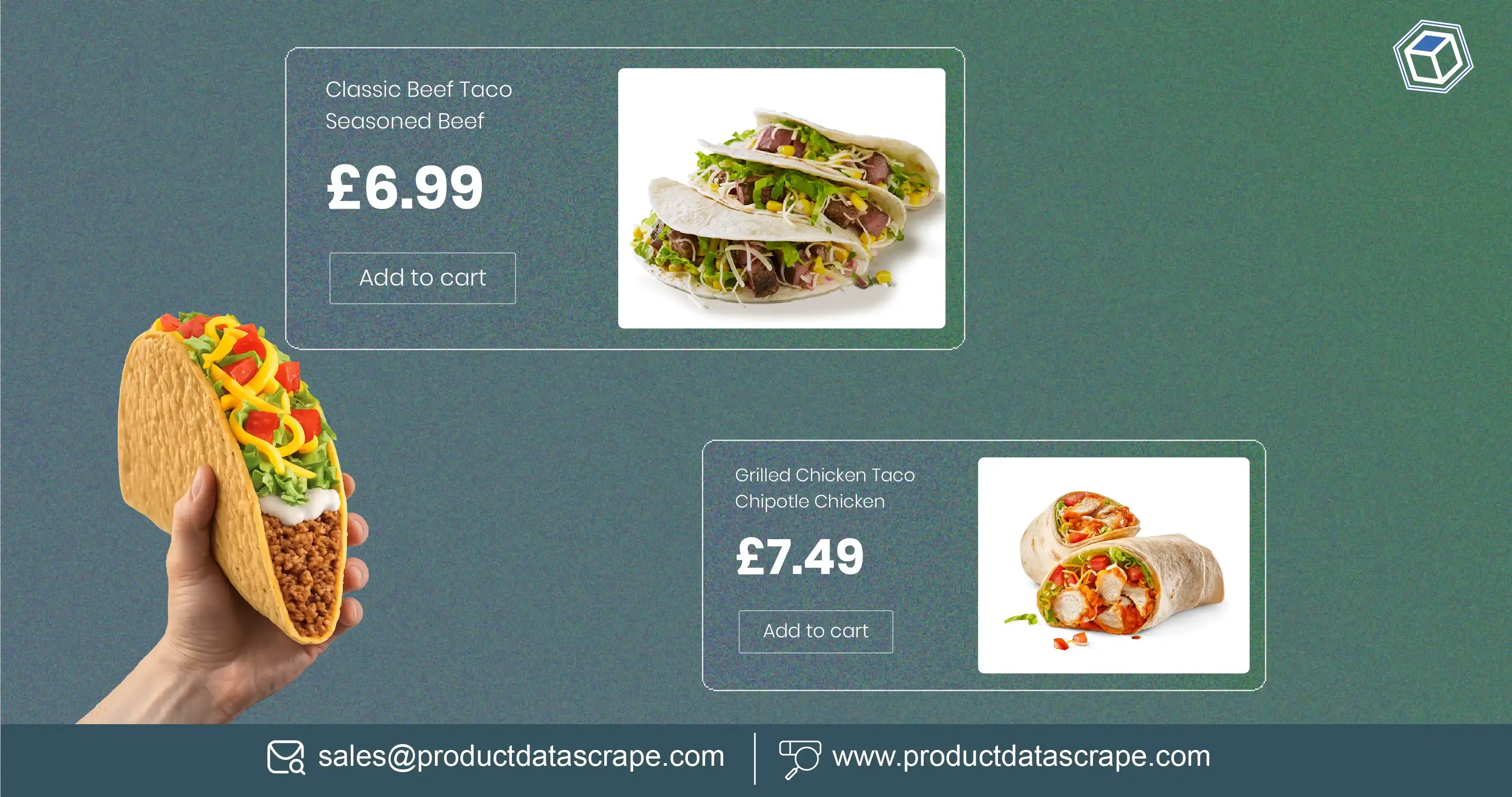
Restaurants that use Taco Shop Price Scraping Across Food Delivery Platforms
gain real-time visibility into competitor pricing, promotions, menu availability, and regional
trends. This helps businesses optimize pricing, increase profitability, improve promotional
campaigns, and make faster data-driven decisions across Edmonton/St. Albert and other
competitive food delivery markets.
Industry Insight: According to industry reports, online food delivery revenue
has continued to grow significantly between 2020 and 2026, with digital ordering becoming the
preferred purchasing method for many consumers. Restaurants leveraging pricing intelligence and
menu analytics consistently outperform competitors by responding faster to market changes.
The food delivery industry has transformed how customers discover and order
meals. Consumers now compare menu prices, delivery charges, combo offers, and promotions across
multiple delivery platforms before placing an order. For taco restaurants, staying competitive
requires continuous monitoring of menu pricing, promotional campaigns, and product availability
across leading delivery marketplaces.
Taco Shop Price Scraping Across Food Delivery Platforms enables restaurant
owners, franchise operators, aggregators, market researchers, and Q-commerce businesses to
collect real-time pricing intelligence from major food delivery platforms. By combining
automated data collection with actionable analytics, businesses can optimize menu pricing,
launch targeted promotions, and understand changing customer preferences. Businesses operating
across Edmonton/St. Albert can also evaluate neighborhood-level pricing differences to maximize
revenue and customer engagement.
In addition, analyzing restaurant
menus & food delivery ecosystems provides valuable insights into competitor offerings,
seasonal promotions, meal bundles, delivery fees, and consumer demand. These insights support
smarter pricing strategies and sustainable business growth.
How Can Real-Time Delivery Pricing Improve Restaurant Competitiveness?
Restaurants compete on far more than food quality. Dynamic pricing, promotional
offers, delivery fees, and menu availability influence customer decisions every day. Businesses
that continuously monitor these variables gain a measurable competitive advantage.
One of the most effective approaches is to Scrape taco shop prices from Uber
Eats using Scraper as a Service solutions. Automated scraping
eliminates manual monitoring while providing accurate pricing intelligence across hundreds of
locations.
Restaurant operators benefit from:
- Real-time menu pricing updates
- Daily competitor tracking
- Promotion monitoring
- Combo meal analysis
- Delivery fee comparisons
- Regional pricing intelligence
- Faster pricing decisions
- Improved promotional planning
Businesses serving Edmonton/St. Albert often discover meaningful pricing
differences between nearby delivery zones. These insights help operators tailor promotions to
local demand instead of relying on citywide pricing strategies.
Why automated monitoring matters
Instead of checking dozens of restaurants manually, automated solutions gather
thousands of menu records every day. This enables:
- Faster competitive analysis
- Better promotional timing
- Improved profit margins
- Dynamic pricing optimization
- Better customer retention
Food Delivery Market Snapshot (2020–2026)
.webp)
Projected industry trend.
These trends show that automated menu intelligence is becoming a core
capability for restaurants seeking sustainable growth.
Why Does Competitive Pricing Intelligence Drive Better Promotions?
Modern restaurant promotions require more than occasional discounts. Successful
businesses continuously analyze competitor pricing, meal bundles, limited-time offers, and
seasonal campaigns before launching new promotions.
Businesses using DoorDash taco shop pricing analytics gain a detailed
understanding of customer purchasing behavior, pricing trends, and promotional performance.
These insights allow operators to adjust prices strategically without sacrificing profitability.
Restaurants operating across Edmonton/St. Albert can compare pricing by
neighborhood, identify premium delivery zones, and evaluate customer demand during lunch,
dinner, weekends, and holiday periods.
Key promotional insights include:
- Best-selling taco combinations
- Limited-time promotional offers
- Discount frequency
- Combo meal pricing
- Delivery fee comparisons
- Popular add-ons
- Regional pricing strategies
- Customer value perception
Benefits of continuous analytics
Rather than reacting after competitors change prices, businesses can anticipate
market trends through ongoing monitoring. This proactive strategy helps:
- Increase order volume
- Improve promotional ROI
- Reduce pricing mistakes
- Strengthen customer loyalty
- Enhance market positioning
Restaurant decision-makers also gain visibility into seasonal demand
fluctuations, helping them launch campaigns at the right time.
Delivery Platform Pricing Trends (2020–2026)
.webp)
Projected industry estimates.
Restaurants that combine pricing analytics with promotion intelligence can
better understand customer expectations while protecting margins. Continuous monitoring also
supports faster responses to competitor campaigns and changing consumer preferences.
How Can Comprehensive Menu Intelligence Improve Pricing Decisions?
Restaurant success depends on accurate, timely menu data. Operators need
visibility into product pricing, combo meals, seasonal offerings, limited-time items, and
customer favorites across every delivery marketplace. Manual tracking is slow and often misses
critical pricing changes.
Businesses that Scrape Taco shop menu prices Data using automated Price scraping solutions gain continuous access to valuable
competitive intelligence. Instead of relying on occasional observations, they receive structured
datasets that reveal pricing trends, product availability, and promotional strategies in real
time.
For restaurants operating across Edmonton/St. Albert, menu intelligence helps
identify neighborhood-specific pricing opportunities and customer preferences. Different
delivery zones often show unique demand patterns, making localized pricing strategies far more
effective than one-size-fits-all approaches.
Key insights collected through menu intelligence
- Complete menu catalogs
- Individual item prices
- Combo meal pricing
- Family meal offers
- Limited-time promotions
- Beverage pricing
- Add-on costs
- Seasonal menu changes
- Delivery charges
- Service fees
How businesses use menu intelligence
Restaurant executives and analysts leverage collected data to:
- Benchmark competitor pricing.
- Optimize menu engineering.
- Improve promotional planning.
- Launch region-specific offers.
- Monitor competitor menu expansion.
- Identify profitable pricing gaps.
Historical data also reveals long-term pricing behavior, helping businesses
forecast future trends more accurately. Instead of reacting to competitors after changes occur,
restaurants can anticipate market shifts and adjust strategies proactively.
Taco Menu Intelligence Trends (2020–2026)
| Year |
Average Menu Items Tracked |
Pricing Changes Captured Monthly |
| 2020 |
95 |
120 |
| 2021 |
110 |
145 |
| 2022 |
126 |
170 |
| 2023 |
143 |
205 |
| 2024 |
158 |
235 |
| 2025 |
176 |
268 |
| 2026* |
195 |
305 |
Projected industry estimates.
Restaurants equipped with comprehensive menu intelligence make faster pricing
decisions, strengthen competitive positioning, and improve customer satisfaction through
data-backed strategies.
What Makes Multi-Platform Monitoring Essential for Restaurant Growth?
Today's consumers frequently compare prices across multiple delivery platforms
before placing an order. The same taco meal may appear at different prices depending on the
marketplace, delivery fees, or promotional campaigns.
Using a SkipTheDishes Taco Menu Scraper, restaurants can continuously monitor
pricing, menu updates, and promotional offers available through SkipTheDishes while comparing
them with competing delivery services.
Businesses serving Edmonton/St. Albert benefit significantly from
marketplace-specific monitoring because customer purchasing habits often differ across delivery
platforms. Some neighborhoods may favor one marketplace over another, creating unique pricing
opportunities.
Marketplace intelligence helps monitor
- Menu availability
- Combo meal pricing
- Delivery charges
- Limited-time offers
- Restaurant rankings
- Customer ratings
- Seasonal promotions
- Product launches
Benefits for restaurant operators
Continuous monitoring enables businesses to:
- Detect pricing inconsistencies.
- Improve menu competitiveness.
- Evaluate platform-specific promotions.
- Compare delivery costs.
- Identify underperforming menu items.
- Improve revenue forecasting.
Restaurants can also compare competitor visibility, promotional placement, and
featured menu items to better understand platform merchandising strategies.
Marketplace Growth Comparison (2020–2026)
| Year |
Restaurants Using Delivery Apps |
Marketplace Competition Index |
| 2020 |
100 |
100 |
| 2021 |
118 |
113 |
| 2022 |
136 |
127 |
| 2023 |
154 |
142 |
| 2024 |
169 |
156 |
| 2025 |
182 |
170 |
| 2026* |
198 |
186 |
Projected industry estimates.
Multi-platform visibility helps restaurants remain competitive while adapting
pricing and promotions to changing customer behavior.
How Can Continuous Tracking Improve Revenue and Profitability?
Restaurant pricing changes happen daily. Competitors introduce discounts,
bundle offers, limited-time promotions, and loyalty incentives that influence purchasing
decisions almost immediately. Businesses need continuous monitoring to respond effectively.
Organizations that scrape taco restaurant menu data from delivery apps gain
detailed competitive intelligence through automated Price
monitoring systems. Rather than reviewing menus manually, operators receive updated
datasets that support immediate pricing adjustments.
Across Edmonton/St. Albert, localized monitoring allows restaurants to compare
pricing between neighborhoods, delivery zones, and competing brands. This enables smarter
promotional campaigns based on actual market conditions.
Continuous monitoring identifies
- Price increases
- Discount campaigns
- Bundle pricing
- Seasonal offers
- New menu launches
- Product removals
- Delivery fee adjustments
- Promotional timing
Revenue optimization strategies
Restaurants use continuous monitoring to:
- Protect profit margins.
- Increase average order value.
- Improve promotional effectiveness.
- Launch targeted discounts.
- Reduce unnecessary markdowns.
- Improve customer retention.
Historical pricing records also provide valuable forecasting data for
budgeting, inventory planning, and seasonal campaign management.
Restaurant Pricing Activity (2020–2026)
| Year |
Monthly Pricing Updates |
Average Promotion Campaigns |
| 2020 |
85 |
10 |
| 2021 |
104 |
13 |
| 2022 |
128 |
16 |
| 2023 |
149 |
19 |
| 2024 |
171 |
22 |
| 2025 |
193 |
25 |
| 2026* |
216 |
29 |
Projected industry estimates.
Businesses using continuous pricing intelligence react faster to market
changes, maintain competitive pricing, and maximize long-term profitability.
Why Is Cross-Platform Intelligence the Future of Restaurant Analytics?
Restaurants no longer compete on a single delivery marketplace. Success depends
on understanding pricing strategies across multiple platforms simultaneously. Comparing menus
from different delivery services provides a complete view of the competitive landscape.
Businesses implementing Taco Shop Analytics Across Uber Eats, DoorDash and
SkipTheDishes gain unified visibility into menu pricing, promotions, customer preferences, and
regional trends. Instead of isolated reports, decision-makers receive consolidated intelligence
that supports faster strategic planning.
For restaurants operating throughout Edmonton/St. Albert, cross-platform
analytics reveals how customer behavior varies between marketplaces. These insights support
optimized pricing, localized promotions, and improved menu positioning.
Cross-platform analytics delivers
- Unified pricing dashboards
- Competitor benchmarking
- Promotion comparisons
- Market share insights
- Menu availability tracking
- Regional pricing analysis
- Historical trend reporting
- Forecasting intelligence
Business outcomes
Cross-platform intelligence enables organizations to:
- Improve pricing consistency.
- Benchmark every competitor.
- Optimize promotional calendars.
- Increase operational efficiency.
- Enhance customer experience.
- Support long-term expansion strategies.
Restaurant executives can evaluate pricing performance across multiple
platforms from one centralized dashboard, reducing manual effort while improving decision-making
speed.
Cross-Platform Analytics Growth (2020–2026)
| Year |
Businesses Using Unified Analytics |
Estimated Revenue Improvement |
| 2020 |
22% |
4% |
| 2021 |
29% |
6% |
| 2022 |
38% |
8% |
| 2023 |
47% |
11% |
| 2024 |
57% |
13% |
| 2025 |
67% |
15% |
| 2026* |
76% |
18% |
Projected industry estimates.
As food delivery competition continues to increase, cross-platform analytics
will become a strategic necessity for restaurants seeking sustainable growth, operational
efficiency, and superior customer experiences.
Why Choose Product Data Scrape?
Restaurants and food delivery businesses require accurate, real-time data to
stay competitive. Product Data Scrape delivers scalable web scraping solutions that help
organizations collect actionable market intelligence from leading delivery platforms. Whether
you need Grocery data scraping, menu
intelligence, pricing trends, or Taco Shop Price Scraping Across Food Delivery Platforms, our
automated solutions provide structured, reliable datasets for informed business decisions. We
help businesses operating across Edmonton/St. Albert monitor competitors, optimize pricing
strategies, analyze promotions, and identify market opportunities. Our customizable data
delivery, high accuracy, and enterprise-grade scraping capabilities enable restaurants,
aggregators, and market researchers to make faster, data-driven decisions with confidence.
Conclusion
Success in today's food delivery industry depends on timely, accurate, and
actionable pricing intelligence. Businesses using Uber Eats Grocery Q-Commerce API
alongside Taco Shop Price Scraping Across Food Delivery Platforms gain valuable insights into
menu pricing, promotions, customer preferences, and competitive positioning. Restaurants serving
Edmonton/St. Albert can use these insights to improve profitability, optimize promotional
campaigns, and respond quickly to changing market conditions.
Partner with Product Data
Scrape today to transform your restaurant pricing strategy with reliable food delivery
intelligence and stay ahead of the competition through smarter, data-driven decisions!
FAQs
1. Why is taco shop price monitoring important?
Regular price monitoring helps restaurants compare competitor pricing, evaluate promotional
strategies, identify regional pricing trends, improve profitability, and respond quickly to
changing customer demand across multiple food delivery platforms.
2. Which food delivery platforms should restaurants monitor?
Restaurants should monitor major delivery marketplaces such as Uber Eats, DoorDash, and
SkipTheDishes to understand menu pricing, delivery charges, promotional campaigns, customer
preferences, and regional competition.
3. How often should restaurant pricing data be updated?
Pricing data should ideally be collected daily or multiple times per day since menu prices,
promotional offers, delivery fees, and product availability frequently change across food
delivery platforms.
4. How does Product Data Scrape help restaurant businesses?
Product Data Scrape provides automated web scraping solutions that collect restaurant menu data,
pricing intelligence, competitor analysis, promotional tracking, and structured datasets for
faster, more informed business decisions.
5. Can pricing intelligence improve restaurant profitability?
Yes. Accurate pricing intelligence enables restaurants to optimize menu pricing, launch targeted
promotions, benchmark competitors, reduce pricing errors, improve customer retention, and
maximize long-term revenue growth through informed decision-making.


 Singapore
 EMAIL
EMAIL
 PHONE
PHONE


.webp)
.webp)
.webp)
.webp "thumb")
.webp "thumb")
.webp "thumb")










.webp)