Executive Summary
For most retail data, yesterday's snapshot is fine. For new-listing monitoring, it is worthless.
The entire value of a new-listing feed is latency. A tool that alerts a user when an item matching their saved search is listed — a consumer-alert product, an arbitrage scanner, a collector's watch — is competing against every other watcher of that item. If the alert fires an hour after the listing goes live, the deal is gone. The listing was bought by someone whose feed was faster. In this category, "near real-time" is not a performance metric; it is the product.
This report covers eBay listing data scraping built for real-time new-listing feeds: what such a feed must capture, why latency and completeness are the whole game, and what the delivery looks like as a webhook stream.
This report is published by Product Data Scrape. Sample figures are illustrative of structure, not a live census.
Why New-Listing Monitoring Is a Different Problem
Latency is the product. A price-monitoring feed can refresh daily. A new-listing feed that refreshes daily misses the entire window in which a new listing is actionable. The requirement is seconds-to-minutes, not hours.
Completeness matters as much as speed. A feed that catches most new listings but silently drops some is unreliable in a way that is hard to detect and expensive in practice — the missed listing is the one the user wanted. "All new listings in these categories" means all, and the gap has to be measurable.
Volume is high and bursty. Active categories can produce tens of thousands of new listings a day, arriving unevenly. The pipeline has to absorb bursts without dropping or delaying.
Push beats pull. A consumer-alert product does not want to poll an API on a schedule; it wants listings delivered to its webhook as they appear, so its own alerting fires immediately.
The Traps
Trap one: polling instead of streaming
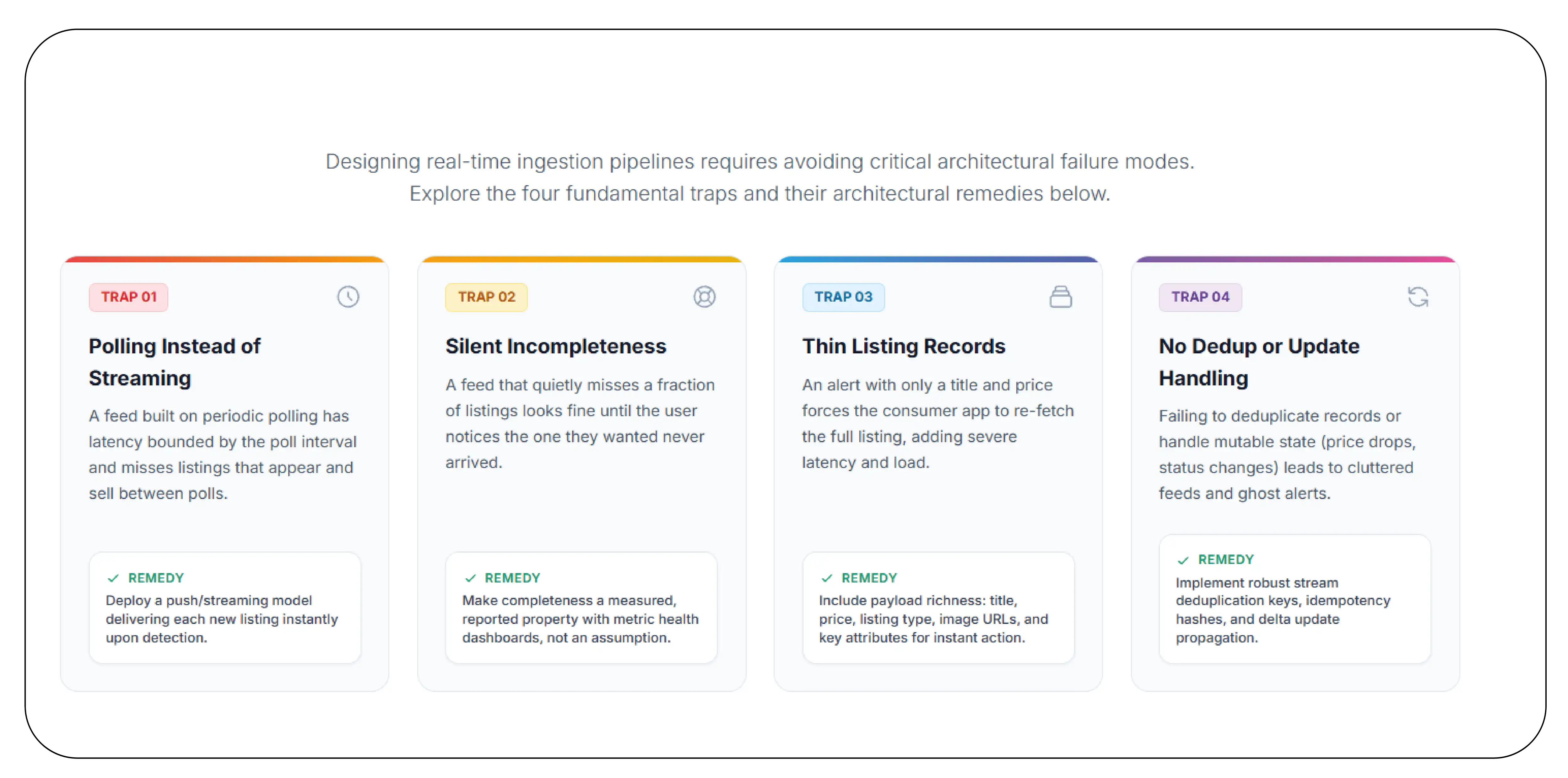
A feed built on periodic polling has latency bounded by the poll interval and misses listings that appear and sell between polls. Real-time monitoring needs a push/streaming model that delivers each new listing as it is detected.
Trap two: silent incompleteness
A feed that quietly misses a fraction of listings looks fine until the user notices the one they wanted never arrived. Completeness has to be a measured, reported property, not an assumption.
Trap three: thin listing records
An alert with only a title and price forces the consumer app to re-fetch the full listing, adding latency and load. The feed record should carry enough — title, price, listing type, image URLs, key attributes — for the app to act without a round trip.
Trap four: no dedup or update handling
The same listing can be seen more than once, and listings change (price edits, relists). A feed that does not dedup and does not distinguish new from updated floods the consumer with noise.
What a Usable New-Listing Feed Captures
| Field group |
Fields |
| Identity |
listing_id, category_id, listing_url |
| Listing |
title, description_excerpt, listing_type (BIN/auction), condition |
| Pricing |
price, currency, auction_start, buy_it_now_price |
| Media |
image_urls[] |
| Timing |
listed_at, detected_at, feed_latency_ms |
| Event |
event_type (new/updated/ended), dedup_key |
detected_at and feed_latency_ms make the feed's speed measurable; event_type and dedup_key keep it clean.
Sample Data: A Webhook Event
An illustrative webhook payload for a single new listing.
{
  "event_type": "new_listing",
  "listing_id": "EB-994210335",
  "category_id": "cat_11450",
  "listing_url": "https://.../itm/994210335",
  "dedup_key": "EB-994210335-v1",

  "title": "Vintage Film Camera - Untested",
  "listing_type": "buy_it_now",
  "condition": "used",
  "price": 89.00,
  "currency": "USD",
  "buy_it_now_price": 89.00,

  "image_urls": ["https://.../1.jpg", "https://.../2.jpg"],

  "listed_at": "2026-07-15T14:22:04Z",
  "detected_at": "2026-07-15T14:22:11Z",
  "feed_latency_ms": 7000,

  "attributes": {"brand": "brand_x", "type": "film_camera"}
}
The three timing fields are the point. The listing went live at 14:22:04; the feed detected and pushed it at 14:22:11 — a seven-second latency, reported on the record itself. A consumer-alert app receiving this can match it against saved searches and notify its user while the listing is still fresh. The record carries enough — title, type, price, condition, images, attributes — that the app acts immediately without re-fetching.
What the Feed Enables
Sub-minute alerting. Consumer-alert products notify users while listings are still available.
Arbitrage and sourcing. Resellers and sourcing tools evaluate new listings against their pricing models in near real time.
Measurable completeness. With detection reporting, the feed's coverage of "all new listings" is auditable rather than assumed.
Clean consumer experience. Dedup and new-versus-updated typing keep the downstream alert stream free of noise.
Who Uses a New-Listing Feed
Consumer-alert platforms aggregate for-sale listings and notify users when a new item matches a saved keyword — the exact need behind requests for "structured JSON to a webhook of all new listings in near real time" as a managed service.
Resellers and arbitrage tools scan new listings against pricing models to find underpriced items before others do.
Collectors and watch tools track new appearances of specific items across categories.
Market-monitoring platforms measure listing flow, pricing, and supply in near real time.
Compliance and Limitations
New-listing feeds monitor publicly available listing data. Latency and completeness are bounded by detection infrastructure and are reported as measurable properties rather than promised absolutely. Auction dynamics and relists require event typing to interpret correctly. We capture publicly available listing information only; sample figures illustrate structure rather than audited statistics.
About the Data
This report was produced using eBay listing data scraping methods from Product Data Scrape. We build near-real-time new-listing feeds across eBay categories and other marketplaces — delivered to your webhook as structured events with title, price, listing type, condition, images, and attributes, plus reported detection latency, deduplication, and new-versus-updated event typing.
Delivered as a managed webhook stream or via API, so your product does the alerting while we handle detection and delivery.
Building a consumer-alert or arbitrage product? Product Data Scrape will stand up a sample real-time feed on your target categories, so you can measure latency and completeness against your use case before you commit.
Product Data Scrape — turning marketplace complexity into decision-ready data.


 Singapore
 EMAIL
EMAIL
 PHONE
PHONE











.webp)