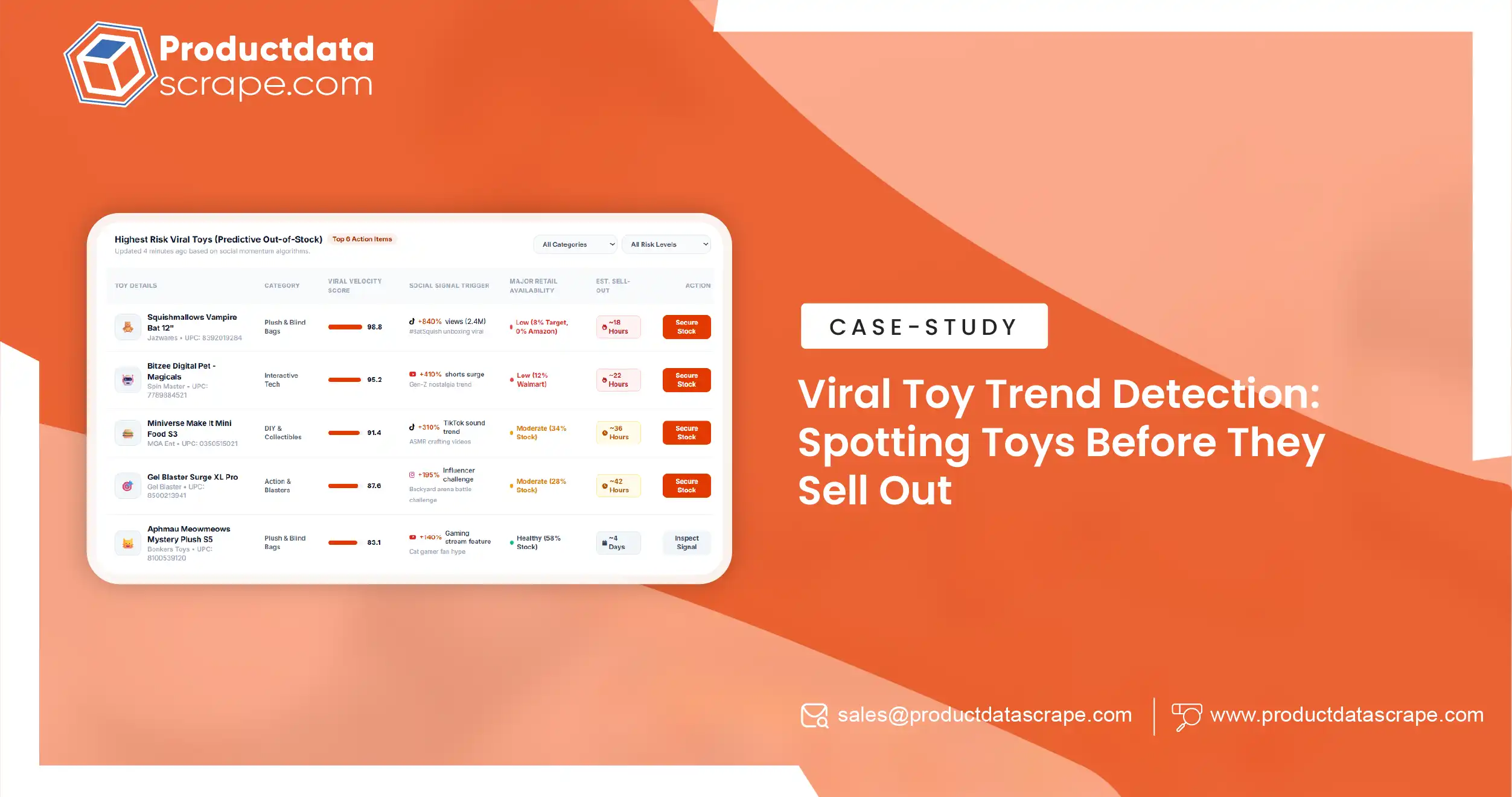
Viral Toy Trend Detection: Spotting Toys Before They Sell Out

The Client

A toy retailer sourcing across categories and brands, selling through marketplaces and its own channel, in a market where a single toy can go viral and sell out everywhere within days — and where being early to a viral hit is worth more than almost anything else.

Client details are anonymised. Figures are representative of the engagement.

The Problem: Always Late to the Viral Hit
The Problem Always Late to the Viral Hit

The retailer kept arriving at viral toys after the window had closed. A toy would catch fire — driven by social trends, a show, or seasonal buzz — and demand would spike and clear available stock within days. By the time the retailer recognised the trend, the toy was sold out across suppliers, and restocking meant paying inflated prices for late delivery, or missing the wave entirely while competitors who moved early sold through at full price.

The retailer's trend-spotting was reactive: it noticed a toy was hot once it was already sold out, from its own missed sales or a supplier's out-of-stock notice. That's the worst possible moment to find out — late enough to have missed the margin, early enough only to feel the loss.

The buying lead's summary: by the time we know a toy's gone viral, it's gone. We're always buying into the top of the wave or missing it completely.

Why Reactive Trend-Spotting Failed

In a market where the window is days, lagging signals guarantee you're late.

Own missed sales are the latest possible signal. Learning a toy is hot from your own stockout means learning after demand has already outrun supply. It's a lagging indicator of a fast event — the worst combination.

Virality builds in the market before it hits your sales. The signals that a toy is accelerating — surging rank, exploding review velocity, tightening availability across sellers — appear in the market days before they show up as your own lost sales. The retailer was watching none of them.

Buying lead times punish lateness. Sourcing takes time. Detecting a spike after it's visible in your own numbers is too late to stock well; the buy has to be made on early market signals, before the peak.

Prices run away at the top. Once a toy is visibly viral and short, its cost to source spikes. The margin is in buying before that, which requires early detection.

The Solution: Viral Toy Trend Detection
The Solution Viral Toy Trend Detection

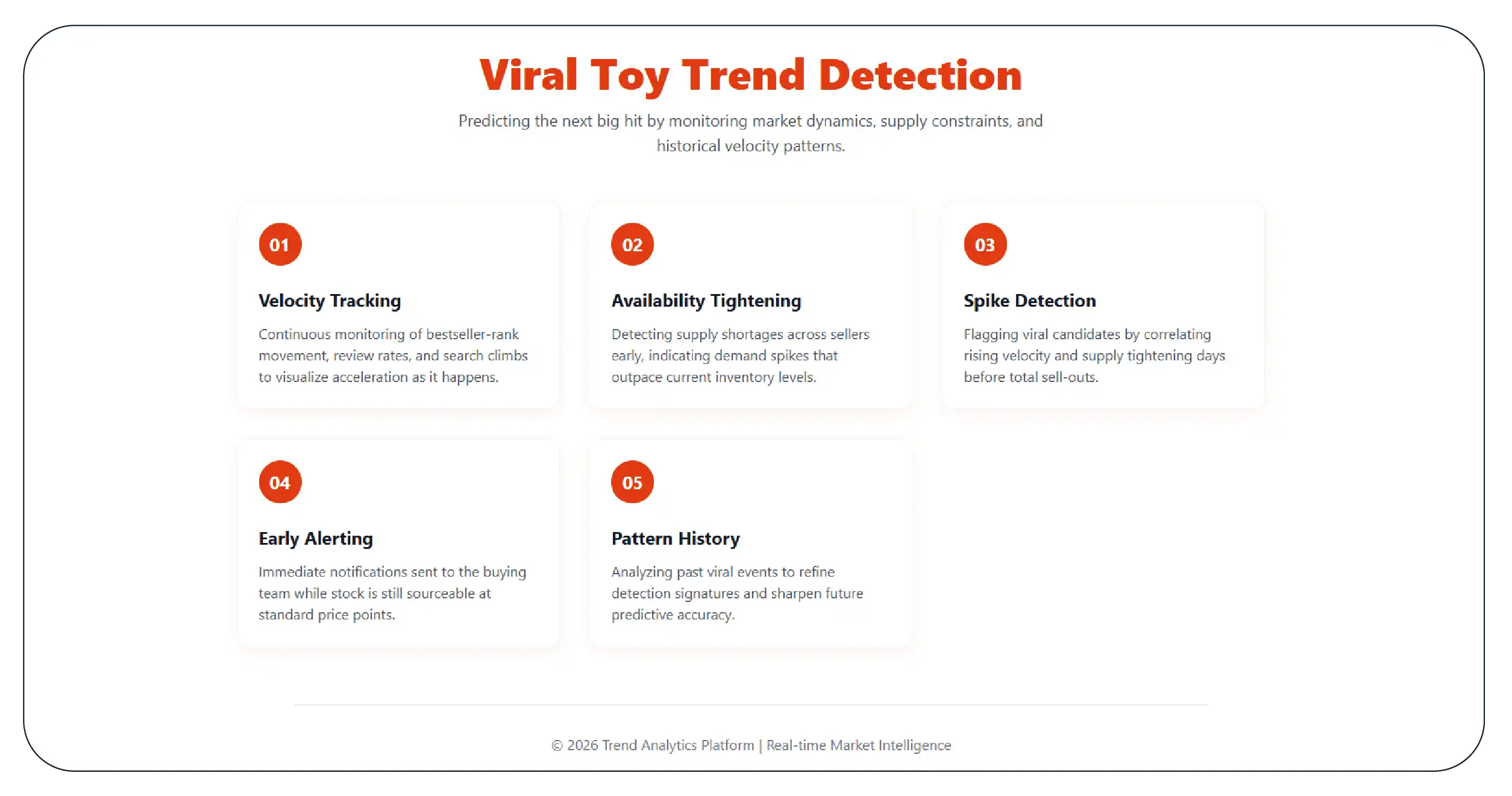
Product Data Scrape built viral toy trend detection — early demand-signal monitoring across the toy market, surfacing spikes before they peaked.

  • Velocity tracking. Across the toy market, demand-velocity signals were tracked continuously — bestseller-rank movement, review-accumulation rate, and search-position climbs — by product, so acceleration was visible as it built.
  • Availability tightening. Stock status across sellers was monitored, so a toy going short across the market — an early sign of a demand spike outrunning supply — was flagged before it sold out everywhere.
  • Spike detection. Combinations of rising velocity and tightening availability were flagged as emerging viral candidates, with a confidence read, days before the toy was broadly sold out.
  • Early alerting. Emerging spikes fired alerts to the buying team while stock was still sourceable at normal prices — the window that matters.
  • Pattern history. Past viral events were logged, revealing the signal signatures that preceded them, sharpening detection over time.

Sample Data: A Spike, Caught Early

An illustrative emerging-viral signal.

Day Rank Trend Review Velocity Sellers In Stock Verdict
Day 1 Stable Low 90% Normal
Day 2 Climbing Rising 85% Watch
Day 3 Climbing fast High 70% Emerging viral — buy now
Day 5 Top ranks Very high 30% Peak — too late to source cheap
Day 7 Top ranks Very high 5% Sold out everywhere

Illustrative series.

The structured record on Day 3:

{
  "product_id": "TOY-COLLECT-8842",
  "captured_at": "2026-07-15T09:00:00+05:30",
  "signals": {
    "rank_trend": "climbing_fast",
    "review_velocity": "high",
    "sellers_in_stock_ratio": 0.70,
    "days_of_acceleration": 2
  },
  "viral_verdict": "emerging",
  "confidence": "high",
  "window_status": "still_sourceable_at_normal_price",
  "recommended_action": "buy_now"
}

The whole value is in the timing. On Day 3, the toy was flagged as an emerging viral candidate — climbing fast, high review velocity, availability starting to tighten (70% of sellers still in stock) — while it was still sourceable at normal prices. By Day 5 the toy was at peak and expensive to source; by Day 7 it was gone. The retailer that acts on the Day 3 signal buys the wave; the one that waits for its own stockout misses it.

What the Retailer Did

Bought into emerging spikes early. When a toy was flagged as an emerging viral candidate — while stock was still available at normal prices — the buying team sourced ahead of the peak, catching the wave rather than its aftermath.

Triaged by confidence. Because each candidate carried a confidence read, the retailer committed harder to high-confidence spikes and watched lower-confidence ones, sizing its bets to the signal.

Avoided buying the top. By detecting spikes early, the retailer stopped sourcing at peak prices — the margin-destroying mistake of buying a toy only once it's visibly viral and expensive.

Learned the signatures. The pattern history let the retailer recognise the signal shapes that preceded past viral hits, improving its read on new candidates.

The Results (Two Quarters)

Metric Before After Two Quarters
Viral hits detected before broad stockout Rarely Consistently, days early
Toys sourced at normal (pre-peak) prices Few Majority of acted-on spikes
Buying into peak prices Common Sharply reduced
Viral hits missed entirely Frequent Materially fewer
Full-price sell-through on trend buys, indexed 100 142
Margin on trend-driven inventory, indexed 100 131

Figures are representative of the engagement outcome.

The buying lead's follow-up: we stopped finding out from our own stockouts. Catching the spike on day three instead of day seven is the whole difference between riding the wave and missing it.

The Lesson

In a market where a hit sells out in days, trend detection is worth everything if it's early and nothing if it's late — and reactive trend-spotting, learning from your own missed sales, is late by construction. The signals that a toy is going viral build in the market days before they reach your sales figures, and they're early enough to source on, if you're watching velocity and availability across the market rather than waiting for your own shelf to empty.

Viral toy trend detection didn't give the retailer better taste or a bigger budget. It closed the gap between when a toy started accelerating and when the retailer knew — from a week to a few days — so it could buy the wave at normal prices instead of chasing the top or missing it. In toys, that few-days head start is the margin.

Work With Product Data Scrape

Product Data Scrape delivers viral toy trend detection: continuous velocity tracking, market-wide availability monitoring, early spike detection with confidence reads, and alerting while stock is still sourceable — as JSON, CSV, API, or a live feed into your buying process.

Ask us to watch the toy market for you — we will flag the next viral hit days before it sells out everywhere.

Product Data Scrape — turning marketplace complexity into decision-ready data.

LATEST BLOG

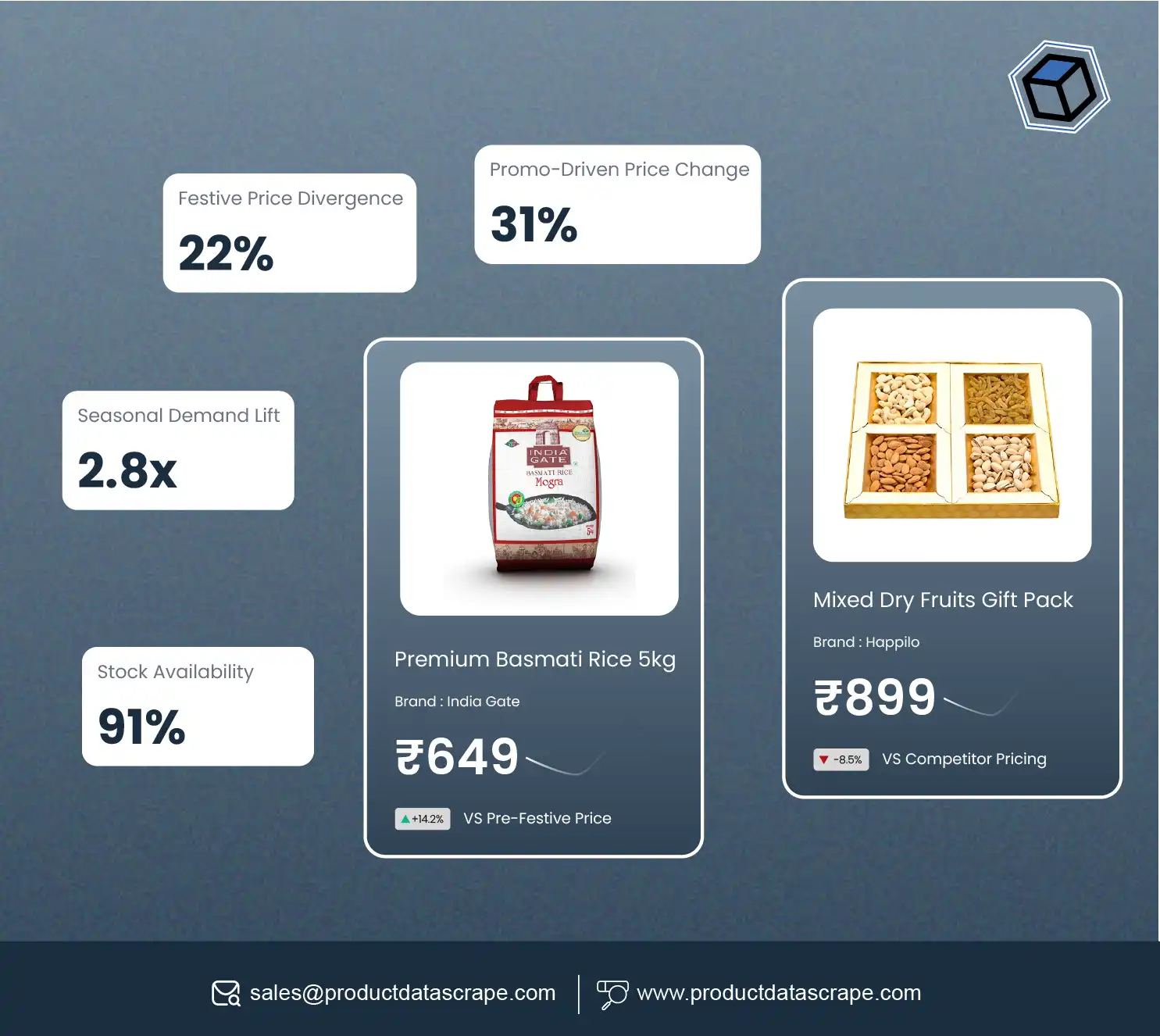
Festive Grocery Price Scraping: Reading Seasonal Patterns Without Getting Them Wrong

Festive Grocery Price Scraping is easy to misread — mix shift looks like inflation. How to measure real festive price movement with a pre-season baseline.

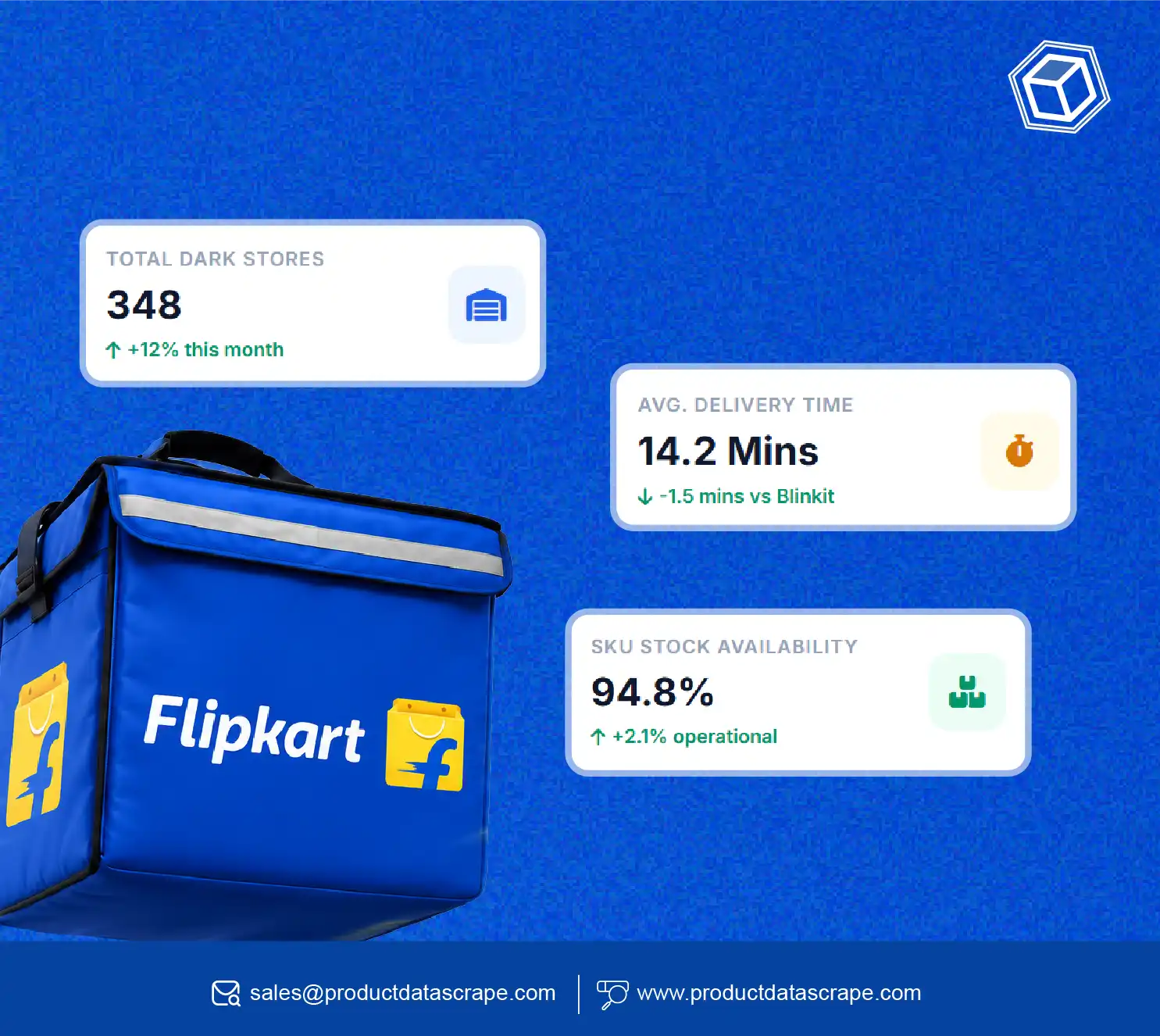
Flipkart Quick Data Scraping: Dark Store Availability and Q-Commerce Insights

Flipkart Quick data scraping reveals dark store coverage, 10-minute delivery ETAs and city-level availability. Fields, sample data and q-commerce use cases inside.

Store Location Data for Healthy Food Access Analysis Using Healthy Food Data for Kroger Store Locations & Competitors

Leverage Store Location Data for Healthy Food Access Analysis to optimize retail planning, accessibility insights, and healthier community outcomes.

Case Studies

Discover our scraping success through detailed case studies across various industries and applications.

WHY CHOOSE US?

Product Data Scrape for Retail Web Scraping

Choose Product Data Scrape to access accurate data, enhance decision-making, and boost your online sales strategy effectively.

Reliable Insights

Reliable Insights

With our Retail Data scraping services, you gain reliable insights that empower you to make informed decisions based on accurate product data and market trends.

Data Efficiency

Data Efficiency

We help you extract Retail Data product data efficiently, streamlining your processes to ensure timely access to crucial market information and operational speed.

Market Adaptation

Market Adaptation

By leveraging our Retail Data scraping, you can quickly adapt to market changes, giving you a competitive edge with real-time analysis and responsive strategies.

Price Optimization

Price Optimization

Our Retail Data price monitoring tools enable you to stay competitive by adjusting prices dynamically, attracting customers while maximizing your profits effectively.

Competitive Edge

Competitive Edge

THIS IS YOUR KEY BENEFIT.
With our competitive price tracking, you can analyze market positioning and adjust your strategies, responding effectively to competitor actions and pricing in real-time.

Feedback Analysis

Feedback Analysis

Utilizing our Retail Data review scraping, you gain valuable customer insights that help you improve product offerings and enhance overall customer satisfaction.

5-Step Proven Methodology

How We Scrape E-Commerce Data?

01
Identify Target Websites

Identify Target Websites

Begin by selecting the e-commerce websites you want to scrape, focusing on those that provide the most valuable data for your needs.

02
Select Data Points

Select Data Points

Determine the specific data points to extract, such as product names, prices, descriptions, and reviews, to ensure comprehensive insights.

03
Use Scraping Tools

Use Scraping Tools

Utilize web scraping tools or libraries to automate the data extraction process, ensuring efficiency and accuracy in gathering the desired information.

04
Data Cleaning

Data Cleaning

After extraction, clean the data to remove duplicates and irrelevant information, ensuring that the dataset is organized and useful for analysis.

05
Analyze Extracted Data

Analyze Extracted Data

Once cleaned, analyze the extracted e-commerce data to gain insights, identify trends, and make informed decisions that enhance your strategy.

Start Your Data Journey
99.9% Uptime
GDPR Compliant
Real-time API

See the results that matter

Read inspiring client journeys

Discover how our clients achieved success with us.

6X

Conversion Rate Growth

“I used Product Data Scrape to extract Walmart fashion product data, and the results were outstanding. Real-time insights into pricing, trends, and inventory helped me refine my strategy and achieve a 6X increase in conversions. It gave me the competitive edge I needed in the fashion category.”

7X

Sales Velocity Boost

“Through Kroger sales data extraction with Product Data Scrape, we unlocked actionable pricing and promotion insights, achieving a 7X Sales Velocity Boost while maximizing conversions and driving sustainable growth.”

"By using Product Data Scrape to scrape GoPuff prices data, we accelerated our pricing decisions by 4X, improving margins and customer satisfaction."

"Implementing liquor data scraping allowed us to track competitor offerings and optimize assortments. Within three quarters, we achieved a 3X improvement in sales!"

Resource Hub: Explore the Latest Insights and Trends

The Resource Center offers up-to-date case studies, insightful blogs, detailed research reports, and engaging infographics to help you explore valuable insights and data-driven trends effectively.

Get In Touch

Festive Grocery Price Scraping: Reading Seasonal Patterns Without Getting Them Wrong

Festive Grocery Price Scraping is easy to misread — mix shift looks like inflation. How to measure real festive price movement with a pre-season baseline.

Flipkart Quick Data Scraping: Dark Store Availability and Q-Commerce Insights

Flipkart Quick data scraping reveals dark store coverage, 10-minute delivery ETAs and city-level availability. Fields, sample data and q-commerce use cases inside.

Store Location Data for Healthy Food Access Analysis Using Healthy Food Data for Kroger Store Locations & Competitors

Leverage Store Location Data for Healthy Food Access Analysis to optimize retail planning, accessibility insights, and healthier community outcomes.

Real-Time Grocery Pricing from Checkers, Pick n Pay, Woolworths and SPAR for Competitive Retail Intelligence

Unlock Real-Time Grocery Pricing from Checkers, Pick n Pay, Woolworths and SPAR to monitor prices, optimize strategies, and stay ahead.

How We Helped a Leading Grocery Brand Tracked Daily Prices Across Tesco, Asda, Sainsbury's & Ocado for UK Supermarket Pricing Intelligence

Tracked Daily Prices Across Tesco, Asda, Sainsbury’s & Ocado for real-time UK supermarket pricing, promotions, and retail analytics.

Scrape Daily Prices for 500 SKUs Across 6 Retailers - Walmart, Target, Wegmans, ShopRite, ACME, and Aldi for Real-Time Pricing Intelligence

Scrape Daily Prices for 500 SKUs Across 6 Retailers to monitor pricing, promotions, stock, and competitor trends with real-time insights.

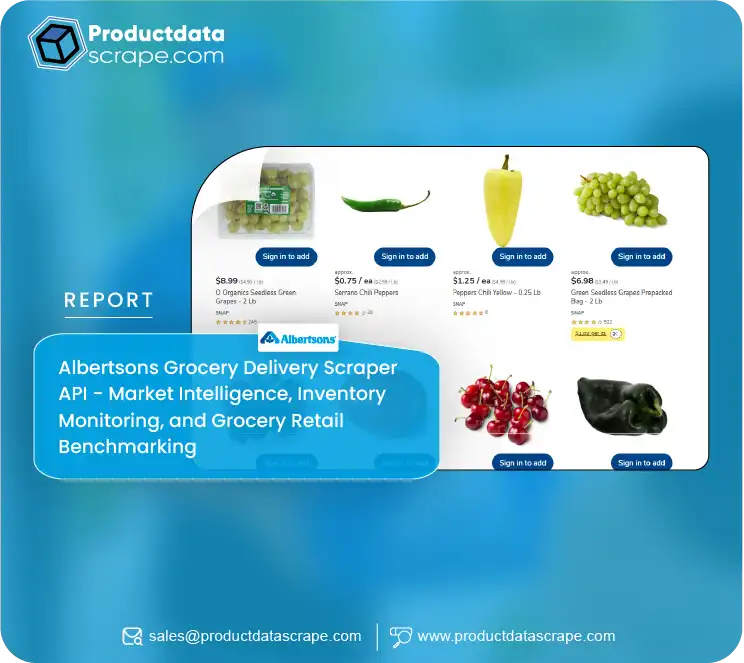
Albertsons Grocery Delivery Scraper API - Market Intelligence, Inventory Monitoring, and Grocery Retail Benchmarking

ASDA Grocery Data Scraping helps track grocery prices, promotions, inventory, and competitor trends across the UK retail market.

Costco Alcohol & Liquor Price Data scraping to Track Consumer Buying Trends and Inventory Intelligence

Costco Alcohol & Liquor Price Data scraping helps brands track pricing, promotions, inventory trends, and competitor insights.

B&M Stores Pet Supplies Data Scraping for Market Research and Pet Product Trend Analysis in Retail Chains

B&M Stores Pet Supplies Data Scraping helps businesses collect pricing, stock, and product insights to optimize pet retail strategies.

Reducing Returns with Myntra AND AJIO Customer Review Datasets

Analyzed Myntra and AJIO customer review datasets to identify sizing issues, helping brands reduce garment return rates by 8% through data-driven insights.

Before vs After Web Scraping - How E-Commerce Brands Unlock Real Growth

Before vs After Web Scraping: See how e-commerce brands boost growth with real-time data, pricing insights, product tracking, and smarter digital decisions.

Scrape Data From Any Ecommerce Websites

Easily scrape data from any eCommerce website to track prices, monitor competitors, and analyze product trends in real time with Real Data API.

Fresh Citrus Price Wars - Coles vs Aldi — What Does the Data Say?

Fresh Citrus Price Wars — Coles vs Aldi: data-driven comparison of prices, trends, and savings to see which retailer wins on value for shoppers.

Retail Inflation 2025 – Comparing Grocery Baskets in Dubai vs. Abu Dhabi (Noon)

Retail Inflation 2025 – Comparing Grocery Baskets in Dubai vs. Abu Dhabi (Noon) highlights price differences and real-world grocery costs across UAE cities.

Unlock Winning Products on Pinduoduo - How Scraping Bestseller Data Reveals Top Titles, Prices & Sales Trends

Scrape Pinduoduo bestseller data to analyze top-selling products, pricing trends, sales performance, for smarter eCommerce and intelligence decisions.

FAQs

E-Commerce Data Scraping FAQs

Our E-commerce data scraping FAQs provide clear answers to common questions, helping you understand the process and its benefits effectively.

E-commerce scraping services are automated solutions that gather product data from online retailers, providing businesses with valuable insights for decision-making and competitive analysis.

We use advanced web scraping tools to extract e-commerce product data, capturing essential information like prices, descriptions, and availability from multiple sources.

E-commerce data scraping involves collecting data from online platforms to analyze trends and gain insights, helping businesses improve strategies and optimize operations effectively.

E-commerce price monitoring tracks product prices across various platforms in real time, enabling businesses to adjust pricing strategies based on market conditions and competitor actions.

Get a free sample dataset

See the exact fields, accuracy and format — for your products, on your target sites — before you spend a rupee or a dollar.

  • Sample delivered within 24 hours
  • Scoped to your real use case, not a generic demo
  • No obligation, no long contract

Tell us what you need

A specialist replies within one business day.