Executive Summary
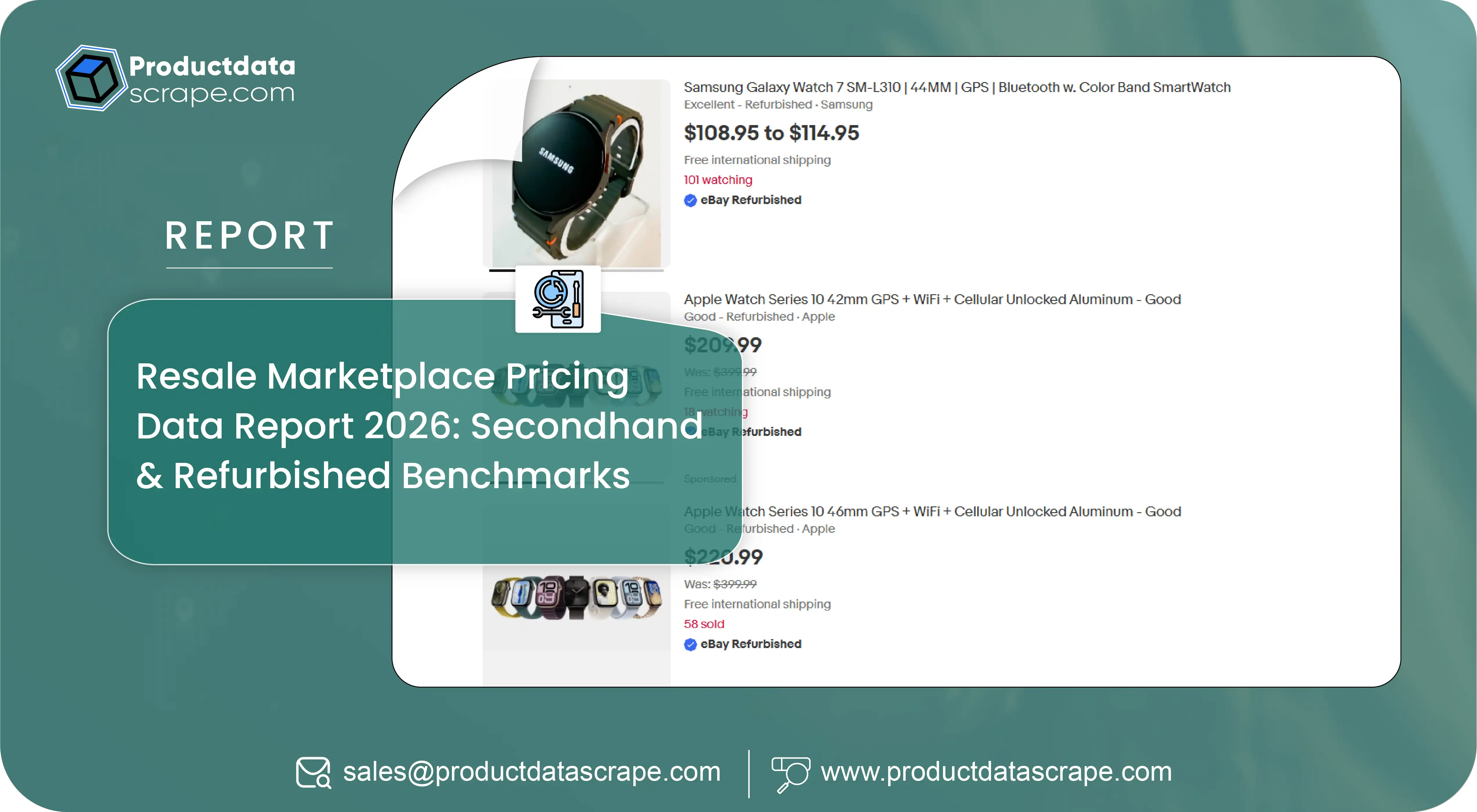
Resale has moved from the margins to the mainstream. Secondhand fashion platforms and refurbished-electronics marketplaces now shape how shoppers value products, set an alternative price floor beneath new goods, and increasingly influence what brands themselves can charge. This report from Product Data Scrape uses large-scale Resale Marketplace Pricing Data to benchmark how secondhand and refurbished prices compare with new across categories and condition tiers in 2026.
The figures below are representative benchmarks drawn from Product Data Scrape's managed monitoring across leading resale and refurbished platforms. They are designed to help brand, pricing, and strategy teams understand the resale market's influence — not to replace a scoped audit of a specific catalog.
Why Resale Pricing Now Matters to Every Brand
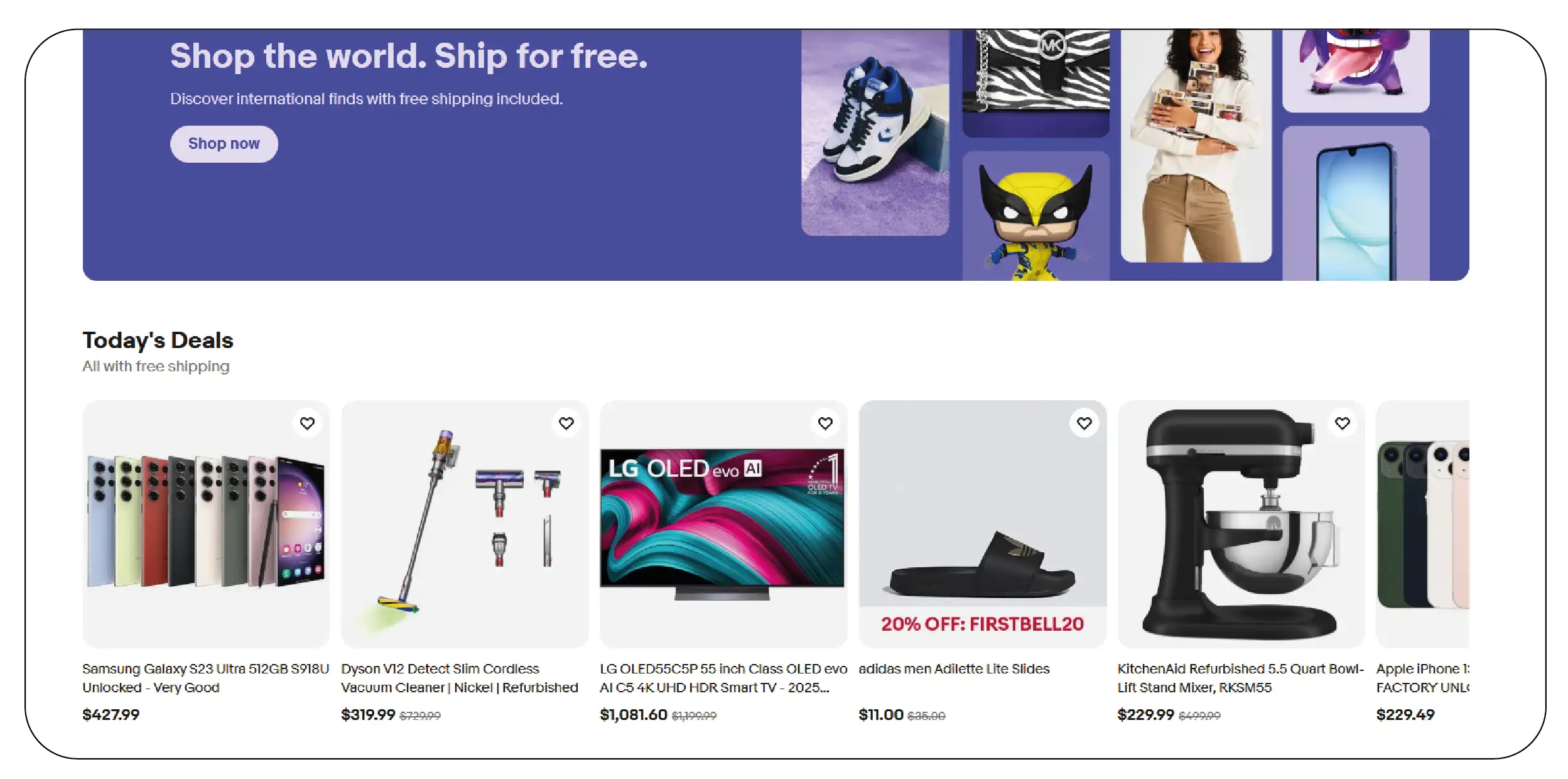
For years, resale sat outside brand strategy. That is no longer true. A thriving secondhand market signals strong brand equity and durable demand, but it also creates a visible, cheaper alternative that anchors what shoppers expect to pay for new. Refurbished electronics do the same, offering a discounted path to the same device and reshaping the value curve for every generation of product.
Resale prices also carry rich signal. How well a product holds value on the secondhand market is a direct read on desirability, durability, and brand strength. Ignoring resale means ignoring both a competitor to new sales and one of the clearest available measures of long-term brand health. Resale Marketplace Pricing Data makes that signal measurable.
What This Report Measures
For this study, Product Data Scrape tracked comparable items across secondhand fashion and refurbished-electronics platforms, matching each resale listing to a new-price reference where one exists. Condition matters enormously in resale, so listings are captured with their condition tier rather than treated as interchangeable.
For every item, the dataset records resale price, condition tier, the new-price reference, the resale ratio expressed as a percentage of new, category, and platform. Rolled up, these signals produce value-retention curves by category and condition, revealing which products hold value, which depreciate quickly, and how steeply price falls across condition tiers.
Key Findings
The 2026 monitoring data surfaces several consistent patterns across categories:
Value retention varies sharply by category. Premium fashion and flagship electronics hold a far higher share of their new price than commodity or fast-fashion items, which shed value quickly.
Condition drives steep price steps. The gap between "like new" and lower condition tiers is large and consistent, so condition is the single biggest lever on a resale price.
Refurbished sits in a predictable band. Refurbished electronics typically cluster at a stable discount to new, offering shoppers a reliable middle path between new and used.
Strong brands resell stronger. The products that command the highest resale ratios belong to brands with the strongest equity, making resale value a proxy for brand health.
Resale sets an expectation floor. In categories with active resale, the secondhand price visibly anchors what shoppers are willing to pay for new.
Together, these findings show that resale is not a fringe channel but a pricing force — one that both competes with new sales and reveals which brands and products are genuinely holding their value.
Sample Data: Resale vs New Price Comparison
The value of Resale Marketplace Pricing Data is in the condition-aware comparison behind every item. Below is a representative sample of the structured output Product Data Scrape delivers.
| Category |
Item |
Platform |
Condition |
Resale Price |
New Reference |
Resale Ratio |
Captured |
| Premium Handbags |
Designer Tote |
Resale-Fashion A |
Like New |
₹48,000 |
₹72,000 |
67% |
2026-07-14 |
| Smartphones |
Flagship (prev gen) |
Refurb-Electronics B |
Refurbished |
₹34,999 |
₹54,999 |
64% |
2026-07-14 |
| Fast Fashion |
Casual Jacket |
Resale-Fashion A |
Good |
₹899 |
₹2,999 |
30% |
2026-07-13 |
| Laptops |
Ultrabook (prev gen) |
Refurb-Electronics B |
Refurbished |
₹52,000 |
₹84,999 |
61% |
2026-07-13 |
| Sneakers |
Limited Edition |
Resale-Fashion A |
Like New |
₹14,500 |
₹12,999 |
112% |
2026-07-12 |
Every row is timestamped and condition-tagged, so pricing and strategy teams can see how each product holds value and how steeply price steps down across conditions.
How Brands Use Resale Marketplace Pricing Data
Brands that monitor resale use the data in several forward-looking ways. First, they read value retention as a brand-health metric, tracking how well their products hold price on the secondhand market relative to competitors as an early indicator of desirability and durability.
Second, they inform new-product pricing. Where resale sets a strong expectation floor, brands price and message new products with that anchor in mind rather than against it. Third, a growing number use the data to enter resale and refurbished channels themselves — certified pre-owned and trade-in programs — pricing those offers accurately against the open secondhand market instead of guessing.
Investors and category analysts use the same feed to size the resale opportunity and gauge brand strength across a category. In every case, the data turns a previously opaque market into a measurable input for pricing and strategy.
What Changed in Resale in 2026
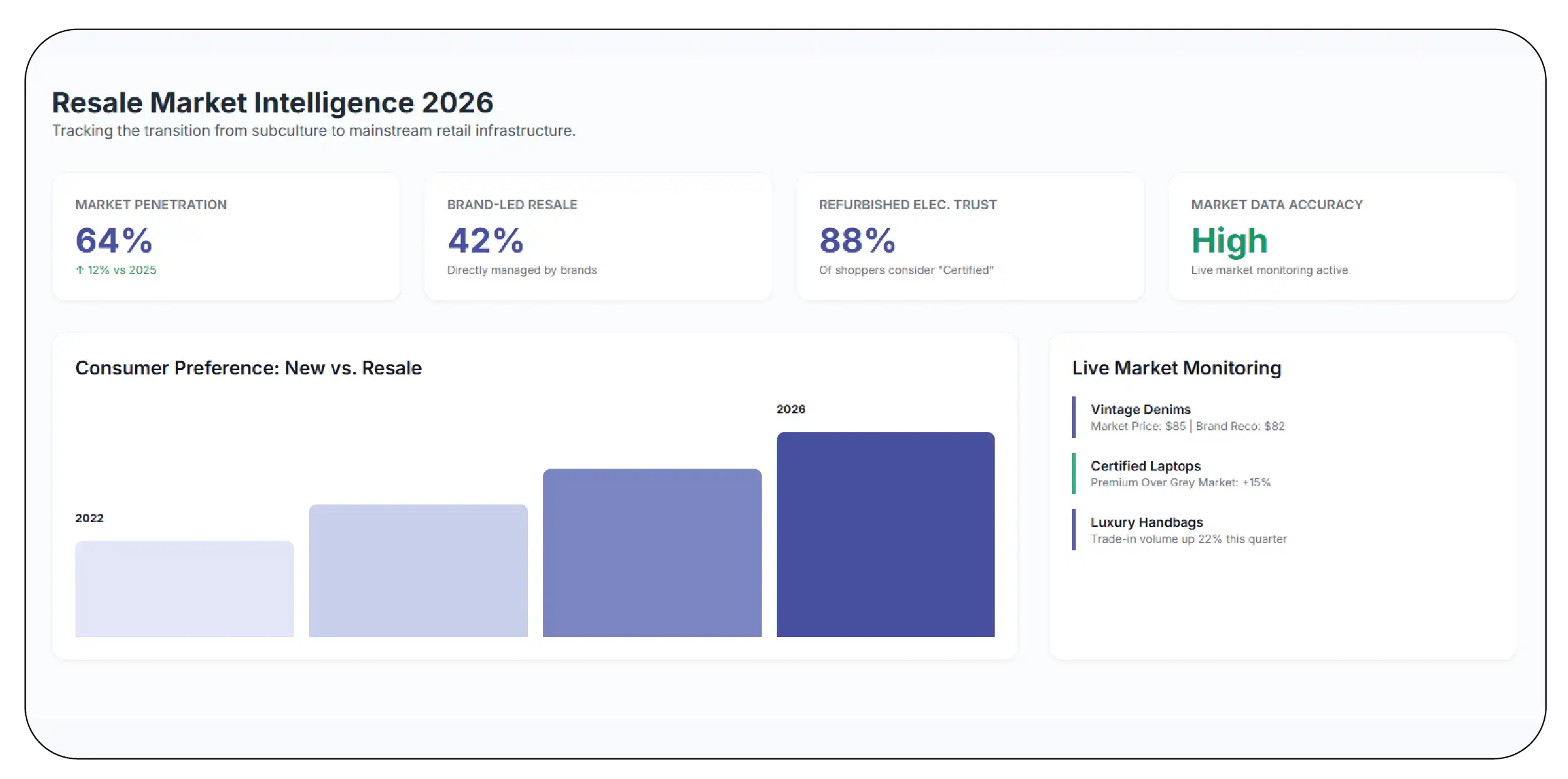
Resale has crossed from subculture to mainstream retail infrastructure. Circular-economy demand, led by younger shoppers who treat secondhand as a first option rather than a fallback, has expanded the market's depth and legitimacy. Refurbished electronics have followed the same path, moving from a discount curiosity to a mainstream purchase route backed by warranties and structured condition grading.
The most significant shift is that brands themselves are entering resale. Certified pre-owned programs, trade-in schemes, and brand-operated resale storefronts are multiplying, which means resale pricing is no longer something that only happens to a brand — it is something the brand must price and manage directly. That raises the stakes on accurate resale data. Setting a trade-in value or a certified pre-owned price without a clear read of the open secondhand market means either leaving money on the table or pricing out of step with what shoppers can find elsewhere. Continuous resale monitoring is what keeps those decisions grounded in the live market.
Resale Marketplace Pricing Data FAQs
Why does condition matter so much in resale pricing? Because the price step between condition tiers is large and consistent. A resale comparison that ignores condition is not comparable, so every listing is captured with its condition tier.
What is the resale ratio? It is the resale price expressed as a percentage of the new-price reference — a single number that shows how well a product holds value.
Can this support a brand-operated resale program? Yes. Accurate open-market resale and refurbished pricing is exactly what certified pre-owned and trade-in programs need to price competitively.
Methodology and Data Quality
The findings in this report are built from listing-level data collected by Product Data Scrape's managed pipelines, not from surveys or estimates. Products are captured directly from live marketplace pages at scale, normalized into a consistent schema, and matched across platforms so that every comparison is genuinely like-for-like. Prices, availability, and other fields are recorded with a timestamp, which makes it possible to measure change over time rather than relying on a single snapshot that is out of date the moment it is taken.
Every dataset passes automated validation before it is used. Duplicate listings are removed, outliers are flagged for review, and records that fail consistency checks are re-collected rather than left to distort the results. Because the pipelines are monitored continuously, coverage adapts as marketplaces change their page structures, so the data stays reliable even as the sites underneath it evolve. This is what separates a defensible resale pricing benchmark from a one-off manual scrape that cannot be repeated or trusted at scale.
Who This Report Is For
This report is written for brand and pricing teams, strategy leads exploring resale or trade-in programs, sustainability and circular-economy teams, and investors sizing the secondhand opportunity. If resale touches your category — and it increasingly touches every category — this view is directly relevant to your pricing and brand-health decisions.
What You Get With Product Data Scrape
Product Data Scrape delivers Resale Marketplace Pricing Data as a managed service across secondhand and refurbished platforms, so teams do not have to build or maintain scrapers in-house. Coverage captures resale price, condition tier, new-price reference, resale ratio, category, and platform at listing level.
Data is refreshed on a cadence you choose and delivered in the format your team already uses — CSV, JSON, API feed, or dashboard. Because the pipelines are custom-built and monitored, coverage extends to new resale and refurbished marketplaces as they grow.
Get Your Category Benchmarked
The figures in this report are representative; your real value-retention profile depends on your products and the platforms they resell on. Product Data Scrape will run a free sample dataset scoped to your brand and target platforms, so you can see the exact fields, accuracy, and resale ratios before committing to anything.
Request a sample to benchmark resale value in your category — and turn Resale Marketplace Pricing Data into an input for smarter pricing, stronger brand-health tracking, and a confident move into resale and refurbished channels.


 Singapore
 EMAIL
EMAIL
 PHONE
PHONE


.webp)
.webp "thumb")
.webp "thumb")
.webp "thumb")








.webp)