Introduction
In today’s fast-moving ecommerce environment, pricing is no longer stable for even a single day. Competitors frequently adjust discounts, launch flash sales, and experiment with aggressive promotional strategies to capture customer attention. For businesses operating in such volatile conditions, reacting after price changes occur is no longer effective.
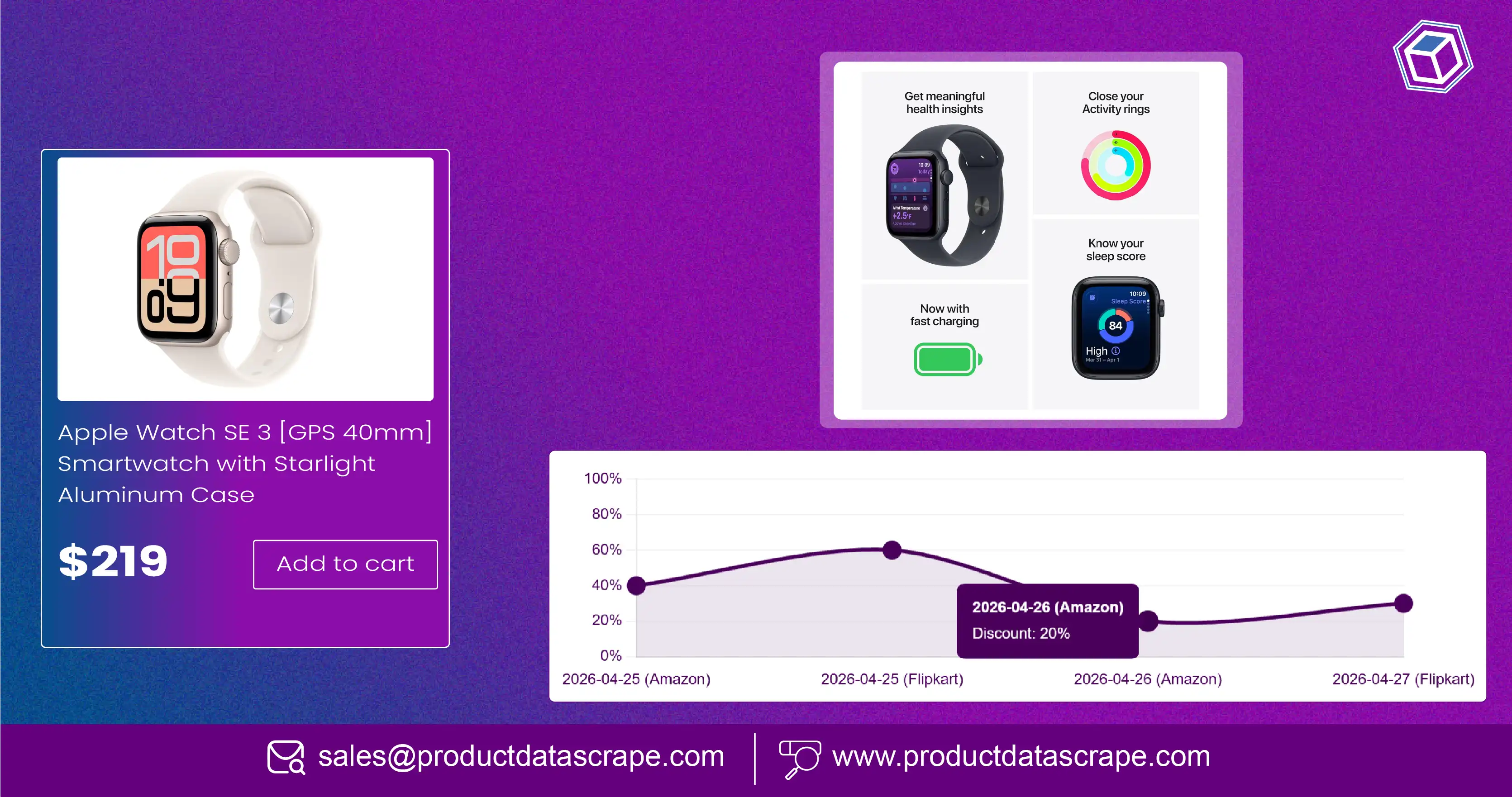
This is where the ability to Predict Competitor Flash Sales using Scraped Discount data becomes a game-changing capability. Instead of responding to market shifts, businesses can anticipate them and act ahead of time. This predictive approach enables retailers to detect early discount signals and prepare strategic pricing responses before competitors officially launch campaigns.
At the core of this system are Competitor Price Monitoring Services, which continuously track pricing behavior across ecommerce platforms, marketplaces, and direct-to-consumer websites. These systems gather structured discount data that reveals hidden patterns behind competitor promotions.
From 2020 to 2026, companies using discount intelligence systems have significantly improved forecasting accuracy, reduced revenue loss from sudden price drops, and strengthened overall pricing strategies. The shift is clear: pricing is no longer reactive—it is predictive.
This blog explores how scraped discount data can be transformed into predictive intelligence, how flash sales can be anticipated, and how businesses can stay ahead of sudden market disruptions using data-driven insights.
Understanding discount patterns as predictive signals
The foundation of predicting flash sales lies in understanding competitor discount behavior over time. Businesses now focus on Scraping Competitor Discount Patterns for Flash Sale Prediction, powered by Pricing Intelligence systems.
Every competitor follows certain behavioral patterns—weekend discounts, end-of-month clearances, seasonal sales, and event-based promotions. When these patterns are analyzed over time, they reveal strong predictive signals.
Discount behavior trends (2020–2026):
.webp)
These insights show that structured discount analysis significantly improves forecasting capability.
For example:
- Frequent small discounts → often lead to flash sale buildup
- Sudden price drops → indicate inventory clearance cycles
- Repeated weekend discounts → predict recurring promotional events
By identifying these signals early, businesses can adjust pricing strategies proactively instead of reacting after competitors reduce prices.
Predicting flash sales before they launch
One of the most powerful use cases is identifying promotions before they go live. This is achieved through Flash Sales Before Launch using Scraped Pricing Data, supported by Ecommerce Website Data Scraping.
Scraped pricing data helps detect subtle early indicators such as:
- Temporary price testing
- Hidden promotional tags
- Pre-discount inventory adjustments
- SKU-level pricing fluctuations
Early detection performance (2020–2026):
| Metric |
2020 |
2026 |
| Detection Time |
72 hrs |
6–10 hrs |
| Accuracy Rate |
60% |
95% |
| Revenue Protection |
Low |
High |
These improvements highlight the importance of early warning systems.
Instead of waiting for a competitor’s flash sale to go live, businesses can now prepare in advance—adjusting pricing, planning promotions, and protecting margins.
This predictive advantage helps companies maintain stability even during aggressive market disruptions.
Advanced analytics for discount forecasting models
Modern pricing systems are powered by Competitor Discount Prediction Scraping Analytics combined with Digital Shelf Analytics.
These systems go beyond simple tracking—they analyze historical behavior, real-time pricing shifts, and competitor promotional cycles to build predictive models.
Analytics improvement trends (2020–2026):
.webp)
Digital shelf analytics adds another layer of intelligence by analyzing:
- Product visibility changes
- Discount depth variations
- Ranking fluctuations during promotions
- Category-level pricing behavior
When combined with scraped discount data, these systems can accurately predict upcoming flash sales with high confidence.
This enables businesses to align inventory, marketing, and pricing strategies in advance.
Real-time competitor monitoring for instant insights
Speed is critical in competitive pricing environments. Businesses now rely on Scrape Competitor Discounts to Predict Flash Sales using Web Scraping API Services.
These systems continuously collect pricing and discount data from multiple ecommerce platforms in real time.
Automation impact (2020–2026):
| Metric |
Manual Tracking |
Automated Scraping |
| Response Time |
48 hrs |
Real-time |
| Accuracy |
72% |
97% |
| Cost Efficiency |
Low |
High |
Real-time scraping ensures businesses never miss sudden discount spikes or promotional signals.
For example:
- A sudden 30% discount on multiple SKUs → indicates flash sale preparation
- Repeated price testing across categories → signals upcoming campaign
This enables instant decision-making and proactive pricing adjustments.
Continuous monitoring of competitor discount behavior
To maintain long-term pricing intelligence, businesses use Monitor Competitor Discount Changes Scraping systems that track pricing fluctuations continuously.
This creates a live feed of competitor behavior, allowing businesses to identify patterns as they form.
Monitoring coverage expansion (2020–2026):
.webp)
Continuous monitoring helps identify:
- Sudden price drops
- Multi-product discount events
- Category-wide promotions
- Flash sale triggers
This ensures businesses maintain full visibility across competitive landscapes.
Historical data as the foundation of prediction
Accurate forecasting depends heavily on Scrape Historical Discount Patterns Competitors.
Historical data reveals long-term pricing behavior that cannot be seen through real-time monitoring alone.
Historical analysis improvements (2020–2026):
Historical insights help identify:
For example, if a competitor consistently runs flash sales every 45–60 days, businesses can prepare pricing strategies in advance.
This significantly reduces uncertainty in pricing decisions.
Why Choose Product Data Scrape?
Predicting flash sales requires accurate, high-frequency, and structured data. One of the most reliable ways to achieve this is through Product Data Scrape, which enables businesses to collect competitor pricing and discount data at scale.
It helps transform raw ecommerce data into actionable insights that power predictive pricing systems and flash sale forecasting models.
Conclusion
In a highly competitive digital marketplace, anticipating competitor actions is more powerful than reacting to them. By leveraging Scraped Discount data, businesses can uncover hidden patterns behind pricing strategies and predict future flash sales with high accuracy.
With Scraper to Track Competitor Product Pricing and Promotions, organizations gain real-time visibility into competitor behavior and can adjust strategies proactively instead of reactively.
The ability to Predict Competitor Flash Sales using Scraped Discount data allows businesses to protect margins, optimize promotions, and stay ahead of sudden market drops.
Now is the time to move from reactive pricing to predictive intelligence. Businesses that embrace data-driven forecasting will consistently outperform those relying on manual tracking.
To build scalable predictive systems, many enterprises rely on Product Data Scrape for continuous data extraction and intelligence generation.
Partner with Product Data Scrape to build powerful discount intelligence systems that help you predict flash sales, track competitor pricing, and stay ahead of every market shift with real-time data accuracy.
FAQs
1. What is flash sale prediction using scraped data?
It is the process of analyzing competitor discount behavior to predict when future flash sales will occur.
2. How accurate is flash sale prediction?
With advanced analytics and historical data, prediction accuracy can exceed 90%.
3. Why is discount scraping important?
It helps identify pricing patterns, promotional cycles, and competitor strategies.
4. Can businesses react before flash sales launch?
Yes, early discount signals allow proactive pricing adjustments before campaigns go live.
5. Which industries benefit most?
Ecommerce, FMCG, electronics, fashion, and quick commerce industries benefit the most.


 Singapore
 EMAIL
EMAIL
 PHONE
PHONE


.webp)
.webp "thumb")
.webp "thumb")
.webp "thumb")








.webp)