Introduction
There is a question most brand teams cannot answer about their own products: what does my SKU cost in Nagpur?
They can tell you the MRP. They can tell you the price they saw on Flipkart this morning, from a laptop in a Bengaluru or Gurugram office. What they usually cannot tell you is whether that price holds in Indore, whether the product is even deliverable to a pincode in Assam, or whether a competitor is running a deeper discount in exactly the tier-2 markets where the brand's distribution is weakest.
That gap exists because almost every price-monitoring setup in India captures data from a single location. And on Flipkart, location is not a cosmetic detail. It is a pricing variable.
This guide covers pincode-level Flipkart price scraping: what actually changes across India's pincodes, which fields to capture, what the output looks like, and how FMCG and CPG brands convert hyperlocal data into regional pricing and distribution decisions.
The Single-Location Blind Spot
Almost every price-monitoring programme has the same architecture. A scraper runs from one place. It captures one price per SKU. That price goes into a dashboard, and the dashboard becomes the brand's picture of the market.
The architecture is efficient and it is wrong in one specific, expensive way: it assumes national price uniformity on a platform that does not offer it.
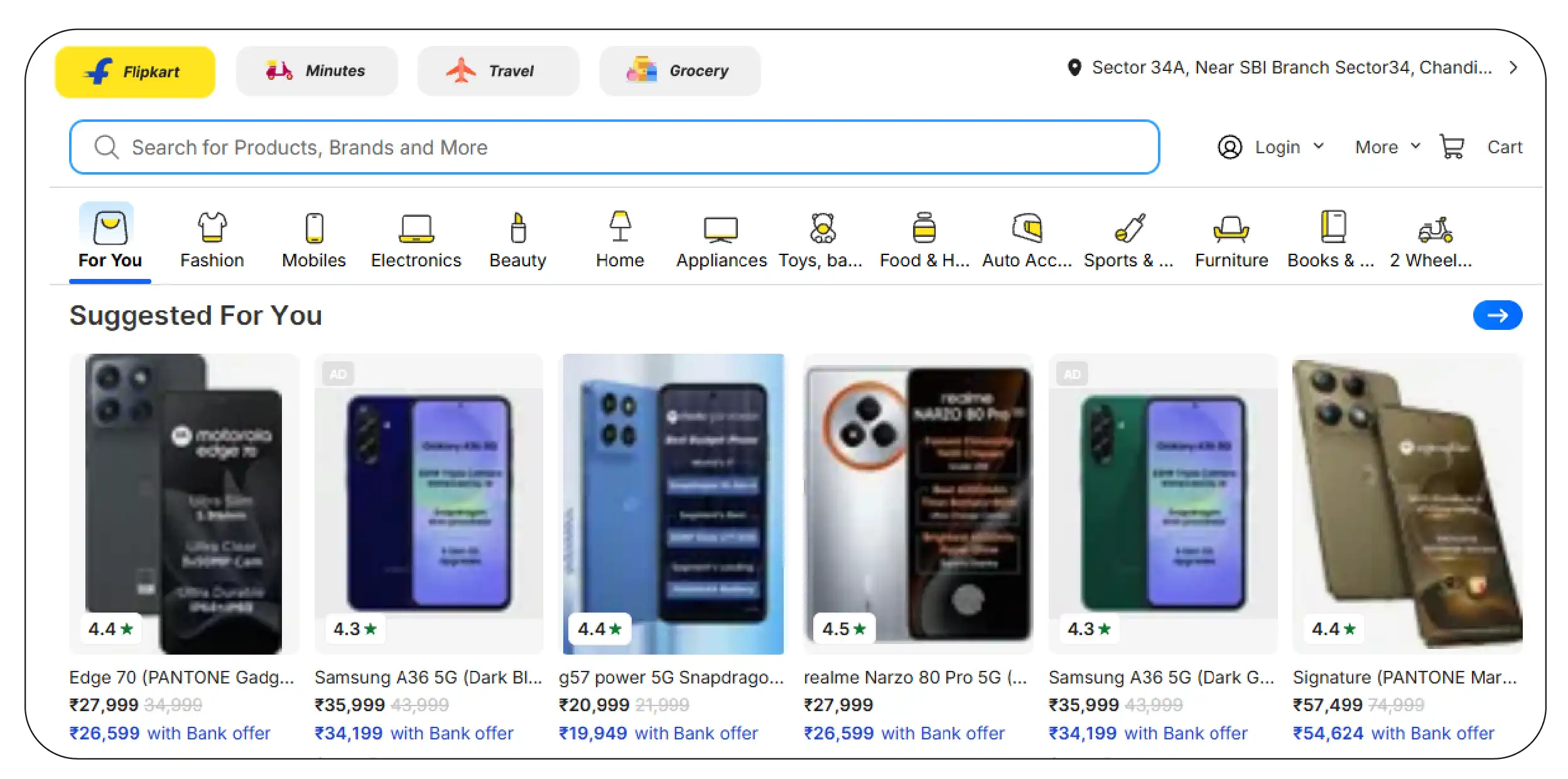
On Flipkart, the same SKU can differ across pincodes on price, on deliverability, on delivery ETA, on which sellers serve that location, on which bank offers apply, and on whether Flipkart Quick is available at all. A brand monitoring from one metro pincode is not monitoring the Indian market. It is monitoring one pincode and extrapolating.
For categories where the metros behave like the rest of India, the extrapolation is roughly harmless. For FMCG — where volume growth is disproportionately coming from tier-2 and tier-3 markets — it is precisely backwards. The brand has the least visibility exactly where it has the most at stake.
What Actually Varies Across Pincodes
Price
Price differences across pincodes arise from several mechanisms at once: different sellers serving different regions, regional promotional campaigns, seller-side logistics costs baked into pricing, and localised competitive responses. The result is a price surface, not a price point.
Deliverability
A SKU that is unavailable in a pincode is, for that customer, a SKU that does not exist. Deliverability gaps are the quietest form of lost revenue there is: no stockout alert fires, no listing disappears, the product simply cannot be bought. Brands routinely discover, on first running a pincode panel, that a hero SKU is undeliverable across an entire region.
Delivery ETA
Two days versus seven days is a conversion difference, not a logistics footnote. In categories where a competitor delivers next-day and you deliver in five, the price comparison is not the comparison the customer is actually making.
Seller Mix
Which sellers appear on a listing can change by location. A pincode-blind pipeline sees one seller array and assumes it is national. It is not.
Offer Availability
Bank offers and promotional campaigns can be regionally scoped. The effective price a customer pays is therefore geographically variable even when the listed price is not.
Flipkart Quick Eligibility
Flipkart's 10-minute delivery service operates in select cities and depends on dark-store coverage. Quick eligibility is intrinsically a pincode-level attribute.
The Fields to Capture
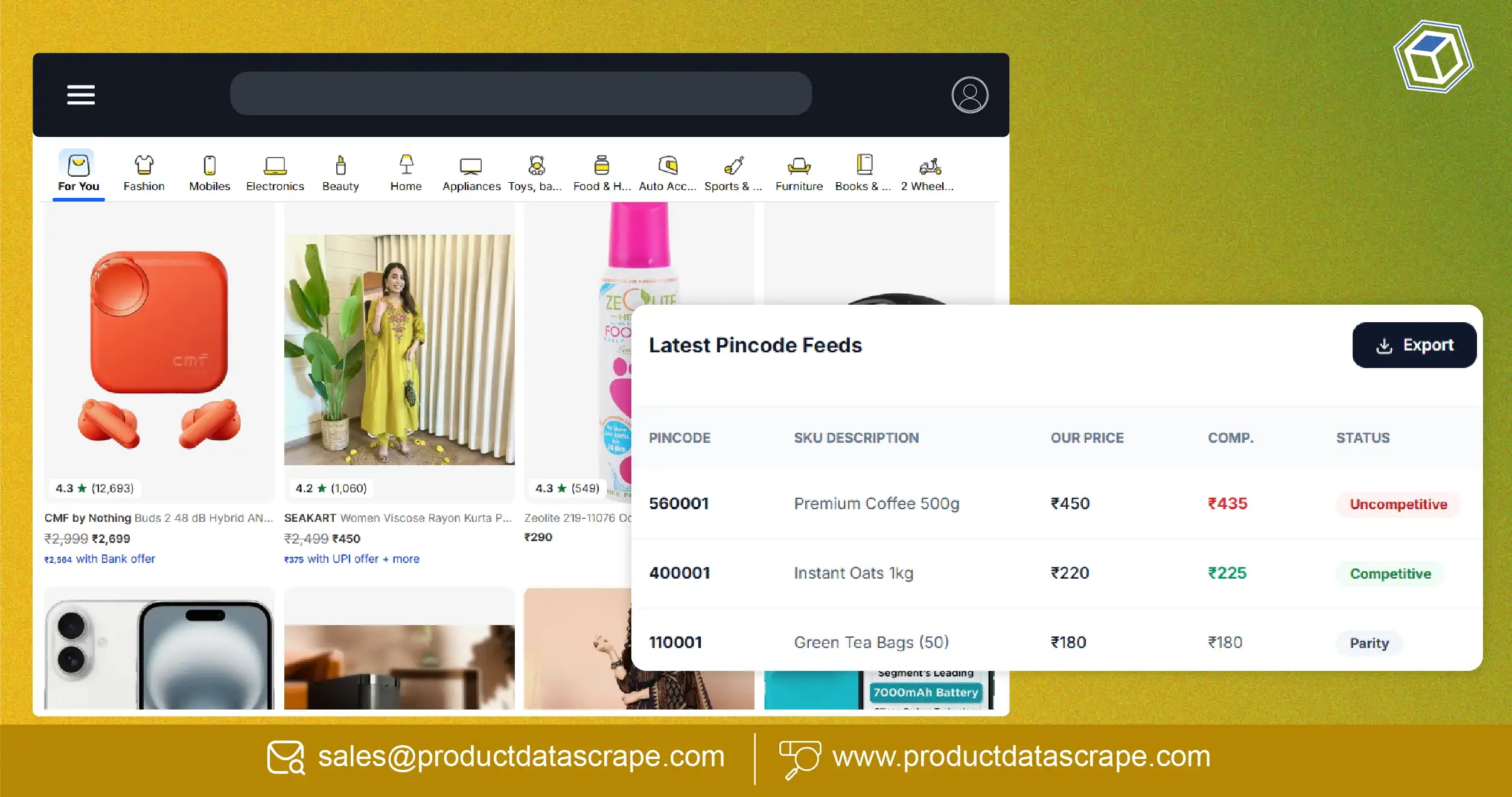
Pincode-level Flipkart price scraping means passing a pincode into the request and receiving a location-resolved record. At Product Data Scrape, the schema looks like this:
| Field |
Description |
| pincode |
The pincode the record resolves to |
| city, state, region_tier |
Geographic rollup dimensions |
| deliverable |
Whether the SKU can be delivered to this pincode at all |
| delivery_eta_days |
Promised delivery window |
| pincode_price |
Standard price resolved for this location |
| plus_exclusive_price |
Flipkart Plus member price for this location |
| effective_price |
Price after applicable bank offers, EMI and exchange value |
| all_sellers[] |
Sellers serving this pincode, with price and F-Assured status |
| is_f_assured |
Authenticity and fast-delivery badge, per seller-SKU |
| variants[] |
Per-variant price and stock for this location |
| flipkart_quick_eligible |
Whether 10-minute delivery is available here |
| quick_eta_minutes |
Quick delivery ETA where applicable |
| bank_offers[] |
Offers applicable at this location |
| captured_at |
Timestamp — essential for trend and evidence work |
Product Data Scrape supports pincode panels across India, from a focused 20-pincode metro panel through to broad national coverage spanning thousands of pincodes.
Sample Data: One SKU, Five Pincodes
An illustrative record set for a single FMCG SKU captured on the same day across five pincodes.
| Pincode |
City |
Tier |
Deliverable |
ETA (days) |
Price |
Plus Price |
Effective Price |
Sellers |
Quick |
| 400001 |
Mumbai |
Metro |
Yes |
1 |
449 |
429 |
399 |
6 |
Yes |
| 380015 |
Ahmedabad |
Metro |
Yes |
2 |
449 |
435 |
415 |
4 |
Yes |
| 440010 |
Nagpur |
Tier-2 |
Yes |
4 |
479 |
— |
479 |
2 |
No |
| 452001 |
Indore |
Tier-2 |
Yes |
4 |
469 |
459 |
459 |
3 |
No |
| 781005 |
Guwahati |
Tier-2 |
No |
— |
— |
— |
— |
0 |
No |
The same product. The same day. Five very different commercial realities.
A brand monitoring only from Mumbai would record a price of 449, a Plus price of 429, an effective price of 399, six sellers, and Quick availability. Every one of those figures is unrepresentative of the country.
The findings hiding in five rows:
- A 30-rupee price premium in Nagpur — roughly 6.7 percent above the metro price, in a market where the brand is trying to build volume.
- No Plus pricing in Nagpur — meaning the platform's highest-value customer segment is being served worse there than in metros.
- Guwahati is not deliverable at all. Not out of stock. Not expensive. Simply unavailable. Zero sellers serve the pincode.
- Effective-price spread of 80 rupees across deliverable pincodes — the customer in Mumbai pays 399, the customer in Nagpur pays 479, a 20 percent gap.
- Seller depth collapses outside metros — six sellers in Mumbai, two in Nagpur. Fewer sellers means less price competition, which is precisely why the tier-2 price is higher.
In JSON, the Guwahati record:
{
  "product_id": "FMCGX7K2QP9WZ",
  "title": "BrandY Premium Product, 500 g",
  "pincode": "781005",
  "city": "Guwahati",
  "state": "Assam",
  "region_tier": "tier_2",
  "captured_at": "2026-07-14T08:40:11+05:30",
  "deliverable": false,
  "delivery_eta_days": null,
  "pincode_price": null,
  "plus_exclusive_price": null,
  "effective_price": null,
  "all_sellers": [],
  "flipkart_quick_eligible": false,
  "note": "No seller serves this pincode for this SKU"
}
That single record is worth more to a regional sales head than a month of metro price charts.
Building a Pincode Panel That Actually Works
Choose the panel before you choose the frequency. A well-chosen 50-pincode panel captured daily is more useful than 500 pincodes captured monthly. Coverage should be representative, not exhaustive.
Weight toward your weakness. Include the regions where distribution is thinnest and where your competitor is strongest. The pincodes you are least confident about are the ones the data will teach you the most about.
Cover all tiers. Metro, tier-2, and tier-3 pincodes behave differently. A panel of eight metros will confirm what you already believe.
Track deliverability as a first-class metric. Most brands treat it as a null value in the price field. It is not a null. It is a finding. Report it as a coverage percentage: this SKU is deliverable to 78 percent of our panel, and trend that number.
Roll up to decision units. Analysts think in pincodes; sales leaders think in territories. Aggregate pincode data into the regions your sales organisation is actually structured around, or the data will not get used.
Compute effective price at the pincode level. Because bank offers can be regionally scoped, an effective price calculated nationally and applied to every pincode reintroduces exactly the error you are trying to eliminate.
How FMCG Brands Use Hyperlocal Flipkart Data
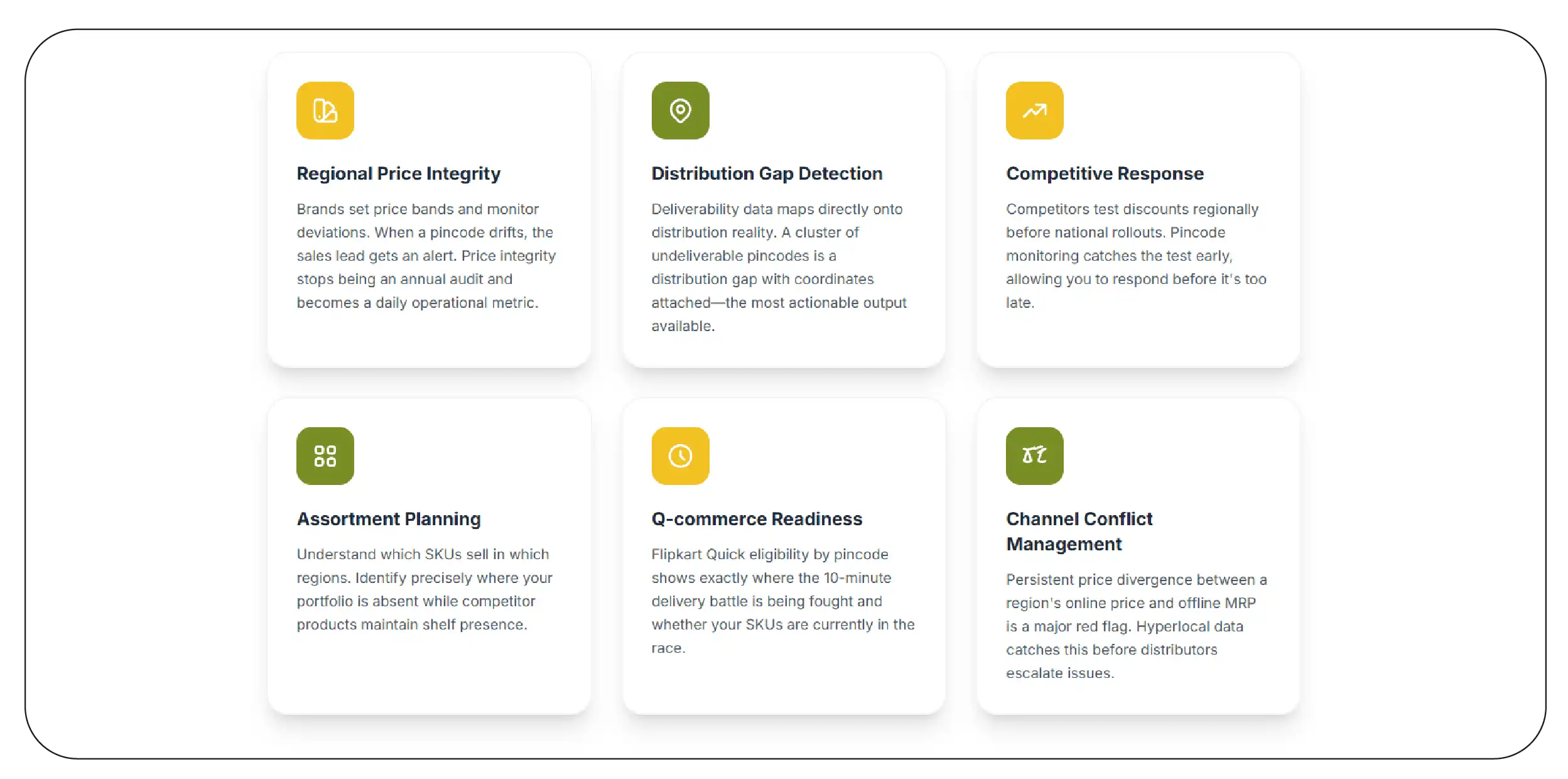
Regional price integrity. Brands set a price band and monitor deviation. When a pincode drifts outside the band, the sales lead for that region gets an alert. Price integrity stops being an annual audit and becomes a daily operational metric.
Distribution gap detection. Deliverability data maps directly onto distribution reality. A cluster of undeliverable pincodes is a distribution gap with coordinates attached — the single most actionable output most FMCG brands get from this data.
Competitive regional response. When a competitor discounts, they rarely do it nationally first. They test regionally. Pincode monitoring catches the test. Single-location monitoring catches it once it has been rolled out nationally and it is too late to respond cheaply.
Assortment planning by region. Which SKUs sell in which regions, and which of your SKUs are simply absent where a competitor's are present.
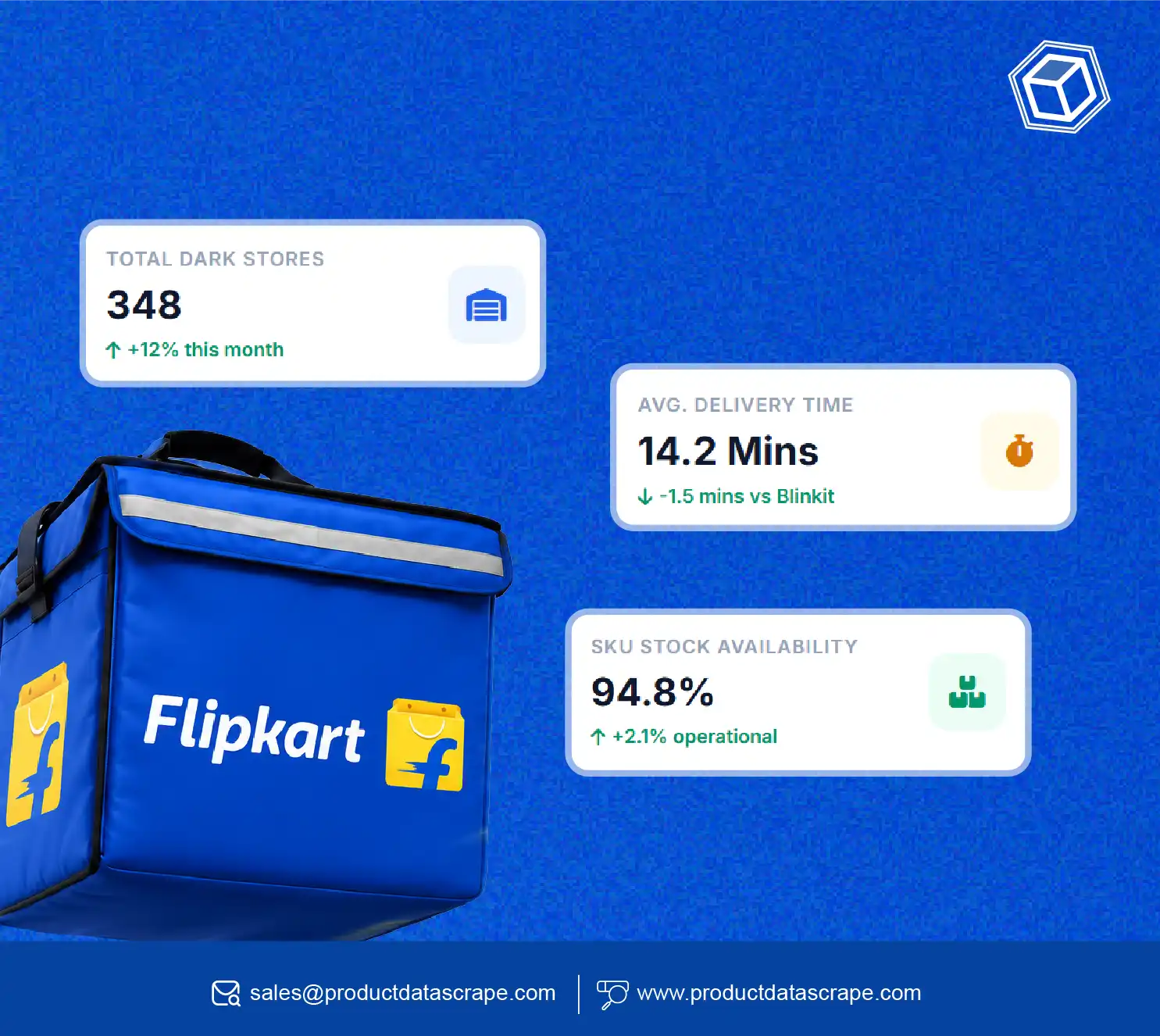
Q-commerce readiness. Flipkart Quick eligibility by pincode shows exactly where the 10-minute delivery battle is being fought and whether your SKUs are in it.
Trade and channel conflict management. Persistent price divergence between a region's online price and its offline MRP is a channel-conflict signal, and hyperlocal data is how it gets caught before distributors escalate it.
Scale and Reliability Considerations
Pincode-level scraping multiplies request volume. A catalogue of 500 SKUs across 100 pincodes is 50,000 records per capture cycle — and that is before variants and sellers expand each record further. Three things determine whether the programme holds up:
Frequency discipline. Not every SKU needs every pincode every day. Tier your monitoring: hero SKUs across the full panel daily, long-tail SKUs across a reduced panel weekly.
Sale-event capacity. During Big Billion Days, request volume and platform load both spike. Product Data Scrape provisions for the spike rather than the average, so collection stays stable when the data is most valuable.
Responsible collection. We gather publicly available product information only — no personal data, no authenticated content, no circumvention. Rate-limited, respectful collection is both the ethical baseline and the practical requirement for a pipeline that survives long-term.
Frequently Asked Questions
How many pincodes can you monitor?
Panels range from a focused set of 20 to broad national coverage across thousands of Indian pincodes.
Does Flipkart pricing really vary by pincode?
Price, deliverability, delivery ETA, seller mix, offer applicability, and Quick eligibility can all vary. Deliverability and seller mix vary most dramatically.
Can you tell me where my product cannot be delivered?
Yes — deliverability is captured as an explicit field, and coverage percentage is reported per SKU across the panel.
What formats do you deliver in?
JSON, CSV, REST API, or direct pushes to S3, GCS, Snowflake, or BigQuery.
How quickly can a pilot run?
A diagnostic pass across a sample SKU set and a representative pincode panel typically turns around in days, not weeks.
See Your Price Surface, Not Your Price Point
Your product does not have a price on Flipkart. It has a price surface stretched across India, with peaks in the markets where seller competition is thin, valleys in the metros, and holes where the product cannot be delivered at all.
Product Data Scrape builds pincode-level Flipkart price scraping pipelines for FMCG and CPG brands — capturing price, Plus pricing, effective price, deliverability, ETA, seller array, variant stock, and Quick eligibility across configurable pincode panels nationwide.
Ready to see what your SKU costs in Nagpur? Talk to our team about a hyperlocal diagnostic pass on your own catalogue.
Product Data Scrape — turning marketplace complexity into decision-ready data.


 Singapore
 EMAIL
EMAIL
 PHONE
PHONE


.webp)
.webp "thumb")
.webp "thumb")
.webp "thumb")








.webp)