Quick Overview
A fast-growing grocery technology company partnered with Product Data Scrape to improve hyperlocal grocery intelligence, pricing visibility, and inventory analytics across regional delivery markets. The client required scalable KisanKonnect Grocery Delivery Data Scraping solutions to automate fresh produce tracking, pricing updates, and product availability monitoring in real time.
Using advanced extraction infrastructure and a structured Grocery store dataset, we enabled the client to improve forecasting accuracy, optimize regional inventory planning, and strengthen competitor benchmarking capabilities. Over a six-month implementation period, the client achieved a 43% improvement in pricing visibility, reduced manual monitoring efforts by 72%, and improved fresh produce availability forecasting across multiple delivery zones.
The Client
The client was a grocery technology and retail analytics company specializing in hyperlocal grocery intelligence, fresh produce monitoring, and supply chain optimization solutions for urban delivery ecosystems. The business primarily served FMCG brands, grocery retailers, and quick commerce companies seeking actionable insights into regional grocery demand and pricing fluctuations.
Between 2020 and 2026, hyperlocal grocery delivery platforms experienced rapid growth due to changing consumer shopping behavior and increasing demand for same-day delivery convenience. This market expansion created intense competition among grocery retailers, making real-time visibility into pricing, inventory, and fresh produce trends essential for operational success.
Before partnering with us, the client relied on fragmented data collection workflows that lacked scalability and automation. Manual tracking processes delayed updates for Real time KisanKonnect grocery pricing data, resulting in inconsistent reporting and limited operational responsiveness. The company also struggled to integrate multiple regional datasets efficiently across fast-changing grocery catalogs.
To address these challenges, we implemented enterprise-grade Web Scraping API Services designed to automate grocery intelligence collection, improve pricing visibility, and enable real-time analytics across hyperlocal grocery delivery ecosystems.
Goals & Objectives
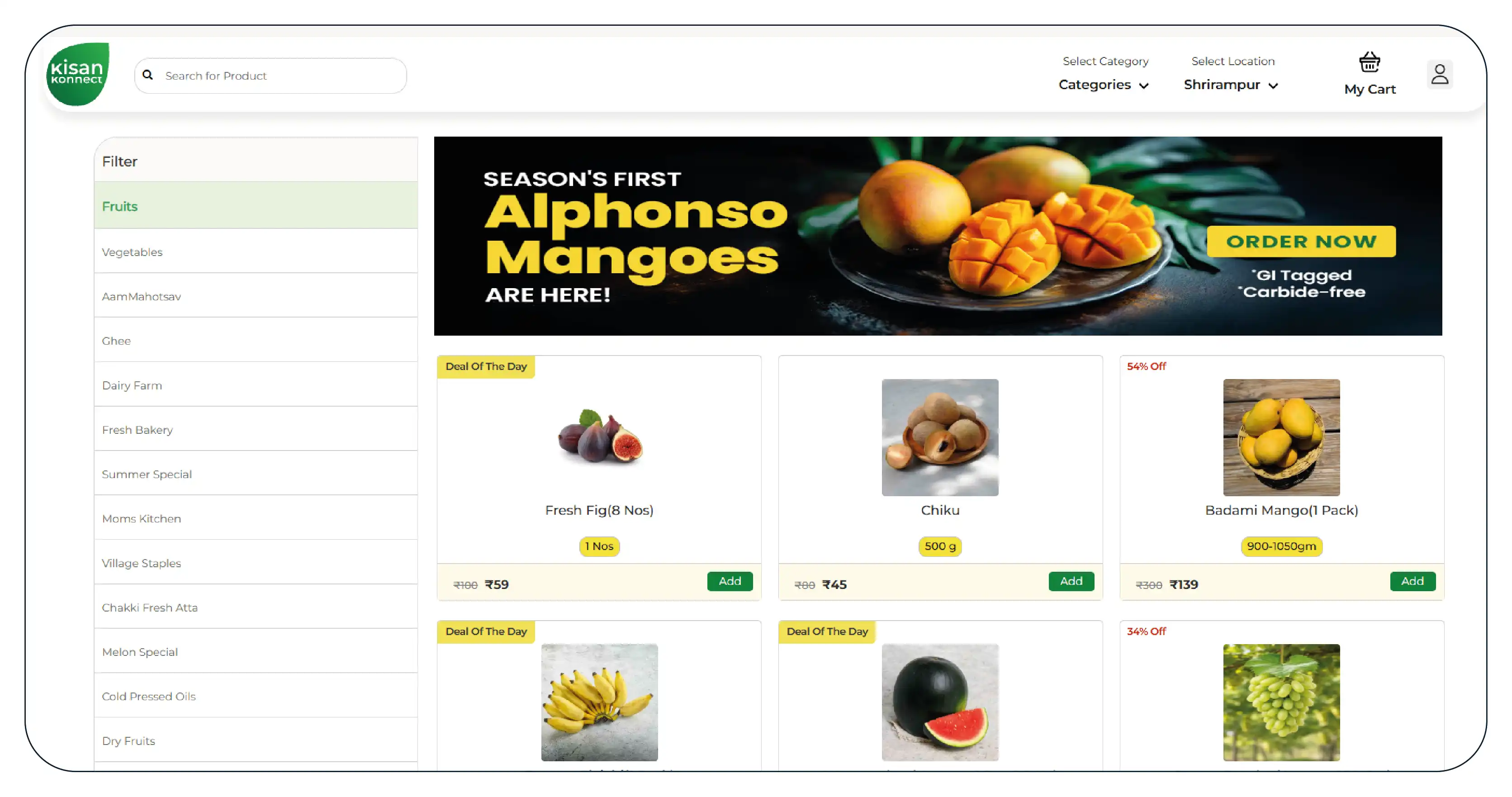
The client’s primary goal was to improve regional grocery intelligence capabilities and enable scalable automation for pricing and inventory monitoring across hyperlocal delivery markets. The business also wanted to Scrape KisanKonnect product catalog Data efficiently to improve product visibility and forecasting accuracy.
Additional goals included reducing operational delays, improving category-level analytics, and strengthening competitor benchmarking capabilities for fresh grocery products.
From a technical perspective, the project focused on building automated extraction pipelines, scalable APIs, and real-time analytics dashboards. We also integrated advanced Pricing Intelligence Service solutions to support regional pricing analysis and category-level trend monitoring.
The infrastructure needed to process large-scale grocery datasets with high extraction accuracy, low latency, and seamless synchronization across dynamic product catalogs.
Improve fresh produce pricing visibility by 40%
Reduce manual monitoring workflows by 70%
Increase real-time inventory tracking accuracy
Improve hyperlocal forecasting responsiveness
Enable automated SKU-level analytics reporting
Strengthen regional competitor benchmarking capabilities
The Core Challenge
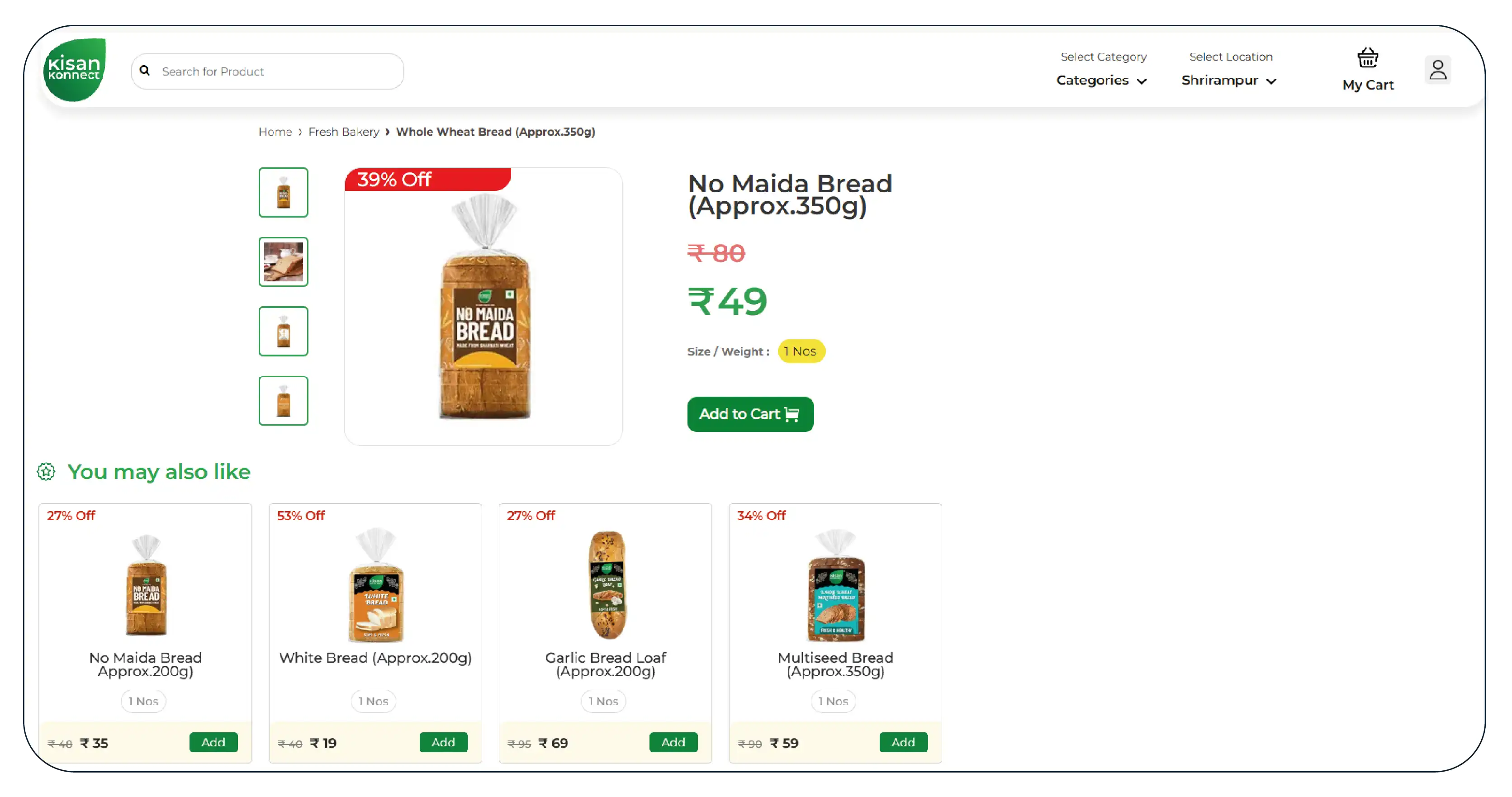
Before implementing automation systems, the client faced major operational inefficiencies related to grocery pricing updates, fresh produce tracking, and regional inventory analytics. Their existing workflows relied heavily on manual monitoring processes, resulting in delayed data updates and inconsistent reporting accuracy.
One significant challenge involved the ability to Extract KisanKonnect fresh produce listings efficiently from rapidly changing grocery catalogs. Product availability fluctuated frequently across different delivery zones, making it difficult for the client to maintain accurate inventory visibility.
The company also struggled with fragmented data structures and inconsistent product categorization. This reduced reporting efficiency and limited their ability to generate actionable hyperlocal insights across grocery segments. Without scalable automation, monitoring fresh produce trends became increasingly resource-intensive.
Additionally, the absence of centralized Digital Shelf Analytics capabilities limited visibility into competitor product positioning, regional pricing trends, and category-level assortment changes. These operational bottlenecks negatively impacted forecasting accuracy, customer reporting quality, and supply chain responsiveness across multiple retail partners.
Our Solution
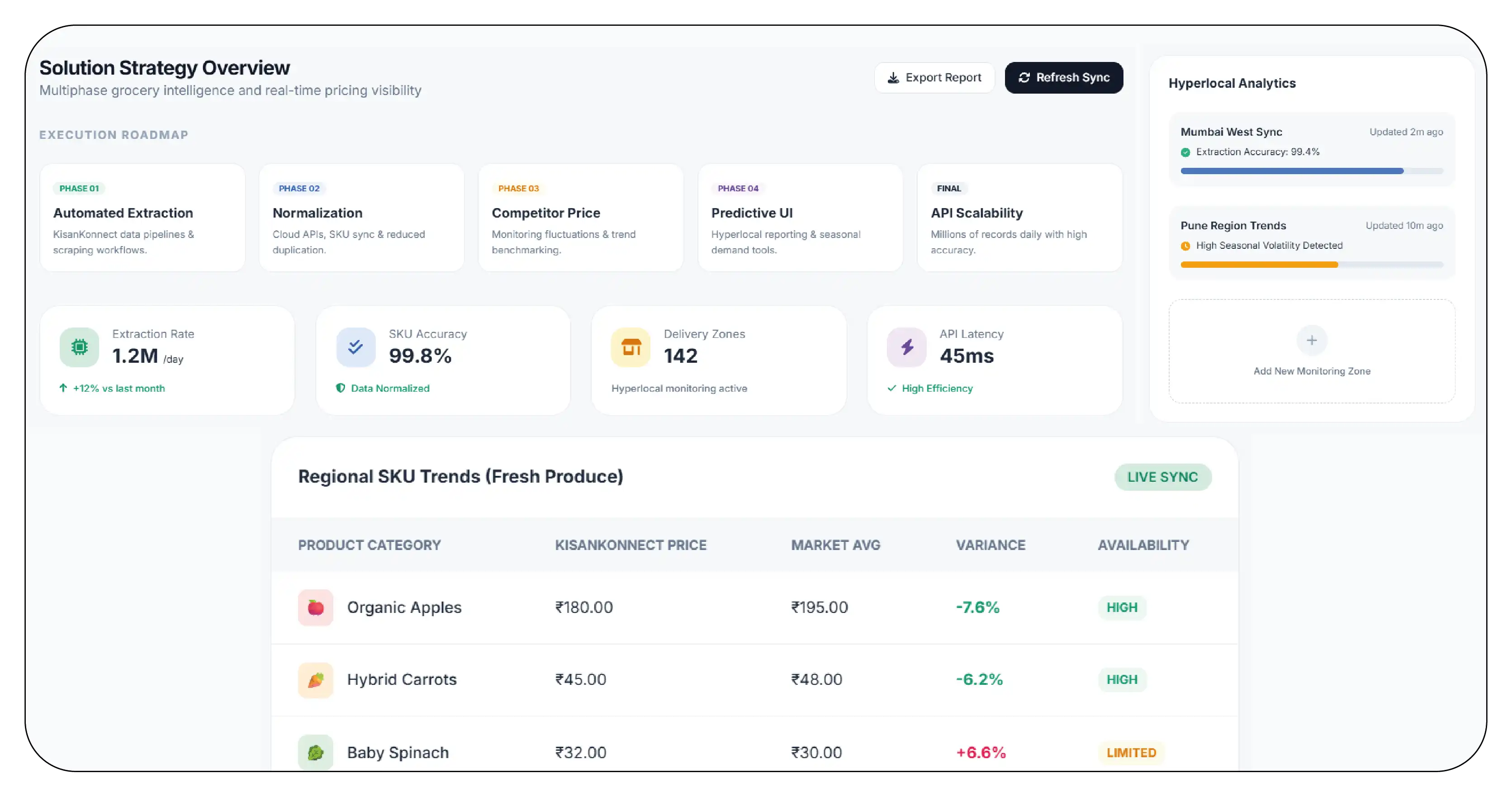
We implemented a multi-phase grocery intelligence strategy focused on scalable automation, real-time pricing visibility, and hyperlocal analytics optimization.
Phase 1: Automated Data Extraction
Our engineering team designed automated extraction pipelines capable of large-scale KisanKonnect fruits and vegetables data extraction across dynamic grocery catalogs. We developed intelligent scraping workflows to collect pricing, availability, category, SKU, and product metadata from regional delivery ecosystems in real time.
Phase 2: Data Normalization & Scalability
Using cloud-based APIs, structured parsing systems, and automation frameworks, we standardized grocery catalog data and improved SKU-level synchronization across delivery regions. This significantly reduced duplicate entries and improved reporting consistency.
Phase 3: Competitor Monitoring & Analytics
We deployed Competitor Price Monitoring Services to track regional price fluctuations, category-level pricing trends, and promotional variations across fresh produce categories. These insights enabled the client to benchmark pricing competitiveness and optimize category-level analytics workflows more effectively.
Phase 4: Predictive Dashboards & Optimization
We implemented predictive analytics dashboards and hyperlocal reporting systems. These tools enabled the client to monitor inventory trends, pricing movements, seasonal demand fluctuations, and regional product availability dynamically.
The final implementation phase focused on API scalability optimization and real-time synchronization. We built enterprise-grade automation infrastructure capable of processing millions of grocery records daily while maintaining high extraction accuracy and operational efficiency across multiple delivery zones.
Results & Key Metrics
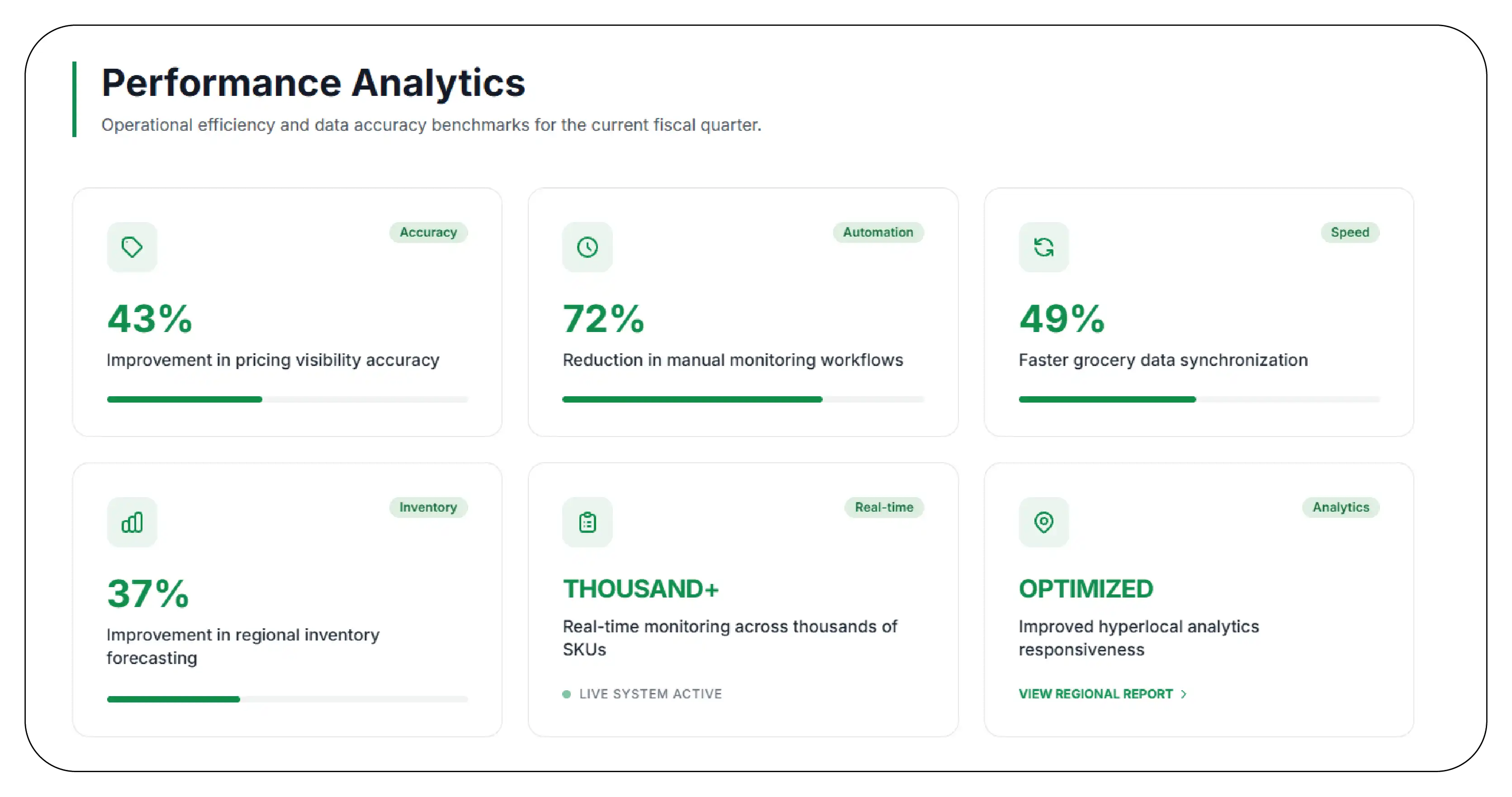
Through advanced KisanKonnect price monitoring for fresh produce solutions, the client achieved measurable improvements in automation, pricing visibility, and regional inventory intelligence.
Key outcomes included:
43% improvement in pricing visibility accuracy
72% reduction in manual monitoring workflows
49% faster grocery data synchronization
37% improvement in regional inventory forecasting
Real-time monitoring across thousands of SKUs
Improved hyperlocal analytics responsiveness
The client also achieved stronger operational scalability and category-level reporting consistency across fresh grocery segments.
Results Narrative
The implementation of automated grocery intelligence infrastructure transformed the client’s hyperlocal analytics capabilities significantly. Pricing updates became fully automated, improving reporting speed and enabling faster decision-making across regional grocery ecosystems.
Real-time dashboards provided stronger visibility into inventory fluctuations, pricing competitiveness, and fresh produce availability trends. This enabled the client to improve forecasting accuracy, optimize category planning, and strengthen customer reporting quality.
As a result, the company expanded analytics coverage, improved operational responsiveness, and strengthened its position within the rapidly growing hyperlocal grocery intelligence market.
What Made Product Data Scrape Different?
We differentiated itself through enterprise-grade automation frameworks, scalable grocery intelligence systems, and advanced analytics infrastructure tailored specifically for hyperlocal delivery ecosystems.
Our proprietary systems enabled businesses to Scrape Grocery SKU data from KisanKonnect efficiently while maintaining high extraction accuracy and real-time synchronization across dynamic grocery catalogs.
Unlike traditional extraction systems, our advanced KisanKonnect Grocery Delivery Data Scraping infrastructure integrated pricing analytics, inventory monitoring, predictive forecasting, and category-level reporting into a unified automation ecosystem.
This innovation enabled the client to scale analytics operations rapidly while improving operational efficiency and hyperlocal market visibility significantly.
Client’s Testimonial
“Product Data Scrape helped us completely transform our grocery intelligence infrastructure. Their automation expertise and scalable analytics solutions enabled us to improve pricing visibility, strengthen forecasting accuracy, and automate regional grocery monitoring efficiently.
The advanced KisanKonnect Grocery Delivery Data Scraping workflows significantly improved our operational responsiveness and helped us deliver higher-quality insights to our retail and FMCG partners.”
— Director of Data Strategy, Grocery Technology Brand
Conclusion
The rapid expansion of hyperlocal grocery delivery ecosystems has increased the importance of scalable automation and real-time analytics visibility. Businesses leveraging advanced KisanKonnect Grocery Delivery Data Scraping systems gain actionable insights into regional pricing trends, fresh produce availability, and category-level demand fluctuations.
We helped the client automate grocery intelligence workflows, improve inventory forecasting accuracy, and strengthen hyperlocal analytics capabilities through enterprise-grade automation infrastructure. Advanced Web Scraping Grocery & Gourmet Food Data solutions also enabled scalable SKU-level reporting and stronger operational efficiency.
As grocery delivery ecosystems continue evolving, intelligent automation and predictive analytics will remain essential for businesses seeking long-term growth and competitive advantage.
FAQs
1. What is KisanKonnect Grocery Delivery Data Scraping?
It is the process of extracting grocery pricing, inventory, SKU, and product availability data from KisanKonnect delivery platforms for analytics and business intelligence purposes.
2. Why do grocery brands need hyperlocal grocery intelligence?
Hyperlocal intelligence helps businesses monitor regional pricing trends, forecast demand, improve inventory planning, and strengthen competitive positioning.
3. What data can be extracted from KisanKonnect?
Businesses can extract product listings, fresh produce availability, pricing details, stock status, SKU information, category insights, and regional inventory trends.
4. How does Product Data Scrape improve grocery analytics?
Product Data Scrape provides scalable APIs, automation infrastructure, real-time analytics dashboards, and predictive grocery intelligence solutions.
5. Which industries benefit from grocery delivery data scraping?
FMCG brands, grocery retailers, quick commerce companies, analytics firms, supply chain businesses, and market research organizations benefit from structured grocery intelligence.


 Singapore
 EMAIL
EMAIL
 PHONE
PHONE


.webp)
.webp "thumb")
.webp "thumb")
.webp "thumb")








.webp)