Quick Overview
A leading packaged food and grocery brand partnered with Product Data Scrape to modernize its retail intelligence and inventory monitoring processes across multiple supermarket categories. The client required a scalable solution to automate competitor tracking, product availability analysis, and pricing visibility from Key Food marketplaces. By implementing Key Food Grocery data scraping along with a customized Key Food Grocery Data Scraping API, we streamlined large-scale grocery data extraction and reporting workflows. Over a six-month engagement, the client improved inventory visibility by 68%, accelerated pricing updates by 55%, and reduced manual monitoring efforts by 75%. The transformation enabled faster decision-making, improved stock planning, and stronger competitive positioning in the grocery retail market.
The Client
The client was a fast-growing food and beverage brand supplying packaged grocery products, snacks, beverages, and household essentials across regional retail chains. As the grocery industry became increasingly data-driven, the company faced mounting pressure to monitor pricing fluctuations, inventory availability, and changing consumer demand patterns in real time.
Rising competition among grocery retailers and digital marketplaces made Key Food grocery market analytics essential for maintaining market visibility and improving retail performance. Seasonal promotions, rapid stock fluctuations, and aggressive competitor pricing strategies created operational challenges for the client’s sales and merchandising teams.
Before partnering with Product Data Scrape, the company relied on spreadsheets and manual research methods to organize its Grocery store dataset across different product categories. These outdated workflows delayed access to critical insights, resulting in slower pricing adjustments, inaccurate inventory forecasting, and missed promotional opportunities.
The business lacked a centralized analytics infrastructure capable of handling large-scale grocery intelligence efficiently. Teams spent excessive time collecting and validating product data manually, which reduced operational speed and reporting accuracy. To remain competitive, the client required an automated and scalable system capable of delivering real-time grocery intelligence while supporting faster and more informed business decisions.
Goals & Objectives
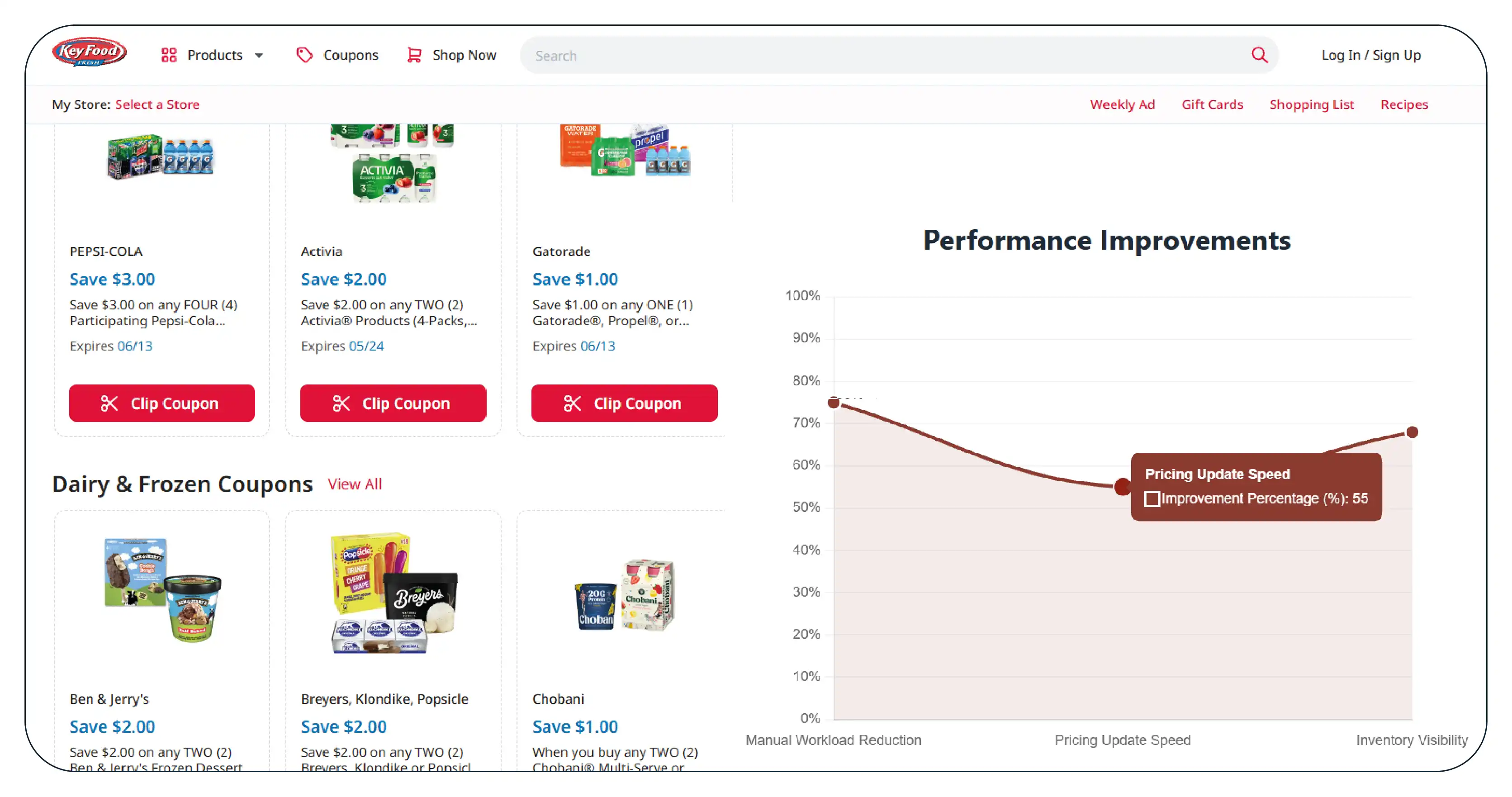
The primary goal was to improve operational efficiency and strengthen the client’s ability to respond to changing grocery market conditions. Through Key Food grocery demand tracking, the company aimed to gain better visibility into inventory trends, competitor pricing, and product availability across multiple categories. The business also wanted to reduce manual reporting efforts while improving scalability and data accuracy.
The technical objective focused on building an automated framework powered by Product Price Data Scraping Services to collect, process, and standardize grocery marketplace information in real time. The solution needed seamless integration with analytics dashboards, reporting systems, and inventory planning tools.
Reduced manual grocery monitoring workload by 75%
Improved pricing update speed by 55%
Enhanced inventory visibility by 68%
Increased product data accuracy significantly
Accelerated reporting turnaround times
Improved category-level competitive analysis
Enabled faster analytics-driven decisions
The Core Challenge

The client struggled with fragmented grocery intelligence processes that limited visibility into product availability, pricing trends, and competitor activity. Teams responsible for Key Food supermarket trend monitoring relied heavily on manual workflows that were slow, repetitive, and difficult to scale across thousands of grocery SKUs.
Frequent pricing updates and inventory fluctuations created major operational bottlenecks. Product information often became outdated before reports were completed, resulting in delayed pricing decisions and inaccurate stock forecasting. This reduced the company’s ability to respond quickly to changing market conditions and competitor promotions.
Another major challenge was the lack of scalable automation infrastructure. Existing systems could not process large volumes of marketplace data efficiently or adapt to changing website structures. Without reliable Web Scraping API Services, the client faced repeated disruptions in data collection workflows and reporting consistency.
The absence of centralized analytics also impacted operational performance. Data collected from multiple sources lacked standardization, causing duplicate records, inconsistent outputs, and delayed reporting cycles. Teams spent excessive time validating product listings manually instead of focusing on strategic planning.
As competition intensified in the grocery sector, the client needed a scalable and automated solution capable of delivering accurate real-time insights while improving operational speed and reliability.
Our Solution
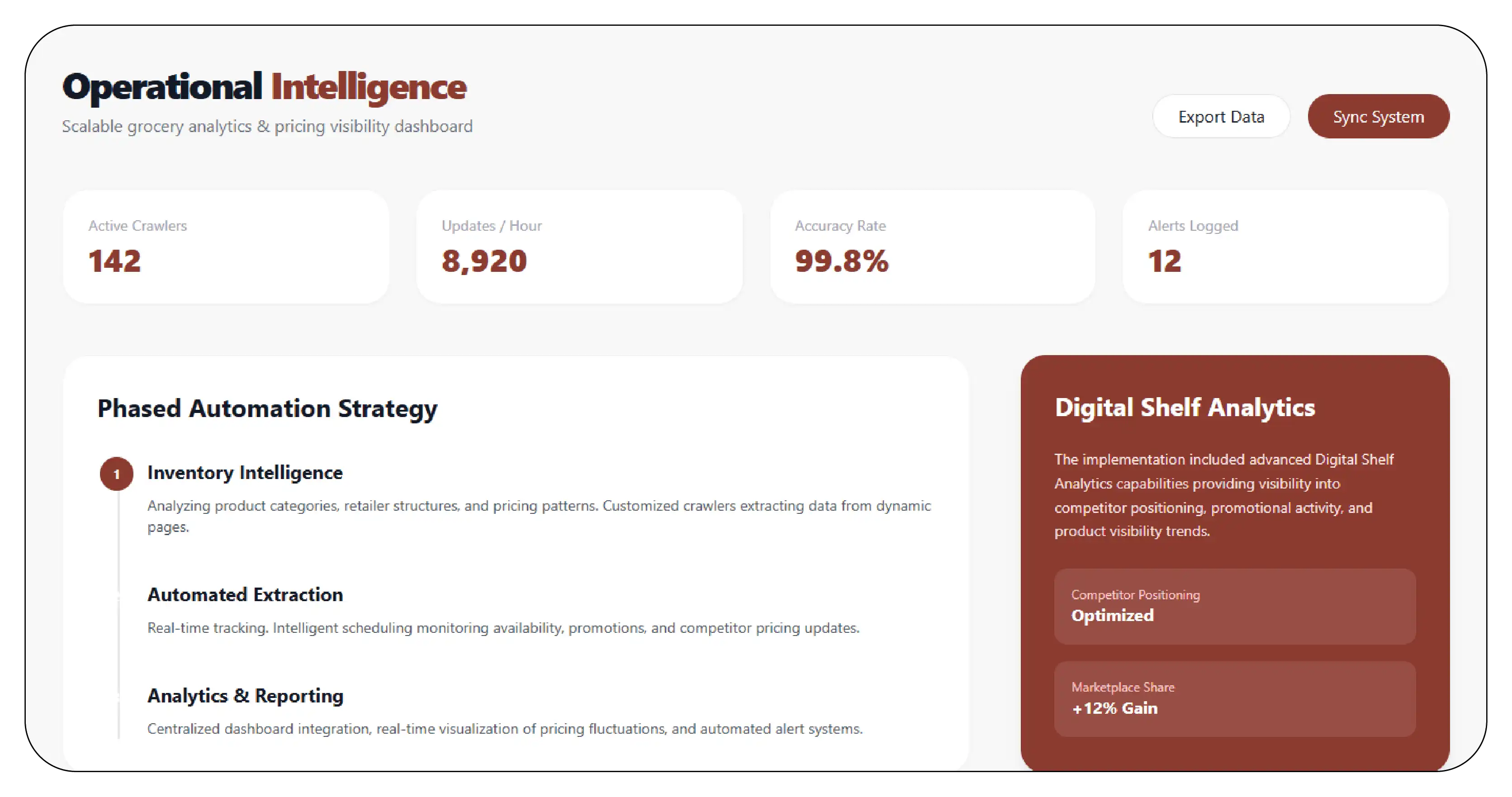
We implemented a phased automation strategy focused on inventory intelligence, pricing visibility, and scalable grocery analytics.
The first phase involved analyzing product categories, retailer structures, inventory formats, and pricing patterns across Key Food grocery listings. Our engineering team built customized crawlers capable of extracting structured grocery information from dynamic product pages and category listings.
During the second phase, we deployed automated extraction workflows to support Key Food grocery Track pricing trends in near real time. Intelligent scheduling systems continuously monitored inventory availability, promotions, discounts, and competitor pricing updates across multiple grocery categories.
Advanced validation and cleansing mechanisms were integrated to improve dataset accuracy and eliminate duplicate records. Automated processing pipelines standardized extracted information into analytics-ready formats optimized for reporting and forecasting.
The third phase focused on analytics integration and centralized reporting. Extracted datasets were connected to business intelligence dashboards, enabling teams to visualize pricing fluctuations, category performance, and inventory movement trends in real time. Automated alert systems also notified stakeholders about sudden pricing changes and low-stock conditions.
To improve scalability, we leveraged distributed cloud infrastructure and API-driven synchronization workflows capable of processing high-volume grocery datasets efficiently. The solution delivered faster reporting cycles while maintaining consistent extraction performance during peak retail periods.
The implementation also included advanced Digital Shelf Analytics capabilities that provided deeper visibility into competitor positioning, promotional activity, and product visibility trends. These insights enabled the client to optimize pricing strategies, improve inventory planning, and strengthen overall marketplace performance.
The phased deployment significantly reduced operational inefficiencies while creating a scalable framework capable of supporting future grocery analytics initiatives and retail intelligence expansion.
Results & Key Metrics
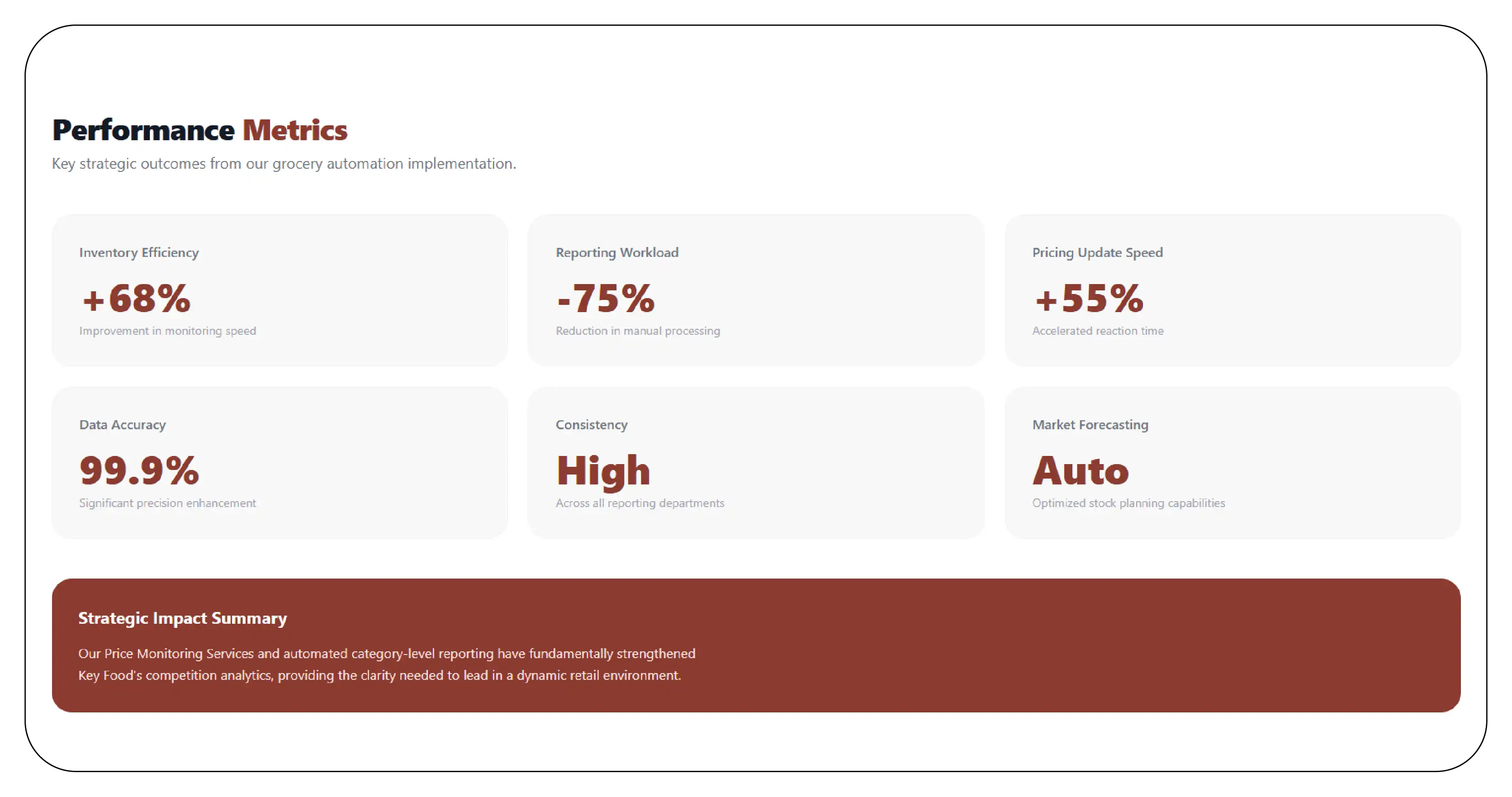
Improved inventory monitoring efficiency by 68%
Reduced manual reporting workload by 75%
Accelerated pricing updates by 55%
Enhanced product data accuracy significantly
Improved reporting consistency across departments
Strengthened Key Food grocery competition analytics capabilities
Enabled automated category-level reporting
Improved retail forecasting and stock planning
Enhanced market visibility through Price Monitoring Services
Results Narrative
The automated solution transformed the client’s ability to monitor grocery marketplace activity in real time. Continuous extraction workflows replaced repetitive manual processes and delivered structured visibility into pricing, inventory, and promotional changes across multiple categories.
Business teams gained faster access to actionable insights, enabling quicker pricing decisions and improved inventory forecasting. Centralized dashboards improved collaboration between sales, operations, and merchandising teams while increasing reporting efficiency. The implementation strengthened operational scalability and provided a reliable framework for long-term grocery intelligence and competitive analysis initiatives.
What Made Product Data Scrape Different
Our approach combined scalable automation, intelligent extraction frameworks, and customized grocery analytics tailored specifically for retail businesses. Unlike traditional data collection methods, our system delivered advanced Key Food shopper behavior insights while maintaining high accuracy across rapidly changing grocery product listings.
We implemented cloud-based processing pipelines, automated validation systems, and centralized analytics integration to improve reporting speed and operational reliability. The solution was designed to support large-scale grocery intelligence while providing actionable insights for pricing optimization, inventory planning, and competitive benchmarking. This combination of automation and strategic analytics enabled long-term scalability and stronger retail decision-making.
Client’s Testimonial
“Product Data Scrape helped us completely modernize our grocery analytics and inventory monitoring processes. Their expertise in Key Food grocery product intelligence and Key Food Grocery data scraping enabled us to automate complex reporting workflows while improving pricing visibility and stock forecasting accuracy.
The solution reduced manual effort significantly and provided our teams with faster access to actionable insights across multiple grocery categories. We can now monitor pricing trends, competitor activity, and inventory fluctuations in near real time. The automation framework has improved our operational efficiency and strengthened our ability to respond quickly to market changes.”
— Director of Retail Operations, Leading Food & Beverage Brand
Conclusion
This project demonstrated how automation and real-time retail intelligence can improve operational performance in the grocery sector. By implementing scalable extraction frameworks and centralized analytics systems, the client gained faster visibility into pricing changes, inventory movement, and competitor activity.
The integration of Extract Grocery & Gourmet Food Data capabilities enabled the business to improve reporting speed, optimize inventory planning, and strengthen category-level decision-making. Through advanced Key Food Grocery data scraping, the client established a scalable foundation for long-term grocery intelligence, improved operational efficiency, and smarter retail growth strategies.
FAQs
1. What is Key Food Grocery data scraping?
It is the process of extracting structured grocery marketplace information such as pricing, inventory, product listings, promotions, and competitor insights from Key Food platforms.
2. Why do grocery brands use data scraping solutions?
Brands use scraping solutions to monitor pricing trends, track inventory availability, analyze competitors, and improve retail decision-making with real-time insights.
3. What type of grocery data can be extracted?
Businesses can extract product names, prices, stock availability, discounts, category details, ratings, promotions, and retailer information.
4. How does automation improve grocery analytics?
Automation reduces manual work, improves data accuracy, accelerates reporting, and enables faster responses to pricing and inventory changes.
5. Can scraped grocery data integrate with analytics platforms?
Yes. Structured grocery datasets can integrate with business intelligence dashboards, inventory systems, forecasting tools, and reporting platforms for advanced retail analytics.


 Singapore
 EMAIL
EMAIL
 PHONE
PHONE


.webp)
.webp "thumb")
.webp "thumb")
.webp "thumb")








.webp)