Quick Overview
A leading jewelry retailer partnered with Product Data Scrape to strengthen assortment planning and pricing decisions in an increasingly competitive market. Over a six-month engagement, the retailer leveraged Jewellery Retail Competitor and Price Intelligence to gain visibility into market trends, competitor product offerings, and pricing movements. By integrating E-commerce data for jewelry into its planning processes, the company improved product range accuracy, accelerated decision-making, and enhanced category performance. Key outcomes included a 32% improvement in assortment optimization, a 28% increase in pricing responsiveness, and a 40% reduction in manual market research efforts. The project enabled the retailer to transition from reactive merchandising to a proactive, data-driven strategy that aligned inventory, pricing, and customer demand more effectively.
The Client
The client is a rapidly growing jewelry retailer operating across multiple online and offline sales channels. The jewelry industry has experienced significant transformation in recent years, driven by digital-first consumers, evolving fashion preferences, and increased transparency in pricing. Customers now compare products across multiple platforms before making purchasing decisions, creating intense pressure on retailers to remain competitive.
Prior to working with Product Data Scrape, the client relied heavily on manual processes to scrape jewellery competitor prices Data and evaluate market trends. These methods were time-consuming, prone to inconsistencies, and unable to provide real-time visibility into competitor activities. As competitors introduced new collections more frequently and adjusted prices dynamically, the retailer struggled to maintain a responsive merchandising strategy.
The company also lacked advanced Pricing strategy services capable of aligning assortment planning with market demand. Product range decisions were often based on historical sales data rather than current market intelligence, resulting in missed opportunities and inventory imbalances.
Recognizing the need for transformation, the retailer sought a scalable solution that could automate competitor monitoring, provide actionable insights, and improve assortment planning. The objective was to create a data-driven ecosystem that enabled faster decisions, improved competitiveness, and supported sustainable growth in a rapidly evolving marketplace.
Goals & Objectives
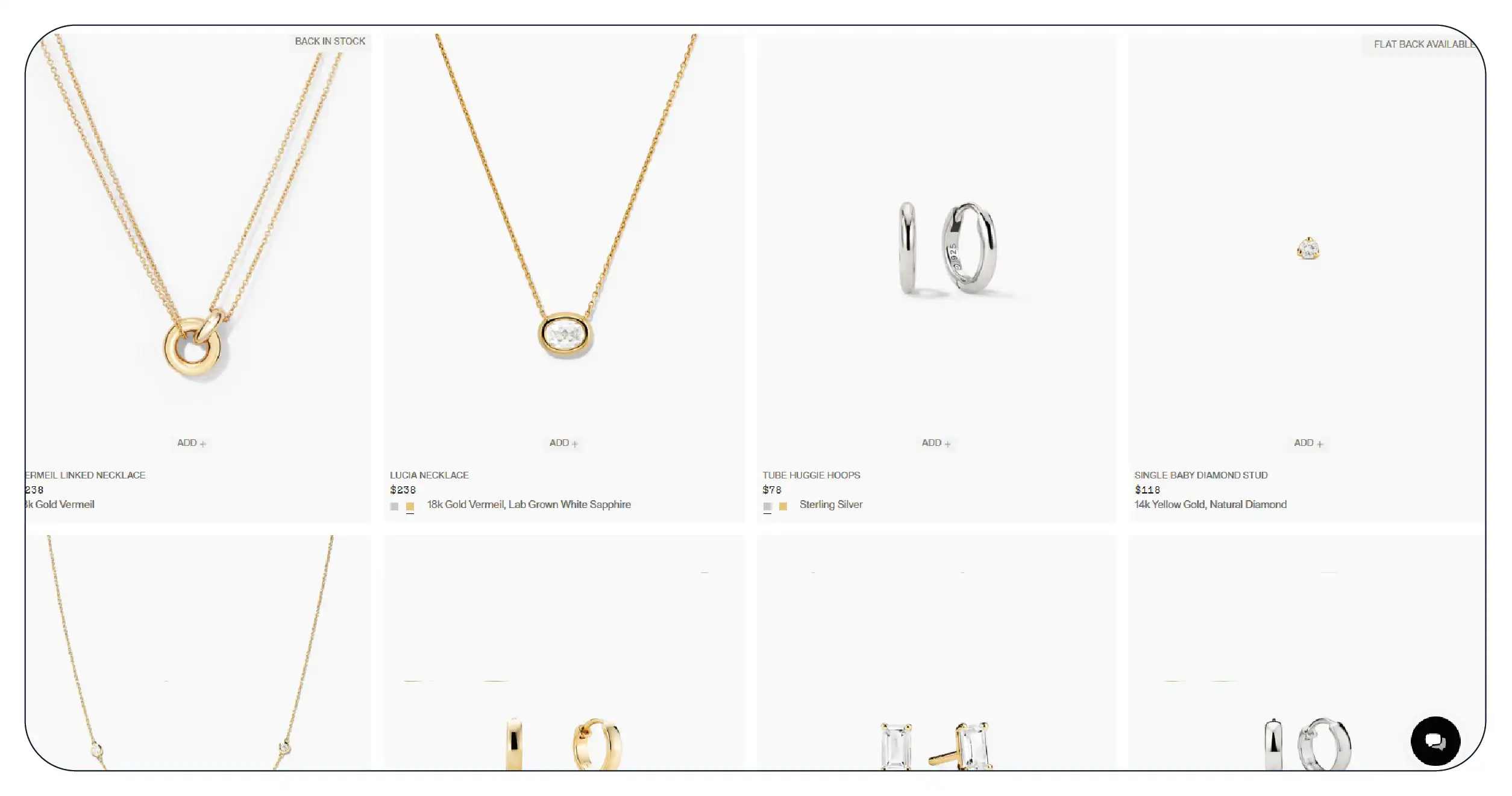
The retailer aimed to create a scalable intelligence framework capable of supporting continuous assortment optimization and pricing analysis. A key priority was the ability to track jewellery SKU performance across competitors and identify emerging trends before competitors gained an advantage.
The project focused on implementing automation, centralized data collection, and advanced Digital Shelf Analytics capabilities. The retailer required real-time visibility into competitor catalogs, pricing fluctuations, product launches, and assortment changes. Technical objectives included seamless integration with existing reporting systems and automated data refreshes.
Increase assortment planning accuracy by 30%
Reduce manual data collection efforts by 40%
Improve pricing responsiveness by 25%
Enhance competitor product visibility by 50%
Increase category-level decision-making speed by 35%
Improve SKU benchmarking efficiency across key competitors
Enable near real-time reporting and analytics
Strengthen strategic assortment planning capabilities
These goals ensured measurable improvements from both business and technology perspectives while creating a foundation for long-term growth.
The Core Challenge
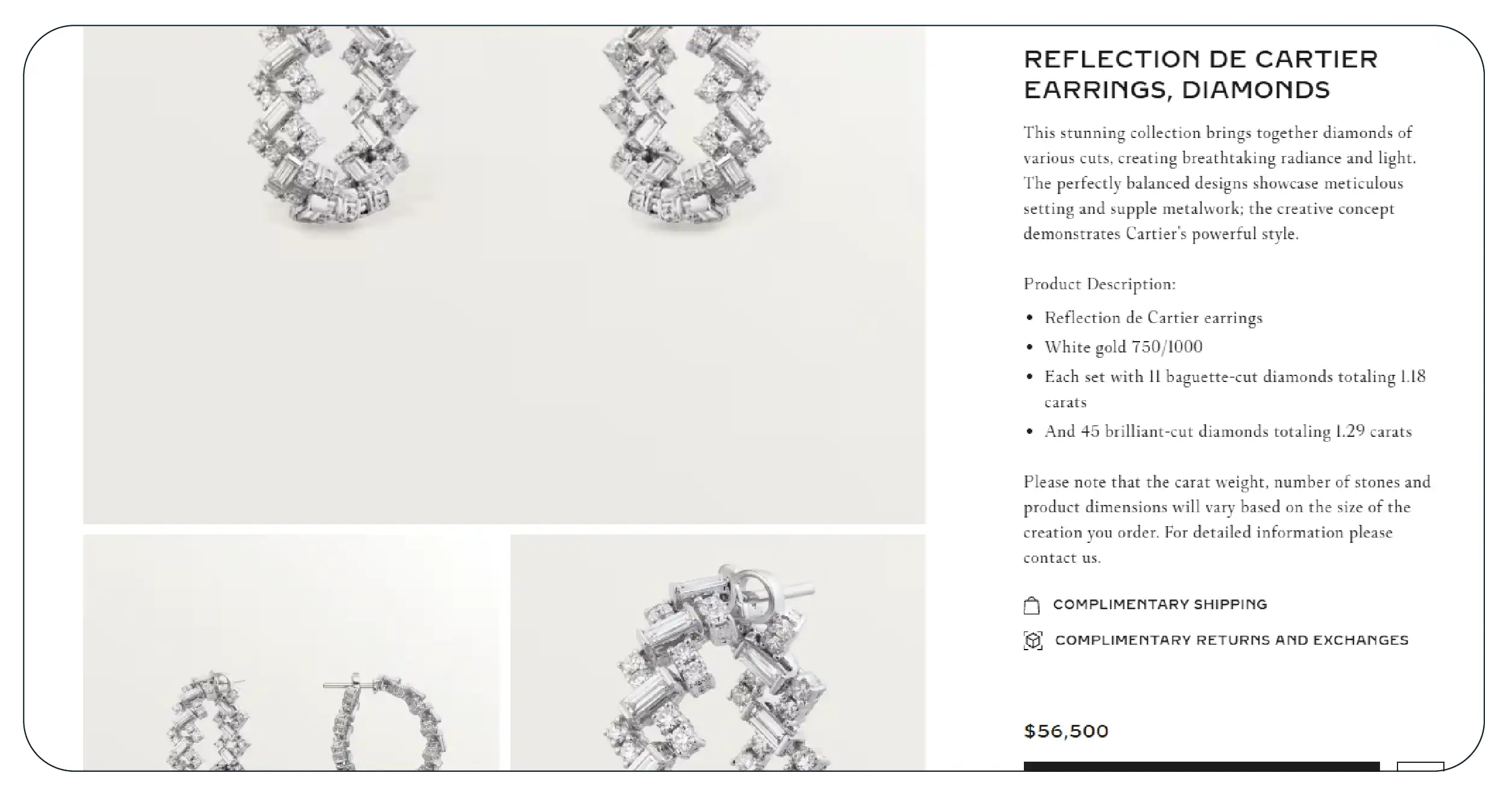
The retailer faced significant operational challenges in maintaining visibility across a rapidly changing competitive landscape. Teams spent substantial time attempting to scrape jewellery retailer websites for Competitor intelligence, manually gathering product information from multiple sources. The process was inefficient and often resulted in outdated insights by the time reports were completed.
Pricing volatility further complicated decision-making. Without automated Price scraping, the retailer lacked timely information regarding competitor promotions, markdowns, and assortment shifts. This delay limited the organization's ability to react effectively to market changes and optimize product positioning.
The absence of centralized intelligence also created inconsistencies across merchandising, pricing, and inventory planning teams. Different departments relied on separate datasets, resulting in fragmented decision-making processes and conflicting business priorities.
Data quality issues compounded the problem. Duplicate records, incomplete product attributes, and inconsistent categorization reduced confidence in reporting outputs. Merchandising teams struggled to identify assortment opportunities while pricing teams lacked sufficient visibility into competitor strategies.
As the retailer expanded its product portfolio, these challenges became increasingly difficult to manage manually. The organization needed an automated solution capable of delivering accurate, comprehensive, and actionable intelligence at scale while supporting faster and more strategic business decisions.
Our Solution
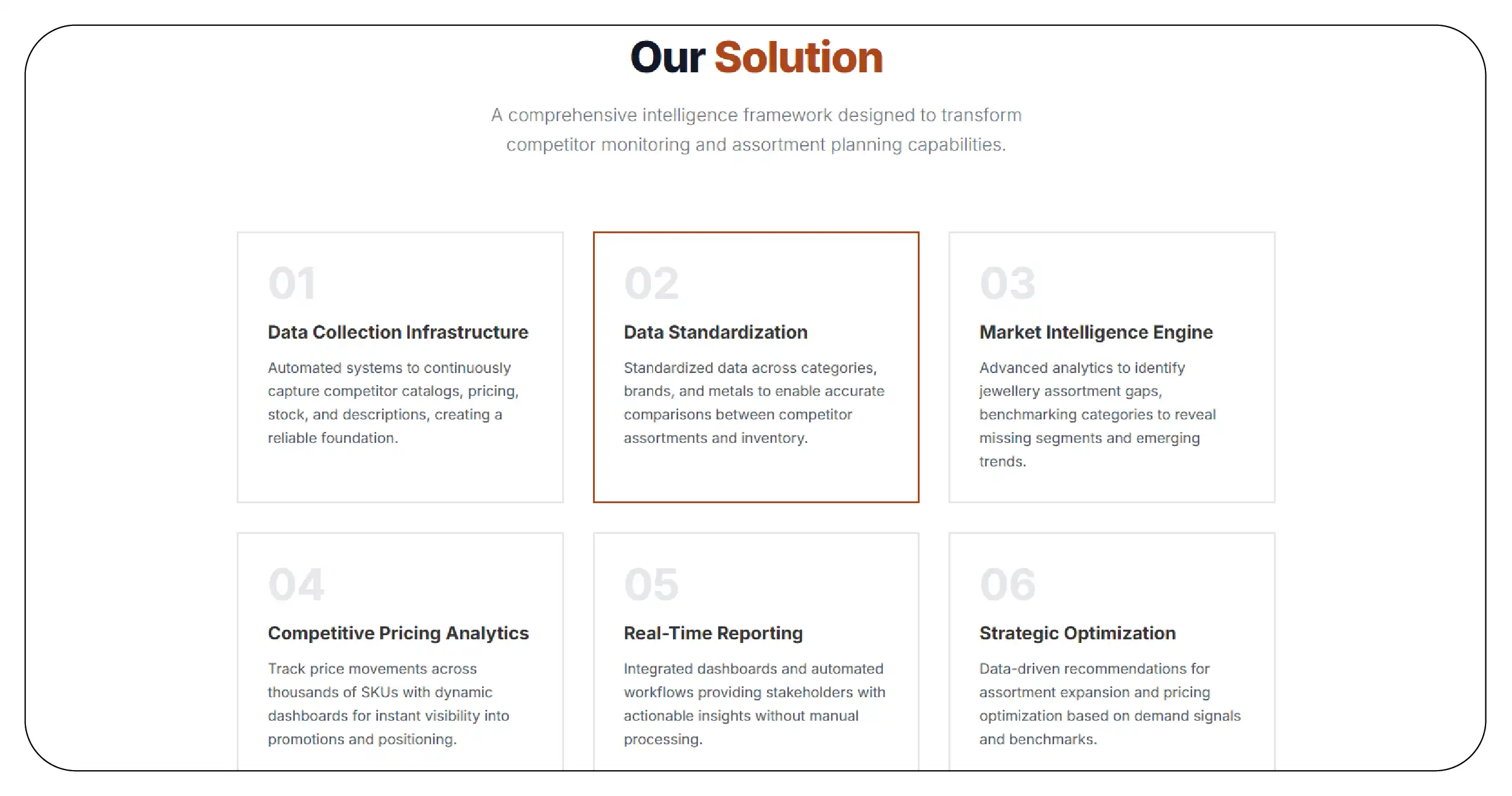
Product Data Scrape implemented a comprehensive intelligence framework designed to transform competitor monitoring and assortment planning capabilities.
Phase 1: Data Collection Infrastructure
We established automated systems to continuously capture competitor product catalogs, pricing information, stock availability, product descriptions, and assortment changes. This created a reliable foundation for market intelligence collection.
Phase 2: Data Standardization
Collected data was standardized across categories, attributes, brands, gemstones, metals, and product types. This enabled accurate comparisons between competitor assortments and the retailer's inventory.
Phase 3: Market Intelligence Engine
Using advanced analytics, we helped the retailer analyze jewellery assortment gaps with competitor monitoring. Product categories were benchmarked against leading competitors to identify missing product segments, underrepresented styles, and emerging trends.
Phase 4: Competitive Pricing Analytics
Automated Competitor price monitoring capabilities were deployed to track pricing movements across thousands of SKUs. Dynamic dashboards provided instant visibility into price changes, promotional activities, and market positioning.
Phase 5: Real-Time Reporting
Interactive dashboards and automated reporting workflows were integrated into the retailer's existing systems. Stakeholders gained access to actionable insights without manual data processing.
Phase 6: Strategic Optimization
Data-driven recommendations supported assortment expansion, product rationalization, and pricing optimization initiatives. Decision-makers could evaluate category opportunities based on competitor benchmarks and consumer demand signals.
This phased implementation eliminated manual research efforts, improved data quality, enhanced visibility into competitor strategies, and enabled the retailer to make faster, more confident merchandising decisions while maintaining a competitive market position.
Results & Key Metrics
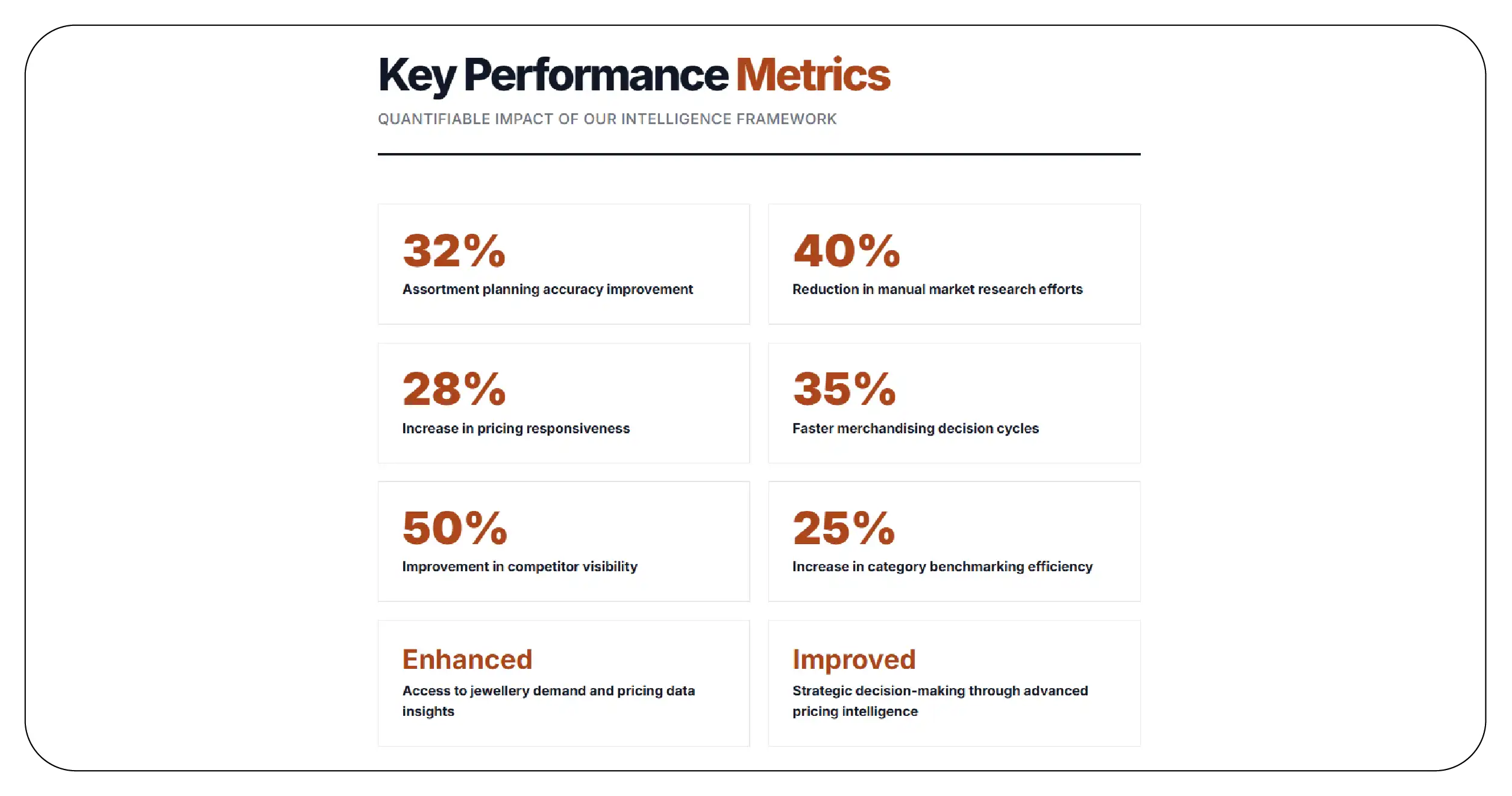
32% improvement in assortment planning accuracy
40% reduction in manual market research efforts
28% increase in pricing responsiveness
35% faster merchandising decision cycles
50% improvement in competitor visibility
25% increase in category benchmarking efficiency
Enhanced access to jewellery demand and pricing Data insights
Improved strategic decision-making through advanced Pricing intelligence
Results Narrative
The retailer successfully transformed its assortment planning and pricing processes through automated market intelligence. Access to comprehensive competitor data enabled more accurate product selection and faster response to market changes. Merchandising teams identified assortment opportunities earlier, while pricing teams gained visibility into competitive positioning across key categories. Improved collaboration between departments resulted in more consistent decision-making and stronger alignment with consumer demand. The retailer established a sustainable framework for ongoing growth, innovation, and competitive differentiation.
What Made Product Data Scrape Different
Product Data Scrape delivered a unique combination of automation, scalability, and intelligence tailored specifically for retail analytics. Our proprietary frameworks supported large-scale data collection while maintaining exceptional accuracy and consistency. Advanced matching algorithms simplified product benchmarking and assortment comparisons. The platform's automated workflows reduced manual effort and accelerated reporting cycles. Through specialized Jewellery Retail Competitive Pricing Analysis, the retailer gained deeper visibility into pricing dynamics, competitor strategies, and assortment opportunities. This combination of technology, domain expertise, and actionable insights enabled faster decision-making and measurable business impact.
Client's Testimonial
"Product Data Scrape transformed how we approach assortment planning and market analysis. Their expertise in Jewellery Retail Competitor and Price Intelligence provided unprecedented visibility into competitor strategies, product trends, and pricing movements. The automated dashboards replaced hours of manual research and empowered our teams with reliable, real-time insights. We now make faster, more confident merchandising decisions while maintaining stronger market competitiveness. The partnership has become a critical component of our growth strategy and continues to deliver measurable value across our organization."
— Head of Merchandising & Category Strategy
Conclusion
As competition within the jewelry sector continues to intensify, access to accurate market intelligence has become essential for sustainable growth. Through automated collection and analysis of Competitive pricing data, the retailer significantly improved assortment planning, pricing responsiveness, and operational efficiency. By leveraging Jewellery Retail Competitor and Price Intelligence, the company established a scalable framework for data-driven decision-making. The project not only delivered measurable performance improvements but also created a future-ready foundation capable of adapting to evolving consumer preferences, market dynamics, and competitive pressures.
FAQs
1. What is Jewellery Retail Competitor and Price Intelligence?
It involves collecting and analyzing competitor pricing, assortment, promotions, and market trends to support better retail decisions.
2. How does competitor monitoring improve assortment planning?
It helps retailers identify product gaps, trending categories, and opportunities to expand or optimize inventory.
3. Why is automated pricing intelligence important?
Automated monitoring provides real-time visibility into market pricing changes, enabling faster and more informed decisions.
4. Can competitor intelligence improve profitability?
Yes. Retailers can optimize pricing, improve product selection, reduce inventory inefficiencies, and enhance competitiveness.
5. How does Product Data Scrape support jewelry retailers?
Product Data Scrape delivers automated data collection, competitor monitoring, assortment analysis, pricing intelligence, and actionable analytics that help jewelry retailers make smarter business decisions.


 Singapore
 EMAIL
EMAIL
 PHONE
PHONE


.webp)
.webp "thumb")
.webp "thumb")
.webp "thumb")









.webp)