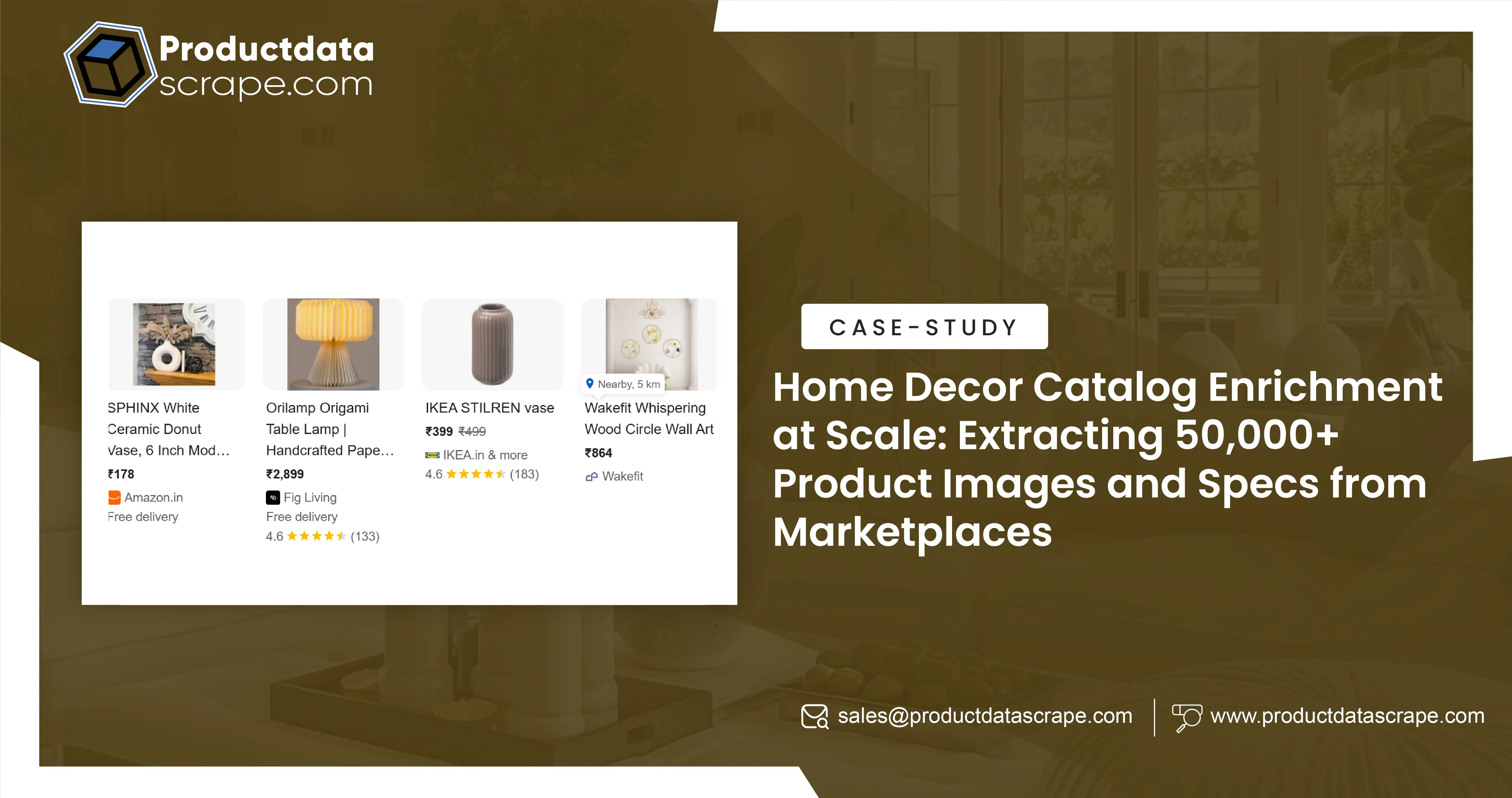
Home Decor Catalog Enrichment at Scale: Extracting 50,000+ Product Images and Specs from Marketplaces

The Client

A home decor and furnishings brand selling a large catalogue across several marketplaces and its own D2C storefront — lighting, soft furnishings, wall decor, and small furniture. Thousands of SKUs, sourced from many suppliers, each supplier supplying product data in a different, incomplete format.

Client details are anonymised. Figures are representative of the engagement.

The Problem: A Catalogue Full of Half-Built Pages
The Problem: A Catalogue Full of Half-Built Pages

The brand's catalogue looked complete in a spreadsheet and was anything but on the page.

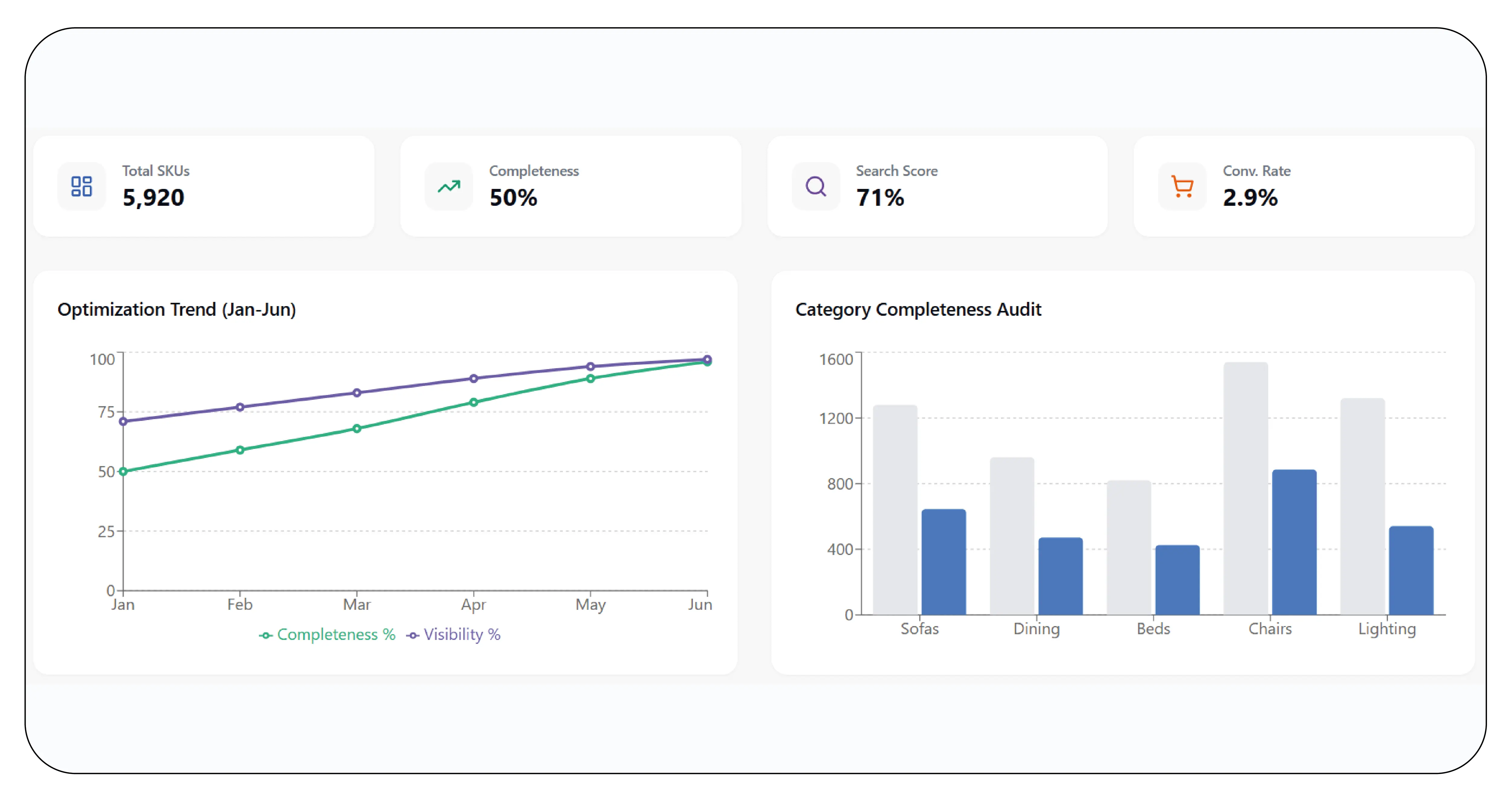
Because SKUs came from dozens of suppliers, the product data arrived inconsistent and incomplete. Some listings had one low-resolution image; competitors had eight. Some had a material and a dimension; competitors had material, dimension, weight, finish, care instructions, assembly requirement, and room recommendation. The brand's own storefront and its marketplace listings were, on a large share of the catalogue, thinner than the competition on exactly the attributes that decide a home decor purchase.

This showed up in two places that matter.

Search. On marketplaces, product discoverability depends heavily on structured attributes. A sofa with no "seating capacity" attribute does not appear when a shopper filters for a three-seater. The brand was invisible to filtered search on any attribute it had failed to populate — and it had failed to populate many.

Conversion. Home decor is a considered, visual purchase. A shopper deciding on a light fixture wants to see it from multiple angles, in a room, at a known size. A single image and a two-line spec loses to a competitor's eight images and full specification, even at the same price.

The catalogue lead's summary: we're not losing on price or product. We're losing on pages that aren't finished.

Why the Brand Could Not Fix This Manually

The obvious fix — populate the missing data — was the problem, because of scale and source fragmentation.

Scale. Tens of thousands of SKUs, each missing a different subset of attributes and images. Manually researching and populating them, SKU by SKU, was a multi-year project the brand did not have the staff for.

Source fragmentation. The missing data existed — on the manufacturers' own listings, on other marketplaces, on the brand's own better-populated SKUs — but it was scattered across dozens of sources in dozens of formats. There was no single place to copy it from.

Consistency. Even where a team member did populate a field, different people entered "Solid Wood," "solid-wood," and "Sheesham (solid wood)" for the same thing, which defeated the filtered search the exercise was meant to fix.

The Solution: Catalog Enrichment at Scale

Product Data Scrape built a home decor catalog enrichment pipeline that extracted, normalised, and mapped product images and specifications across marketplaces at scale.

Image extraction. For each SKU, all available product images were located across the manufacturer's listing and matched marketplace listings, captured at full resolution, deduplicated, and ordered — so a SKU that had one image on the brand's storefront could be enriched toward the eight the market expected.

Specification extraction. Every available structured attribute was captured — material, dimensions, weight, finish, colour, assembly requirement, care, room, style — from the richest available source per SKU.

Attribute normalisation. This was the step that made the rest usable. Captured attribute values were normalised to a single controlled vocabulary, so "Solid Wood," "solid-wood," and "Sheesham (solid wood)" all resolved to one canonical value that filtered search could act on.

Gap-first prioritisation. The pipeline scored each SKU by how incomplete it was and how much traffic it received, so enrichment effort concentrated where it moved the most revenue first.

Delivery into the catalogue. Enriched, normalised records were delivered in the brand's own schema, ready to load, rather than as a raw dump requiring manual reconciliation.

Sample Data: One SKU, Before and After

An illustrative field-completeness comparison for a single lighting SKU.

Attribute Before Enrichment After Enrichment
Product images 1 7
Material Brushed brass, glass
Dimensions Height only Height, width, drop, canopy diameter
Weight 2.4 kg
Bulb type / base E27, max 40W
Finish Antique brass
Room recommendation Living room, dining
Style tag Mid-century
Care instructions Dry cloth, no solvents
Filterable attributes populated 2 11

The enriched record, structured:

{
  "sku": "LIGHT-PENDANT-4471",
  "title": "Brass Pendant Lamp — Mid-Century Dome",
  "images": [
    {"url": "img_001.jpg", "type": "primary", "resolution": "2000x2000"},
    {"url": "img_002.jpg", "type": "angle"},
    {"url": "img_003.jpg", "type": "in_room"},
    {"url": "img_004.jpg", "type": "scale_reference"},
    {"url": "img_005.jpg", "type": "detail"},
    {"url": "img_006.jpg", "type": "detail"},
    {"url": "img_007.jpg", "type": "packaging"}
  ],
  "attributes": {
    "material_primary": "brass",
    "material_secondary": "glass",
    "finish": "antique_brass",
    "height_cm": 34,
    "width_cm": 28,
    "drop_max_cm": 120,
    "weight_kg": 2.4,
    "bulb_base": "E27",
    "wattage_max": 40,
    "room": ["living_room", "dining"],
    "style": "mid_century",
    "care": "dry_cloth_no_solvents"
  },
  "attribute_completeness_pct": 92,
  "normalisation_applied": true
}

Every value in attributes is drawn to a controlled vocabulary — antique_brass, not "Antique Brass" or "brass, antique" — which is what allows the marketplace filter to match it.

What Changed

The catalogue became searchable. Filterable-attribute coverage across the catalogue rose sharply, and SKUs began appearing in filtered searches — by material, by room, by style, by dimension — where they had previously been invisible.

Pages started converting. Enriched pages, with full imagery and complete specifications, converted at a materially higher rate than the thin pages they replaced. In home decor, the completeness of the page is a substantial part of the purchase decision, and the data made that visible.

One vocabulary, everywhere. Normalisation meant the same SKU carried the same canonical attributes on the D2C storefront and every marketplace, which fixed both filtered search and the internal reporting that had been fragmented by inconsistent values.

The Results

Metric Before After Enrichment
SKUs with complete image sets (5+) Minority of catalogue Large majority
Median filterable attributes per SKU ~3 ~10
SKUs appearing in filtered marketplace search Low Substantially higher
Conversion rate on enriched pages, indexed 100 131
Catalogue enrichment throughput SKUs per week (manual) 50,000+ SKUs, structured
Attribute value consistency Fragmented Single controlled vocabulary

Figures are representative of the engagement outcome.

The catalogue lead's follow-up: we didn't add products or cut prices. We finished the pages we already had, and the numbers moved.

The Lesson

In categories where the purchase is visual and considered — and home decor is the clearest example — the product page is the product. A shopper cannot touch the fabric or lift the lamp. All they have is the imagery and the specification, and if those are thinner than the competitor's, the competitor wins at the same price and the same quality.

The brand's catalogue was not bad. It was unfinished, and unfinished in a way that was invisible in a spreadsheet and decisive on the page. Catalog enrichment at scale did not require new products, new suppliers, or lower prices. It required completing what already existed — across tens of thousands of SKUs, to one consistent standard, faster than any manual effort could.

That is a data problem, and it has a data solution.

Work With Product Data Scrape

Product Data Scrape delivers home decor catalog enrichment at scale: full-resolution image extraction, complete specification capture, attribute normalisation to your controlled vocabulary, and gap-first prioritisation — delivered in your own schema as JSON, CSV, API, or straight into your catalogue system.

We capture publicly available product information only, structured and ready to load.

Ask us for an enrichment audit on a sample of your catalogue — we will show you exactly which SKUs are losing to unfinished pages, and by how much.

Product Data Scrape — turning marketplace complexity into decision-ready data.

LATEST BLOG

Analyze Zomato Delivery Pricing Before Opening a Restaurant - A Complete Guide to Smarter Restaurant Launch Planning

Analyze Zomato Delivery Pricing Before Opening a Restaurant to optimize menu pricing, delivery costs, profits, and market positioning.

Flipkart Big Billion Days Price Tracking: Capturing Every Deal, Drop, and Stockout in Real Time

Big Billion Days price tracking done right - capture every deal, price drop, stockout and repricing move on Flipkart in real time. Fields and sample data inside.

Pincode-Level Flipkart Price Scraping: Why Hyperlocal Pricing Data Matters for India FMCG Brands

Pincode-level Flipkart price scraping reveals how price, delivery and stock shift across India. See the fields, sample data and workflows FMCG brands rely on.

Case Studies

Discover our scraping success through detailed case studies across various industries and applications.

WHY CHOOSE US?

Product Data Scrape for Retail Web Scraping

Choose Product Data Scrape to access accurate data, enhance decision-making, and boost your online sales strategy effectively.

Reliable Insights

Reliable Insights

With our Retail Data scraping services, you gain reliable insights that empower you to make informed decisions based on accurate product data and market trends.

Data Efficiency

Data Efficiency

We help you extract Retail Data product data efficiently, streamlining your processes to ensure timely access to crucial market information and operational speed.

Market Adaptation

Market Adaptation

By leveraging our Retail Data scraping, you can quickly adapt to market changes, giving you a competitive edge with real-time analysis and responsive strategies.

Price Optimization

Price Optimization

Our Retail Data price monitoring tools enable you to stay competitive by adjusting prices dynamically, attracting customers while maximizing your profits effectively.

Competitive Edge

Competitive Edge

THIS IS YOUR KEY BENEFIT.
With our competitive price tracking, you can analyze market positioning and adjust your strategies, responding effectively to competitor actions and pricing in real-time.

Feedback Analysis

Feedback Analysis

Utilizing our Retail Data review scraping, you gain valuable customer insights that help you improve product offerings and enhance overall customer satisfaction.

5-Step Proven Methodology

How We Scrape E-Commerce Data?

01
Identify Target Websites

Identify Target Websites

Begin by selecting the e-commerce websites you want to scrape, focusing on those that provide the most valuable data for your needs.

02
Select Data Points

Select Data Points

Determine the specific data points to extract, such as product names, prices, descriptions, and reviews, to ensure comprehensive insights.

03
Use Scraping Tools

Use Scraping Tools

Utilize web scraping tools or libraries to automate the data extraction process, ensuring efficiency and accuracy in gathering the desired information.

04
Data Cleaning

Data Cleaning

After extraction, clean the data to remove duplicates and irrelevant information, ensuring that the dataset is organized and useful for analysis.

05
Analyze Extracted Data

Analyze Extracted Data

Once cleaned, analyze the extracted e-commerce data to gain insights, identify trends, and make informed decisions that enhance your strategy.

Start Your Data Journey
99.9% Uptime
GDPR Compliant
Real-time API

See the results that matter

Read inspiring client journeys

Discover how our clients achieved success with us.

6X

Conversion Rate Growth

“I used Product Data Scrape to extract Walmart fashion product data, and the results were outstanding. Real-time insights into pricing, trends, and inventory helped me refine my strategy and achieve a 6X increase in conversions. It gave me the competitive edge I needed in the fashion category.”

7X

Sales Velocity Boost

“Through Kroger sales data extraction with Product Data Scrape, we unlocked actionable pricing and promotion insights, achieving a 7X Sales Velocity Boost while maximizing conversions and driving sustainable growth.”

"By using Product Data Scrape to scrape GoPuff prices data, we accelerated our pricing decisions by 4X, improving margins and customer satisfaction."

"Implementing liquor data scraping allowed us to track competitor offerings and optimize assortments. Within three quarters, we achieved a 3X improvement in sales!"

Resource Hub: Explore the Latest Insights and Trends

The Resource Center offers up-to-date case studies, insightful blogs, detailed research reports, and engaging infographics to help you explore valuable insights and data-driven trends effectively.

Get In Touch

Analyze Zomato Delivery Pricing Before Opening a Restaurant - A Complete Guide to Smarter Restaurant Launch Planning

Analyze Zomato Delivery Pricing Before Opening a Restaurant to optimize menu pricing, delivery costs, profits, and market positioning.

Flipkart Big Billion Days Price Tracking: Capturing Every Deal, Drop, and Stockout in Real Time

Big Billion Days price tracking done right - capture every deal, price drop, stockout and repricing move on Flipkart in real time. Fields and sample data inside.

Pincode-Level Flipkart Price Scraping: Why Hyperlocal Pricing Data Matters for India FMCG Brands

Pincode-level Flipkart price scraping reveals how price, delivery and stock shift across India. See the fields, sample data and workflows FMCG brands rely on.

Skincare Review Sentiment Analysis: How a D2C Brand Used Nykaa and Amazon Reviews to Reformulate a Bestseller

Home Decor Catalog Enrichment turned 50,000+ thin marketplace listings into complete, search-ready product pages. See the field-level lift and the conversion gain.

Home Decor Catalog Enrichment at Scale: Extracting 50,000+ Product Images and Specs from Marketplaces

Home Decor Catalog Enrichment turned 50,000+ thin marketplace listings into complete, search-ready product pages. See the field-level lift and the conversion gain.

How a Consumer Electronics Seller Used Flipkart Effective Price Monitoring to Re-Price Mid-Sale

Flipkart effective price monitoring showed a consumer electronics seller it was losing on post-offer price, not listed price. See how it re-priced mid-sale.

Albertsons Grocery Delivery Scraper API - Market Intelligence, Inventory Monitoring, and Grocery Retail Benchmarking

ASDA Grocery Data Scraping helps track grocery prices, promotions, inventory, and competitor trends across the UK retail market.

Costco Alcohol & Liquor Price Data scraping to Track Consumer Buying Trends and Inventory Intelligence

Costco Alcohol & Liquor Price Data scraping helps brands track pricing, promotions, inventory trends, and competitor insights.

B&M Stores Pet Supplies Data Scraping for Market Research and Pet Product Trend Analysis in Retail Chains

B&M Stores Pet Supplies Data Scraping helps businesses collect pricing, stock, and product insights to optimize pet retail strategies.

Reducing Returns with Myntra AND AJIO Customer Review Datasets

Analyzed Myntra and AJIO customer review datasets to identify sizing issues, helping brands reduce garment return rates by 8% through data-driven insights.

Before vs After Web Scraping - How E-Commerce Brands Unlock Real Growth

Before vs After Web Scraping: See how e-commerce brands boost growth with real-time data, pricing insights, product tracking, and smarter digital decisions.

Scrape Data From Any Ecommerce Websites

Easily scrape data from any eCommerce website to track prices, monitor competitors, and analyze product trends in real time with Real Data API.

Fresh Citrus Price Wars - Coles vs Aldi — What Does the Data Say?

Fresh Citrus Price Wars — Coles vs Aldi: data-driven comparison of prices, trends, and savings to see which retailer wins on value for shoppers.

Retail Inflation 2025 – Comparing Grocery Baskets in Dubai vs. Abu Dhabi (Noon)

Retail Inflation 2025 – Comparing Grocery Baskets in Dubai vs. Abu Dhabi (Noon) highlights price differences and real-world grocery costs across UAE cities.

Unlock Winning Products on Pinduoduo - How Scraping Bestseller Data Reveals Top Titles, Prices & Sales Trends

Scrape Pinduoduo bestseller data to analyze top-selling products, pricing trends, sales performance, for smarter eCommerce and intelligence decisions.

FAQs

E-Commerce Data Scraping FAQs

Our E-commerce data scraping FAQs provide clear answers to common questions, helping you understand the process and its benefits effectively.

E-commerce scraping services are automated solutions that gather product data from online retailers, providing businesses with valuable insights for decision-making and competitive analysis.

We use advanced web scraping tools to extract e-commerce product data, capturing essential information like prices, descriptions, and availability from multiple sources.

E-commerce data scraping involves collecting data from online platforms to analyze trends and gain insights, helping businesses improve strategies and optimize operations effectively.

E-commerce price monitoring tracks product prices across various platforms in real time, enabling businesses to adjust pricing strategies based on market conditions and competitor actions.

Get a free sample dataset

See the exact fields, accuracy and format — for your products, on your target sites — before you spend a rupee or a dollar.

  • Sample delivered within 24 hours
  • Scoped to your real use case, not a generic demo
  • No obligation, no long contract

Tell us what you need

A specialist replies within one business day.