Executive Summary
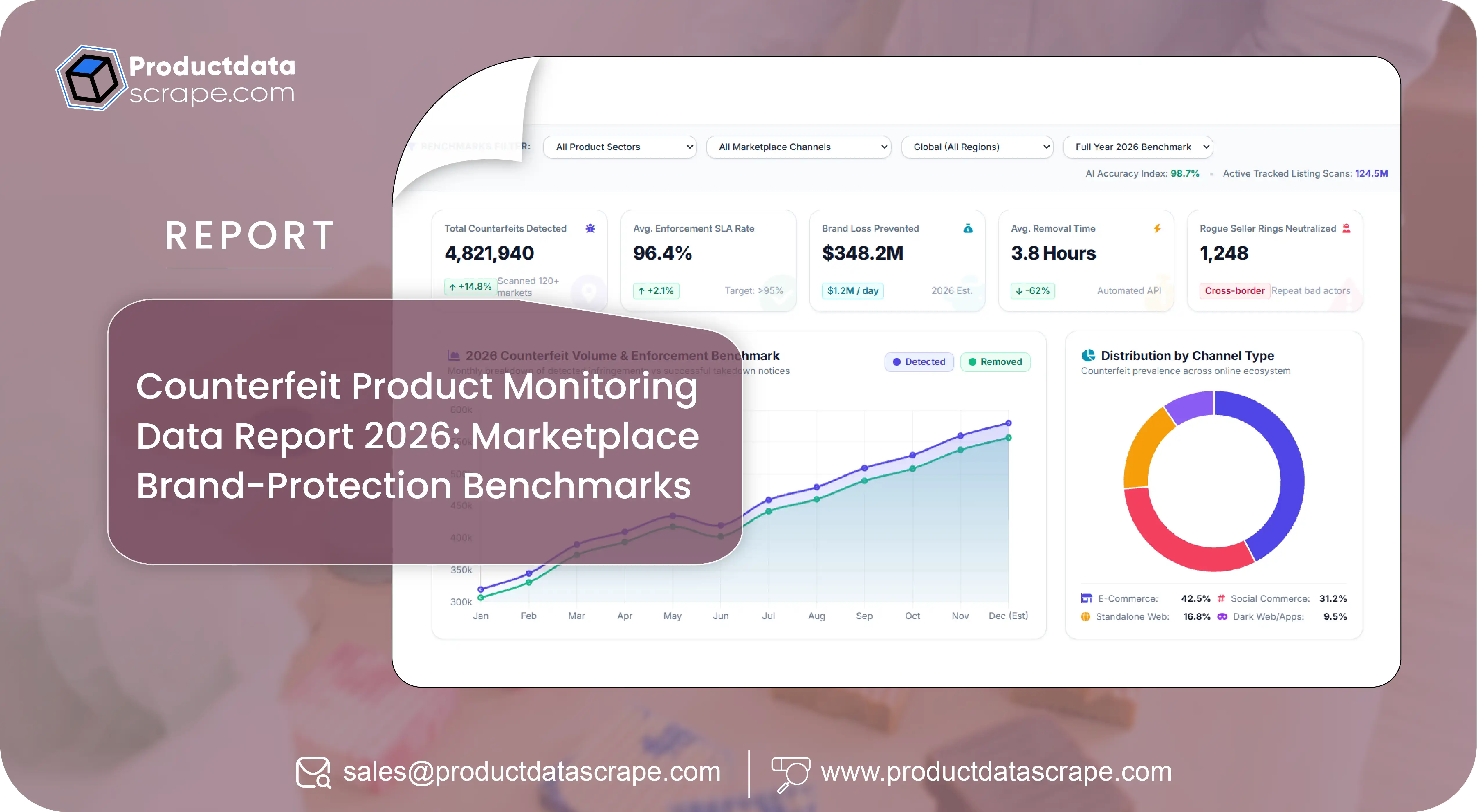
Counterfeit goods and unauthorized sellers have moved from a fringe nuisance to a board-level revenue threat. As marketplace assortments expand and cross-border sellers flood catalogs, brands are quietly losing sales, margin, and customer trust to listings they never approved. This report from Product Data Scrape distills what large-scale Counterfeit Product Monitoring Data reveals about the state of brand abuse across major e-commerce and quick-commerce platforms in 2026 — and what real protection looks like when it is powered by structured, continuously refreshed data rather than manual spot checks.
The benchmarks below are drawn from Product Data Scrape's managed monitoring operations across 500+ retailers in six countries. They are representative figures intended to help brand-protection, legal, and e-commerce teams size their exposure and prioritize enforcement — not a substitute for a scoped audit of your own catalog.
The Scale of the Problem in 2026
Counterfeiting is no longer confined to obscure resellers. Across the branded catalogs Product Data Scrape monitors, roughly one in six active listings originates from a seller with no verifiable authorization from the brand. On open-marketplace models, that share climbs higher, because anyone with a seller account can attach an offer to an existing product page.
Three categories consistently show the heaviest exposure: beauty and personal care, electronics accessories, and health supplements. These share a common profile — high margins, strong brand recognition, and small, easy-to-fake packaging. Fashion and footwear follow closely, driven by replica manufacturing and lookalike listings that borrow brand imagery without naming the brand outright.
The pattern that alarms brand owners most is velocity. Unauthorized listings do not appear once and sit still; they surface, get taken down, and reappear under new seller identities within days. Without continuous Counterfeit Product Monitoring Data, enforcement teams are always reacting to last month's problem while this month's violations quietly convert shoppers.
Why Counterfeits and Unauthorized Sellers Keep Multiplying
Several structural forces are working against brands at once. Open-seller marketplace models prioritize assortment breadth, so onboarding friction is low and verification is light. Listing hijacking lets a rogue seller win the buy box on a legitimate product page simply by undercutting price, redirecting sales to counterfeit stock while the genuine listing takes the reputational hit from bad reviews.
Gray-market arbitrage adds another layer. Distributors offload authorized inventory into unauthorized channels, and cross-border platforms make provenance almost impossible to trace by hand. The rapid rise of ultra-low-cost cross-border marketplaces has widened the gap further, introducing thousands of near-duplicate listings with unclear supply chains.
Quick commerce complicates the picture at a hyperlocal level. As dark stores expand pincode by pincode, the same counterfeit SKU can appear in one delivery zone and vanish in another, so a single national check misses regional violations entirely. Each of these dynamics is invisible to periodic audits and only becomes measurable when listing-level data is captured at scale and refreshed on a schedule.
What This Report Measures
For this study, Product Data Scrape analyzed millions of branded listings across leading platforms — including Amazon, Flipkart, Myntra, Nykaa, major quick-commerce apps, and emerging cross-border marketplaces. Every listing is evaluated against a consistent set of Counterfeit Product Monitoring Data signals rather than a single yes-or-no flag.
Those signals include seller authorization status matched against a brand's approved-seller list, price deviation versus MAP or MSRP, seller account age and history, reuse of official product images and copy, review anomalies such as sudden negative spikes referencing quality, and packaging or title mismatches. A listing is not condemned on one signal alone; a risk score combines them, so teams can triage the highest-confidence violations first and avoid wasting legal effort on false positives.
Key Findings
The 2026 monitoring data surfaces several consistent patterns across brands and regions:
Category concentration. Beauty, electronics accessories, and supplements account for the majority of high-risk listings, reflecting where counterfeiters find the best margin-to-effort ratio.
Price is the loudest signal. A large share of counterfeit-risk listings are priced well below the brand's MAP — deep, sustained discounts that authorized sellers rarely offer are one of the strongest early indicators of an unauthorized or fake offer.
Seller sprawl. For a typical mid-size brand, unauthorized sellers routinely outnumber authorized ones, and a small cluster of repeat offenders is responsible for a disproportionate share of violations.
Reappearance rate. A meaningful portion of listings removed after a takedown resurface within two to three weeks under a new seller name, confirming that one-off enforcement rarely holds.
Regional blind spots. In quick commerce, violations cluster in specific pincodes and metros, so brands relying on national-level checks systematically under-count their true exposure.
Individually, none of these findings is new to a brand-protection lead. Together, and quantified at listing level, they turn a vague sense of "we have a counterfeit problem" into a prioritized, defensible enforcement roadmap.
Sample Data: What a Flagged Listing Looks Like
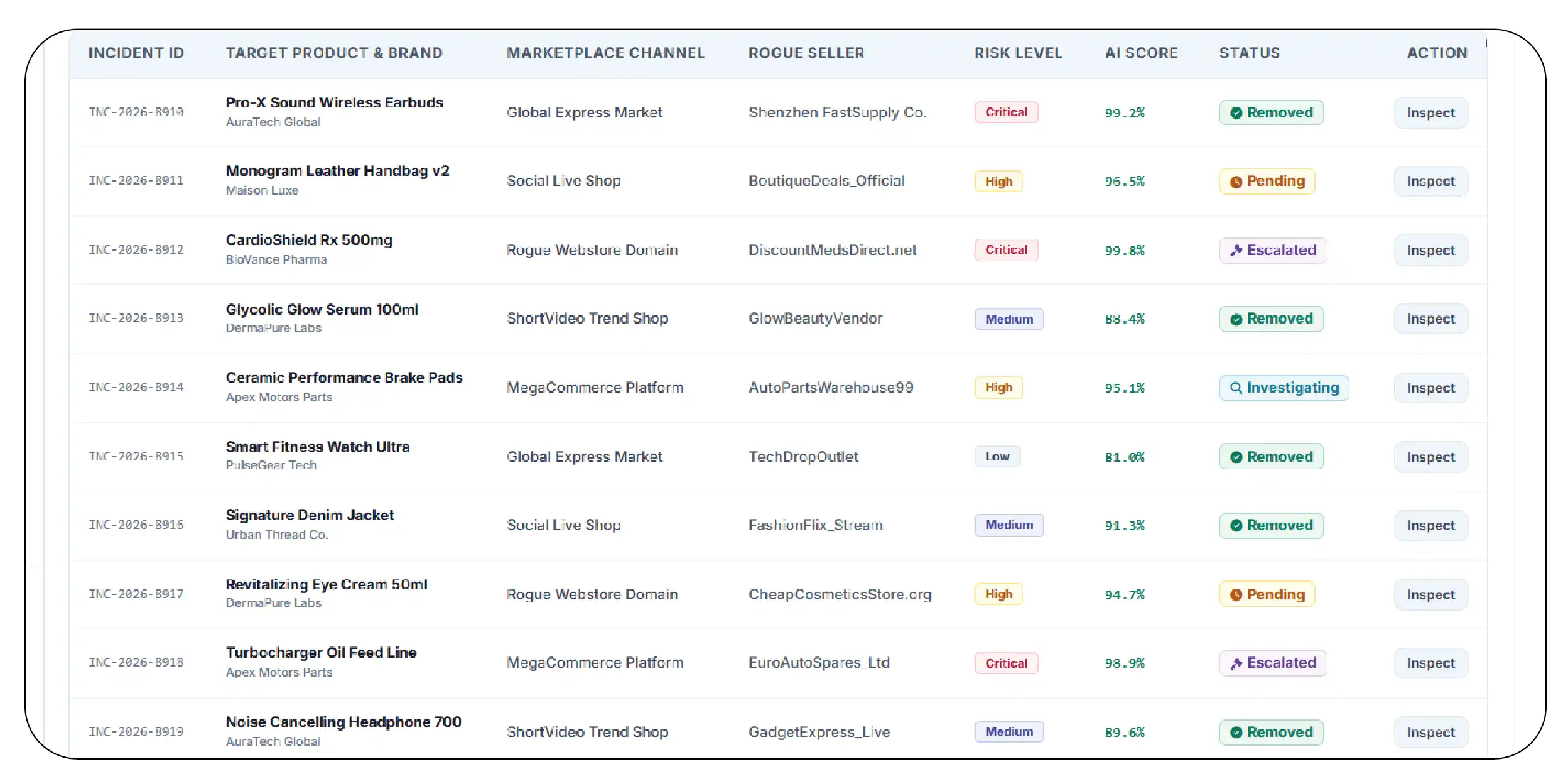
The value of Counterfeit Product Monitoring Data lies in the record behind every flag. Below is a representative sample of the structured output Product Data Scrape delivers for each monitored listing.
| Marketplace |
Product / SKU |
Seller Name |
Auth Status |
Listed Price |
MAP / MSRP |
Price Deviation |
Risk Score |
Detection Signal |
Region / Pincode |
Captured |
| Amazon |
Serum 30ml (B0XXXX1) |
GlowMart_IN |
Unauthorized |
₹649 |
₹1,199 |
−45.9% |
0.92 (High) |
Below-MAP + image reuse |
400001 (Mumbai) |
2026-07-14 |
| Flipkart |
Wireless Earbuds Pro |
AudioZone99 |
Unknown |
₹1,299 |
₹2,499 |
−48.0% |
0.88 (High) |
New seller + review spike |
560001 (Bengaluru) |
2026-07-14 |
| Nykaa |
Face Cream 50g |
BeautyBazaarX |
Unauthorized |
₹499 |
₹899 |
−44.5% |
0.81 (High) |
Title mismatch + batch anomaly |
110001 (Delhi) |
2026-07-13 |
| Quick-Comm |
Protein 1kg |
(3rd-party dark store) |
Gray-market |
₹1,749 |
₹2,299 |
−23.9% |
0.64 (Medium) |
Price outlier by pincode |
411001 (Pune) |
2026-07-13 |
| Myntra |
Sneakers (lookalike) |
TrendKicks |
Unauthorized |
₹1,199 |
₹3,499 |
−65.7% |
0.95 (High) |
Brand imagery, unnamed brand |
700001 (Kolkata) |
2026-07-12 |
Every row is timestamped and enforcement-ready: it can be exported as evidence for a marketplace takedown, routed into a legal case file, or fed into a live dashboard that tracks violations by seller, category, and region over time.
How Brands Turn Counterfeit Product Monitoring Data Into Enforcement
Structured monitoring data is only useful if it drives action, and the brands that see the strongest return use it in a few repeatable ways. First, they build takedown evidence packs automatically — screenshots, seller details, price history, and risk scores bundled per violation — which dramatically shortens the marketplace escalation cycle.
Second, they maintain a living authorized-seller whitelist, so any new seller attaching to their listings is flagged the moment it appears rather than at the next quarterly review. Third, they prioritize physical test-buys using the risk score, spending investigation budget only on the highest-confidence cases instead of chasing every discount.
Finally, they connect enforcement to executive reporting. When a brand-protection team can show leadership exactly how many violations were detected, removed, and how much revenue was recovered, the program stops being a cost center and becomes a measurable growth lever. This is precisely the kind of visibility that turns an internal data project into a scoped engagement — and why counterfeit monitoring generates some of the highest-intent inquiries in retail data.
The Real Cost of Leaving Counterfeits Unmonitored
Every unmonitored counterfeit listing carries three compounding costs. The first is the direct sale a brand loses when a shopper buys a cheaper fake instead of the genuine product — revenue that never reaches the P&L and is almost impossible to recover. The second is margin erosion across the whole catalog: once unauthorized sellers set an artificially low anchor price, authorized partners feel pressure to match it, and a carefully managed pricing architecture collapses from the bottom up.
The third cost is the hardest to reverse — trust. A single bad experience with a counterfeit unit, from a cracked device to an ineffective serum, produces a negative review that sits permanently on the genuine product page. That review depresses conversion for every future shopper, so the damage from one fake sale outlives the sale itself by months. Quantifying these three costs at listing level is exactly what turns brand protection from a defensive expense into a documented return, and it is why continuous Counterfeit Product Monitoring Data pays for itself well before an enforcement team files its first takedown.
What You Get With Product Data Scrape
Product Data Scrape delivers Counterfeit Product Monitoring Data as a managed service, so brands do not have to build or maintain scrapers in-house. Coverage spans 500+ marketplaces across six countries, with listing-level capture that includes seller identity, authorization status, price versus MAP, image and content reuse, review signals, and pincode-level context for quick commerce.
Data is refreshed on a cadence you choose — from daily to real-time for high-risk categories — and delivered in the format your team already uses, whether that is CSV, JSON, a direct API feed, or a ready-to-read dashboard. Because the pipelines are custom-built and monitored, coverage extends to emerging marketplaces as they appear, so your protection keeps pace with where counterfeiters move next.
Get Your Brand's Exposure Benchmarked
The figures in this report are representative; your real exposure could be higher or lower, and the only way to know is to measure it. Product Data Scrape will run a free sample dataset scoped to your brand, on your target marketplaces, so you can see the exact fields, accuracy, and violation counts before committing to anything.
Request a sample to benchmark your counterfeit and unauthorized-seller exposure — and turn Counterfeit Product Monitoring Data into an enforcement program that protects your margin, your customers, and your brand.


 Singapore
 EMAIL
EMAIL
 PHONE
PHONE


.webp)
.webp "thumb")
.webp "thumb")
.webp "thumb")








.webp)