Introduction
In today’s fast-evolving retail landscape, pricing agility is no longer optional—it’s essential. Businesses that fail to adapt to real-time pricing intelligence risk falling behind competitors who leverage automation and data-driven strategies. Automated Price Scraping for US Retailers has emerged as a critical solution, enabling brands to track competitor prices, monitor trends, and optimize pricing decisions at scale.
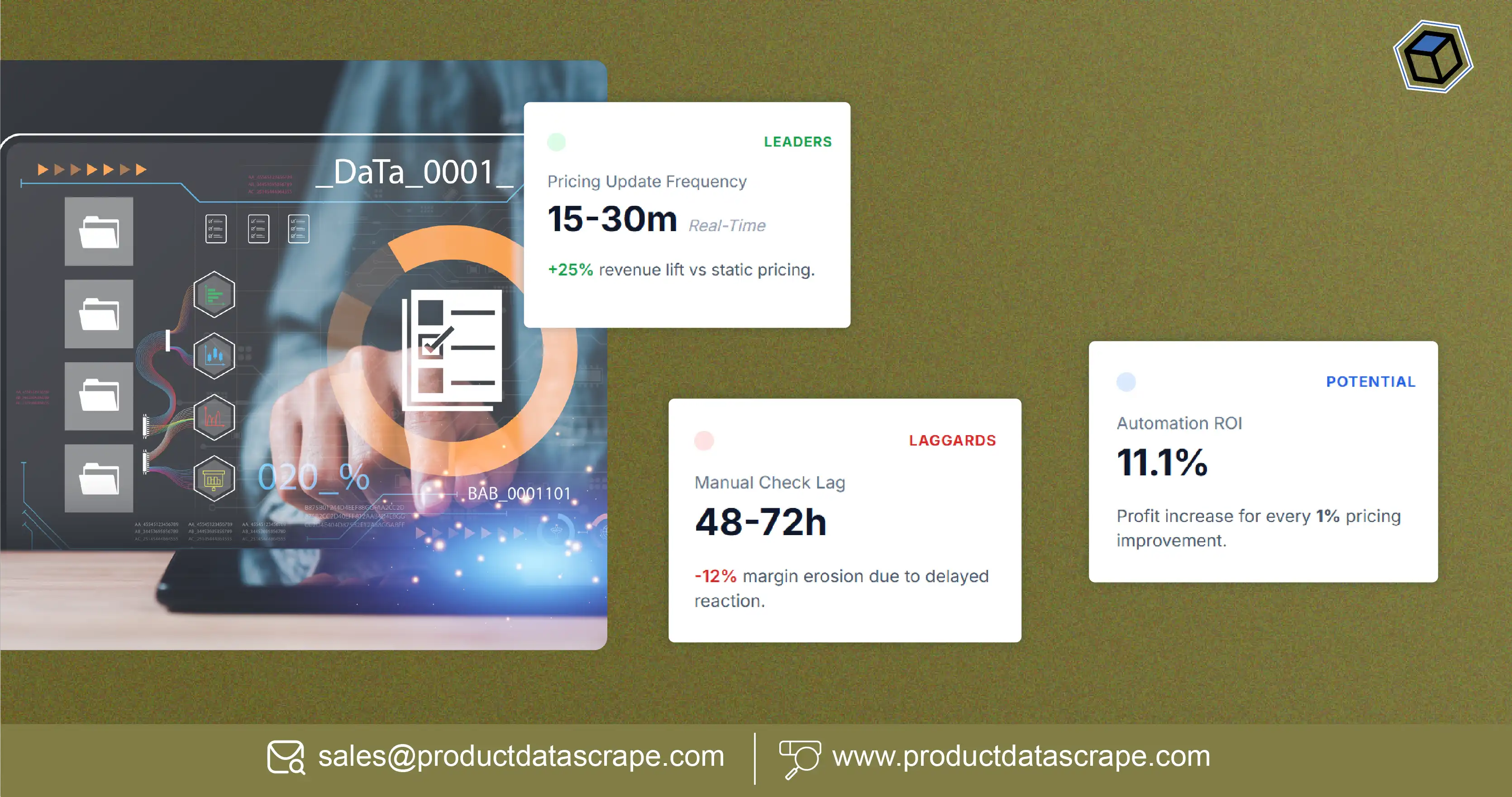
Recent industry insights reveal a striking gap—81% ( What the Laggards Are Missing)—highlighting how a majority of retailers still rely on outdated or manual pricing methods. This gap leads to missed opportunities in revenue optimization, customer acquisition, and competitive positioning. Between 2020 and 2026, the adoption of automated pricing technologies has surged, with leading retailers achieving higher conversion rates and improved margins.
This blog explores how automated price scraping bridges this gap, offering actionable insights, real-time monitoring, and scalable solutions that empower retailers to stay competitive in a dynamic market.
Building Data-Driven Pricing Foundations
To succeed in modern retail, businesses must leverage Automated Price Scraping data US Retail Market, Product Price Data Scraping Services to create a strong data foundation. These solutions enable retailers to collect structured pricing data from multiple competitors and marketplaces efficiently.
From 2020 to 2026, the volume of pricing data in the US retail market has grown exponentially, driven by the expansion of eCommerce and omnichannel strategies.
US Retail Pricing Data Growth (2020–2026)
| Year |
Data Volume Growth |
Automation Adoption |
Data Accuracy |
| 2020 |
20% |
35% |
70% |
| 2022 |
35% |
50% |
80% |
| 2024 |
55% |
65% |
88% |
| 2026 |
75% |
80% |
95% |
By implementing automated scraping services, retailers can eliminate manual errors and ensure consistent data collection. This foundation supports advanced analytics, enabling better pricing decisions and improved operational efficiency.
Gaining Competitive Edge Through Price Intelligence
Retailers must adopt Automated Price Scraping for competitive pricing US retailers, Product Competitive Pricing Services to stay ahead in a crowded market. Competitive pricing intelligence allows businesses to analyze competitor strategies and adjust their own pricing dynamically..
Between 2020 and 2026, retailers using competitive pricing tools reported a 30% increase in revenue and a 25% improvement in customer retention.
Competitive Pricing Impact (2020–2026)
.webp)
By leveraging these insights, retailers can identify pricing gaps, optimize product positioning, and enhance customer engagement. Competitive pricing ensures that businesses remain attractive to price-sensitive consumers while maintaining profitability.
Scaling Data Collection with Advanced APIs
Efficient data collection requires Scrape Competitor Price Data US Retailers, Web Scraping API Services to handle large-scale operations. APIs enable seamless integration and real-time data extraction from multiple sources.
From 2020 to 2026, API adoption in retail analytics increased significantly, enabling faster and more accurate data collection.
API Adoption Trends (2020–2026)
| Year |
API Usage Rate |
Data Processing Speed |
Integration Efficiency |
| 2020 |
30% |
Medium |
Low |
| 2022 |
45% |
High |
Medium |
| 2024 |
60% |
Very High |
High |
| 2026 |
75% |
Extremely High |
Very High |
These APIs allow retailers to automate data extraction, reduce manual effort, and ensure real-time updates. This scalability is essential for managing large product catalogs and maintaining competitive pricing.
Enabling Real-Time Monitoring for Accuracy
To remain competitive, retailers must implement US Retail Real time Automated Price Monitoring, Price Monitoring systems. Real-time monitoring ensures that pricing data is always up-to-date and accurate.
Between 2020 and 2026, real-time monitoring adoption increased by over 70%, driven by the need for instant decision-making.
Real-Time Monitoring Benefits (2020–2026)
.webp)
Real-time systems enable retailers to respond quickly to market changes, ensuring optimal pricing strategies. This reduces the risk of overpricing or underpricing products.
Implementing Dynamic Pricing Strategies
Modern retail requires Dynamic Pricing Strategy using Competitor Price Intelligence, Digital Shelf Analytics to adapt to changing market conditions. Dynamic pricing allows businesses to adjust prices based on demand, competition, and customer behavior.
From 2020 to 2026, retailers using dynamic pricing reported a 35% increase in profitability and improved customer engagement.
Dynamic Pricing Impact (2020–2026)
| Metric |
Improvement |
| Profit Margins |
+35% |
| Customer Engagement |
+30% |
| Conversion Rate |
+28% |
| Sales Growth |
+32% |
By leveraging digital shelf analytics, retailers can monitor product performance and optimize pricing strategies. This ensures maximum revenue and improved market positioning.
Benchmarking for Continuous Improvement
To achieve long-term success, retailers must adopt Automated US Retail Competitor Price Benchmarking. Benchmarking helps businesses compare their pricing strategies with competitors and identify areas for improvement.
Between 2020 and 2026, companies using benchmarking tools achieved a 30% increase in conversion rates and enhanced profitability.
Benchmarking Benefits (2020–2026)
.webp)
Benchmarking ensures continuous improvement and helps retailers stay competitive in a dynamic market environment.
Why Choose Product Data Scrape?
Product Data Scrape provides advanced solutions to leverage Pricing Impact on Retail Demand and Conversion Analytics, enabling businesses to understand how pricing influences customer behavior. With expertise in Automated Price Scraping for US Retailers, the platform delivers scalable and reliable data solutions tailored to retail needs.
By integrating cutting-edge technologies, we ensure accurate data extraction, real-time monitoring, and actionable insights. Businesses benefit from improved pricing strategies, enhanced decision-making, and increased competitiveness. Whether managing small inventories or large-scale operations, we offer customized solutions to meet your requirements.
Conclusion
The retail landscape is rapidly evolving, and businesses must adopt automated solutions to stay competitive. Laggard Retailers missing Automated Price Scraping data risk losing market share and revenue opportunities. By leveraging Automated Price Scraping for US Retailers, companies can bridge this gap and achieve data-driven success.
From real-time monitoring to dynamic pricing strategies, automated scraping provides the tools needed to optimize pricing and improve performance. Businesses that embrace these technologies gain a significant competitive advantage.
Ready to close the gap and transform your pricing strategy? Partner with Product Data Scrape today and unlock the full potential of automated price intelligence!
FAQs
1. What is automated price scraping in retail?
Automated price scraping collects competitor pricing data in real time, enabling retailers to monitor market trends, optimize pricing strategies, and improve competitiveness across multiple sales channels.
2. Why is price monitoring important for US retailers?
Price monitoring helps retailers stay competitive, identify pricing gaps, and adjust strategies dynamically, ensuring better customer engagement and improved profitability in a fast-changing market.
3. How does automation improve pricing accuracy?
Automation eliminates manual errors, ensures real-time updates, and provides consistent data, enabling retailers to make accurate and informed pricing decisions quickly.
4. What role does Product Data Scrape play in pricing intelligence?
Product Data Scrape provides advanced scraping and analytics solutions to collect, structure, and analyze pricing data efficiently for better decision-making.
5. What are the benefits of dynamic pricing strategies?
Dynamic pricing improves revenue, enhances customer engagement, and ensures competitive positioning by adjusting prices based on demand, competition, and market trends.


 Singapore
 EMAIL
EMAIL
 PHONE
PHONE


.webp)
.webp "thumb")
.webp "thumb")
.webp "thumb")








.webp)